Flow, Fissure, Mesh

Home » Articles posted by kevinmcneilly (Page 7)

Author Archives: kevinmcneilly

Short Take on Thumbscrew (Mary Halvorson, Michael Formanek, Tomas Fujiwara)

For the last four weeks or so, since its release on the Cuneiform label on January 21st, I have kept returning to the eponymous debut CD by Thumbscrew, a collective trio of Mary Halvorson, guitar, Michael Formanek, double bass, and Tomas Fujiwara, drums. It’s a consistently great album, offering up music that collides warmly responsive interplay with infectiously kiltered grooves. The opening track, a Fujiwara head called “Cheap Knock Off,” alludes texturally– you can listen for yourself and decide if this makes aural sense – to the early John Scofield trio with Steve Swallow and Adam Nussbaum, or, given the bell-like tone at times of Mary Halvorson’s guitar, even to the Jim Hall trio of the mid 1970s with Terry Clarke and Don Thompson.

But – despite the title – this is hardly derivative or imitative; it’s more of a music keenly aware of precedents and precursors but pushing forward along the leading edge of its own present tense.  What emerges sonically in these nine tracks is the trio’s shared practice of bending and unfolding time; they co-create in each piece a motile amalgam of historicity and futurity, gesturing (at least to my ears) at a rich set of musical antecedents from the jangling two-steps of Son House to the poly-intervallic melodies of Henry Threadgill, while simultaneously opening their improvised lines outward, palpably reaching, as Robert Browning once put it, to exceed their grasp. Michael Formanek’s big tone and rhythmic conception remind me of Johnny Dyani or Henri Texier: what’s remarkable is how he – and how the whole trio – manage to synch up with such metrical acuity (listen to those unisons) while driving so fiercely forward, right on top of the beat, meeting it head on, ahead. This trio, tightly together, gives the impression of an elastic looseness, a surge and release that’s a hallmark of the best kind of collaborative improvising. For instance, the toe-tapping shuffle of Fujiwara’s stick-and-brushwork on Formanek’s “Still . . . Doesn’t Swing” gives way to a raucously dehiscent free improvisation, as if the trio had momentarily lost its footing, only to reassert its cogency as melody at a slightly slowed tempo, transformed and tugged apart and then refolded onto itself again through Halvorson’s taffy-pull lines. Countable time comes unglued, seems to stretch and then reasserts its urgencies. Thumbscrew offers a music that moves, and that moves us along with them, listening: theirs is a remarkable and important record.

Profane Listening: Teaching Roddy Doyle’s The Commitments

In “A Valediction: Forbidding Mourning,” John Donne famously cautions his beloved to keep composed and quiet – like a dying “virtuous” man – as they part from one another:
So let us melt, and make no noise,
No tear-floods, nor sigh-tempests move;
‘Twere profanation of our joys
To tell the laity our love.
Rarefied, sinecured, privileged and private, their bond differentiates itself, at least as far as the poem’s speaker is concerned, from “[d]ull sublunary lovers’ love.” Refurbishing clichés of neo-Platonic idealism, Donne labours to distinguish their joys from vulgar heterosexual desire – his opening conceit enacts, literally, a mortification of the flesh – by linking love parasitically to a form of spiritually-ascendant class mobility. That elitism, moreover, is tied directly to a contradiction built into the poetic speech act: he’s telling her not to tell, creating an exclusive circle of two – speaker and listener – as his poem’s contingent public domain. Or maybe even a circle of one, himself, since the poem’s success depends wholly on whether his audience, the beloved interlocutor hailed by his lines, is even willing to listen, and to be correspondent to his desire, to do as he tells her to. There is a doubled model of listening articulated through the poem that seems to me to hinge on what its reader, its audience, is inclined to do with its profanity, its repurposing of the sacred for its own persuasive ends. Donne’s inflated coinage “profanation” casts our inner ears back, I think, to the word’s Latin etymology: the verb profanere (to desecrate, to violate, to make unclean) suggests being outside or before (pro-) a temple (fānum), which at least implicitly prods its listeners to consider the ersatz sacredness of this or any poetic text: how metaphysical, how hermetic, how divorced from this world, can such words ever be? The hyphenated compound nouns (“tear-floods” and “sigh-tempests”), while presented under prohibition, also make audible in their clashed, clumped consonants (rfl, dsn, stsm) the very – and very human, embodied – noise that Donne wants to suppress. The poem tends to profane itself, I mean.
         I am teaching The Commitmentsby Roddy Doyle  this week, and part of the reason I have started off with this excursus through Donne is that the novel is one of the most profane and noisy texts I have encountered. Reading excerpts and examples aloud in class, in public, activated some shame in me that’s most likely connected both to my own well-spoken intellectualism – despite common sense and academic privilege, it still felt a bit wrong and even a bit dangerous to utter all those “fucks” and “shites” and racist epithets in front of students – and to a hackneyed moralism circulating around how we listen to popular music, which is arguably the governing trope of the book as well as the focus of my course (and I’m thinking of how iTunes, for example, labels its downloaded songs, based on assessments of the lyrics, as either “clean” or “explicit”). The Commitments, at its heart, is an explicit, expletive text.
         It’s hard to gauge student reactions sometimes, but this class on the literature of popular song has tended so far to be a bit quiet, and who knows exactly why. Faced with reading Doyle’s novel, however, I can imagine they might feel a little shouted down, and a little affronted. In the book, as the band is cobbled together and starting to rehearse, they’re presented as Jimmy Rabbitte’s students. The book opens with Outspan and Derek asking for Jimmy’s musical advice, a moment that leads directly to the formation of The Commitments:
                  —We’ll ask Jimmy, said Outspan.  —Jimmy’ll know.
                  Jimmy Rabbitte knew his music. He knew his stuff.
Jimmy is the discursive centre for this particular configuration of Barrytown, this orchestration of their disenfranchised urban space, their north Dublin, and the vocabulary, the knowledge, in which he trades and which constitutes his cultural capital, is pop music. Jimmy, it’s worth noting, doesn’t play an instrument (well, none of them do, at first, except maybe for Joey The Lips Fagan), and he never performs on stage with the band; his music consists of talk, and his way of organizing the band involves giving lectures, correcting and managing what they “know” about and what they can learn through African-American soul music: “They loved Jimmy’s lectures,” the narrator tells us, although it’s not always clear that Jimmy has any more privileged access to Black music than anyone else. Even Joey The Lips’s stories of playing with Otis Redding, James Brown and just about any other “name” in R & B canon seem like a mix of fiction and wishful thinking; he claims to get a call to play with Joe Tex, but after he leaves Jimmy remembers that Joe Tex had died in 1982. When Joey The Lips confesses that “The biggest regret of my life is that I wasn’t born black,” the insurmountable disconnect, around race, between the given and the made, between provenance and aspirational self-fashioning comes crashing to the fore. The learning project in which Jimmy has the band engaged is doomed by its inherent dislocations, by its insurmountable, racially marked otherness. If “soul is community,” as Jimmy and Joey both contend, the success of their common project, the outcome of their commitment to any “real” provocation to social or cultural transformation through what Jimmy keeps calling “sex and politics,” remains inexorably out of reach.
         They can’t help but profane their lofty goals. The alteration they want to bring about by singing about “real” love is framed, as in the Donne poem, by the negation of overwrought, mundane clichés and by the evocation of a transcendent ideal – an African-American idiom that inherently resists the idioms of both saccharine top-of-the-pops and Irish folk: “—All tha’ mushy shite abou’ love an’ fields an’ meetin’ mots in supermarkets an’ McDonalds is gone, ou’ the fuckin’ window. It’s dishonest, said Jimmy.” But performing covers of James Brown or Wilson Pickett hardly seems any more honest, any closer to the lived realities of Barrytown: “— It’s not the other people’s songs so much, said Jimmy. —It’s which ones yis do.” Connection and commitment means finding material that somehow speaks to their experience, and for Jimmy, that speaking means a felt connection at the level of a pre-articulate viscerality, something he hears, for instance, in the rough “growl” of Declan Cuffe’s voice. Jimmy links this fleshy throatiness both to James Brown’s thoroughly sweaty, embodied performance – the grain of his voice, an association mired in sexual stereotypes around black masculinity – and, compellingly, to the band’s obvious inability to get beyond imperfect mimicry of that style; their cultural “politics,” inured in an experience of pervasive alienation, seems best represented by their failure to represent themselves musically in any idiom. Everything is imperfectly borrowed, mistaken, and troubled. In Jimmy’s bedroom, listening to the record of James Brown’s “Sex Machine,”the complexities and complicities of musical and racial appropriation emerge in a mix of sacrilege and idolatry, in a prose that both mimes what it hears and disrupts any easy mimesis:
         —Funk off, said Deco.
Outspan hit him.
Jimmy let the needle down and sat on the back of his legs between the speakers.
—I’m ready to get up and do my thang, said James Brown.
A chorus of men from the same part of the world as James went:  —YEAH.
—I want to, James continued,  —to get into it, you know. (—YEAH, said the lads in the studio with him.)  —Like a, like a sex machine, man (—YEAH YEAH, GO AHEAD.)  —movin’, doin’ it, you know. (—YEAH.)  —CAN I COUNT IT ALL? (—YEAH YEAH YEAH, went the lads.)  —One Two Three Four.
Jimmy positions himself dead-centre, as if to co-opt the sonic space of the recording, to claim it and manage it. The French-Joycean punctuation of dialogue with em-dashes tends to blur the distinctions between voices, to create a polyphonic overlay, a palimpsest. The identification of Jimmy with James manifests itself not only spatially but also in the collision of idioms from different “parts of the world”: James Brown’s sidemen aren’t Irish “lads” in any sense of the word, and when James Brown says “you know,” the point-of-view implicitly shared with Jimmy, the fella in the novel who, more than any other, presents himself as in the know, is both shared and dismantled; it’s worth noting how the transcription of the words in interrupted by editorializing and by typographical juxtapositions,  but also how the original record itself involves call-and-response banter that cuts across and disrupts closure. That disruption is also audible in the textures of the transcribed words:  “— GER RUP AH——“ they hear James Brown intone, abrading his words in a manner not too far removed from Donne’s noisy consonants. 
         If this record, though, is about affirming rough and vital cultural energies (YEAH YEAH YEAH), if it’s about the “politics,” of movin’ and doin’, Jimmy’s listening remains caught in a dynamic of negation and difference: “—No, listen, said Jimmy.” Making black music more “Dubliny” – by substituting, for example, the names of the stops on the DART line, moving North toward Barrytown, for the improvised train stops up the Eastern seaboard of the United States, tracing a kind of second-hand root for post-Civil War reconstruction, in James Brown’s improvised words for “Night Train” – enables what Jimmy wants to call “Dublin Soul” to be born, but those words also offer a fragile and finally untenable amalgam, as the band breaks up before it’s able to make even its first single on “Eejit Records,” and as Joey The Lips comes to realize that “Maybe soul isn’t right for Ireland. So I’m not right.” Their music, in its wrongness, is inherently profane, monstrous. But it also attains, in passing, in rehearsal, a kind of nascent greatness:
By now, The Commitments had about a quarter of an hour’s worth of songs that they could struggle through without making too many mistakes. They could sound dreadful sometimes but not many of them knew this. They were happy.
Though they’re unable to hear themselves, to “know” themselves for what they are – even when “[t]hey taped themselves and listened” – they still embrace the rough misprisions and imperfect “Dubliny” slippages and derive a happiness, a profane joy, in the struggle to connect with each other. The agonof music making, the profane and profaning effort to play together, forms a contingent community within that difficult nascence: “There were mistakes, rows, a certain amount of absenteeism but things were going well.” If the point seems to be not to put too much weight on the inevitable failure of their awful, unruly, “racialist” appropriations, neither is it to overlook or sanitize their offenses. Rather, we’re meant to bear witness to the possibility of creative coexistence, of producing a shared, poorly-recorded, mistake-ridden music that manages still, in its noisy and troubling way, to enact a poetry.

Hey, That’s Me: Bruce Springsteen and Audience, Part 1

Last week, I started off the current version of an undergraduate course I’m teaching on song lyrics and popular culture with a four-class unit about Bruce Springsteen. I have tried to use his music as an introductory case study in how popular music works, and in what it can do. One of the things we began to think through was the way in which his songs consistently thematize their own reception, representing both textually and musically a set of relationships between singer and audience. Specifically, I tried to read his songs as invitations not only into an erotic reciprocity – to touch and be touched, to feel each other’s presence – but also into a form of shared community: the nascent and loving democracy his “America” promises to be, even if maybe it can never realize that dream. These songs want to communicate, hopefully.
In what’s really the first essay in 31 Songs(2002), Nick Hornby asserts that his all-time favourite song is Springsteen’s “Thunder Road.” That song both addresses and enacts, for him, a durable and enduring moment of love, and it describes the living arc of his own long-term fandom:
I can remember listening to this song and loving it in 1975; I can remember listening to this song and loving it almost as much quite recently, a few months ago.
[. . .] So I’ve loved this song for a quarter of a century now, and I’ve heard it more than anything else, with the possible exception of . . . Who am I kidding? There are no other contenders.
This one song manages, whenever he hears it, to speak to him, for him and about him. I have to say, too, that I know exactly the feeling and exactly the identification that Nick Hornby maps out here, exactly what it is that “Thunder Road,” even despite itself sometimes, makes happen for listeners and for fans every time it plays. Hornby describes his experience of the song as a kind of mimesis, in its perennial capacity to “express who you are, perfectly”: who he is, he must mean, although the second person – in which the bulk of the song is written – is significant. The song itself begins – after a brief descriptive intro – with a series of apostrophes, of interpellations that present themselves as urgent invitations, open doors:
The screen door slams. Mary’s dress waves.
Like a vision she dances across the porch
as the radio plays.
Roy Orbison singing for the lonely,
Hey that’s me, and I want you only.
Don’t turn me home again. I just can’t face
myself alone again.
Don’t run back inside, darlin’ – you know
just what I’m here for.
So you’re scared and you’re thinking that
maybe we ain’t that young anymore.
Show a little faith there’s magic in the night.
You ain’t a beauty but yeah you’re alright.
The shift from the distance of romantic spectacle to something like discursive proximity – close enough to make yourself heard – hinges on another inset moment of audibility, and of interpellation: Roy Orbison’s “Only the Lonely” (echoed in the end rhymes) not only mimes the persona’s desire for Mary, but also hails him into existence, into audible range, as both a listening and a speaking-singing subject: “Hey, that’s me . . . .” Hearing Roy Orbison’s song on Mary’s radio gives him voice, and lets him talk, and also offers him a vocabulary and an idiom through which the rest of his own song can play out.
Professing desire beyond what he’s able or willing to say means for him returning to a literacy, to a kind of “talk,” a cultural field that the soundscape of rock’n’roll provides him with: “Now I got this guitar, and I learned how to make it talk.” Springsteen positions himself both as ventriloquizing fan and as nascent legend to produce a kind of proactive audience, a practice of listening that means trying to learn how to attend to others while still managing to talk for yourself, and to talk yourself up. The song offers an extended invitation to a feminized, idealized other; Springsteen, from somewhere within the heteronormative city limits of an imaginary Freehold, New Jersey, asks his own listeners – on this the opening track of Born to Run – to be like Mary and to get in the front seat of his car and pull out of the deadened space of here with him, to win. That idealization is also both fractured and resisted, even as it’s declaimed as an article of faith, by insistent disavowals and negations (“ain’t . . . ain’t . . .”), and by Mary’s coy but very real refusals. If she seems to be framed merely as an object of his desire, existing “only” for him to overcome his loneliness and affirm his masculine agency, his long cascade of pleas and poetic flattery, of goading and passive aggressive come-ons, also tends to undermine itself from the outset; after all, who in their right mind would accept a date from a man who tells you you’re not beautiful, but just alright? Sure, he’s just being honest, I guess, but the conventional hyperbole inherent in love song lyrics, diffused into something plain and mundane, also loses most of its persuasive tug, its “magic.”
What’s worth noting is that, even if we end up choosing not to go with him somewhere else (and as “Born to Run” puts it, to “get out while we’re young”), or if on the other hand we turn out to be willing to trade in our angelic wings for some very earthbound wheels, what we experience for the five minutes of “Thunder Road” is still a sustained and open invitation, a seemingly one-sided conversation that nonetheless keeps asking us to respond, and that leaves its requests unanswered, those imaginary responses as-yet and always unheard, either from Mary or from us: they’re all potential,  all unfulfilled promise. “The door’s open,” we’re told, “but the ride ain’t free.” And the return, that cost, is a commitment to reciprocity. So when Nick Hornby says the song expresses “who you are, perfectly,” what he must mean, what he can only mean, is actually opposite to perfection or to closure; the song’s conversant subject, the “me” who both listens for and sings to Mary, never coheres, but remains unfinished, a figuration of desire.

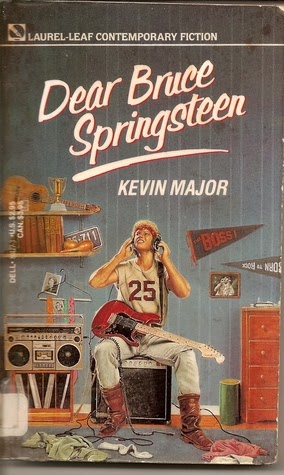
         When I was sixteen, I finished my grade eleven economics exam early, and I couldn’t leave the exam room, so I copied out from memory the lyrics to “Thunder Road” on the back of the exam booklet. It was a young fan’s act of mimicry, though I’m not sure what those lyrics might even have meant to me then, if I understood them or identified myself through them the way I might now, or might not. But what I do recognize in retrospect is that re-writing, transcribing, Springsteen’s words by hand was an initial gesture at that reciprocity. In those few free minutes, I started to write myself into a dialogue – a little like fourteen-year-old Terry Blanchard in Kevin Major’s YA novel Dear Bruce Springsteen – a conversation with whoever it was I’d always want to become. “My love, love, love,” he sings later and elsewhere, “will not let you down.” That’s not to say Springsteen’s songs will tell us who we are, but that they will always keep that reciprocal Eros, that mutuality, live and open, that invitation to join him heading down the road.

Catriona Strang and Christine Stewart at Play Chthonics (Audio)

This is an audio capture of a reading last night (Wednesday, 15 January 2014) by Catriona Strang and Christine Stewart at Green College at the University of British Columbia, as part of the Play Chthonics: New Canadian Readingsseries. There were a few minor tech problems with the recorder, so the beginning minutes of their reading were unfortunately lost; the recording fades in with Christine Stewart reading from a collaborative piece written for the Institute for Domestic Research, which presents their shared poetic methodology (I think it’s called “aleatoric alchemy” at one point in the text) for collective, collaborative research practice. The piece finishes with a declaration of openness – “We do not come to terms. We abound.” – that signals a key shared interest in practices of listening. Christine Stewart suggests at one point that listening might be understood as a way of reading, or of being read, and Catriona Strang’s poems consistently inclined toward loving intensifications of attention, toward keeping things open: “Imagine,” she writes to Proust in Corked (her forthcoming book from Talonbooks), “all my conclusions are tentative.” Christine Stewart read from Virtualis, her collaboration with David Dowker published by BookThug in the spring of 2013. She also read from a text on Paul – joined by another collaborator, Ted Byrne, who happened to be in the audience – and she and Catriona Strang traded poems, reading each other’s work, to conclude the reading itself. On the recording, the reading is followed by an extended conversation with members of the audience about their poetics.

Sincere thanks to Green College, UBC for their ongoing and generous support of this reading series. Copyright for the recordings remains with the artists.


Carly Rae Jepson’s "Call Me Maybe": lecture notes and audio

For our second class of English 228B here at the University of British Columbia, I drafted a short lecture on reading  on beginning a close reading – Carly Rae Jepson’s “Call Me Maybe,” a song which I had used as an introductory example in the first class, on pop music and lyrics. The students had been asked to look at the video, and to look at the “parody” done by Carly Rae Jepson with Jimmy Fallon and The Roots. I decided to write out some lecture text – the preferred mode for the class, I’m imagining, will be workshop discussion – in order to give something of a firm anchor point from which to begin thinking about how reading takes place. The class took place on Wednesday, January 8, 2014. An audio capture of the lecture portion of the class (hosted on my SoundCloud page) is attached below. (Just a note – in the audio, I credit Eve Kosofsky Sedwick with the term “heteronormativity” [I am thinking of her introduction to Epistemology of the Closet], but the term seems to have originated with Michael Warner.)
The protagonist of Nick Hornby’s 1995 novel High Fidelity, Rob Fleming, defines his self-awareness in terms of his record collection, an accumulation of popular music he inhabits and that gives him a second-hand voice: “Is it wrong, wanting to be at home with your record collection? It’s not like collecting records is like collecting stamps, or beermats, or antique thimbles. There’s a whole world in here, a nicer, dirtier, more violent, more peaceful, more colorful, sleazier, more dangerous, more loving world than the world I live in; there is history, and geography, and poetry, and countless other things I should have studied at school, including music.” Following on our initial reading of Carly Rae Jepson’s song “Call Me Maybe” at our first class, I want to suggest some of the ways we can begin to address what I called the “cultural work” of popular music, how (in more contemporary terms) the playlists of favourite songs – a version of what Rob Fleming and his record-store colleagues call their “top five“ lists – both produce and define their listeners as subjects, and speak to the welter of value systems – taste, morals, desires – through which we circulate.
         For this course, I’m suggesting that we concentrate on the poetics of song lyrics, on the kinds of texts that popular music articulates but also on the cultural contexts in which those words operate. One of the things to notice in the passage from Nick Hornby’s novel – which we’re not reading in this course, and which I’m unlikely to mention again – is its utopianism: text and context intersect to form an ideal “whole world,” a world that appears to promise comfort and escape but that also presents a qualitatively better, richer position from which to view our contemporary world critically. (This is, as a matter of fact, one of the ways in which the Marxist philosopher Ernst Bloch understood the transformative political impetus of utopian, as offering what he calls “the principle of hope,” as an instance of the “not yet.” ) In class last day, we arrived at a what seemed like an essential conflict in our assessments of “Call Me Maybe” – both the lyrics and the video – that suggests that the song might either encourage conformity to an illusory middle-class heteronormativity (the romantic idealism that manifests itself in clichés that come from other pop songs and romance novels – “I trade my soul for a wish”) or that it might be a critically-minded parody of those dangerously mindless delusions, that it does in fact see the boy-girl, romantic-rescue scenario it thematizes as “crazy” and disempowering (some of you noted, for example, how the song appears to invert the terms of agency, so that the stereotypically passive ingénue becomes the one who is actively seeking an erotic encounter, thus undermining heteronormative gender hierarchies – an inversion marked in the video, although not in the song itself, by the singer’s disappointment when it’s revealed that the object of her desire, of her gaze, is gay). We might appear to have reached a bit of a stalemate: which reading of the song is right, or at least to be preferred? Is the utopianism of the song’s vestigial “romance” narrative self-reflexively critical or does it merely reproduce coercive mass-culture escapism?
         I want to look at the lyrics to try to work our way through this dilemma, and to think about how popular song interpellates us as listening subjects. By “interpellate,” I mean what Louis Althusser describes as “hailing,” when the apparatus of the state or of “ideology” calls out to us. Althusser’s famous example is a policeman’s “Hey, you!” but I want us to think for a moment about how this song calls us, maybe. The trope in the title is the phone call, after the persona behind the lyrics has given her number to a prospective lover. That number is, if you think about it, a marker of personal identity, like her name. To be called at your number is to be recognized, to be desired back, and, as the title indicates, to be hailed as a “me,” as somebody who’s seen, whose gaze (“I looked to you,” “I wasn’t looking for this”) is returned, who gets noticed, seen herself. Not to be noticed, in this schema, is to be nobody. 
         The song remains, however, in a kind of state of abeyance around this possibility. We don’t know if her call or her gaze is answered, if she does get interpellated by her prospective “baby.” The title (which is also the tag line of the chorus) indicates this uncertainty in its clipped and tenuous syntax – it doesn’t feel like a proper sentence – but it can also be read as the persona naming herself: her name, what she’s called, is Maybe. Her sense of self consists in the dilemma we’re contingently trying to resolve here. She’s an aggregate of her own desires, uncertain of the terms in which those desires can articulate themselves. Her sense of the rightness of her object of desire, the “foresight” she seems to have, attempts to firm itself up in the circular repetition of the chorus and the bridge – “Before you came into my life, I missed you so bad” – but in the temporal paradox that she voices here, that sureness and that feeling of (his) presence are effects of desire, of want, of absence, of “missing,” which in turn suggests that her maybe-ness is the only space she has, a fractured assemblage of clichés and skewed grammar that is as catchy as it is troubling.

Otherhood: Sina Queyras, Sylvia Plath and Negation

I haven’t received my print copy of this month’s issue of Poetryyet, but I have been reading around in the on-line issue. I’m caught by a new poem by Sina Queyras, “Sylvia Plath’s Elegy for Sylvia Plath.” It’s a remarkable poem, not least for its gutsiness in taking on the fraught legacy of Sylvia Plath, responding to the difficulty of her poetic, to what feels like Plath’s inassimilable otherness. Queyras makes a poem out of Plath’s refusal to be remade, out of her recalcitrant inapprehensibility. That refusal for me is also a version – though in a very different idiom – of Paul Celan’s practice of Widerruf (which means something like revocation, cancellation or retraction), which is itself I think a poetic version of Hegelian sublation, Aufhebung: the repeal, the resolution through negation. I’m not prepared, and I may never be, for a careful philosophical interrogation of these concepts, but I am fine about invoking them as tropes, as resonant elements of a poetic toolkit. “Sylvia Plath’s Elegy for Sylvia Plath” strikes me – given the come-and-go controversy around negative reviewing in which Queyras has been participating over the last year or so, mostly as a provocateur – as a kind of negative review of Plath’s poetry (and really of one poem in particular, “Tulips” from Ariel), but “negative” in a much more complex and nuanced sense than you might think. The poem, after all, functions at least on first reading as both tribute and celebration, as affirmative. But what it also does, and does very well, is revise Plath – that is, re-see her words – by conversing and debating with her poetry as poetry. It’s not composed, despite the circularity of the title, in anything like the critical meta-language of the review. Rather, it recasts the decidedly patriarchal lineage of the Widerruf (a lineage that might be heard as Oedipal contestation in, for instance, Harold Bloom’s Anxiety of Influence) as what Queyras, in her mini sonnet sequence published in this same issue of Poetry, calls “otherhood,” a portmanteau of otherness and motherhood. Queyras takes up and takes on Plath, I want to suggest, not to wrestle her way elegiacally past a predecessor (like Milton on Shakespeare, for instance, or Ashbery on, say, Stevens), but to address Plath’s own challenging relationship to canonization and patriarchy, and to reframe what it means, in Queyras’s terms, to be a “bad / Mother.”
         Here is what Freida Hughes says about her own difficult mother in the foreword to the “restored edition” of Ariel, published in 2004:
Since she died my mother has been dissected, analyzed, reinterpreted, reinvented, fictionalized, and in some cases completely fabricated. It comes down to this: her own words her best, her ever-changing moods defining the way she viewed her world and the manner in which she pinned down her subjects with a merciless eye.
As Plath seems to predict in “Tulips,” written in 1961 but carried forward to posthumous publication in Ariel, Plath sees herself as subject to both vivisection and autopsy, and not only as subject (patient, body, even victim) but also as her own surgeon, wielding a merciless scalpel. Plath, that is, casts herself as both mother and mothered, other and othering. “Nothing, not even death,” says Queyras’s poem, “frees mothers from the cutting board.” Her “Sylvia Plath,” though, is much less visual and much more tactile, more textural, than Plath herself tends to be. In “Tulips,” Plath’s reflexives, the negations, are characteristically optic: “Nobody watched me before, now I am watched.” Plath depicts herself, on a hospital bed with her head sandwiched between two pillows, as the “stupid pupil” of an eye “between two white lids that will not shut.” Queyras’s Plath, by contrast, is sculptural, material, rife with aesthesis, wanting to “feel the tulip’s skin, . . . the soft gravel / Of childhood under cheek,” her words given kinetic dimension, corporeal space and thickness as they are made to writhe “Across the page . . . ass / High as any downward dog and cutlass arms / Lashing any mother who tries to pass.” Echoes of barely suppressed violence seethe and twist through Queyras’s lines, much as they do through Plath’s; notice how the “firm rhyme” here around “ass” – hardly an instance of poetical diction, though Plath was often fond in her late poems of shocking sensibilities, of lashing out at her reader “lightly,” a little – is drawn off-centre, away from the line-ends of any ersatz “hard couplet.” Plath’s offspring, if that’s what these lines are, want to shred neatnesses, prying cracks in their verbal containers.
         “Tulips,” from which I’ve been suggesting that Queyras draws much of her raw material for this poem, was written after Plath underwent an appendectomy, following a miscarriage. The red tulips, presumably flowers sent to her in hospital, suggest both vitality and woundedness. Plath refuses remedy, the distant “health” at her poem’s close, choosing instead to worry metaphorically at her incisions, to use poetry to pull at her sutures. Craving the blankness of anesthesia (“I didn’t want any flowers, I only wanted / To lie with my hands turned up and be utterly empty”), she nonetheless builds and weaves text from her own troubled persistence; poetry consists in the refusal of her self-awareness to let go: “And I am aware of my heart: it opens and closes / Its bowl of red blooms out of sheer love of me.” Queyras picks up on the irresolution with which Plath’s poem contingently finishes:
                           The tulips were never warm
                  My loves, they never smelled of spring,
                  They never marked the path out of loneliness,
                  Never led me home, nor to me, nor away
                  From what spring, or red, or tulips
                  Could never be.
Performing their hiatus, these lines neither empathize with Plath nor refuse her. Despite the entitlement Plath’s readers’ often feel – our dogged identification with her cultural predicament as a woman caught between domestic codependency and urbane independence, between love and loneliness – this Plath settles for neither home nor escape, but produces, reproduces herself negatively, by refusing either option.
Hers is an idiom of ingrained melancholia, of resolute infelicity. Metaphor – consisting simultaneously of semantic slippage and connective bridgework – emerges from the roiling fractures of that refusal. In “Tulips,” Plath’s metaphors (falling into intemperate simile, for example) suggest both likeness and unlikeness, motherly bond and otherly dehiscence:
The tulips are too red in the first place, they hurt me.
Even through the gift paper I could hear them breathe
Lightly, through their white swaddlings, like an awful baby.
That disavowal, that sublation, is also enacted syntactically in Plath’s comma splices, which suture her open sentences together, like loose stitches, gating without cinching her red salt flow of words. Queyras picks up on this stylistic tic, as the set of run-ons that close her poem, which I have cited above, suggest. But Queyras also distances herself formally from Plath’s poem. The couplets, or perhaps the two-line bunches, that shape Queyras’s poem recall not “Tulips” but “Berck-Plage,” which also uses comma splices to create a sense of spontaneous overflow, of fractal rush. Plath’s texts hover between the immediacy of rough spontaneity (most of the poems in Ariel tend to speak, as manuscripts demonstrate, in a holographic present tense, as if addressing the moments of their own composition) and the considered formal mediations of obsessive revision, of the reflex of craft. The writing self, which in Plath often manifests as a cascade of first-person pronouns, is in Queyras’s text further withheld, suspended in an indeterminate second person for at least the first half of the poem: “If you can’t feel love in life you won’t feel it in death, nor / Will you feel the tulip’s skin . . . .” Any empathic connection to Plath, feeling as if you might feel what she might have felt, reaching imaginatively across the absolute barrier of her death (though “not how you imagine it will,” writes Queyras) to draw her voice, liminally, back into the living frame of your own poem, is also impeded – negated – by the mythopeic work of Plath’s posthumous dissection and monstrous reassembly as an icon of fraught womanhood, of otherhood. She refuses to be caught. “The vivid tulips,” as Plath herself proleptically puts it, “eat my oxygen.” The tropes will always digest their own maker, her vitality. “Let’s be frank,” says Queyras, but candour in a poem about Plath isn’t a matter of re-casting details from her biography, or reshaping lines and fragments from her poetry. Rather, it seems to consist in facing up to the cancellations and refusals that shape her voice and her sense of self, of self-elegy. And self in Plath isn’t something that, Yeats-like, you must remake. Rather, self comes to consist in the work of revision, in the negatives through which those rewritten poems emerged, and, in moments such as those of Queyras’s poem, still emerge.

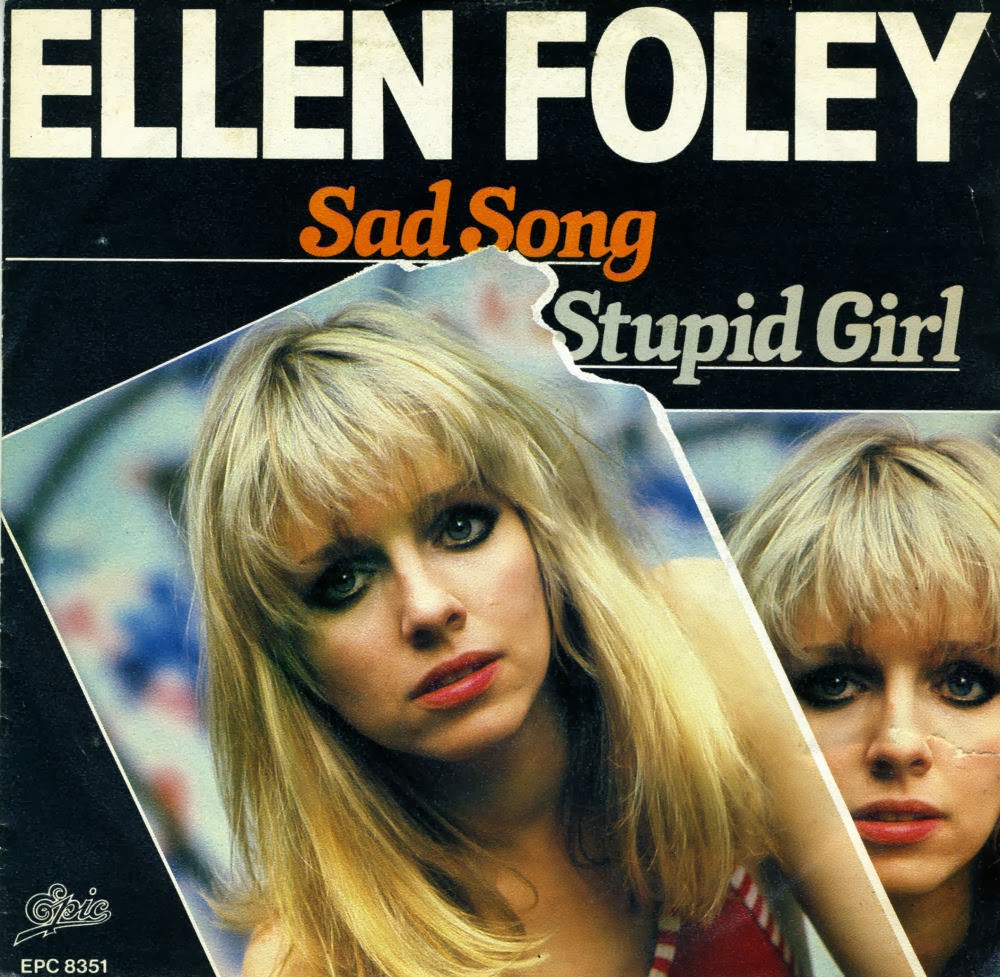
Ellen Foley, No Stupid Girl

In her disco-punk memoir The Importance of Music to Girls, Lavinia Greenlawfrequently dwells on a disconnect, an existential fracture that shapes and even constitutes her self-image; the book maps out her negotiations – some deliberate, some instinctive – among a conflicted mix of adolescent identities, of identifications, that seem to circulate around what it means to be a girl, to be called a girl, in the late 1970s and early 1980s. I’m not being tentative when I say seem to: the work of seeming, as both pretending and appearing, is at the crux of her methodical self-fashioning. The book consistently returns to a vocabulary of wanting, of want. Greenlaw depicts herself as a teenaged wannabe, trading costumes, styles and surfaces: always trying, always coming up a bit short. For instance, she articulates her admiration for “Tina,” role-model for nascent disco queens, by collating a wilting deference to peer-pressure with an ersatz Amazonian fierceness:

I was becoming a girl as instructed by girls but I knew I wasn’t a real girl, at least not of this kind. I wanted to be a disco girl like Tina whose every aspect conformed to some golden section of girldom: her height relative to her shape, her prettiness relative to her smartness, her niceness relative to her toughness. Tina offered certainties. She issued instructions on how to dance, who to like and what to wear. . . . Each morning, her face would be retuned – the brightness turned down, the colour turned up – and she would stride into school, her hips and breasts armoured, her hair a winged blonde helmet. I wanted this shell, which she used to attract or deflect at will. To me she was wise and ruthless, a goddess of war.
Those certainties soon become illusory, their surfaces shivered. Greenlaw’s leave-taking from disco (to take up another set of surfaces, another glamour, in punk) involves an accidental collision – a moment of casual violence – with her friend on the dance floor; as she waits for help with her cut face, she catches a glimpse of herself in a washroom mirror: “the face I saw was mine but this was not a reflection. It was too far away, more like some inner self that had slipped free and looked back at me now with my own fundamental sadness.” Mimesis is belied by its own bad promises. What’s fundamental for her, as a girl, what’s essential to who she wants to be, can never be more than pathos in lack: a likeness – “more like some inner self” – that sadly never can or will make herself whole.
         Lavinia Greenlaw’s about my age. My own leap wasn’t from disco but from some sort of sci-fi soft rock – I liked Styx a lot – to punk and after, but the dynamics were roughly the same as hers. Except, of course, for the girl part. I was enabled by the same dynamic as Greenlaw, and I understand her preoccupation with want and fracture, with that fundamental sadness, but I came at it as more of an insider, as a boy. I didn’t seem to need my own version of that armour, and I could choose to identify more directly, though still at some remove, with Joe Strummer or (like Greenlaw) Ian Curtis or with any other self-styled punk frontman.  I perceived the homoeroticism in Pete Townshend’s 1980 song “Rough Boys” as emblematic of a transgressive effeminacy in punk ‘s – particularly the Sex Pistols’ – preoccupation with image, although I am not sure how far I was ever able to follow through on its gender trouble.
Still, I was reminded of this version of the girl problem with the release in November of About Time, Ellen Foley’s first album in about thirty years. (I haven’t listened to the record well enough yet, but it sounds to me so far like the power, the tough richness of her voice has remained undiminished, and I’m so glad to be able to hear her belt out some raw, driving rock and roll again.) Ellen Foley’s return to recording recalls how important her first two albums were to teenaged me – Nightout (1979) and Spirit of St Louis (1981) – as well as her vocal presence on Sandanista! by The Clash (who are essentially her backing band on the second record, which was made while she was dating Mick Jones, billed in the liners as “my boyfriend”). She was the girl, as far as I could see and hear then. Her sound, her image and her sensibility yoked together a seemingly fey prettiness – what Greenlaw says she wanted simultaneously to embrace and to throw off – and a powerfully resilient, gutsy resistance to bullshit effeminacy. Despite appearances, she was nobody’s girl, nobody’s fool.
         There is plenty to say about what Ellen Foley’s music comes to embody, but I want to concentrate on her take on the iconography of the girl. She first made her presence known in pop music as the female interlocutrix on Meatloaf’s “Paradise by the Dashboard Light,” and she recorded duets with Ian Hunter (who had produced, and performed on, her debut album, Nightout) and others that extend her role as respondent, as the girl you serenaded but who could out-sing and even out-swagger you back. She performed a version of “We Gotta Get Out of Here” with Hunter on “Fridays,” ABC’s short-lived answer to Saturday Night Live, on May 5, 1980, a performance that suggests much about how Ellen Foley takes on a male-dominated stage.

She comes in half-way through the song – you can catch glimpses of her, back to the audience, waiting to pounce. Most importantly, for me, is her refusal to be subdued, even by Hunter’s obvious recalcitrance. (And it’s important to note that these are rock-and-roll theatrics: Ellen Foley has stressed in a number of interviews how grateful she was to Hunter and to Mick Ronson, and how happy she was with their musical relationship.) At the close of the song, she declares into the mike she’s going to have a dance contest with Hunter, and he turns to face her, but does nothing. Undaunted, she goes ahead and has a dance contest all by herself.
         She seems here in one sense to have donned the blonde armour, the make-up of girlish deference that Greenlaw describes around disco girls, but – strident in her flashy white pantsuit – she also becomes something more in this clip: unshaken, energized, assured. She owns the last minute of that song. This playful, ironic  doubling emerges most tangibly in one of the most memorable covers on Nightout (a song she still performs in concert), the Jagger-Richards penned “Stupid Girl”:
I’m not talking about the kind of clothes she wears 

Look at that stupid girl 

I’m not talking about the way she combs her hair 

Look at that stupid girl
You see the way she powders her nose 

Her vanity shows and it shows 

She’s the worst thing in this whole damn world 
Well, look at that stupid girl
The song first appeared on the Rolling Stones 1966 lp Aftermath, occasioned as both Keith Richards and Mick Jagger have separately admitted by their frustration with female fans and with their failed relationships. Prima facie, as the lyrics make obvious, it’s a misogynist rant. Girls are sick and stupid, Keith and Mick tell us, because they’re so shallow, so vain, because of their obsession with image. (Not at all like Mick and Keith. Not at all.) So why would Ellen Foley choose to sing this particular song? Because the thing is, if you listen to her version, backed by snarling guitars and thumping four-on-the-floor kick drums, you get no sense of anything but absolute commitment, of anything but digging in and digging deep. There is nothing vain, nothing insincere about Ellen Foley’s voice. It sounds completely like she means it.
But what exactly can she mean? Because, despite the venomous lyric, what we hear from her isn’t a woman calling others out, sniping at all the Tinas she can’t ever be. She’s singing the admixture of desire and loathing that the Stones song articulates, sure, but she’s also shoving it back in their faces, in their ears, our ears. I remember hearing this song as an adolescent listener, blasting it out of my stereo, and feeling that mixture of toughness and allure that few singers beyond Ellen Foley, in those transitional years, ever managed to catch. In a lip-synched video of “Stupid Girl” made for the Kenny Everett television show in1980, that catches a little of this pushback in its campy staging around body builders and beauty contestants.
When Ellen Foley sings into the beefcake armpit of some muscleman or into the plasticized coiffure of a pretty second runner up that “She purrs like a pussycat / Then she turns ’round and hisses back,” it’s not at all certain whose image – boy, girl or her own – is being confronted and undone. Rather than self-pity, the fundamental sadness that Greenlaw highlights, Ellen Foley offers her audience a means to uncover another certainty, a centredness that the unshakable timbre her voice enacts.
         Mick Jones wrote “Should I Stay or Should I Go” for Ellen Foley. As a provocation, it seems to offer a bitter critique of indecision, of a girlfriend unable to make up her mind and of a boyfriend in thrall to her waffling. I’m assuming the song comes at the end of their relationship, and the recording by The Clash does appear to offer a sort of vindicating, and maybe even vindictive, catharsis for Jones. The thrashing guitars and double time chorus enact a release, a letting go that the lyrics themselves never allow.

A 2007 audience video of Ellen Foley performing “Should I Stay or Should I Go” suggests that her vocal power remains undiminished, and goes a long way to reclaiming her agency, again by taking hold of the song and singing it back at the boy or boys who authored it. More than that, it points to the subtle ways in which the indecisiveness of the lyric comes not from the object of its attention – an interlocutrix who doesn’t really answer back within the framework of the song – but from its male persona, who stays bugged by his own irresolution, by the unsatisfied involution of his own desire. When he says that if he stays there will be trouble, but if he goes it will be double, he’s pointing – at least when we hear the song with Ellen Foley’s voice in mind, in our mind’s ear – to the essential conflict, the trouble, around heteronormative desire, around gender and identity, that Greenlaw’s memoir confronts, and into which it sometimes spins and stalls – the difficult importance of music to girls.  And for me, that importance, that insistence, sounds something like the intensity, like the depth and like the ruthless beauty of Ellen Foley’s voice.

Saving Anything of Value, on Carmine Starnino

The last lines of “Cornage” – the sixteen-part sequence of carefully-turned triple quatrains with which Carmine Starninocloses his 2000 collection Credo – frame the cultural work of a poem as an act of salvage, rag-picking language for splashes of unexpected colour (he has just rediscovered the resonances of the word “vermeil”):
                           Even this poem is one more example
of the usefulness in scavenging through
the day’s refuse, saving anything of value.
Starnino’s characteristic line, often an artfully balanced pentameter or (as if to register a little Gallic influence) hexameter, suggests at this point in the sequence a posture of measured resignation. The task he sets for himself isn’t so much to “purify the dialect of the tribe” (as T. S. Eliot once parsed and repurposed Mallarmé), although he might still aspire to breed lilacs out of a nearly dead land, a poetic labour that involves recovery more than rescue – to reanimate what he perceives, even in himself, as contemporary staleness with a mix of archival and ethnopoetic rummaging. The poet doesn’t so much conserve as curate, mindfully intervening in whatever lexical felicities cross his attention by unpacking etymologies and re-stitching phonemic meshes. (In part five, he lists the “[w]ords I’d like to get into a poem: eagle-stone, ezel, / cornage, buckram, scrynne, waes hail, sillyebubbe,” and proceeds to write poems that use most of them.) The idea is to “smuggle in / this fox-fire,” an audible and tangible vitality he feels missing from poetry. But the vatic intensity he craves is often either contained or held at bay in these poems by cautious and even anxious craft, a technical command I have to confess is also what I admire most in Starnino’s writing. He can be affronting – “gnarled turds” is quite a phrase – but it’s not shock that works best in these poems so much as their gently nuanced fabric of echoes and hums; notice above, for instance, how “usefulness” morphs and reduces into “refuse” or “scavenging” into “saving,” or how liquids and vowels from both words fuse in “value.” These words don’t so much flare up as entwine and accrete. I can call that meshwork anxious because I’m taking a cue from Starnino’s “Credo,” which remarks almost as an article of faith “the fear with which / a poem caskets away everything it wants to rescue.” Cultural and poetic rescue, as I said, seems closer here to recovery, a salvage rather than a saving. 
         What is it, then, that these poems do? What’s their function, their “usefulness,” in a contemporary cultural context, a Canadian context (if that’s not too much to demand of them)? Starnino already takes up the procedural challenge at the outset of “Cornage,” where he casts his ear back to a patriarchal medieval world to explain his reasons – as a poetics, in fact – for his choice of title:
Cornage was the duty of every tenant
To alert his distant master of approaching invaders.
I have thereby stationed this poem on a tout-hill, where,
In time of danger, it will blow a horn as warning.
He offers the recovered word as a moment of civic engagement, as cultural “duty”; more than that, the poem comes to act as a warning, as a ward – as portent, as monster (check the etymology, the Latin monstrum). But what exactly is the danger the poem confronts? A linguistic entropy? A verbal decrepitude? A lack of monumentality or durability, of poetic heft? I hear the problem Starnino wants to address, and I hear his trepidation. But I’m not sure how ultimately dire, even to a poet, this situation might be. And I am not sure that building a poetic casket out of that fear is the best way to go here.
         I’m looking back on these poems because I have been reading “An Interview with Carmine Starnino” from the most recent issue of CV2. Writing poetry, he says,
is a critical as well as creative act, and value judgements are part of any good poet’s skill-set. Just as a literary culture is the sum of all our actions, a good poem is the sum of ruthless decisions toward every word in a draft.

In the unflinching self-awareness of the poems in Credo, most of them written a good fifteen years ago, I hear prefigured this interlace of critical and poetic sensibilities. I admire an editorial ruthlessness in composition, evident in the deliberateness of Starnino’s formalism. But I have to say that I don’t accept his over-simplification of aesthetic value judgment, as if there were merely right and wrong, soft and hard choices to be made. (And frankly, I don’t think the best of his poems accept this over-simplification either; they’re much better than that.) Starnino sees a risk, even danger, in critical candour, and he defends his cohort of poet-critics – he mentions Michael Lista and Jason Guriel, among others – as deserving “our respectful attention,” which they do. But I’m not sure that candour – as opposed to acuity, perhaps – is what’s especially missing in recent poetry and recent reviews, Canadian or otherwise: the rigour of poetic attention has always been a sticking point for committed readers of poetry. The issue for me has to be not whether a poet pays attention, but defining the nature and practice of that attention, of that respect.  Saving “anything of value” needs to be made precise, carefully, and the diffuseness of that “anything” replaced with a materially substantive sense of what such value might be, and especially of what cultural and linguistic apparatus is producing that sense of value, of values. To this end, the poet’s task, it seems to me, doesn’t need to devolve into a parochial cosmopolitianism – ferreting out “the best” of what is thought and said in Canada and pushing it onto a fictional world stage – nor into a diffusely Canadian cultural nationalism, so much as to situate and to address, rigorously, the audible and tangible mediations between self and world that a poem – a good poem – wants to gather.

Occupations: Wadada Leo Smith’s Ten Freedom Summers

Wadada Leo Smith speaking to the audience in Guelph after the performance of Ten Freedom Summers 
The citation accompanying the announcement that Wadada Leo Smith’s Ten Freedom Summers was a finalist for the 2013 Pulitzer Prize for Music stresses its monumentality: “An expansive jazz work that memorializes ten key moments in the history of civil rights in America, fusing composed and improvised passages into powerful, eloquent music.” He was also voted “Composer of the Year,” in Downbeat magazine’s critics’ poll, for this same work – as well as for his compositions for large ensemble, recordings with the Finnish orchestra TUMO issued as Occupy the World (TUM) earlier this summer. His comments on the Downbeat award, published in the August 2013 issue, stress more than history and canon, more than monument making, although Smith remains deeply conscious of his enmeshment in the continuum of African American musics. Smith points to community-building and change as key principles both in the historical self-awareness promoted by the AACM, through which his compositional and instrumental practices were first nurtured and supported, and in his own compositional practice, which stresses collaboration and mobility.
Those principles suggest, if not enact, a powerful cultural politics: a politics both invoked and put at issue in Ten Freedom Summers. His music, in many respects, offers aural analogues to grass-roots participatory democracy – mutual resonances that come together in practices of sounding and of sounding out.  As Franz A. Matzner’s liner notes for Occupy the World put it, “Smith has long inhabited the space where political and artistic movements converge.” Matthew Sumera’s notes for the Cuneiform 4-cd recording of Ten Freedom Summersargue that Smith’s work produces much more than programmatic musical echoes of real-world engagement: “[This] music was not simply about the Civil Rights and Black Power movements. It was part of them.” He quotes Wadada Leo Smith’s assertion that the performances of the suite invite a proactive and imaginatively engaged audience: “They poetically suggest what can be done. . . . None of these pieces [is] meant to simply be listened to.” Sumera pushes this claim further: “Rather, they are meant to be lived.” Extending the reach of Smith’s music beyond the aesthetic (as merely music) into the political (as music that makes a difference, that matters) isn’t liner-note hyperbole, but gestures at the core impetus of his improvisational and compositional practice, of his fusion – as the Pulitzer citation puts it – of these two seemingly incommensurate conceptual frameworks.
In an interview with Daniel Fischlin published as an appendix to an article by Fischlin in Critical Studies in Improvisation, Smith still calls what he does a “model” for political engagement, retaining the idea of an aesthetic analogue: “I strongly feel that the most beautiful model that we have of the practice of democracy is in fact expressed through the workings of a musical ensemble when it is improvising. That experience is a microcosm of those same democratic principles.” But I also hear echoes of Walter Benjamin’s call, in the last of his Theses on the Philosophy of History, for a refusal to aestheticize the political – to convert engagement into spectacle or artful mimesis – and, more importantly, for a creative practice that politicizes the aesthetic, that makes art matter. And it seems to me it’s worth testing, at least a little, how Smith’s work delivers on its claims, how it refuses the dilution of its vital human energies and seeks to reanimate a commitment to positive social and cultural change.
         I’m already sounding like I’m on board with the broader project, and I have to admit that I am. But it’s important, I feel, still to retain a certain level of skepticism in order to assess the critical potential of this nascent utopianism, addressing what I feel is a persistent need for colliding artistic and political ideals, but doing so in as open-eyed and keen-eared a manner as I can manage. This exact idealism certainly coloured my expectations when I bought a ticket for a scaled-down performance on Saturday September 7, 2013, at the River Run Centre in Guelph by Wadada Leo Smith’s Golden Quartet (without accompanying chamber ensemble) – which included Anthony Davis on piano, John Lindberg on bass and Anthony Brown on percussion. I was jazzed. This concert had the potential to be transcendent, epochal, monumental. The suite contains creative music – I had been listening at some length to the recording – of the highest order, and I really wanted it to deliver on its implicit promises of raised and altered consciousness – a promise that, in my earphones and on my stereo, I felt as if it had already abundantly kept, in fact. It sounds as if I was setting myself up for a disappointment, but that wasn’t the case. The quartet’s music was eloquent, deep, and uplifting. However, in performance, the often stringent demands of Smith’s conception and of the score itself also become a bit more tellingly evident. (A review of the performance by Alayne McGregor can be found here.) The Golden Quartet arranges itself in a semi-circle, with Smith stage left, rather than in the horns-to-the-front configuration of the typical post-bop ensemble. (Smith has often in his recordings worked with the spatiality of sound; on the ECM record Divine Love, for instance, he uses proximity and distance from the microphone to reshape the texture of multiple improvising trumpets.) While at first this spatial configuration might suggest a quasi-democratic leveling, in performance it makes Smith more visible to the other members of the quartet, leaving him able to direct the music more cleanly and organically.

During the Guelph concert, their eyes moved only from score – much of the music looks like it has been through-composed, though its sounds highly spontaneous – to Smith, closely attentive to the demands of structure and direction. In this particular instance, the rhythm section (all of whom are masterful composers, improvisers and bandleaders in their own right) appeared at times a little anxiously bound to the page, which gave the music at a very few points a brittleness, a slight strain that was out of keeping with the committed attack that the composition demands: it needs the instrumentalists to be on, fully inhabiting any given sound moment. While the musicians clearly share in the responsibility for carrying the larger design forward, Smith is still in charge; at several points in the Guelph set, when the collective energy seemed to lag, he strode to centre stage, pumping his right arm as if to impel the rhythm more vigorously forward. He frequently cued the quartet as to which of the nineteen movements they were playing next; rather than establishing a running order ahead of time, it appeared as if he were allowing the dictates of the moment to establish where the music would go next.
The larger design was always there, marked by definitively firm fragments of melody; I recognized (from my earlier listening to the recording) the In a Silent Way-like line from the second part of “America” (section 15) and the loping dirge of “September 11th, 2001” (section 16). (According to the review I’ve linked above, they didn’t play “America,” but I’m sure I heard it.) Jesse Gilbert’s video projections (of photographs of various civil rights activists, for example, marking several evocative moments in the suite) are also meant to suggest certain diegetic moments, when the music speaks its politics definitively. In the May 3, 2013, edition of The New York Times, Ben Ratliff reviewed the first of three nights of a complete performance of Ten Freedom Summers at Roulette in Manhattan, remarking on its simultaneously resonant and frustrating narrative aspirations:
This piece has stories to tell, or rather to refer to. It’s not meant to suggest a narrative but a series of images, evoked mostly through sound. It’s never obvious or literal, which is both very good and sometimes problematic.
A little of that frustration appeared to me to find its way into the urgency of Smith’s efforts to conduct the ensemble on stage in Guelph, visibly driving the music toward making it communicate, making it speak.
In the interview with Daniel Fischlin, Smith suggests that this tension is deliberate, and that speech – as democratically motivated debate and discussion – comes more as an after-effect of the listening experience, rather than as any expressive content of the music itself:
But the quartet still enacted a key aspect around the idea of productive debate, of musical performance as a thinking-through of the politics of voice and voicing. Smith still retained something like mastery over the set. His horn tone, for example, was magisterial, brassy, Armstrong-like, with a southern rawness to it: his own sound guided the ensemble fairly firmly. At the same time, Smith’s compositions aspire to what he calls multiple-dominance, a negotiation for aural space within the shifting dynamics of an ensemble:
I’m not sure I saw – although I may still have heard – a great deal of this sort of collaborative compromising during that set in Guelph; instead, it felt as if Smith were urging the other players toward a more definitive and confident co-participation in the music, but that the urgency and commitment still originated with him, with his instrumental voice.
In a very real sense, Smith wants the other performers in his groups to occupy his compositions. The liner notes for Occupy the World take an epigraph from Henry David Thoreau’s Civil Disobedience that speaks to a link between aesthetics and politics, a link that Mr Smith has pursued musically, improvisationally, for more than four decades: “Is a democracy, such as we know it, the last improvement possible in government? Is it not possible to take a step further towards recognizing and organizing the rights of man?” The aesthetic dimension might not leap at first glance out of these lines, but if you look again closely at what Thoreau says, it does begin to locates itself in the crossover between a phenomenology of recognition and the craft of organization: how, we could ask, does Smith’s music activate and intensify participatory attention as it organizes and re-organizes itself?  The coincidence and dehiscence of individuated lines, the fluid rhythmic geometries of his conception, the resonant potentialities of diversely intersecting timbres are all for him avenues, in performance, for occupying music. There are, he has said, two crucial aspects to his “concept for composing,” which he calls (in the liner notes for Occupy the World) rhythmic and polylinear:
Firstly, my composition are non-metric designs in regards to their rhythmic and sonic construction. The horizontal flow of the rhythms and sonic elements of a composition [is] achieved through a proportional structuring of the music’s geometric forms that, in performance, is realized by the shape f the music’s properties and not by its metric count. [. . .] [Secondly,] when I compose, I do not change the tonality of the instruments being used. . . . I do not believe in reducing the sonic field to a singular tonal spectrum, where one could have a multiple sonic spectrum hat shares the same musical grid without losing the large world of possibilities inherent in the sound universe.
The sometimes clashing sometimes consonant textures of the given timbre and tonality of instruments enacts a dynamics of argument, of compromise and self-assertion that, for Smith, has the potential to achieve what he calls a “higher level of realization,” as both performers and listeners, audience members. I am not sure if this realization happened during the hour or so I witnessed The Golden Quartet perform Ten Freedom Summers: Smith has set the bar very high for his collaborators. The music, taken on its own terms, was wonderful, powerful, moving: playing of a very high order that I was privileged to hear live. In the Downbeat piece, Smith admits that his project remains necessarily utopian, a figuration of human potential. He evokes the Occupy movement in New York, and globally, as a vitally nascent politics in which his music, he hopes, might participate:
“That was a great re-imagining of the possibilities of our society and possibility for radical change of our society,” Smith said. “It has not achieved it as such, but nevertheless, the idea is still there and not going away.”

And that persistence suggests something of the feeling of monumentality, of significance, that Smith’s music evokes: its moment.

Half Sonnet for Nelson Mandela

I have been putting up the odd poem in this blog, self-publishing what feel to me like more public pieces, and maybe worth getting out there quickly enough, after they’re done. There’s an element of the improvisational in these ones, for me, because they’re pretty immediate, not heavily revised. So here is what I have done in memory of Nelson Mandela, who not only called for racial justice, for human dignity and respect, but lived that call. I was listening to Eddie Daniels interviewed last night on As It Happens on CBC Radio about his friendship with Nelson Mandela: powerful stories of Mr Mandela’s humility and the politics of care.

Half Sonnet for Nelson Mandela
Fact is,
Nelson Mandela died today.
Half a cold world away,
the pared-down moon
hangs like a tin cup,
like an upturned palm
low in the ecliptic.
He said: own up,
atone. Moonlight
pushes it blue fingers
through the chain-link back fence.
Fact is, he said,
it falls to us
to put this world aright.
5 December 2013