Flow, Fissure, Mesh

Home » Articles posted by kevinmcneilly (Page 8)

Author Archives: kevinmcneilly

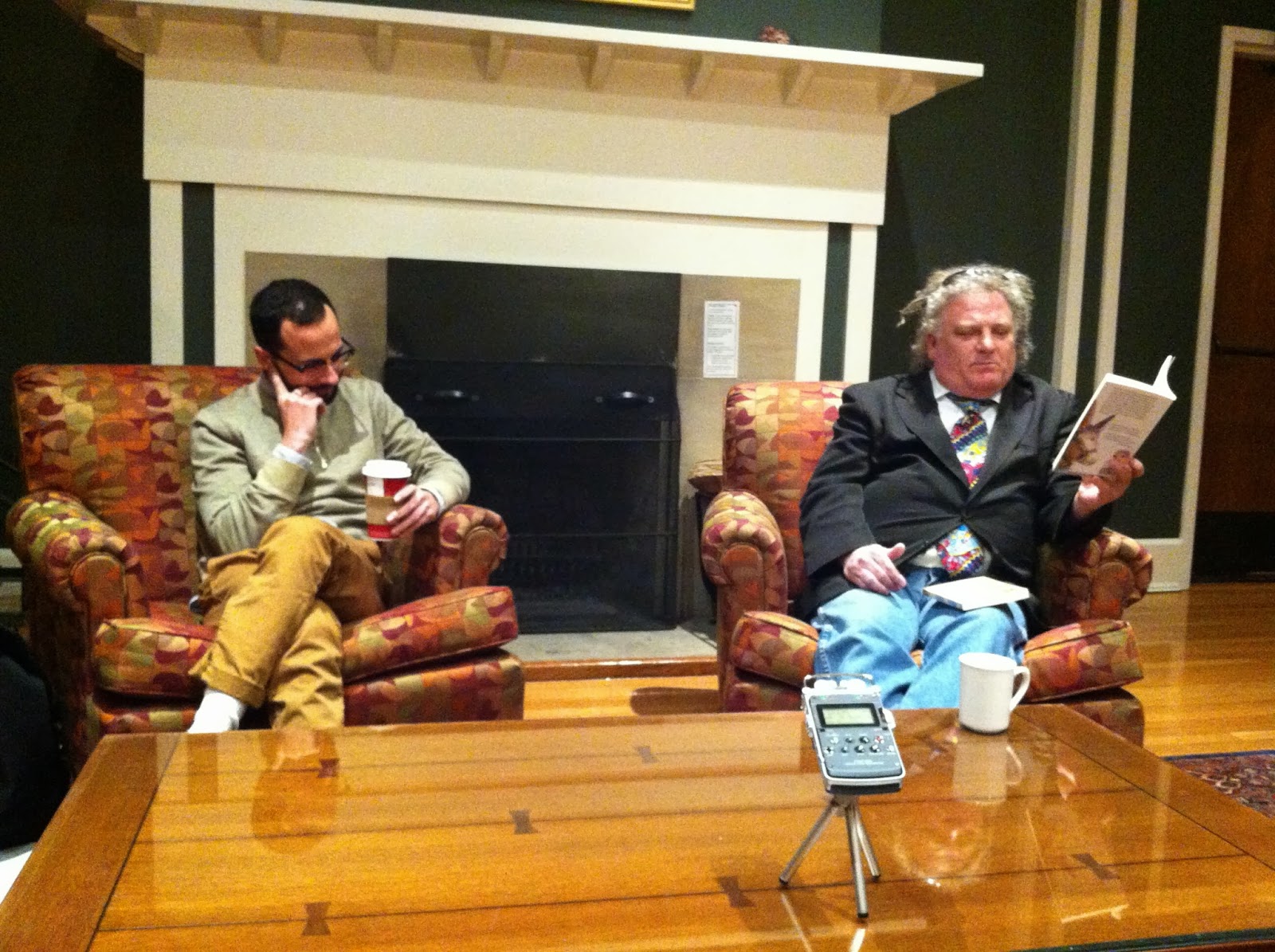
David McGimpsey and Daniel Zomparelli at Play Chthonics (Audio)

I am keen to introduce the poets: photo by Ryan Fitzpatrick
Daniel Zomparelli and David McGimpsey read at Green College yesterday, as the third pairing in this year’s series of Play Chthonics: New Canadian Readings at the University of British Columbia. Here is an audio capture of the reading, which includes their responses to questions after the reading. Daniel read new work from his iPad, including a poem about Kimmy Gibbler that he had written that day, dedicated, he said, to David McGimpsey. McGimpsey read from his recent collections: Li’l Bastard (2012), which he describes as a sequence of “chubby sonnets,“ and Sitcom (2007), some of which he noted involved re-casting text from Timon of Athens. Both poets engaged in their own versions of what I think is a kind of pop-culture code-switching, coaxing and inverting lyric from pulverized mass media language and image flows. Zomparelli read a pair of poetic synopses of gay porn films. His poems and McGimpsey’s play with the ways in which, as viewers, we’re alienated from experience by screen or headset and, as participants, we’re thoroughly immersed in and seduced by the variegated and empty textures of spectacle, of hubbub: “That Taylor Swift song is not about you,” McGimpsey writes in sonnet 11, “David McGimpsey likes – then unlikes – this.” The reflexive play, the give and take of mass culture that interpellates us (making us feel as if a song were about you, were calling you) even as it refuses us any shared humanity, informs McGimpsey’s poetics, and lends them something of a pathos of misrecognition: “I tried / to recall lyrics to a pop song once loved.” An “I” – like a dropped syllable – feels as if it’s missing from that last line, which is already metrically slightly ungainly, one syllable over its normal count: a spectre of subjectivity, of a self that wants to call itself into existence amid the tangle and meshes of discourse swirling from phones and pads and pods; but trying is not recalling, and recalling is not reanimating. Words, for both of these poets, seem to act as placeholders, markers of wanting, of what – remaindered and unrealized – might still despite everything get to be called human love.

Sincere thanks to Green College for their ongoing and generous support of this reading series, and to the Improvisation, Community and Social Practice research initiative for helping to sustain the series this year. Copyright for this work remains with the artists.

Steve Lacy’s Tips: Scott Thomson and Collaborators at Guelph (2011)

A unit of tactile measure: the foot, the arm, the thumb. [from Le Jour et la Nuit: Cahiers de Georges Braque (1917-1952)]
When I took up this blog in earnest – well, more in earnest than I had before – in 2011, one of the pieces I meant to write but didn’t manage to get down on paper was my reaction to a workshop-performance of Steve Lacy’s suite Tips by a trio called The Open (Scott Thomson, trombone; Susanna Hood, voice/dance; and Kyle Brenders, soprano saxophone), augmented by dancer Alanna Kraaijeveld, at the Guelph Jazz Festival in September that year. The trio is a sub-configuration of The Rent, Thomson’s excellent quintet dedicated to performing Steve Lacy’s music, one of a number of significant repertory bands – including Ideal Bread and The Whammies – to have emerged after Lacy’s death. (Lacy’s collaborator, trombonist Roswell Rudd, who has also been Thomson’s teacher and mentor, has written a promotional blurb for The Rent’s 2010 recording praising their many virtues: “The Rent has done the world a solid favor by rendering a bouquet of Steve Lacy’s compositions with precision, imagination and love. Thanks so much.”) Gratitude is also something I feel when I remember, even now, the powerfully moving reading of Tips the quartet gave that September afternoon in the foyer of the Macdonald Stewart Art Centre at the University of Guelph. It was one of the highlights of the festival, and continues to be, to my mind, one of the most artistically engaged and engaging moments I have experienced as an audience member, as a listener.
         In the autobiographical essay he wrote for Daniel Kernohan’s anthology Music is Rapid Transportation(2010), Thomson describes a shift in approach and attitude he underwent as he began performing demanding improvisational music like Lacy’s:
 [B]efore I started playing music, while I certainly listened deeply, passionately and, indeed,  differentlythan most people I knew, I listened as an ostensible outsider and as a kind of passive consumer. […] Since I started playing, however, the tangible experience of playing collaboratively (improvisation, composition, or both, it doesn’t matter) has taught me how to listen as a participant in the music making process whether performing or not, a change that has been profoundly rewarding. Fundamentally, it’s the difference between listening to and listening with.
The shift in prepositions is significant, because it speaks to a practice of listening as active engagement; Thomson is careful to note that this practice isn’t limited to musicians, but that in his case collaborative musical performance is how he felt enabled to begin to produce a bridging of intersubjective detachments through co-creative experience, through some kind of shared aesthesis. It’s a sharing that appears to consist, as well, both in and through not identification but mutual difference – as opposed, perhaps, to mutual indifference.
What I think I found truly uplifting about their version of Tips was that it seemed as if I had shared in a bit of that bridgework; as an audience member, I felt as if I were somehow taking part in the unfolding, present tense of sound and movement in front of me. The “open” in the trio’s name suggests an openness – in approach, in conception and in realization. Both despite and through their virtuosity, their “precision” as Rudd puts it, these performers offer each other and their listeners genuine, tangible openings onto a temporal and spatial immediacy, onto the textures of what happens, of happening itself. (A video of the workshop performance, with question-and-answer session about their work, can be viewed here, on the Improvisation, Community and Social Practice website. If you look carefully, you can even catch me, on the left hand side, asking a question.) It may be a bit hard to sense or to glimpse this collaborative vitality in the video recording that was made that afternoon: we’re held at something of a remove by lens and electronic screen, by the interface. The presence that informs a palpably successful live performance is sometimes hard to catch second-hand. For me, there was something powerfully affecting in the mesh of the instrumental lines, of Susanna Hood’s voice and of Alanna Kraaijeveld’s kiltering, edgy movements that drew me in and that held me, for a while. I wish I could explain it better. (“In art,” writes Georges Braque in his diaries, the source for all the aphorisms and tips in Lacy’s brief suite, “only one thing counts: that which cannot be explained.”) Lacy’s music can sometimes seem a bit detached, a bit incisively formal, but when this quartet took up Tips that day they uncovered in its firmly unresolved tone-rows and intervals, in its fricative melodic eddies and currents, a fleeting means to touch the all-too-human fabric of our uneasy time. “Emotion,” writes Braque, “cannot grow nor be imitated; it represents the seed, the work of art represents the bud.” A pathos.

Ngugi wa Thiong’o: Memoir as Self-Translation (Lecture Notes)
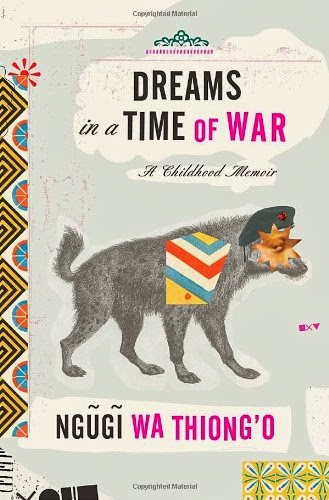
(On Wednesday, 6 November 2013, I gave the second lecture that week on Ngugi’s memoir, Dreams in a Time of War, for my first-year class at the University of British Columbia, English 111, which is an introduction to prose non-fiction, focused this year on the theme of “dislocations.” I have been developing what I want to think of as an “improvisational pedagogy,” which aims to foster as sense of engagement by trying to stage an on-your-toes critical thinking around texts, and their interpretation: the idea is to go into class well prepared, but to try and let the lecture unfold in situ, allowing the structure to emerge as you speak. When this kind of teaching works, the results (from my perspective) are really significant, and what I hope happens, right there in the classroom, is a more vital and compelling dialogue around the course material. However, this kind of improvising can also be a bit risky, in as much as it can also potentially fall apart on you. After my first lecture on Ngugi, I felt that I hadn’t brought the material together as fully as I had hoped, so I decided to script the second lecture more completely, which I did the night before, not to work at the last minute but still to preserve a few vestiges of that critical immediacy, if possible. The last paragraph of the script, along these lines, isn’t really a coherent paragraph, but consists of a set of claims about Ngugi’s memoir that I could then elaborate at that moment, which I did. Here is the script for that lecture, which I think turned out pretty well; this was intended as introduction to reading Ngugi for first-year students, not as particularly original criticism – work for which others are probably much better qualified than I am. But it does attempt to map out my own engagements with Ngugi’s texts, to model a potential critical practice for these students.)

Over this past summer, I read In the House of the Interpreter, a second recent volume of memoir by Ngugi wa Thiong’o, published in November 2012. That reading prompted me to put the first volume of Ngugi’s memoirs, Dreams in a Time of War (2010), on the syllabus for this course. As in the earlier text, Ngugi offers a first-hand account of growing up in late colonial Kenya centred on his time as a student, in the latter volume his experience at Alliance, the first high school in the region aimed specifically at educating Africans – apparently modeled on Booker T. Washington’s Tuskegee Institute in Alabama. The New York Times “Sunday Book Review” (from February 8, 2013) praises Ngugi’s second memoir for  “eloquently telegraph[ing] the complicated experience of being simultaneously oppressed and enlightened at the hands of a colonial regime.” The double-bind of an imperialist cultural pedagogy, empowering the colonized by inculcating in them a reflexive deference to the literature and values of the colonizers, is a pervasive theme of both memoirs. The earlier volume also maps Ngugi’s peripatetic early experiences at several schools, from the fostering of Gikuyu language and identity at Kamandura elementary to the often violent suppression of native culture at the “new” Manguo school. In Decolonizing the Mind, Ngugi has recounted the punishments he and his classmates received at this latter school for speaking their own languages, or for not speaking English, and he replays that infamous scene for us in Dreams in a Time of War:
In the new Manguo school, English was still emphasized as the key to modernity, but, whereas in the Karing’a Manguo English and Gikuyu coexisted, now Gikuyu was frowned upon. The witch hunt for those speaking African languages in the compound began, the consequence rising to bodily punishment in some cases. A teacher would give a piece of metal to the first student he caught speaking an African language. The culprit would pass it to the next person who repeated the infraction. This would go on the whole day, and whoever was the last to have the metal in his possession would be beaten. Sometimes the metal was inscribed with demeaning words or phrases like “Call me stupid.” I saw teachers draw blood from students. Despite this we were proud of our English proficiency and eager to practice the new language outside the school compound. (177)
It’s important for Ngugi to recognize that the key moment in the colonization of selves and minds happens in and through linguistic violence, epitomized in the sharp-edged scrawl on that metallic shard. Ngugi traces his largely innocent and even “eager” complicity – and the complicity of his classmates – in the British colonial machine (and who, after all, wants to be beaten, or wants to be labeled stupid?), but his aim is often more diagnostic than imputing. He tries to describe and to understand how this fractious doubling of self and place emerges as a cultural symptom of colonization, and he wants to lay the groundwork for evolving a set of tactics and practices with which he can negotiate with that complicity, if not somehow manage to throw it off.
         The title page of his 2006 novel Wizard of the Crowbears a one-line epigraph: “A translation from Gīkūyū by the author.” Ngugi has been practicing self-translation from Gikuyu into English since the late 1970s. There is a deeply political commitment in self-translation that emerges when we know something of Ngugi’s biography, which I am reproducing from his own website; in 1977,
Kenya’s ruling dictatorship appears to have made a number of attempts to assassinate Ngugi in the decades following his release, and his work was often suppressed in Kenya; he has written and taught in exile, principally in the United States, to the present day. While in prison, he made a statement about his writing practices that has gained wide notoriety, remarking on what he felt was a necessary turn in his work toward indigeneity and autochthony, a reconnection to a genetic sense of place:
Dreams in a Time of War begins with Ngugi’s nostalgic imaginative return to the familial – in fact, largely maternal – “oral universe of story-telling,” shared around a fire (29). Going to school, and gaining a education for which he yearns palpably, also fractures that intimate connection to home, to place: “And then I went to school, a colonial school, and this harmony was broken. The language of my education was no longer the language of my culture” (Decolonising the Mind). English, and soon English literature, produced a seductively modern scission from the vitality of the oral, from its magic:
English became the measure of intelligence and ability in the arts, the sciences, and all the other branches of learning. English became the main determinant of a child’s progress up the ladder of formal education.
Literary education was now determined by the dominant language while also reinforcing that dominance. Orature (oral literature) in Kenyan languages stopped. In primary school I now read simplified Dickens and Stevenson alongside Rider Haggard . . . .
Thus language and literature were taking us further and further from ourselves to other selves, from our world to other worlds. (taken from Decolonising the Mind)
Understanding Ngugi’s complex relationship to those “other worlds,” to globalization, is crucial to beginning to evolve a reading of his memoir that remains responsive and alert to the negotiations he undertakes with decolonization. It’s not a question, after all, of simply returning to Gikuyu; in many ways, Ngugi simply can’t go back, at least not unproblematically. His writing operates self-consciously from a position of exile, of geographic otherness. On the second page of Dreams in a Time of War, for example, he frames his hunger – as a child of poverty, he couldn’t afford lunch at school – analogically, thinking his life echoes a famous scene from Oliver Twist (“Please, sir, can I have some more?”), which, he says, he had read in an “abridged version” at school: “I identified with that question; only for me it was often directed at my mother, my sole benefactor, who always gave me more whenever she could” (4). The literature of forced displacement is also the literature of analogic return to the maternal hearth, to earthy genetics. The book opens, in fact, with a reflection on reading (“years later”) the opening line of T. S. Eliot’s The Waste Land, but Ngugi hears not only an arbitrary mimicry of the name of a colonial Kenyan governor, Sir Charles Eliot, but also the impossible echoes of a day in April 1954 in his hometown of Limuru, when his elder brother Good Wallace, a Mau Mau partisan, escapes police custody. Highbrow, canonical Anglo-American literature is reappropriated by Ngugi’s personal Gikuyu imaginary, and converted into raw material for popular local story. In his Wellek Library lectures published in 2012 as Globalectics: Theory and the Politics of Knowing, Ngugi describes this re-appropriation of canon (itself framed by a reference to an exiled maverick of African-American literature, the novelist James Baldwin) as a necessary step for re-entering the debate – the dialectics, as he suggests (compare Marjane Satrapi’s Persepolis, Marji’s comic book “Dialectic Materialism”) – that not only surrounds but actually informs the decolonizing self, a self not so much translated as continuously translating, negotiating its own terms:
This post-colonial catholicity – a kind of troubled but widely various universalism, perhaps a “humanism of the other” as one philosopher (Emmanuel Levinas) suggestively puts it – manifests itself in Dreams in a Time of War as young Ngugi’s enthusiasm for the poetic magic of words, both Gikuyu and English; “one day,” he writes, “I am able to read on my own the Gikuyu primer we used in class”:
I can hear the music. The choice and arrangement of the words, the cadence, I can’t pick any one thing that makes it so beautiful and long-lived in my memory. I realized that even written words can carry the music I loved in stories [. . .] (64-65)
Gikuyu transcribed in Latin-European orthography promises a return to that enlivening maternal hearth, but that return is only enabled by the acquisition of a literacy proffered by colonial culture. Biblical passages – re-purposed chunks of Christian liturgy – are also almost as resonant for him: “I committed . . . whole passages to memory. They were poetic. They were music” (69). Ngugi seems to unpack an Afrologicalcadence, a rhythmic sense, even from Western European literatures; they sing in his ear, in a manner that recalls Karen Blixen’s seduction by the landscape and culture of Kenya in the early pages of Out of Africa: “When you have caught the rhythm of Africa, you find that it is the same in all her music” (24). But for Ngugi, the point isn’t to parody the kind of cultural safari in which Blixen engages, trying to catch a vitality from that world that promises her some “magnificent enlargement of all [her] world” (25). The enlargement entailed by colonial modernity certainly catches up young Ngugi in its whelming sweep, but the cadences he uncovers in his languages, in translation, wants to reverse that flow, to push back at it, and to open other spaces.
         More often than not, that oral creativity finds itself beaten down or overwritten by imperialist literacies; space for articulating shared connections to place, to ground oneself, is not always made within the written, but is instead undone by it, as in the case of the double-sale of Ngugi’s father’s land. (See page 19.) The Gikuyu, by Ngugi’s account, are forced to re-appropriate resources, to squat, to inhabit their own spaces simultaneously as outsiders and native and to make subversive use of the scraps and shards of economic modernization, of globalization. Consider Ngugi’s description of how he and his brother constructed their own skewed version of a wheelbarrow, which they then market back to those in power – metonymically, the landlord’s children. (See pages 52-55.) His description of his circumcision (pages 196-203) counterpoints cultural inscription on the body – a Gikuyu ritual of initiation into the community of manhood – with the modern work of education, of self-writing. How are bodies tied to place, and how are they sites of displacement, of translation, of debate? Conflicting accounts of the Lari massacre (pages 180-81) seem aptly to frame, for Ngugi, the ironies – which he’ll later start to spin into dialectics, generative conflicts – of colonial discourse. And finally, Mzee Ngandi’s recounting of Jomo Kenyatta’s 1952 courtroom speech offers us, through the added filter of Ngugi’s memory, an instance of the creative misprisions and re-appropriations of story-telling, as the oral and the written collide and reshape one another. (See page 187 on.) This section concludes by giving the memoir its title, and suggesting something of the expansive power not simply of myth but of myth-making that Ngugi wants to take on in his own creative writing (195).

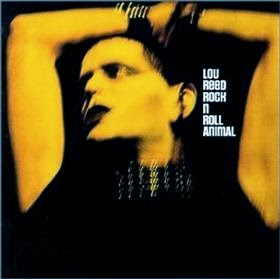
Without Lou Reed Around

Here’s a short tribute piece, an elegy that came together quickly earlier this week – a small offering from a listener, in memory of.
Without Lou Reed Around
Without Lou Reed around
         the real world starts to feel
under rehearsed.
Without Lou Reed around
you’re going to get away
with less.
Without Lou Reed around
you’ll find out how much noise
those one-chord wonder boys won’t throw your way.
Without Lou Reed around to set you straight
you’ll wish you’d paid
a lot better heed the first time.
Without Lou Reed around
bootworn floorboards ought not
to rumble like the trashed cones of blown subwoofers.
Without Lou Reed around
any silk-screened bananas
on leftover album covers will likely turn brown.
Without Lou Reed around
dog collars and lampblack lipstick
become a hard look to pull off.
Without Lou Reed around you’ll never know
whatever else it was you once
needed to know.


Short Conditional Take on Anne Carson

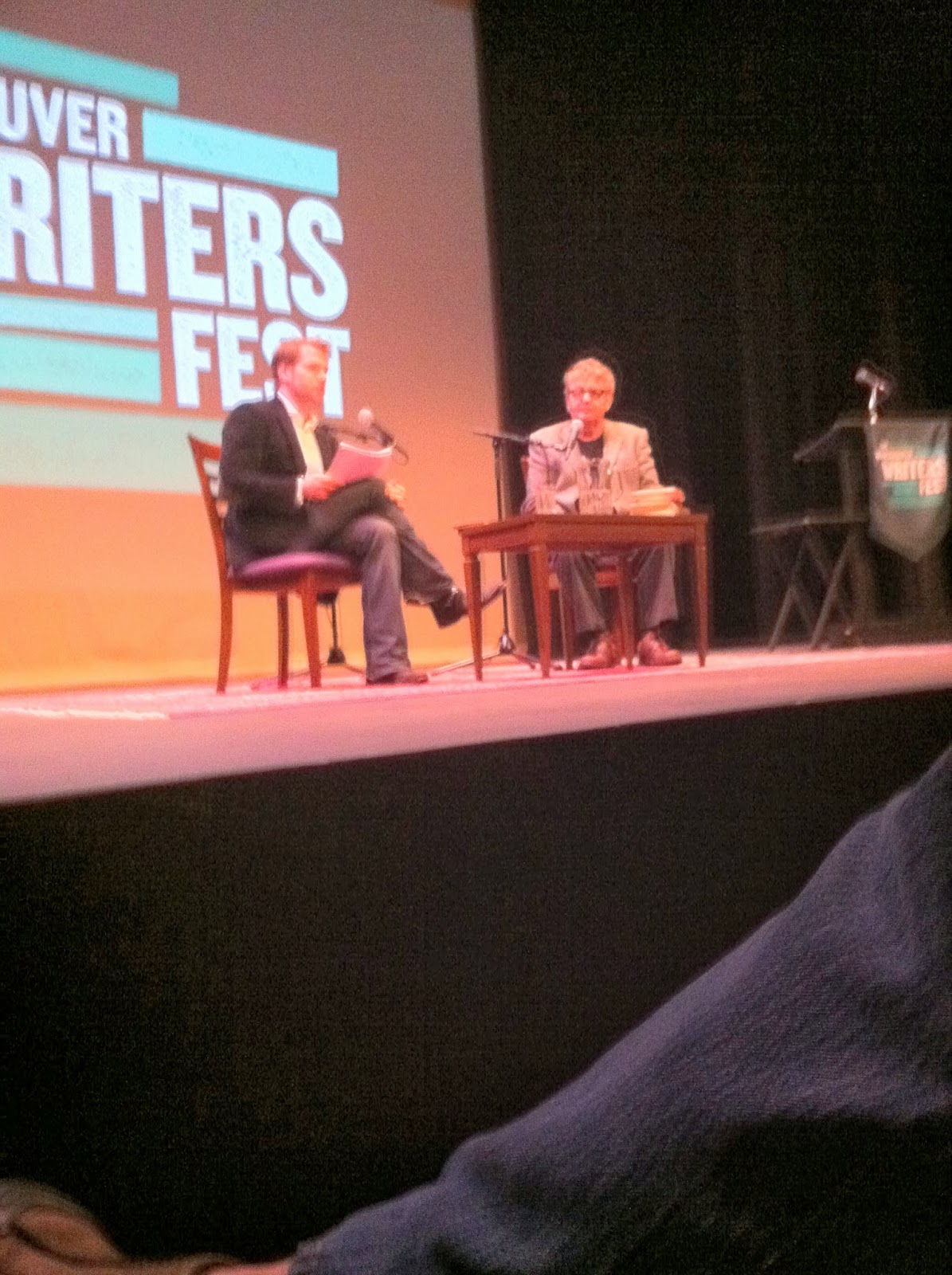
If I attended “An Hour with Anne Carson,” at the Vancouver Writers Festival yesterday.
If Aislinn Hunter introduced her, using the unlikely but nifty words “betweenity” (purloined from the Brontës’ letters, she said) and “blacksmithery” (source unclear).
If Aislinn Hunter spoke of Anne Carson’s writing’s “fierceness, a fearlessness framed in exquisite craft.”
If Anne Carson then said she had never had an introduction that used the words “betweenity” and “blacksmithery.”
If her miked voice had what seemed to me to be intensity in restraint.
If Anne Carson said she was glad to be back in Canada if only to get a proper bran muffin.
If she then read an essay written in a kitchen in Ontario in winter.
If it was called “Merry Christmas from Hegel,” and if it was, post Nox, a meditation on stillness.
If she admitted, perhaps untruthfully perhaps not, to not understanding Hegel.
If she said she will paraphrase Hegel badly.
If the essay described, with what seemed to me to be aching restraint, what she called “snow-standing” amid the stillness of conifers.
If the text only mentioned Hegel briefly.
If she wrote something like, “The world subtracts itself in layers.”
If she also described that subtraction as something like, “shadow on shadow in precise velocities,” which might be an image of Hegelian negation.
If she said afterward that she wouldn’t be able to answer any questions about Hegel.
If people applauded because it was a beautiful essay and her reading was very beautiful.
         If she then read an essay on a painting by Betty Goodwin.
If the essay was called “Betty Goodwin Seated Figure with Red Angle,” and if it was written for an issue of Art Forum.
If the right title is “Seated Figure with Red Angle (1988) by Betty Goodwin (by Anne Carson).”
If Anne Carson said, “The form is kind of whacked out.”
If by form she meant her essay not the painting.
If she also said that she wanted to find a form or a syntax that suited her own inability to have an opinion about Betty Goodwin’s painting.
If she never said, Ut pictura poesis.
If the form she chose was to write the whole thing in conditionals, seventy-three of them she said, including mention of horses and Freud, each of the seventy-three beginning with the word “if.”
If the idea was to open up to the sentence “the space in your mind that is prior to opinion.”
If I heard in her sense of “opinion” what Plato calls pistis, “belief,” a subordinate form of doxa, “opinion,” but she did not say this, and I may be both pretentious and wrong.
If she said her conditional essay “was fun to do but will be intolerable to listen to.”
If no one believed her when she said this.
If it wasn’t intolerable, not at all.
If she wrote, “If body is always deep, but deepest at its surface.”
If this made me think.
If she also wrote, “If artists tell you art is before thought.”
If by that she meant Betty Goodwin specifically, but I also took it to mean herself.
If everyone applauded again because she was wryly brilliant and provocative.
If she went on to read from Autobiography of Red and red doc>.
If there was more heartfelt applause.
If she took a bow.
If people asked her questions.
If she took another bow.
If she autographed my book, “Respectfully, AC.”
If I could thank her.

Short Take on Paul Muldoon Talking, a Précis

Paul Muldoon was interviewed by John Freeman on stage at the Waterfront Theatre at the Vancouver International Writers Festival this afternoon, and he’ll be reading as one of eight poets at the Poetry Bash tonight at Performance Works on Granville Island. He was asked right off the bat to talk about his collaboration with Warren Zevon, which resulted in a song, “My Ride’s Here,” the title track on Zevon’s last record (and was then covered for a posthumous tribute album by none other than Bruce Springsteen). Mr Muldoon said he “kind of went to school with Warren Zevon,” noting “just how difficult it is to write a song” to make it sound so effortless, and praising Zevon’s genius. He found himself, in composing his lyrics, trying to locate a raw, emotional “angle of entry” into a song. Asked to differentiate between poetry and song, he said:  “I suppose at some level the pressure per square inch in that [Muldoon’s lyric, ‘You Say You’re Just Hanging Out . . .’] isn’t quite what it could be in one of the poems.” At the same time, he said how he wants to realize his own desire for directness and clarity, which lyrics can so better “at some level.” He said he was still “struck by Seamus Heaney’s (I think) successful attempts to pick up Yeats’s suggestion that ‘Myself I must remake,'” and also declared that “poems are more evidently (not necessarily more truly) made out of the core of one’s being.” He described the impact of BBC radio on his desire for clarity and “the need to be direct.” At John Freeman’s request, he read “Wind and Tree” from his first collection: “In the way that most of the wind / Happens where there are trees, / Most of the world is centred / About ourselves.” He read from Madoc, noting as well that he was a “big fan of our friend Laurence Sterne” and how he had also derived a “fascination with lists” from Robinson Crusoe, Defoe’s interest in “stuff.” He said he encouraged his students to develop “a sense of the resonances of every word in a poem,” the specificity of language. He read his song-lyric, “Elephant Anthem,” and noted how he used to pore over lyrics printed on lp sleeves.

Teaching Literature in the Time of the MOOC (Audio)

Here is an audio capture of my part of a colloquium session for the University of British Columbia Department of English Faculty Research series, which took place in the afternoon of Friday, October 18, 2013, on “Teaching Literature in the Time of the MOOC.” I co-presented with Jon Beasley-Murray. (There are a few glitches – I inadvertently call Dave Cormier “Eric” – so I have included a script for the talk below. I truncated the long quotations when I presented. The gain on the recorder was also set a little high — my apologies for any clipping. Jon’s portion of the session can be found here.)

The past year has seen massive and radical shifts in the practice and delivery of higher education, particularly around the emergence of the MOOC, the “Massive Open Online Course,” adopted and (as of January 2013) offered for credit through many prominent North American and Australian universities. While some commentators continue to suggest that educators are over-enthusiastically caught up in surging hype around the technologizing of education, hype that will soon deteriorate into backlash, it has become clear that the MOOC represents much more than a passing trend. It signals a fundamental change in the cultural and pedagogical mission of the university – in what constitutes a university, and what constitutes university education, in our time. I, we, believe it is vitally important for academics – not just administrators, not just early adopters, not just those in the managerial echelons of an emerging knowledge economy, but particularly academics in the critical humanities – to address and to interrogate the implications of this change. Because of the velocity of these ongoing renovations to the form and substance of higher education, we need to do more than act as latecomers or followers, to be more than epigone adopters. Bluntly put, our job descriptions are changing, with or without our direct input and even our consent, and it is vital that we find the means, as both pedagogues and scholars, to contribute not only to managing but also to shaping the direction and structure of these nascent developments.

I don’t want to position myself as anything like an expert. Frankly, it’s too soon in the arc – I won’t say history, not yet – in tracing the developmental arc of media-savvy pedagogies for anyone but a few originators to lay claim to expertise, and even then there seems to me to be something endemic to these kinds of digital humanities, something inherent in what has come to be called connectivity, that wants both to exploit and to refuse cults of expertise, cults that have also largely tended to be understood as the provenance of a professoriate. I’m still under the sway, myself, of Paolo Freire’s critique of what he called the “banking model” of education, and I think I share his thorough suspicion of the cultural privilege of expertise. But rather than offer any materially rigorous critique of the economics of knowledge production and dissemination, I’m going to stick to a critique of the MOOC at the level of metaphor, something I feel like I can do with some confidence in my own method. It’s how I work, in my own field, as I understand it. But I want to be clear that I’m thinking of what I’m proposing today, briefly, as gestural and provisional, as a small contribution to a workshop rather than as a definitive or in any way exhaustive reading of the MOOC in our time, in its time.

I should offer at this point a potted history of the MOOC, although in a spirit of appearing to let shallow précis pass for knowledge, I have to defer to Wikipedia, which does a much better job than I ever could at condensing the last four or five years of MOOC history and at naming the significant names. Wikipedia – and Jon can tell you better than I can – in some very telling ways epitomizes the networked, editorial crowd-sourcing that is currently tending to replace expertise in this contemporary educational episteme, the time of the MOOC. So, go read Wikipedia, and find out something about Dave Cormier, George Siemens, cMOOCs, xMOOCs, Coursera, EdX, and the whole whelming business. In a November 2, 2012, article on Education Life, New York Times correspondent Laura Pappano dubbed 2012 “The Year of the MOOC,” lending an epochal weight to a phenomenon that is, I’m willing to argue, almost without a history, and even without history.

So what does a MOOC have to do with time? I want to gesture at two key aspects of generalized MOOC temporality, both of them catachrestic: packeting and velocity. As one among many formations in the current digitalization (as opposed to the digitization) of knowledge, MOOCs imply a mediated phenomenology, a specific set of experiential markers keyed to time management – or to a common figure in MOOC syllabi, a figure that I’m going to suggest manifests as generic course content around learning outcomes a technological latency, the data packet. For example, Jennifer Shoop’s current syllabus for “English 402: The Poetry of John Milton,” a MOOC from saylor.org, has a detailed segment on “Time Commitment,” which is distinctive to on-line pedagogy:

Time Commitment: This course should take you a total of approximately 73.25 hours to complete. Each unit includes a time advisory that lists the amount of time you are expected to spend on each subunit. These advisories should help you plan your time accordingly. It may be useful to take a look at these time advisories and to determine how much time you have over the next few weeks to complete each unit, and then to set goals for yourself. For example, Unit 1 should take 6.5 hours to complete. Perhaps you can sit down with your calendar and decide to complete subunits 1.1 and 1.2 (a total of 3hours) on Monday night; subunits 1.3 and 1.4 (a total of 6.5 hours) on Tuesday night; etc.

The precision suggests an empirically obsessive scientism, but also a desire to lay out student commitments with as much transparency and accuracy as possible. Al Filreis’s “ModPo,” a “fast-paced” and much more loosely orchestrated MOOC from UPenn on “Modern & Contemporary American Poetry,” still lays out participant time commitments (“Workload: 5-9 hours/week”) and offers some proleptic feedback in an FAQ on course velocity:

You say the course is “fast paced.” Will it move too fast for me?
ModPo is “fast paced” because we will not spend long on any one poet. This is a “survey” course — covering many poets with the objective of conveying a sense of poetic movements and trends. We will study only a few poets in any depth (Dickinson, Williams, Gertrude Stein, John Ashbery) but otherwise during each week we will typically talk about poems by three or four or even five different poets.

A sense of depth is sacrificed for coverage, and the learning outcomes are accordingly adjusted, offering gestalt in lieu of detail. Finally, the extensive course matter around Gregory Nagy’s HarvardX MOOC on the Ancient Greek Hero in 24 Hours explains at some length how pace and segmentation interconnect, a pedagogical strategy as well as a gesture at the temporality of his subject-matter, particularly the Homeric epic. Indeed, of all of the MOOC syllabi I have tried to encounter so far, Nagy’s is the most reflexively sophisticated, and conveniently provides me with something of a test-case for an informed critique of the humanities MOOC.

In an article from The New Yorker earlier this year, Nathan Heller seems to think so too, spending considerable column-length on Nagy’s HarvardX course, and its time-demands:

Nagy has been experimenting with online add-ons to his course for years. When he began planning his mooc, his idea was to break down his lectures into twenty-four lessons of less than an hour each. He subdivided every lesson into smaller segments, because people don’t watch an hour-long discussion on their screens as they might sit through an hour of lecture. (They get distracted.) He thought about each segment as a short film, and tried to figure out how to dramatize the instruction. He says that crumbling up the course like this forced him to study his own teaching more than he had at the lectern.

Presuppositions about attention span and attentiveness push Nagy to “crumble up” and parcel out his material, but I’d like to assert that what’s happening here isn’t so much an effect of his students’ shrinking cognitive capacities, but rather the impact of the structural informatics of media-dense teaching. He’s creating analogues on his students’ screens to the data packets – as distinct, though not entirely so, from the packaging or commodification of information – into which his texts and videos must be divided in order to disseminate efficiently across a network. Data packets are essentially arbitrary segments (blocks, cells) of bits and bytes, of data, into which a text, for instance, must be materially fractured if it is to be transmitted effectively. The process of packet-switching involves a horizontal leveling of parceled information to facilitate exchange across a dimensional (as opposed to linear) network; in a way, you could imagine one of Nagy’s students ranging in an anti-linear fashion through the welter of text, video and assessment tools that make up his MOOC, although that movement is still governed by a broadly linear rhetoric – at least a rhetoric, if not a teleology – of progress and completion, of sectional and totalized learning outcomes.

Efficiency, as a hallmark of good tech, of vibrant network and of functional pedagogy, is tied to velocity or pace, the re-assemblage and the intake of cultural knowledge – in Nagy’s case, of Homeric epic and Sophoklean drama. The trick to success in his course in particular, he suggests, is learning to manage and to adjust your rate of reading, to accelerate and decelerate modes of critical attention. There is, frankly, way too much material on Nagy’s syllabus, as there is on Filreis’s. I have to confess that I signed up for the Nagy MOOC – drawn by the promise of some sort of close-ish link to the cult of expertise that accretes around Nagy’s work on Homer. And I flunked it, mostly because I just didn’t have time to do the reading or to complete the multiple-choice and short-answer assignments. It’s reading, of course that I have done before, for the most part, so that shouldn’t have been a problem, but there is a density of information – something keyed to what I’d like to think of, analogically again, as bit-rate compression – that was frankly overwhelming, particularly as spare-time or extra-to-load reading. Nagy insists in the descriptive matter he writes about how to take up his assigned coursework, that students need to learn different velocities of reading, from fast to slow; the second is privileged, as a mode of close attention that Nagy develops from his own take on Friedrich Nietzsche’s Homeric philology. (I hope you’ll pardon the extensive quotation.)

So what do I mean when I say slow reading and fast reading? Let me explain briefly, starting with slow reading in §5A and then moving on to fast reading in §5B. For the reading of the following paragraph, §5A, you will have to slow down and take more time. For the reading of the paragraphs after that, §5B, §6, §7, §8, and the Appendix, I hope you will feel free to speed up again.
§4a. So here is the paragraph that needs to slow you down until you have finished reading it (and this paragraph includes the moderately long quotation that you see ahead). Please give yourself about five minutes. That said, let me delve into it. When you do slow reading in this course, you have to slow down and give yourself time to stop and think about what you are reading. You have to do this even if you feel at first that you simply do not have the time to do this. You have to develop a sense for feeling that you really do have the time to stop your reading and to think about what you have just read, allowing yourself to make connections with what you have read earlier. Some people think that philology is the “art” of such slow reading. Friedrich Nietzsche was one of these people, and he compared the “art” of this “philology” to the art of the goldsmith:
“Philology is that venerable art which demands of its votaries one thing above all: to go aside, to take time, to become still, to become slow – it is a goldsmith’s art and connoisseurship of the word which has nothing but delicate cautious work to do and achieves nothing if it does not achieve it lento. But for precisely this reason it is more necessary than ever today; by precisely this means does it entice and enchant us the most, in the midst of an age of “work,” that is to say, of hurry, of indecent and perspiring haste, which wants to “get everything done” at once, including every old or new book: – this art does not easily get anything done, it teaches to read well, that is to say, to read slowly, deeply, looking cautiously before and aft, with reservations, with doors left open, with delicate fingers and eyes.”
In closing, let me highlight one big change I made in the translation I just quoted: the translator had written “with delicate eyes and fingers,” but Nietzsche in the original German text mentions fingers first and eyes second – in order to drive home his comparison of philology with the art of the goldsmith: when you read slowly, you read with a sense of touch – with “delicate fingers and eyes” (mit zarten Fingern und Augen). We see here an example of reading out of the text instead of reading into the text (I will define these terms in §8).
Now that I am finished with this paragraph, please feel free to go back into a mode of fast reading.

Such Nietzschean tactility feels anathematic to a largely tactless and intangible internet. The manual control of the eye, its kinesis across the liminal surface of a screen, seems to be a transplanted version of formalism or of the deconstructive “slow reading” practiced, or so he says, by J. Hillis Miller. Nietzsche, it sounds like, wants you to run your finger over the paper, tracing each line. But the tactility of translucent fonts is both metaphorical and – despite the existence of the touch-screen and the new Windows touch, say – at best a feint. Stopping to think, rewinding a video, going back over a passage are all embodied reactions, all reading tactics, that have nothing inherently to do with electronic media. Rather, Nagy is cautiously attempting to return something of the material character of the book – of the manuscript, of “hand-writing,” in fact – to a multifunctional medium that fractures, compresses and accelerates. Yet rewinding, as Laura Mulvey reminds us, is a temporal trait – a gestural inversion of what Vladimir Jankélévitch characterizes as time’s essential irreversibility – that remains specific to cinematic media, from videotapes and DVDs to the YouTube videos. The time of the MOOC – that is, broadly understood, its temporal episteme – has everything to do with shaping and managing these recursions and inversions, with stopping and starting, with packet-switching and shifting velocities. In 1993, Paul Virilio asserted with dire conviction that

With acceleration there is no more here and there, only the mental confusion of near and far, present and future, real and unreal – a mix of history, stories, and the hallucinatory utopia of communication technologies. (The Art of the Motor 35)

I want to start to claim here, pace Virilio’s warning, that we need to think carefully about how the anxieties around mass connectivity and the knowledge economy, anxieties that are for me essentially temporal in character, don’t so much impel us to withdraw nostalgically into a world of letters and paper, but help motivate is to address (say, through a more careful interrogation of something as seemingly incidental as metaphor) what it means to teach literature, and what literature and reading might become, in an era when something like a MOOC is even conceivable, let alone a cultural and educational destiny.

Audio: Carnets de Routes Improvisées

Here is an audio capture of a paper I delivered on Thursday, September 5, 2013 at the Colloquium of the Guelph Jazz Festival, which took place at the MacDonald Stewart Art Centre at the University of Guelph. It’s called “Carnets de Routes Improvisées: Transcultural Encounters in the work of Guy Le Querrec and the Romano-Sclavis-Texier Trio,” and, like the title says, it connects a number of recorded improvisations by a European trio around the African photography of Magnum photographer Guy Le Querrec to certain concepts of decolonization and latter-day ethnography. I try to suggest, in a limited utopian vein, how viable transcultural encounters might be realized through improvisation – not only musical, but visual as well. I also refer to the compelling historical work of Julie Livingston around biomedical practices in southern Africa, particularly her book Improvising medicine: An African Oncology Ward in an Emerging Cancer Epidemic (2012). This paper formed part of a two-person panel on media and transculturalism; the other presenter was Alan Stanbridge of the University of Toronto. The moderator for the session, whom you can hear offering an introduction at the beginning of this recording, was Nicholas Loess.
Here is the abstract for the paper:
Sponsored by French cultural institutions, the improvising trio of clarinetist Louis Sclavis, bassist Henri Texier and drummer Aldo Romano formed in early 1990 to undertake a tour of central Africa, including performances in Chad, Gabon, Congo, Cameroon and Guinea. Other tours would follow in 1993 and 1997. Despite both appearance and funding support, this group wasn’t engaged in officially-sanctioned cultural promotion, but had been conceived as an artistic and cultural project by Magnum photographer Guy Le Querrec, who appears to have wanted to chronicle in images the encounters of European jazz musicians with mostly rural African audiences. Le Querrec had already taken numerous photographic trips to North Africa—in 1969-71, 1978 and 1984, for example—trips that had produced significant images in his portfolio concentrating on both the troubling appropriations of ethnographic image-making and the complex challenges and impediments to transcultural understanding. His work with the Romano-Sclavis-Texier trio, now seen in retrospect, constitutes a deliberate post-colonial cultural intervention, a re-engagement by both aesthetic and documentary tactics in parts of the world from which colonial France had withdrawn. Le Querrec curates this particular tour of leading voices in French free jazz—he is listed on the recordings as a fourth member of the trio, not merely as a courtesy but as an active if tacit participant in the performances—for two main reasons. First, Le Querrec is one of the preeminent jazz photographers in Europe, and several of his collections centre on historic images of canonical jazz musicians. A 1997 show in Paris saw musicians (including Texier and Sclavis) improvising to projections of Le Querrec’s work; the show’s title, Jazz comme un Image, suggests how closely Le Querrec links his photography to improvisational musical (and visual) practices, a connection he further clarifies in an artist’s statement for the performance:
Être jazz c’est avant tout une manière de vivre, de se promener sur le fil du hazard pour aller à la rencontre d’un imaginaire qui contient toujours l’improvisation, la curiosité, qui oblige à écouter les autres, à les voir, à être disponible pour mieux les raconter en manifestant sa propre poésie.
This complex sense of likeness, at play in the overlap between rencontrer and raconter, to encounter and to give account, traces itself back in the context of French colonialism and ethnography to the Dakar-Djibouti expedition of 1931-33, and particularly the poetic-documentary writing of Michel Leiris in L’Afrique fantôme and L’Âge d’Homme, the latter of which in particular focuses on the Afrological substrata of jazz. Second, both the trio’s music and Le Querrec’s photography investigate the give-and-take, the tensions between re-appropriation and creative misprision inherent in this jazz-based transcultural model. The music on the three compact discs released by the trio (Carnet de Routes, 1995; Suite Africaine, 1999; African Flashback, 2006; each accompanied by booklets collating Le Querrec’s photographs from their 1990, 1993 and 1997 tours) does not come from their live performances, which seem (apart from the photographs) to have gone undocumented, but consists of recordings in a French studio after the tours were done, improvised reactions to the photographs as well as compositions that emerged from their African experiences. The “poetry” of imaginative encounter that Le Querrec describes is enacted musically (and even visually) in the extemporaneous negotiations of difference, and the creative troubling of Eurocentrisms, that these improvisations offer. Rather than reproduce the exoticism and even nostalgia that shapes late colonial, modernist ethnography, these audio-visual “records” investigate performatively how a transculturalism of shared differences, a contingent community of unlikeness, can be brought extemporaneously into being.

Philip Glass and Kronos Quartet: Music is a Place

Last night Christina and I attended “Kronos at 40,” a sold-out concert by Kronos Quartet at the Chan Centre at the University of British Columbia celebrating the string quartet’s 40th anniversary as a working unit. The programme, a gathering of contemporary work and commissioned arrangements of folk and roots music, was fairly typical – if anything Kronos does can be said to be typical – of what has become the quartet’s cultural mission: a strong commitment to fostering new, sonically-arresting, cutting-edge composition and to disseminating those often challenging soundscapes to as wide an audience as they can draw. That commitment was powerfully evident last night, for me, in the taut rhythmic virtuosity that each member of the group – David Harrington, Hank Dutt, John Sherba and new cellist Sunny Yang – brought to every piece they played. Whatever a composer’s method, approach, aesthetic, they were on it, utterly and unflinchingly. And after forty years, absolutely nothing about their energy, enthusiasm or dedication to all kinds of new music has diminished.
         Highlights from last night’s performance included a brief but wonderfully nuanced version of an arrangement by trombonist-improviser-composer Jacob Garchik of a blues by the little-known Geeshie Wiley, “Last Kind Words.” The unresolved subtleties and the powerful timbres of Wiley’s voice that ghost through the song’s surface-noise-laden original recording (from around 1930) are translated by Garchik into gently interlacing dissonances across a palette of strings, with Harrington’s violin taking a kind of vocal lead, weaving in and out of the other lines with a give-and-take that offers a present-day mirroring of the collaborative call and response of traditional African-American form. It worked brilliantly, I thought.  There were fine arrangements, too, of Iranian, Ottoman and Jewish songs, as well as electronically- and instrumentally-augmented compositions by Canadians John Oswald and Nicole Lizée, and by Serbian-born Aleksandra Vrebalov. They played three encores, arrangements of Greek and Columbian melodies and a killer version of what was has been their signature piece, Jimi Hendrix’s “Purple Haze,” complete with light-show and rumbling feedback: they rocked the house, really.
         The centerpiece of the concert was the world premiere of Philip Glass’s String Quartet No. 6, commissioned for Kronos’s 40thanniversary, as (according to the composer’s notes) “the most recent result of a long and ripening friendship between myself and the Kronos Quartet.” Before the concert, Eleanor Wachtel interviewed Philip Glass on stage at the Chan; the interview was being recorded for broadcast, she said, on CBC Radio on November 19, on Ideas. Their conversation concentrated on Glass’s history of collaborating with Kronos and with filmmaker Godfrey Reggio, particularly Glass’s soundtrack to Reggio’s The Visitors, but Glass also talked – very warmly and personably – about his own aesthetics, and his compositional style. He noted how Kronos’s “love and dedication” to the form “were unparalleled,” and said that the string quartet as a genre could create the “most intimate expression of a composer’s work,” allowing for “a maximum of density and clarity at the same time.” The quartet is “a prism through which the light of music can shine and be broken into colours.” He also noted how he has a difficult time extricating himself from the aural world of his music, of hearing his compositions – such as this new string quartet – from an objective outside: “I’m probably the person who knows least about what they sound like.” He also said he has been concerned with thinking about “where music comes from,” with “what music is,” and has decided that “music is a place . . . a real place,” defining “a consensual reality” that can be inhabited in composing and performing: in music, we become “citizens of the same country.”
         His String Quartet No. 6 opened a door into that place. The performance was about half an hour, and consisted of three movements, at tempos (maybe allegro -andante – allegro) creating a kind of envelope or frame that seemed to reflect a classical formalism; Glass mentioned Haydn in his earlier remarks, and there is something of Haydn’s structural symmetry carried forward in Glass’s writing. Glass also referred to the dynamic feel of Bartok, and it’s important to recognize that this sixth quartet also enacts a certain loosening in its textures, particularly around the dynamics; the hurried contrapuntal minimalism of his early work is moderated in this work into waves of surge and release, which Kronos managed brilliantly. In the third movement, I thought I kept hearing echoes of MGM-style film music, but afterward Christina told me she thought those were traces of Aaron Copland’s folk idiom and I think she was right – whether Glass intended these echoes or not, the work communicates a sense of a late Americana that is both moving and engrossing. It was a true privilege to be able to hear this music, and to hear Philip Glass speak. 

Short Take on What I Like Most about The Avett Brothers
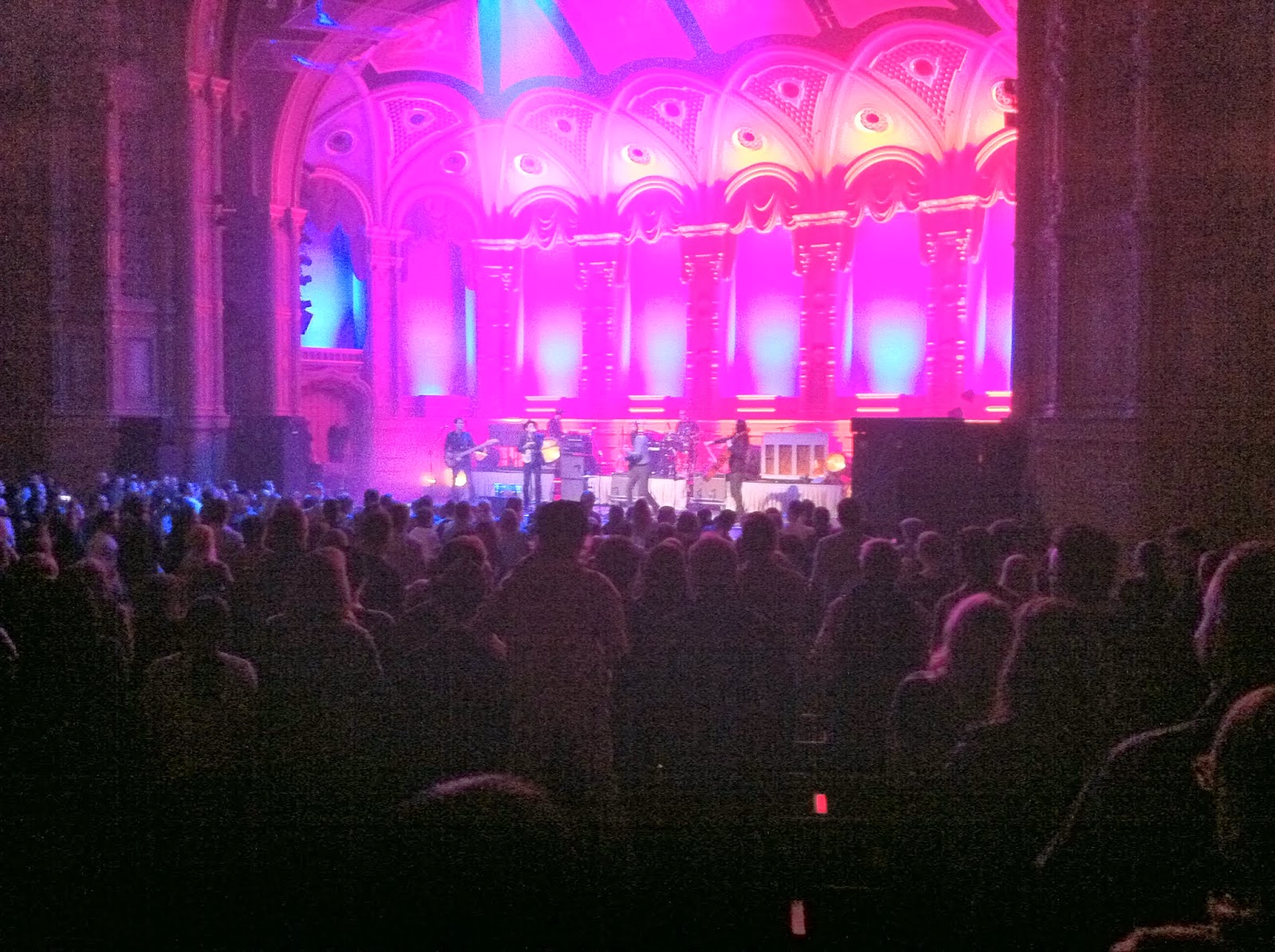
Go back a little more than a year and a half ago, and I hadn’t even heard of The Avett Brothers. My wife had started listening to their music on the recommendation of a friend, and she found something they’d done earlier on for NPR, maybe a Tiny Desk Concert. I’ll have to look this up. Within a few days, and after a few repeat listens, she was definitely hooked, and so was I. We bought and/or downloaded a stack of their albums, and their tunes were on heavy rotation on the stereo. Their sound is obviously based in Carolina roots music and bluegrass; their core instrumentation – to which they strip down in concert, or else around which they build their band – is a trio of banjo, acoustic guitar and upright bass, played by Scott and Seth Avett and Bob Crawford. Joe Kwan’s cello has also added a key texture to their aural palette since the early days of the group’s existence, and when they perform the four of them tend to position themselves in a line across the front of the stage, Seth and Scott at the centre, flanked by the other two.
         We were given tickets to an Avett Brothers concert in June 2012, when they appeared as a headliner for the TD Vancouver International Jazz Festival. (Their music has little to do with mainstream jazz, apart from a few commons threads in Americana and the blues, but most jazz fest programmers these days rely heavily on non-jazz acts to bouy up revenues and draw in audiences. I actually ended up missing a Wayne Shorter gig to hear their show, but it turned out to be worth it.) We had great seats, a few rows from the stage. From the moment they hit, the energy in the house was through the roof. This was a couple of months, I think, before the release of The Carpenter, and they were testing out some of the more rock-oriented material from that album. It was my first experience of them live, and I have to say that I was unprepared for the exultant, keen and impassioned drive of their performance. They blew us wholly away.   
         In a recent interview in Rolling Stone, Scott, Seth and Bob talked at length about the band’s evolving sound, positioning them amid what Scott calls “the changing form of somewhere between rock and country and folk.” They refer back to a phrase coined by Scott – “young wonderment” – to describe the tenor of many of their lyrics, their music’s message maybe, but “young wonderment” also encapsulates the impact of their performances on an audience. There are certainly moments at an Avett concert of entrancing delicacy, something of “sparkly-eyed” grace and artful “shine” that their songs often both embrace and disparage: it’s what they want to make happen, but they also articulate a suspicion of being taken in by it, seduced by phony glitter and stagecraft. Still, despite the relentless apologies and self-recriminations in those songs – the admissions of failure and loss that seem pervasively to inform their writing – their performances take up a genuinely hopeful and affirmative trajectory. The youthfulness to which Scott refers isn’t a nostalgia for innocence or naïveté but a raggedly passionate energy. On Thursday night, seeing them for a second time at the Orpheum in Vancouver, I could feel the force of their convictions, their belief in what live music could accomplish. They jumped and thrashed, they caressed and kicked, they stroked and stomped. Sometimes rough, sometimes intimate, they drew from their twangling instruments a tangible sense of commitment, of being right here, in the moment, that moment, giving it whatever they could. The wonderment of the Avett Brothers has nothing to do with passive awe or amazement and everything to do with vitality and vigour, a fierce and embodied poetry. One review noted the “joyful buzz” they produced in the audience emerging onto the street after the show had ended. That feeling, that liveliness, the life-force they and their music seems to offer us as a gift, keeps going.