Flow, Fissure, Mesh

Home » Articles posted by kevinmcneilly (Page 9)

Author Archives: kevinmcneilly

Audio: Nicole Markotić and Louis Cabri at Play Chthonics

Nicole Markotić and Louis Cabri read at Green College at the University of British Columbia last evening, as part of the Play Chthonics: New Canadian Readings series. This is an audio capture of their reading. They each offered new work, as well as material from recent collections: Cabri’s Poetryworld(CUE, 2010) and Markotić’sBent at the Spine (BookThug, 2012). (There’s a reviewof Bent at the Spine from rob mclennan’s blog; a review of Nikki Reimer from an April 2010 edition of The Globe and Mail might give some sense of Markotić’s poetics. Louis Cabri has an essay, “Unanimism and the crowd: Early modern social lyric,” in a 2011 issue of Jacket 2 that suggests some of the ways in which he combines poetics with critical-theoretical work.) They also took questions about their poetics. Thanks to both of them for their excellent, engaging readings. The recording, like the one from September also linked to this blog, is fairly vérité, with some air-vent noise in the background, but the voices come through very clearly. The introduction is by Andrew McEwan. Copyright remains with the authors. Sincere thanks to Green College for hosting this event and for providing generous support for the series, and also to the UBC Department of English.

Audio: A Lecture on Kathleen Jamie’s “Fever” and “Surgeons’ Hall”

Here is an audio capture of a lecture I gave on Wednesday, October 16, 2013, at the University of British Columbia, on two essays by Kathleen Jamie: “Fever” and “Surgeons’ Hall.” Both come from her 2005 collection Findings, which I’m using in my section of English 111, a first-year introduction to the study of nonfiction, to provide a set of thematic and conceptual anchor-points for the course. In the lecture, I focus on Jamie’s sense of the limits of language, of the intersections of body and text, on the concept of intersubjectivity, and on trying to understand the page as a porous membrane.

Our Alice Munro

Most Canadian readers must be over the moon about Alice Munro, who was awarded the Nobel Prize for Literature last week. There’s a reactive cultural nationalism, no doubt, around the immediate rediscovery of her work, which was never really lost from view, never really in need to being recovered: Munro remains one of a handful of Canadian writers with a huge international profile. (The most-quoted blurb on Munro’s book jackets has to be from the American Cynthia Ozick, who famously called her “our Chekov”: every time I’ve seen that phrase quoted I have bristled, as I suppose many of Munro’s readers might – quietly, of course, the Anglo-Canadian way: just who is this “our” Ozick was talking about? Despite her long catalogue of stories in The New Yorker, Munro could never be taken for American.  If anything, the global enters Munro’s work through the awkward, partial lens of the local, the marginalized mundaneness of small-time Ontario or British Columbia life. Out there remains not quite here; Chekov is somebody you might read at school, and who comes from someplace else, somewhere more sophisticated, smarter, better.) What we tend to recognize, reading Munro, what we take to be “ours,” reflected back at us, is a wry, homegrown acuity – a passing and contingent certainty that these our seemingly unheralded voices might still have something to say, and something worth hearing about.
I first encountered Alice Munro’s writing in 1982, during a first-year English Lit survey course at the University of Western Ontario – which turned out, although nobody mentioned this at the time I don’t think, to have been her alma mater, or almost to have been, since she left university to get married in 1951 before finishing her prospective degree either in journalism or (like mine was to be) in English, depending on which sources you read. The course was team-taught by Richard Stingle, Donald Hair and – for one guest lecture – by the poet James Reaney, all of whom were immersed, critically at least, in the work of Northrop Frye; our reading list included Jay MacPherson, slices of Spenser, both King Lear and Twelfth Night, Reaney’s invocation to the muse of satire, The Waste Land, something from John Hollander (“Swan and Shadow”: classic), and a spate of poems and essays. I can’t remember if there was a novel or not. But there was Alice Munro: her first collection of stories, Dance of the Happy Shades, published in 1968.  My professors taught her writing as an example of Southwestern Ontario Gothic – the term is James Reaney’s, I think, and wasn’t given to me in that freshman class, but came out of a graduate seminar I took with him some years later. The idea, as Reaney put it, drawing heavily on Munro’s characteristically small-town, domestic mise-en-scène, was that there was something dark and unpleasant creeping under the flowery kitchen linoleum, a version of what Munro herself might come to characterize as the “open secrets” – the bad things everybody knows and no one can admit to knowing – that circulate with muted insistence around WASPish, repressed Canadian communities like her Jubilee, putatively a displaced rendering of Wingham, Ontario.
The story to which I gravitated most in Dance of the Happy Shades– it’s a great collection: early work, but in so many ways fully formed, shaped by a spare virtuosity – was the generically named “Images.” It involves narrative set-pieces that will soon become familiar to Munro’s readers: the forbidding marshland physiography anticipates the swampy grave of “The Love of a Good Woman,” and the muskrat trapping – echoing the mink farm of “Boys and Girls” – also prefigures the paternal farm of Lives of Girls and Women. In “Images,” we encounter (through the eyes of a young girl, out with her father) the figure of Joe Phippen, who wields a vaguely-threatening hatchet and lives in the cellar of his burnt-out family home off in the bush outside town. The story is built – as my Frygian professors no doubt insisted it must be – on Jungian archetypes. Joe’s house pretty obviously refigures the chapel perilous,  a trope derived from Arthurian quest romance, which as students of T. S. Eliot we had presented to us through Jessie L. Weston’s From Ritual to Romance. Here’s how Munro describes the entrance to his underground burrow: “We came out in a field of dead grass, and took a track across it to another, wider, field where there was something sticking out of the ground” (39). Something: hardly the highfalutin grandiloquence of some latter-day Chanson de Roland.  But the resonances and uneasiness build. We had been reading Sir Gawain and the Green Knight, too. “Mind your head here,” says Joe Phippen, the hatchet man, as they descend into his dark space. He’s an Anglo-Ontario clone – the settler-culture, second-hand version – of an English green man, a latter-day Wodwo.
Here is how Ted Hughes renders the chapel perilous in his translation of the poem from Middle English (we used another, more scholarly version – not Tolkien, either):
Still he could see nothing. He thought it strange.
Only a little mound, a tump, in the clearing,
Between the slope and the edge of the river, a knoll,
Over the river’s edge, at a crossing place,
The burn bubbling under as if it boiled.
[. . .]
Shaggy and overgrown with clumps of grass,
It had a hole in the end, and on each side.
Hollow within, nothing but an old cave
Or old gappy rock-heap, it could be either, or neither.
                                    (Hughes 1187)
Munro’s tump relocates – and dislocates, too – her Anglo-Celtic image pool, her genetic word-hoard. ‘Images” read this way appears to offer an unresolved passage through a waste land, a katabasis from which we cannot quite extricate ourselves – an epigone modernity, maybe. “Surely,” Hughes’s Gawain muttered, “This is desolation.” But Munro finds something else in the recounted experience as well. She must. Because what I remember most about this story is peculiar and strangely familiar detail: the candies. “Let’s see,” says Joe Phippen, down in his basement home,
“what’ve we got for the little girl to eat?”  Nothing, I hoped. But he brought out a tin of Christmas candies, which seemed to have melted then hardened then melted again, so the coloured striped had run. They had a taste of nails. (41)
Joe Phippen is a kind of anti-Santa, a figure of decimation, of bad remainders, rather than of plenitude. Munro’s prose neatly reproduces the melted fusion of the candies when she lifts out commas and lets the girl’s words blur a little – a hallmark of writerly skill, of craft. But what sticks with me aren’t the descriptive tactics, but a palpability: the taste of nails. How does this girl know what nails taste like? And how do I? Is this the taste of blood? Of poison? Do the nails suggest violence? Crucifixion? Industrial detritus? What this phrase recalls, for me, isn’t necessarily a shared “deep” image-pool, but a kind of reactive resistance built into that sharing, an experiential dissonance. The story ends with the child-narrator’s out refusal to accept the archetypal terms of the katabatic narrative, a kind of deliberate un-likeness:
Like the children in fairy stories who have seen their parents make pacts with terrifying strangers, who have discovered that our fears are based on nothing but the truth, but who come back fresh from marvellous escapes and take up their knives and forks, with humility and good manners, prepared to live happily ever after – like them, dazed and powerful with secrets, I never said a word. (43)
We are both made by our stories, and by our refusal to tell them: for Munro, we don’t consist of our globally-shared typologies, or common fairy tales, but by what remains outside of telling, just beyond the dark reach of words. We are alike in our unlikeness. Munro’s sense of place, of belonging in and to a distinctively Anglo-Canadian experience, isn’t a case – as James Reaney might have put it, of re-making the global in the image of the local, but instead of resisting from within its deterministic narrative pressures, of working our way into and through its gappy cracks.
Books
Ted Hughes. Collected Poems. Ed. Paul Keegan. New York: Farrar
Straus Giroux, 2003. Print.
Alice Munro. Dance of the Happy Shades. Toronto: McGraw-Hill
Ryerson, 1968. Print.

Audio: Kathleen Jamie’s "Sabbath"

Because of time constraints, I wasn’t able to finish my lecture to my first-year class on Prose Non-Fiction at the University of British Columbia on Wednesday, October 3, 2013. I was set to talk about Kathleen Jamie’sessay “Sabbath,” from her collection Findings(2005), but I had to finish up some discussion of Marjane Satrapi’s Persepolis. So, about a week later, I have tried to wind things up with this improvised audio podcast. I was talking in my lecture about forms of framing, and frame narrative, as well as Satrapi’s sense of a divided subject, and I wanted to dovetail some of these ideas into my reading of Jamie’s brilliant essay. One recurrent theme in Jamie’s work is the shortfall of language — she suggests that poetry, that writing itself, emerges from (and in) this shortfall. Instead of a frame, she creates a kind of frayed, open-ended counterpoint in “Sabbath.” She addresses the complexities of place and displacement, of the monumental and the entropic, of the global and the local, and the challenges of translation, of multiple, partial and incommensurate discourses. And she does all this in a language that is limpid, engaging and open-hearted.

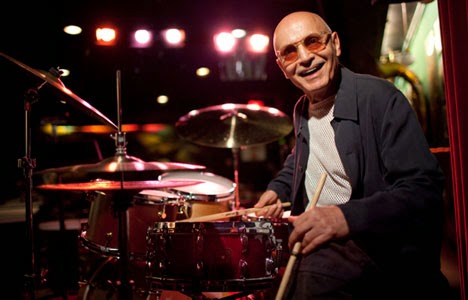
Drummerless, on Paul Motian

I have been trying for some time to find proper, better words to describe what has now come to seem like my own very long commitment to the music of percussionist Paul Motian, who died nearly two years ago. His particular feel, the way in which his music characteristically unfolded and continues to unfold, sui generis, both temporally and spatially, has had a sustained effect on how I have begun to think about the poetic apprehension of time, the material experience of the human body in its textiles, its welter and wash. It sounds so generic, so mundane, so less than momentous, to say: for some time. And maybe I only mean to play on the titles of some of Motian’s compositions, which also both thematize the experience and elegize the ineffability of the temporal: “It should have happened a long time ago.” So I feel like I’m trying here, but inevitably falling short, even before I seem able to get started. But I think that this halting phenomenology might have something to do with the specifics of Paul Motian’s sound. Because there’s a semantic and temporal gap, a kind of hiatus particular to Motian’s sense of line and rhythm, that opens around the question of the thesis, Θέσις: of the subtle incursion of, say, a dancer’s footfall, of the give-and-take around every singular, embodied, creative pulse, step upon step. In Motian’s playing, each beat, each thesis, doesn’t drop into the lockstep of fixed metre, even when he plays in time, but tends to exist as a stroke, a temporal marker, relative only to the beat that preceded it; Motian always seems to be feeling his way forward through time itself, testing its viscosities, its resistances, its eddies, its flows. His sense of measure is tensile, and a little precarious: simultaneously countable and protean, refrained and free.
         I have been listening to Shadow Man, the second recording by Tim Berne’s Snakeoil quartet released (last week) by ECM records. I haven’t made it through to the end of the CD yet, because each time I put it into the player, I’m brought up short by the third track, a duo version – by Berne on alto and Matt Mitchell on piano – of Paul Motian’s composition “Psalm.” I had forgotten that Motian played on Berne’s Mutant Variations  and The Ancestors on Soul Note (both 1983) and also on his early Songs and Rituals in Real Time (Empire, recorded 1981); their musics, even then, appeared to share something of a preoccupation with rhythmic knotting and unknotting. In a 2009 interview with Ethan Iverson, Berne describes his first encounter with Motian:
I met Paul Motian when he was doing a gig with the bass player Saheb Sarbib.  And I just went up to him and I asked him.  And to this day I have no idea how I got the nerve.  But he sort of said “Yeah, man, send me something,” or whatever.  I may have given him a record or sent him a tape.  I called him up a couple of weeks later and asked him if he listened to it, and he said “No.” But then he said, “Yeah, whatever, I’ll do the gig.” And that was this gig that turned into this record. . . . And Paul was great.  I don’t know why I didn’t know to be more frightened.  I think I got more terrified when we did a tour, because then I was like “Holy shit, I’m on the road with Paul Motian.” There are two Soul Note records with Paul too, and he plays just great on them.
Berne’s version of “Psalm” offers a lyrical tribute to this yes-and-no meeting, but, fittingly, also audibly remarks on Motian’s posthumous absence: it’s performed drummerless, and fluidly rubato. (Notably, Russ Lossing has also made a brilliant solo piano CD of Motian compositions, Drum Music [Sunnyside, 2012], that theatizes the composer’s absence in a similar fashion, but which is also wonderfully attentive to the prod and pull of Motian’s lines.) The openness and the looseness of the duo’s time feel is wholly appropriate to Motian’s music. The melody, lightly fragmented by Mitchell’s right hand, is not especially definitive, and seems to emerge, to find its feet so to speak, out of an undifferentiated gentle swathe of long tones, here played sotto voce by Berne; on the original version by the Paul Motian Band – “Psalm” is the title track and the first cut on Motian’s 1982 ECM lp – the core line of the song (and many of Motian’s compositions consisted of not much more than melodic fragments) wells up tenuously from layers of saxophone, guitar and bass. In his liner notes to the ECM boxed set of Motian recordings that appeared earlier this year, also from ECM, Ethan Iverson describes how “Psalm” “begins like an emission from deep space before a chorale comes into focus.” And he’s not wrong: Iverson has keen, practiced ears, and he hears a kind of primal rhythm behind all of Motian’s playing, a well-defined, historically-informed sense of jazz time: “With Paul,” he wrote in a New York Times obit,“there was always that ground rhythm, that ancient jazz beat lurking in the background.” But I’m not sure I agree with him, or, at least I don’t know if I hear the same sense of beat he does. For me, Motian’s playing, at its best, digs into that ground, destabilizes it, turns it over. His time extends, distends, undoes and reknits the whole sense of primal beat, of pulse.  In the Berne-Mitchell version of “Psalm,” I think, a pliable tactility – the gesture toward measure and the soft refusal to fall into a countable frame – manifests, and reminds me, as I listen, of the ways in which Motian’s music wants to open both into time and out of it: to extemporize. That opening – sensible as hiatus or absence, certainly, but also as push, as motion, as the forward heft of a given line – seems to me to form a crucial aspect of Paul Motian’s legacy.
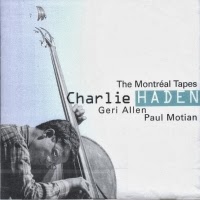
         One more brief note. I only saw Motian play live once, in Montreal in 1989 during the Charlie Haden invitational series early that July. I was at the gig – released as part of The Montreal Tapes – by the Haden-Motian collaborative piano trio with Geri Allen. What I remember most about that concert was that it was over too soon. There wasn’t enough time. It slipped away. Motian’s warm, flexible rhythmic touch is in evidence from the very first notes, on Haden’s fittingly titled “Blues in Motian.” I feel like I need to listen to that record again.

Audio: Jillian Christmas and Chris Gilpin at Play Chthonics
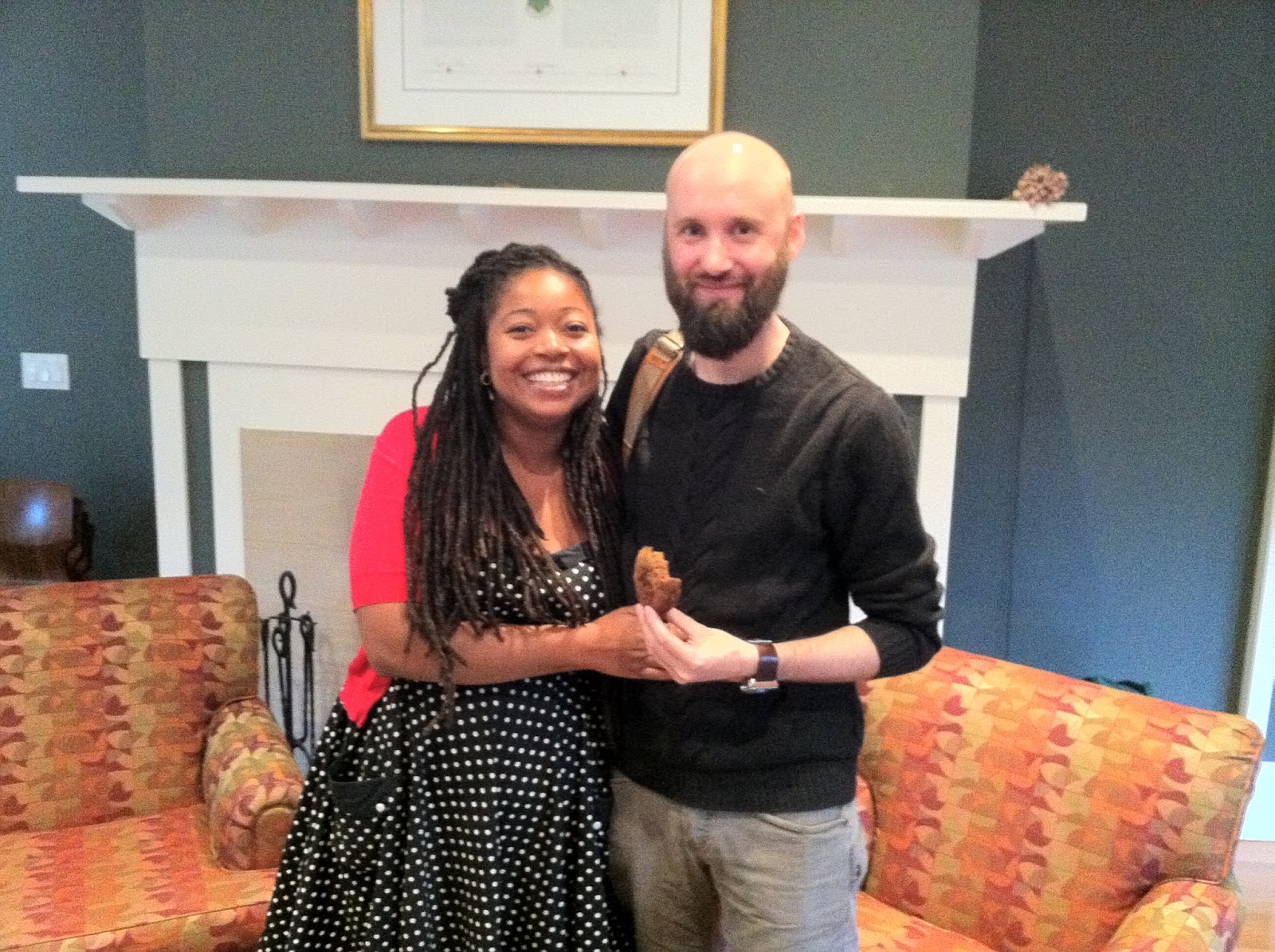
Jillian Christmas and Chris Gilpin read tonight (Wednesday, 18 September 2013) to a small but captivated audience, as part of the Play Chthonics poetry reading series at Green College, U. B. C. I have included an audio recording of their reading in this blog post, below. They alternated performing their own poems, and interspersed their readings with comments on poetics, and answered questions about spoken-word poetry and poetry slams. This was a warm and engaging reading, and it’s a real privilege to have been able to present their work.
         This is a vérité-style recording, but their voices come through very well. It’s just a little marred, just a little, by a noisy ventilation system, and — just to let all potential listeners know — by an overly enthusiastic cleaning person picking up coffee mugs near the end. Other voices you hear include mine and other audience members (among them Andrew McEwan and Carmen Mathes). Copyright for the recording remains with the artists.

         Thanks to Green College, to the U. B. C. Department of English and Faculty of Arts, and to the Improvisation, Community and Social Practice research initiative for their support.

Wisdom of William Parker, Musician

WP1

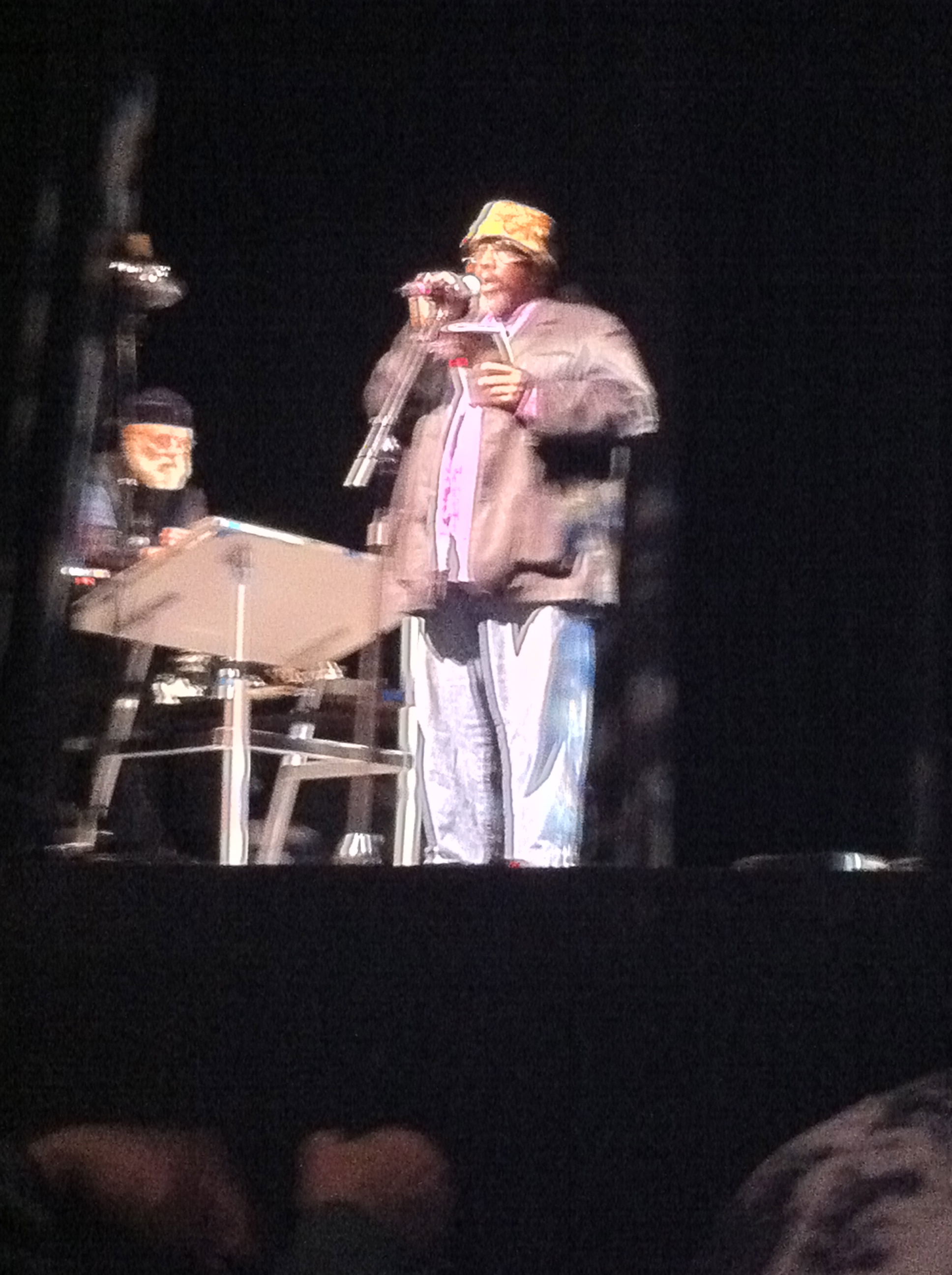
In the late afternoon of Thursday, September 5, at the Macdonald Stewart Art Centre at the University of Guelph, composer and bassist William Parker delivered a keynote talk for the Guelph Jazz Festival Colloquium (this year’s theme: “Sound Knowledges: A World Artist Summit”) called “Sound as Medicinal Herb: Creative Music 61 Years in Transition.” (The “61 years” refers to his age, he told us.) He was introduced by drummer and musical compatriot Hamid Drake, who spoke about “an energy of compassion and understanding that exudes from Mr Parker” and who acknowledged the important role that William Parker has played in fostering “my own artistic potential and awakening.” For about 40 minutes, interspersed with video clips of Cecil Taylor, Sun Ra and Don Cherry, William Parker offered what was essentially an extended set of aphorisms, reflecting on his philosophy of music and on the social impact of artistic practice. If it works, I’m going to reproduce my transcriptions of key sentences from William Parker’s largely improvised remarks; this, for me, is an example of one form of improvisational pedagogy, a gathering of reflections and provocations. Any errors or infelicities are my own.

WP2

Sound acts as a medicinal herb.

The core of music cannot be taught, the self-sound of a musician’s playing.

Why does the musician exist? Save, elevate, inspire and heal.

Muse plus physician equals musician.

As soon as you are born you become part of music.

Music is not something you learn. Music is something you are.

We need to redefine musical terms.

No one owns music. Nobody. Nobody owns music.

Music is the possibility of a miracle occurring.

It is a medicinal herb that heals.

You are responsible for your own self. You play the changes you want to play on a tune.

Sun Ra: “I didn’t know anything about music. It came from someplace else.”

What is the difference between knowing and feeling? You can know all of the answers, and you still can’t get anything right.

You don’t have to understand it, you have to feel it.

You need to be flowing with the spirit.

Jimmy Lyons was a shaman. Shamans heal and move us through sound. The have the juju.

Part of it comes from the blues. You can hear it. All of the musicians from Chicago, where’d they come from? Not Chicago. From the South.

They play extensions of Afro-American Improvised Creative Music.

If you play for three hours with Cecil Taylor and Jimmy Lyons, that’s some magic. And I played eleven years with those cats.

How can you play music and not know anything about it? You don’t need to know anything about it. What’s important is whether your music works.

We have to have a revolution in the world. The music has to step it up a notch. We have to play revolutionary music so that we can enter into the tone-world.

You take a tone, you vibrate it enough, and then you’re in the tone-world.

Each room in the tone-world is a secret of life.

It’s not about making money, but to make music and to heal people through sound.

Don Cherry knew something about music. But at the same time he knew when not to let it get in the way.

Everybody can be an accidental shaman, a shaman for the day.

You don’t want to be a shaman for a day. You want to be a shaman every day.

The listener is also a musician.

The sound of what you say and what you do is so very important.

You are your instrument.

You have to find the Don Cherry in you and the Sun Ra in you.

Wear your colours.

We can all be brighter and bigger than what we are.

What’s the difference between a musician and a shaman? You wouldn’t hire a shaman to play at your wedding.

Music in America is more about entertainment than inner attainment.

Rahsaan Roland Kirk had a composition he called “Volunteered Slavery.” Now what we’re dealing with is a system of volunteered slavery. You just have to go along with the system and enslave yourself.

The best musicians never get recorded because they’re left out of history.

The Guelph festival is very very important because it brings the people who want to hear, to be fed, to rejuvenate, to be inspired.

“It’s as serious as your life.” [Or, “It’s as serious as a laugh.”]

What’s the future of jazz? In one sense jazz is dead, it has no future. Don’t cry. But: music has a future. All your major players are dead: Jimmy Heath, Johnny Griffin. For me, I don’t hear anybody playing any jazz. Jazz has moved on. We just find something else. But hope goes on.

“In order to survive, we must keep hope alive.”

There is a universal tonality.

Boom. Let’s go. Let’s play. Boom.

Juju is in every country. It’s universal.

It doesn’t make any difference what you call it but it will go on.
WP3

Texture, Line, Frissure: Kathleen Jamie and Birgid Collins
In addition to reading her newest volume, Frissure, which is a collaborative set of mediations on healing and attention, I have been re-reading Kathleen Jamie’s 2005 gathering of essays, Findings, to prepare for a set of first-year lectures on prose non-fiction I am set to deliver over the next few months.  The earlier volume appears to lay some of the groundwork for her more recent prose poems. In the pages of Findings, Jamie consistently demonstrates a palpable gift for perceptive clarity, an attunement to visual and auditory detail: the eleven mediations on the “natural and unnatural world” – “world” meaning contemporary Scotland – that make up the book reflect on her own all-too-human need to accrete what she sees and hears, to hold and remember it, to catch something of her sensory drift and document it on paper before it skitters beyond her field of view. She listens and watches, she notes and collects. And what she often ends up attending to, in each piece, are the gaps and uncertainties in the apparatus of her own consciousness. She comes to observe herself wanting to observe, trying to see and hear her way toward a sublimity, a sense of the near-absolute alterity of nature, that keeps refusing her any absolute access. She often directs her creative energies toward collection and preservation, picking up souvenirs and compiling wrack and flotsam from shoreline scrapheaps, a tactic that recalls the poetic salvage of “Mr and Mrs Scotland Are Dead.” (“Do we save this toolbox . . .?”)
Salvage is also self-directed, when she visits, for example, the Royal College of Surgeons in Edinburgh and peruses the formaldehyde-filled anatomical specimen jars: the human form, a late version frittered from Da Vinci’s homo mensura, becomes a collation or an assemblage of posthumous, scattered parts, bottled samples and amputations. “At certain shelves,” she writes, “you have to bend and look closely, without knowing what you might see. It will be pale and strange, and possibly quite beautiful. It will be someone’s catastrophe and death” (from “Surgeon’s Hall”). Bodies are catalogued, labeled, textualized; she sees them as particular, uncanny artefacts, almost art-objects that, with their vestigial humanity, still resist the aesthetical gaze. Medical and representational objectivity is mitigated by empathy, by the traces of human suffering and of feeling – not affect, but feeling – that persist in these fissured bodies, at once remembered and dismembered: “a stranger’s arm with his [not ‘its’] corroding carcinoma, a diseased breast, a kidney taken from a man gassed on the Western Front, all call forth the same plain tenderness, “ for Jamie.
“Pathologies,” the first essay in her subsequent collection, Sightlines (2012), develops this empathetic scrutiny further, when Jamie describes her visit to a pathology lab to observe clinicians performing biopsies. What she thinks of, plainly, are the people with whose tissues she has gained, as she scrutinizes samples through a microscope, a strange and unbidden intimacy, an impossible closeness. This complex ethic in which she finds herself implicated had already been hinted at in Findings, in the essay I’ve been citing, where she offers a précis of one of the earliest accounts, in “an Edinburgh book” from 1863, of a Victorian surgery: a certain “Mrs Ailie Noble, suffering terrible pain from breast cancer[,] is taken into theatre, and in full view of the young medical students undergoes a mastectomy.” Jamie’s writing practice is often highly iterative – texts embedded into texts, marking the retreat of an abyssal subjectivity – and she quotes her source text to close her own essay; but her point is not to remark a futility, so much as to emphasize the shared pathos of loss even in the seeming detachment of patriarchal science:
He says “Don’t think [the students] heartless . . . they get over their professional horrors and into their proper work, and in them pity as an emotion ending in itself, or at least in tears and in a long drawn breath, lessens — while pity as a motive is quickened and gains power and purpose.
Pity converts from romanticized, narcissistic amour-propre into viable empathy for others, an intersubjectivity of care (to borrow a phrase from Julie Livingston), a call to feeling that Jamie seems to discover somewhere between the jars she observes and the archive she re-reads: reminder and remainder. 
Frissure emerges from Jamie’s collaboration with visual-tactile artist Birgid Collins. When she turned 49, Jamie notes in her preface, she was diagnosed with breast cancer, and underwent a mastectomy. For her, she writes, “it seemed ironic: a case of life imitating art.” She had written extensively, as I’ve just noted, on pathology labs and breast cancer, and now her own body was subject to medical scrutiny and intervention. Redirecting her own attention selfward, negotiating the now intimate collision of observer and observed in her own physiology, seems to come to mean, for her, finding some kind of balance point between the aesthetic and the lived, a means of sensible transcription that would become part of her healing. She ended up approaching Birgid Collins to draw her mastectomy scar, to try to find a means of inhabiting this intersubjective tension; collaboration entails both deferring to perspectives outside of your own, and simultaneously voicing yourself against that deference: both seeing closely and being closely seen, in this instance. The scar is an unruly line, not only in the literal sense of a mark on her skin, but also in both the visual and the poetic senses: “Whatever it was, it was a line, drawn on my body. A line, in poetry, opens up possibilities within the language, and brings forth voice out of the silence. What is the first thing an artist does, beginning a new work? He or she draws a line.” She and Collins, in their various media, begin from a contingent, shared understanding of line.
“With that, a line of Burns arrived in my head. ‘You seize the flo’er, the bloom is shed.'”
Jamie composes a number of prose-poems during her recovery, which become part of their collaboration; Collins pastes fragments of text into her constructions, and incorporates found matter and textiles described in Jamie’s texts into her compositions, which she comes to understand not as drawings but as dimensional constructions she comes to call “Poem-Houses,” which she creates in “conversation” or “exchange” with “K’s fragments.” Line here becomes a trajectory of intersections, an empathetic give-and-take (though not without difficulties and uncertainties). Collins begins with drawings, then introduces “natural” matter onto her paper, then builds dimensionality beyond the surface of page or sheet. The resulting hand-sized sculptures, if that’s the right word, have a raw, stunning beauty, an intricacy and a delicacy of texture that suggest an uneasy balance between the found and the made, the fractal and the formal, the aleatory and the intentional, the natural and the unnatural, that informs much of Jamie’s best writing. (You’ll have to buy the book to see photographs of these Poem-Houses; Collins’s website also has plenty of images of similarly-realized constructions.)
The sense of line in these prose poems, for example, is more latent than manifest: the rhythmic shape of each sentence remains insistent but not (yet) fully differentiated from the rhuthmos, language’s unruly cadence, its natural flow: there are no clean lines, but, like Collins’s art, an attention to the besmirched, the impure, the incipient. “What is a line? “ Jamie asks in “Line”: “A border, a symbol of defence, of defiance.” But a body, such as hers, isn’t healed by being defended, medically or poetically, against its own enmeshment in the natural world, by the surgical repair of its boundaries and limits. Rather, healing for Jamie involves a return to the permeability, to the interpenetration, of body and world:  “To be healed is not to be saved from mortality but rather, released back into it: we are returned to the wild, into possibilities for ageing and change” (“Healings 2”). The textures of Collins’s work derive from this enmeshment, emblematized at a number of points in economies of reciprocity, mutuality and interchange, as healing gifts mailed to Jamie from friends, and passed on to her, like letters written in natural scraps, from the landscape around her: “Spilling from an envelope, a get-well gift of silverweed, bog-cotton and thrift.” (The brief catalogues of found matter in these texts recall the collected flotsam of “Findings.”) To heal, for Jamie, is not to protect or to defend herself in art, but to open up her language to the textures of the inhuman, of the given, and to listen carefully for a “music at the edge of sense . . . the sound of the benign indifference of the world.” (“Healings 1”). Tacitly, and amid its contingent stillnesses, Collins’s work performs this same close attentiveness both for and with Jamie, and both for and with us.

Audio: Embouchure, Guelph (2011), with Eric Lewis

Here’s a recording from two years ago. In Guelph for the colloquium and jazz festival, on September 9, 2011, following a talk and a reading by Jayne Cortez, I read a suite of poems from Embouchure, which was then pretty hot off the press, accompanied by Eric Lewis improvising on trumpet and cornet. The introduction is by our good friend Sara Villa. You can visit my Sound Cloud page for more audio, or check out the audio section of my web page.

Improvisation, Text and Media: Research Questions

At the final meetings of the research team for the “Improvisation, Community and Social Practice” research initiative, held on Monday September 2, 2013, at the University of Guelph, we had an opportunity to divide into our various research streams and interest groups, and to reflect on achievements and outcomes over the past six years of the grant, around the establishment of the interdisciplinary field of Improvisation Studies. (Co-ordinators for each of the seven clusters were invited to present at a panel during the upcoming colloquium, on Wednesday morning.) Rather than catalogue books, performances, courses, etc., what many of us elected to do — to reflect the on-going and open-ended aspect of research on and around improvisation — was to produce and hone a set of research questions that had come to inform the work being done by our group.

ICaSPmtg

Here are some of the questions we collectively arrived at, in the “Improvisation, Text and Media” stream, for which I have served as co-ordinator.

How do improvisatory practices affect the production, dissemination and reception of new media art?

What are the impacts of electronic and social media on poetry, literature and other textual practices? How is the study of print culture impacted by a critical emphasis on improvisation?

How can methods and approaches that have emerged from improvisation studies be deployed to assess the velocity of information, and the pace of the transformation of the human archive? What are the emerging temporalities of writing?

How do new media offer a means to investigate the permeability of the academic and non-academic worlds?

What are the key tropes around which inquiry into text and media in improvisation takes place? (Some of the tropes we mentioned included membrane, network, fractal, pod, articulation, mix, polyphony, voice, texture, ear.)

How does improvisation both expose and re-instantiate inherent social power structures, especially around concepts of authority and expertise?

How do social and electronic media influence reading and reception?

How do text and media studies articulate with improvisational pedagogy across the disciplines?

What does the study of improvisation, text and media bring to the understanding of canon, of expertise, genius and orthodoxy? How are we to accept or to resist the tendencies for improvisational tactics to becomes orthodoxies or ideologies?

How are practices of appropriation, borrowing, imitation, representation and revision managed through improvisation?

Our hope was that these questions, and others, might serve as contingent focal points, both to understand the work that has been ongoing in this sub-field and to provoke and urge the development of new work.