Flow, Fissure, Mesh

Home » Uncategorized (Page 6)

Category Archives: Uncategorized

Remembering Introducing Fred Ho (August 10, 1957-April 12, 2014)

I only met Fred Ho once, when I was asked to introduce a talk he was giving — “Identity, Music and the Asian-American Struggle” — in the afternoon of Saturday, February 2, 2002, at the Western Front here in Vancouver. His presentation was highly charged, as full of strident compassion and of life-energy as his music. After the talk, he asked me if he could have a copy of the introduction, and I gave him mine, which had some handwritten notes and corrections. Later, I was contacted to contribute to an anthology of writings about his work, a kind of Festschrift for him, but I never managed to get anything properly together enough to submit; in 2007, I presented an abbreviated version of my work on him as a paper at the academic colloquium attached to the Guelph International Jazz Festival, “Improvising Diaspora: Fred Ho, John Coltrane and the Music of Radical Respect,” the text of which I have posted on my other blog, Frank Styles. This past week, I have been digging through my files to find the text of my introduction, and have finally come across it today. I’ll reproduce it below. I mention how Julie Smith, then the director of educational programming at Coastal Jazz, was working to create a symposium alongside the Time Flies music festival. Now defunct, Time Flies was modelled on Derek Bailey’s Company, an aggregating of free improvisors for a week of performances in ad hoc groupings and ensembles at the Western Front. The symposium eventually led to the Creative Music Think Tank and then, in 2007, to the first of a set of yearly colloquia in Vancouver produced collaboratively by Coastal Jazz and the Improvisation, Community and Social Practice research initiative (ICaSP). Here is the text of my introduction for Fred Ho. I remember him well.


It’s a great pleasure for me to introduce Fred Ho today.

This presentation is the first of the Time Flies Talks, a series of lectures and panels that we hope to develop into a fully-fledged symposium on improvisation and cultural theory next year, during the Time Flies Festival of Improvised Music. This year, to help inaugurate the series, we will also have a panel discussion on “How Time Flies in Improvisation,” featuring musicians Marilyn Lerner and Torsten Muller, and CJBS Artistic Director Ken Pickering, and moderated by me. It will take place here this coming Friday, February 8, at 2:00 pm; admission to the panel is free. Special thanks should go to Julie Smith, who has put these events together.

Fred Ho’s music has been described both as “politically charged,” brimming with “slashing energy” and fierce ironies, and as delicately lyrical, organic, graceful, life-affirming. His work offers a provocative mixture of idioms, drawing on — among other influences — free improvisation, traditional Chinese music and what Rahsaan Roland Kirk once described as “Black Classical Music.” His artistry seems to me to embrace both contrariety and multiplicity. Titles such as “Contradiction Please! The Revenge of Charlie Chan” signal his oppositional political stance, his keen awareness of the fraught dynamics of racial and ethnic identity among North American listeners, as well as a darkly comedic recognition of the exclusive and proprietary nature of cultural and musical stereotypes (not to mention a pun on one of bebop’s most famous pseudonyms). But his music and his thought are not simply directed at resistance to racial and social hegemonies; he is also deeply concerned with, as he has put it, “creating revolutionary aesthetics and changing the relations of cultural production”: with affirmation, with liberation, with creation. Fred Ho’s work seeks out a formal connection between the demands of musical form and the politics of gender, race, and class in a difficult and marginalizing world. The excluded, the marginal, the unacknowledged, sing back and sing out in Ho’s music, laying claim to agency, to presence, to immediacy — making themselves heard. His goal, he has written, “is a radical unity of form and content.” By this he means, I think, that the material lived conditions of social and cultural oppression can be engaged, countered and overcome in radical cultural forms, such as improvisation, that insist on a political dimension in the very substance of their articulation: in sound, in rhythm, in tone — in shout, cry, and caress. Fred Ho is a major artist, and a significant force in the emergence of a multicultural aesthetics. His many recordings and performances with his Afro Asian Music Ensemble, with the Monkey Orchestra, with the Brooklyn Saxophone Quartet, among other incredible ensembles, as well as his numerous publications, lectures and academic residences testify to his formidable energy and dedication to the political work of making music. Fred Ho is a performer, composer, pedagogue, political activist, in short an artist to be reckoned with, who calls us to reckon with ourselves and the world we inhabit. He will speak today on “Identity, Music and the Asian American Struggle.” Please welcome Fred Ho.

Reading Out Loud Together, with Elee Kraljii Gardiner and Renee Sarojini Saklikar

I’m sincerely grateful to Erin Fields, Melanie Cassidy and Trish Rosseel of the UBC Library for inviting me, Elee Kraljii Gardiner and Renee Sarojini Saklikar to read beside the fireplace in the commons on the main floor of the Koerner Library yesterday afternoon. It’s a great venue: students are coming and going, and there was a tangible energy coming from the big room that made for a really wonderful event. I didn’t manage any photos, and my audio recorder jammed out, so I don’t have any archive-worthy material to offer here, but I can at least give a few impressions to make up for my lack of documentation.
         Renee started things by reading a reminiscence about her time in the former Sedgwick and Main libraries at the university, framing some of her experiences of cultural marginalization and of the negotiation of language and accent, and historicizing her account around a year – 1985 – that she said she regards as a kind of talisman. She held up a page filled with a repeatedly-typed date, “June 23, 1985,” which she described as a mantra emerging from the bombing of Air India Flight 182; her book, children of air india: un/authorized exhibits and interjections (Nightwood, 2103), from which she read a set of elegies and fragments “from the archive,” focuses on the complex tensions between bearing witness to lost lives and the fraught absences left in the wake of atrocity. One line describing a seven-year-old girl killed in the bombing powerfully enacts this tension and, despite its brevity, stays with me whenever I have heard Renee read: “Her name was [redacted]”— a life remembered and withheld simultaneously, a collision (as I think I heard her put it in another piece) between tears and terror.
         Elee read poems from her manuscript Serpentine Loop, a collection that employs figure skating as its key trope, reading the skating body, as Elee put it, as “a primary site of language.” She could skate, Elee told us, before she could speak. The blades of her skates inscribe and describe, as she remembers tracing out loose figures on the ice, “a string of unclasped pearls” that also form in four unclosed cursive loops the letters of her given name. She read “School Figures,” a poem that locates delicate resonances in the interstitial spaces between figure and figuration, scribing and script:
Voices are low yet perforate the liminal

zone between silence and song. Each one of us is alone

with something to do: trace a shape of infinity,

perfect the line we know dissolves under water and steam.
(There is audio of her reading this poem on the Radar site, linked above.) Her poem “Who You Are By What You Recognize,” comprised of an alphabetical list mixing figure-skating and military terminology, was for me both lyrically evocative and brilliantly disturbing.
         My own set list for the reading went like this:
                  Embouchure
                  “Hot Lips” from Embouchure
                  “Blue and Boogie 1: Blue” from Ammons
“Small Time Georgic IV (Meat Bees)” – a little local Nova Scotian transplanting of some Virgil
I meant to read a piece for Ted Hughes, called “Slug F**k,” but it got dropped by accident.
         Since the recorder didn’t work, here is an audio version of the piece from Ammons, with my colleague – the superbly excellent Geoff Mitchell – doing his modernistic improvised boogie woogie piano thing along with me. Thanks to everyone who managed to come out, and again to the library folks for putting it all together: I had a great time myself.

Hearing John K. Samson’s "Highway One West"

We have been reading John K. Samson’s Lyrics and Poems 1997-2012 in one of my current undergraduate classes. One of things I want to interrogate critically about this book is the nature of that “and” in its title: what can these texts tell us, as close readers and as attentive listeners, about the relationship between lyrics and lyric, between song and poem? I’m looking to describe a certain nascent melopoeia in John K. Samson’s conception of how words work, in his conception of the cultural work of both singing and saying, of performing. What, he seems to be asking in most of these pieces (repurposing a famous provocation from Rainer Maria Rilke), what can singers and singing be for in a destitute time such as ours?
         I say nascent because, as you thumb through the book, you’ll see that most of the lyrics are printed as if they are prose, like brief essays or prose-poems. Spatially – at least, on the page – this visual arrangement in discrete typographical blocks echoes the cover design (which gestures, as well, at the cover for his 2012 album Provincial and at the graphic design of his webpage), a grid page from an old ledger, sections of which have been filled in with brown and blue hashmarks in pen. The effect, I think, is to gesture at an imaginary map of a parceled rural landscape, the Latin squares of prairie agricultural space. Hand-drawn lines – lines of ink but also lines of poetry – take on topographical resonances. These are songs preoccupied with articulating a human subject in space, with what amounts to placing oneself. In Canada, questions of who I am often become, following a lead from Northrop Frye, questions of where I am and where here is. But rather than fall back on mythopoeic cultural nationalisms – generalizing an Anglo-Canadian psyche as Frye might by locating and defining its (or our) territorial idiom – Samson queries that relationship, and tends to inhabit its inadequacies, and to create a pathos from and within that shortfall. In Vertical Man / Horizontal World, Laurie Ricou reframes the prairie psyche as nascent rather than determinate (and please pardon the gender bias here, which I think is symptomatic of the time at which Ricou’s study was published): “the landscape, and man’s relation to it, is the concrete situation with which the prairie artist initiates his re-creation of the human experience.” Ricou understands this particular landscape as initiating re-creation, as aesthetic disturbance, not as affirming a particular regional identity. The persona, the speaking or singing subject, of a Samson song is usually “left or leaving,” remaindered or else in the process of departure, “undefined” (as the lyric to “Left or Leaving” puts it), but always seeking a positional relation, for better or for worse, with a sense of home, tracking the “lines that you’re relying on to lead you home.” Those lines are also literally nascent, at least in their print form; reading the prose, you can hear metre and rhyme begin to realize themselves, as if lines were gently beginning to extricate themselves, audibly, from an undifferentiated (undefined?) verbal flow, a lineated poem emerging – although not quite emerged – from the prose. It’s not so much that the prose-poem aspires to the condition of song as it is that we experience a sort of hiatus, a space of what the lyrics for “Left and Leaving” might call “waiting,” between conception and realization, between text and song: a betweenity Samson thematizes as “and,” as an unclosed ampersand.
         The printed lyrics to “Highway One West” realize this betweenity both typographically and compositionally. The poem begins and ends with nine single-word lines. (The exception is the first line, which adds an extra word, tellingly the first word of the poem, another “And . . . .”) Framed by these narrow plummets, between them, are five lines of what look like prose – although they’re not prosaic in any sense, but tend toward metaphorical density:
And it
didn’t
take
long
for
the
words
to
slow,
roll over the gravel shoulder, thump into the ditch,
engine cut, battery dying, the station metastasizing
tumours of evangelists and ads for vinyl siding,
the city some cheap EQ with the mids pushed up
in the one long note of wheat.
Too
far
to
walk
to
any
where
from
here.
The 9 + 5 + 9 line-structure mimics a kind of overlapped sonnet. (“(manifest)” and “(past due)” from Reconstruction Site are both sonnets, in fact.) More than this ghostly resonance with literary form, however, the spatial disposition of the lines offers a visual analogue to the physiography in which the subject finds himself immersed. If you turn the page sideways, you can see the high-rise buildings of Winnipeg – or at least of “the city” – emerging in the centre of a flat prairie, the horizon created by a line of upended words. “Here,” the last word of the poem, is produced as a mimesis of distant surveillance, too far away to walk back to. The where of the poem is too far, moreover, from everywhere else; it is an elsewhere, alienated and alienating.

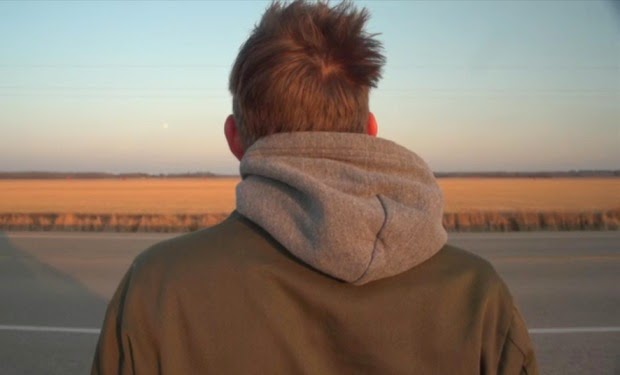
Notably, the song begins in performance with the looping repetition of the last segment (“Too far to walk . . .”), accompanied by a heavy, slow down-strum on the electric guitar, the repetition reinforcing the sense of resigned exhaustion, that “here” might be both everywhere and nowhere. The sounds coming over the car radio – not music but distant voices, a verbal garbage offering false promises of commercial or spiritual satisfaction – metastasizes into diseased noise, rough static. Sound technologies – both for recording and reproduction – offer another metaphorical (as opposed to metastasized) resonance to the geographical descriptors; that urban bump in the middle of the landscape mimics a graphic equalizer with the midrange sliders pushed up. The song gestures, in part, at the electronics used to produce it, and to reproduce it. But if, both visually and sonically, the lyrics and the recorded performance gesture at alienation and at loss, the text also frames and even recovers a degree of expressive potential – finds its voice – from within those horizontal margins, pulled over onto the shoulder of Highway One West, the Trans Canada. The page layout also mimics, coincidentally perhaps, a photograph of John K. Samson, used by The Globe and Mail, that looks like it was taken somewhere out on Highway One.
(I don’t know whom to credit for this photo.) The singer’s image, particularly with his back turned to the lens, echoes the middle section of the poem, while the highway and prairie skyline are picked up by the one-word horizontals. (Again, the page has to be turned sideways to see the mirroring.) What this accidental similarity suggests, for me, is a version of Ricou’s vertical man / horizontal world. The song itself has only a vestigial subjective presence: there is no “I” among the words, which are primarily objective and attenuated. But the voice, the speaking subject here, presents itself, ghosts itself into the song, as a hiatus, an opening in the mids and in the midst of this landscape.  The singer pauses on the shoulder, at the left-hand margin of the road and of the page, to look out and, especially, to listen. The song models, I want to suggest, a late or “weak” practice of attention, an opening of the self to audibility – both heard and hearing, left and leaving – that positions the subject as initiating its own recreation, cobbling itself together from interpellative fragments that he tries to hear, see and identify with as maybe, elsewise, his own.

Alias Fonds 1,2 (Justin Bieber Has Collapsed!)
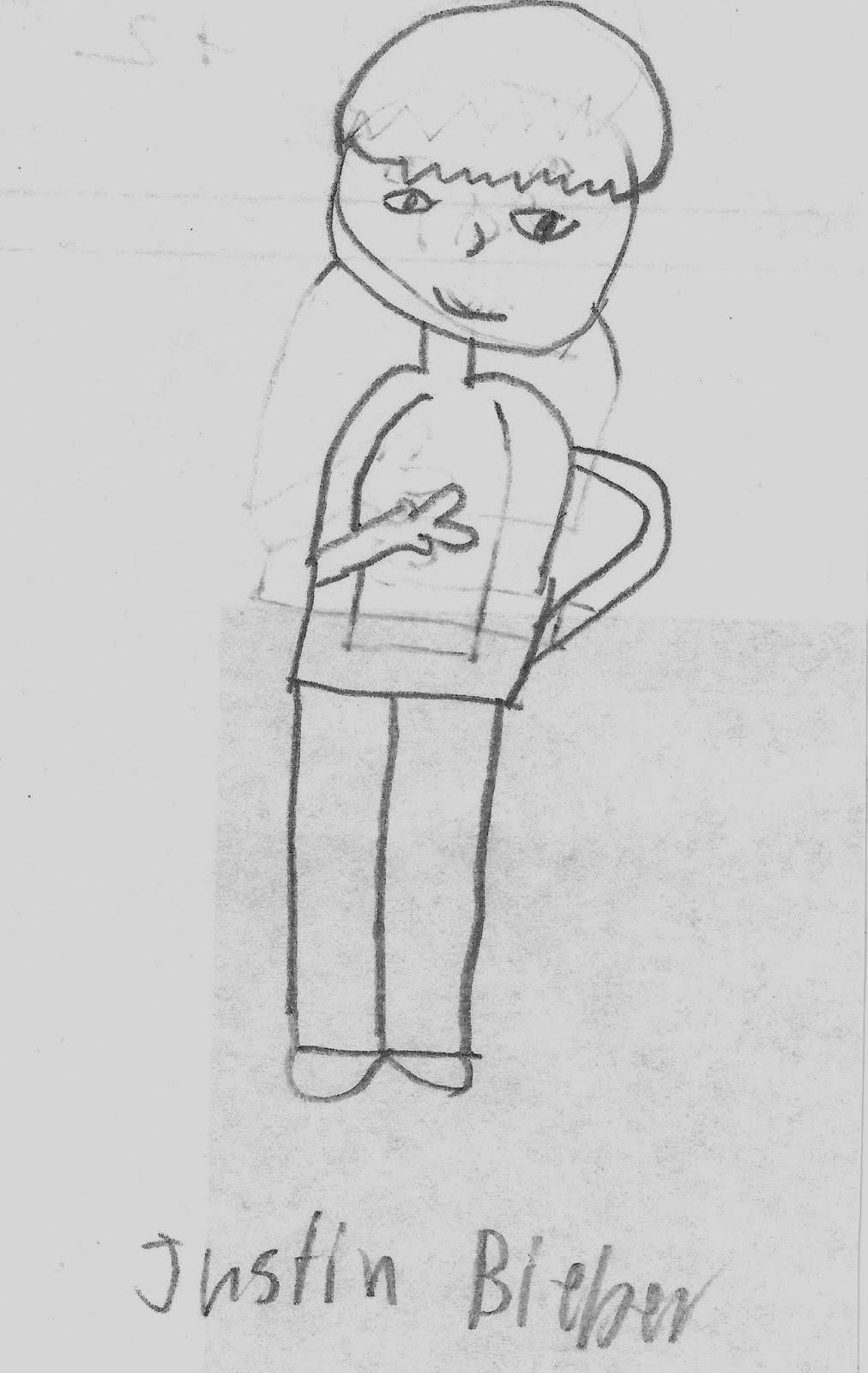
Recent news items about Justin Bieber’s arrest in Miami (where he was charged in January with DUI and with drag racing) and about his subsequent mugshot, as well as earlier reports – to which I had access, like millions of others, via Twitter – of him vomiting milk during a performance and of him collapsing on stage at a concert in London, seem to offer opportunities to interrogate the collision of the body and image, of self and celebrity, and of lyric and media.  And to get a little wordy. I have ended up producing two texts, which I’m calling “Alias Fonds.” The headline for the report on Justin Bieber collapsing in London, when it appeared on a Twitter feed, read like a phase-shifted snippet from a Frank O’Hara poem, which set the composition of the first part in motion. I also overheard a conversation in a coffee shop at the time between two people I took for graduate students in actuarial science. The second part draws on the lyrics of a typical Justin Bieber song, mashed up with Dylan Thomas, W. H. Auden, some high school chemistry, and media reports on the arrest. There’s a lot of bent replication. The texts of the poems can be read here.
         Justin Bieber started out with homemade videos on YouTube. I’m no Bieber, of course, but the homemade audio is meant to gesture at these origins. There is only natural reverb, for instance, on the voice: no effects. I play the instruments – a baritone ukulele and a student-model Yamaha trumpet – and I programmed and sequenced the drum machine (a DM-1 cloned on an iPad) partly to reflect the 5-on-4 metre of the first section. (The second section shifts the rhythm a little, but it’s still there, ghostly-like.) I intend the trumpet loops to be an homage to Bill Dixon. The two poems were written in the space of about eight months. The recordings happened from October 2013 to March 2014. So there you go.

Natalie Simpson and Jonathan Ball at Play Chthonics

Natalie Simpson and Jonathan Ball read yesterday evening (that’s Wednesday, March 19, 2014), for the last installment of Play Chthonics: New Canadian Readings at Green College at the University of British Columbia. It was a real pleasure to host them in Vancouver.
Before the reading, they graciously stopped by my undergraduate course on contemporary poetry and discussed their poetics with the students. The course focuses on British, Irish and Scottish poets, but they each lent a welcome Canadian presence to the class, giving the practice of writing an articulate immediacy that was both inspiring and provocative. Natalie Simpson spoke about the impact of Gertrude Stein and Lisa Robertson on her work, and described her own technique as associative and extemporaneous, building poems from sonic and phonemic echoes within and around text. Jonathan Ball talked about his interest in horror writing, and suggested that poems can act as trauma generators, pushing both readers and himself into new and surprising aesthetic relationships with language and with image. He said that he conceived of poems not as individual lyrics – he confessed to abandoning the lyric some years earlier – but as larger-scale sequences or books.
         At the reading, later, Jonathan Ball went first. He read from his collections Clockfire, Ex Machina and The Politics of Knives. “I noticed,” he said between poems, “I tend to use knives a lot.” He likes the idea of a poem as something that should cut you, engage you, to produce some kind of “ontological uncertainty.” He talked about the poem providing source-matter for, and also consisting in, the re-mix. And he suggested that poetry often inheres in moments of the loss of direction.
         Natalie Simpson read poems from Thrum, her collection forthcoming in April from Talonbooks. “Language,” she said, “is a likely state,” pointing up an aural and syntactic mesh in her work that seem to consist in sets of strange attractors. “Our form,” one of her poems declares, “is buffeted.” Her poems entangle listeners in a kind of attentively close sidewinding, a careful distraction. We find ourselves, as another of her lines has it, “adrift in plainsong tasked with swim.” At least, that’s how I heard it.

         Thanks to both poets for a terrific reading. And thanks to Green College for their ongoing support for this series.

Wanted, Veronica Mars

The first thing we hear in the Veronica Mars movie is a snippet of audio from a telephone message, a young woman’s voice asking for her help. The same plea, the same phrasing – “Veronica, I need your help” – will arrive in Veronica Mars’s cellphone inbox, this time from her former boyfriend and antagonist Logan Echolls, a few minutes into the film, setting the main narrative in motion, a nouveau noir-ish tale about her return to Neptune California to investigate the murder of a pop star with whom she attended high school, and who was part of the privileged crowd of so-called 09ers around whom the storylines of the original three-season television series largely revolved. The movie revisits and remakes the series, of course, but this revision involves much more than nostalgically transplanting an extended new episode of the series onto a big screen. In many ways, the contrast between the cinematic and television screens is no longer an issue of screen size or aspect ratio, which are increasingly and asymptotically close, but rather a question of how that image-system is managed and delivered; Veronica Mars, you could argue, self-consciously puts this screen-to-screen medium-shift at issue, investigating how media wrangle and shape not only audience and fandom – our committed and even addictive reception of television drama – but also our shared perceptual apparatuses: how, as a public, we train ourselves to watch (both as onlookers and as surveillance) and how these communal practices of looking and of listening remediate our worlds. As viewers, I’m saying, we implicitly need Veronica Mars, or television like it, to help us.
         The opening scenes of the movie take place in a fictional office space and studio for This American Life, for whom Veronica’s current love-interest Piz – carried over from the third season of the TV show – works as an on-air personality. (We first glimpse him speaking into a microphone.) Now, I’m working from sketchy notes and memory, having only seen the movie once, last night, but as I remember it, Veronica gets the call from Logan as she and Piz exit the building where the studio and offices are housed, and a street musician with an acoustic guitar is playing a version of the opening lines of the series theme-song, The Dandy Warhols’s “We Used to be Friends”: “A long time ago, we used to be friends, / But I haven’t thought of you lately at all.” There are layers of sound, I’m suggesting, particularly of voices, in play at this moment. Here, talk-radio and theme-song offer us a metonymies of the detective-film voiceover (Kristen Bell’s narration defines the teen noir soundscape of the original show) and of soundtrack (an echo ghosted into Veronica’s displaced life, nine years and a continent away from Neptune). The movie literalizes on the screen what its lyrics declare. We hear Veronica’s inner monologue, what she’s “thinking of,” lately:  a snappy fusion of Philip Marlowe and Nancy Drew, maybe, but more than that a textual identification of Veronica’s subject-position, her point-of-view, with our viewership, inviting spectators to become co-investigators, and temporary friends. But we also hear in that contrapuntal layering of voices a fraught nostalgia, a “need” that Veronica will soon feel, the pull of her high school life (she has, we also discover in the scenes at This American Life, been refusing Wallace Fennel’s text-message invitations to come to their ten-year Neptune High reunion), but also that informs a return to the pleasures of television drama, as we are reunited as viewers with the show itself – although it’s been seven years, not nine, but who’s counting. My point is, I think, that this return, this nostos, this homecoming, is both shaped and managed by the textual and aural mediations of the voice, layers that we hear and (in word-bubbles, on screens, on paper evidence, and in the opening montage) also see.
         Veronica frequently frames her return as addiction. Logan, for instance, is the bad boy rich kid lover in Neptune she can’t resist, while Piz – in New York, where Veronica’s potential career as a lawyer is about to bloom – stands for everything a good guy ought to be. It’s important to recognize, though, that despite her attachments to boyfriends and to her father, and despite her character’s obvious uptake and re-purposing, on screen, of aspects of both the ingénue and the femme fatale, Veronica consistently refused in the TV series and continues to refuse throughout the movie to be contained or determined by masculine desire. The help that Logan or that anyone needsfrom her is not so much erotic fulfillment as it is a kind of necessary deconstruction, a subversion from within, of the stultifying constraints of a patriarchal social system choking on its own authoritarian narcissism. The new corrupt Sherriff Lamb in the movie, for instance, skeevily played by Jerry O’Connell, is taken down by Veronica’s manipulation of his vanity, his own perverse need to be in the media, as seen on TV. As with the original series, the movie concerns itself with the murder of a girl, this time a pop starlet with the stage name of Bonnie DeVille – the “good demon”? – a victim whose Catholic guilt (her recent  album is called Confession) seems to be getting the better of her celebrity. Bonnie’s manufactured and sanitized image begins to crack, and to expose its fraudulence and underlying depravity, a disclosure that’s abetted by Veronica’s visual acuity, as she and we begin carefully perusing video, photographic and textual clues. The crime behind the crime, involving another murdered girl, also hinges on a crucial photograph, which the murderer possesses, and uses to blackmail those complicit in the girls’ deaths. (I’m pulling my descriptive punches here, a little; I don’t want to spoil the plot, for those who haven’t seen the movie.) The help that Veronica offers her friends and offers us, at her own peril, is a corrective, a remediation of how we look at images and what we see. It’s about solving a mystery, of course, but she also proactively fixes what amounts to an uninterrogated and even deadly male gaze by actively directing us to re-think, lately, what we have missed.
         In his introduction to a 2006 “unauthorized” collection of essays on Veronica Mars, creator Rob Thomas – who writes and directs the movie – claims that the show “saved [his] career and, less importantly, [his] soul,” and that it does so by allow him to participate in the remediation of the medium of television itself:
I taught high school during my mid-twenties in Austin, Texas. I have clear memories of sitting in my living room watching TV and wondering how clearly god-awful programming made it on the air.
He needed and TV needed, he suggests, Veronica Mars’s help as much as the rest of us. Framed as cultural pedagogy, a late return to the unfulfilled social promises of high school. Veronica Mars, in 2006 when he writes, is imperiled as a program and will very soon be cancelled, but Thomas is keen to articulate his gratitude for the transformative work that Veronica Mars continued to undertake, a transformation that hinged on an emerged viewership, a fandom, tied to visual and narrative acuity, to paying close attention:
We’re in the middle of our third season, so we’ve defied the odds, and I can say with absolute certainty, there’s nothing about Veronica Mars that I take for granted. Sure, we don’t do well in the ratings, but our fans are fervent, and they pay attention to detail.
Veronica Mars, for him, is about this renovated – and I would say critically-focused – attentiveness, about thinking of you, lately and carefully. The movie was made possible by a Kickstarter campaign that raised in short-order over five million dollars in crowd-sourced funding from donations by more than 91000 fans (donations for which they received early access to digital versions of the completed film). The movie is, in many ways, a love-letter to those fans, but I think it might be better understood as something like a response to the need for help, and for friendship, that the opening telephone message articulates. (Fandom, a potentially psychotic fandom, might also be the motive for the murder Veronica investigates.)
         At one point, Veronica has flowers delivered to Gia, one of her not-so-friendly friends (and whose name, coincidentally, resonates at least for me with the final syllables of nostalgia), and of course the bouquet contains a bug. Veronica tells Logan, over the cellphone, that she has had to use some “old school” tech she has swiped from her father, an FM transmitter that narrowcasts to what she thinks is an unused frequency on the public dial. Meanwhile, she sets up her camera – the one with the huge telephoto lens, an iconic holdover from the TV series, reproduced on the movie poster – across from Gia’s apartment, and, through a set of cinematic echoes of Rear Window  (including the lens itself) – we listen to and watch Gia through a grid of windows. Again, the film layers media and voices, reminding us – in the impurity of the audio or the grid-work of the window panes – of the thickness, of the materiality of mediation. We see the graphic surfaces and hear the interferences, the apparatuses that get in our way as much as they enable our access – to information, to character, and even to Neptune’s imaginary spaces. The movie, in my view, feels like television, and I’m not entirely sure why, but part of that sense has to do with its attention not only to smallness, to luminous particulars, but also with its audiovisual self-awareness. Tele-vision – as “distant” seeing – hinges as a medium not only on the feint of intimacy, a scopophilia inherent in surveillance and in the sharp visual analysis on which Veronica’s “investigations” depend, but also on a kind of telephoto thickening, a quality of light. The burnished visual textures that I have come to associate with the fictional Neptune – the red light, for instance, suffused by stained glass throughout Keith Mars’s office – become symptomatic in the film of an almost tactile proximity, a mildly hellish twilight that betokens the lateness, the late return, in which the show is enmeshed. It also draws us in, inviting to reconsider and to investigate our own desires to watch, to look, to see.

Reading Patti Smith

[This essay, focusing on Patti Smith’s early songs, emerges from teaching and writing I’m doing around an undergraduate course on the poetics of song lyrics and pop culture studies.]
Patti Smith Complete 1975-2006 is more than an anthology of lyrics, and it’s also hardly complete. Patti Smith’s writing – along with her music and photography – is marked and informed by an essential contrariety, by a conflictedness suggested ironically in the book’s blandly generic title, which gestures, I’d say, toward an admixture of excess and fragmentation, of spontaneous overflow and fraught insufficiency that drives her thinking around the making of poems and songs and around her performance style.  She frames this set of contradictions, her sense of voice and of self as embodied contradictions, in the snippets of memoir and reflection scattered throughout the book; commenting on the lyrics for “Birdland,” a track for Horses spontaneously and collectively realized by her and her band in the recording studio, she says that the “concept of improvisation” – and it’s worth nothing that she says concept, rather than practice – “has long repelled and excited me, for it contains the possibilities of humiliation and illumination,” that is, both of the degrading and the vatic. “Sha da do wop da shaman do way sha da do wop da shaman do way,” she sings at the close of her extemporaneous soliloquy; song, as contingent melody, emerges (as in “Land”) off-and-on in the piece from passages of loosely narrative spoken word; the final gently looping chorus blurs doo-wop girl-group nonsense syllables into a vestigial chant of the word “shaman,” and it’s as a kind of nascent and androgynous rock’n’roll shaman that Smith wants here, at the outset of her singing career, to position herself. In a New York Times review of her 1978 collection Babel, a precursor to the “complete” collection we’re now reading in our course on song lyrics and popular culture, Jonathan Cott nicely encapsulates the contradictions that inhere in Smith’s stagy shamanism as he traces out the complexities of her performance persona, of her onstage self-fashioning:
Patti Smith has taken this magic amalgam and manifested it in what she calls “3 chord rock merged with the power of the word,” claiming that rock-and-roll is “the highest and most universal form of expression since the lost tongue (time: pre-Babel).” . . . [B]y adopting a paradoxical theatrical stance – one that confuses male and female roles and that combines the acoustic magic of Rimbaud and the Ronettes – Patti Smith has been able to develop, explore and create a certain shamanistic presence that has eluded many aspiring rock-and-roll seers and heroes.
Counterpointing bits of scripture with caustic fragments of French symbolist poetry, her performative “magic” emerges as an uneasy blend of what she calls – ventriloquizing Jean Genet’s poemLe Condamné à mort” on the back cover of her 1979 album Wave – a doubling of menace into prayer, of prayer as menace.  (In the pages of her Complete, the crux of the line – “Use menace, use prayer.” – becomes an epigraph to the section reproducing the lyrics for Easter [90].)
The infamous first line of “Gloria” – the first track and the first single from her first album, Horses – combines the liturgical and the blasphemous along this same trajectory: “Jesus died for somebody’s sins but not mine.” As an opening gambit, her declaration doesn’t simply articulate what sounds like a resiliently agnostic, existential individualism, but also voices an entitlement – hers, “mine” – to her own deliberate marginality. Her rock-and-roll “magic,” understood as a gestural negation, isn’t so much about belief and shared redemption as it is about disturbance, about a faith – a belief both in and as resistance – that wants uncompromisingly to test its limits and to refuse any vestiges of comfort or assurance. While never quite rejecting Christian iconology and aesthetics (especially the ritual of Roman Catholicism, as the tone poem “Wave,” for example, makes abundantly clear, as well as a very recent photograph of her meeting Pope Francis) Patti Smith describes her Jesus, in the wake of viewing Pier Paolo Pasolini’s film The Gospel According to St. Matthew, as a  “revolutionary figure”: “I began to see him in another light – a teacher, a fighter, a guerrilla” (96). Her Easter is closer to an Easter uprising, a rebirth in turmoil that implicates her in an uncompromised, if not violent, self-remaking. As she appropriates and repurposes the glorified masculine desire that informs Van Morrison’s (as one of Them) original 1963 single “Gloria” (“And oh, she looks so good. Oh she looks so fine / And I got this crazy feeling that I’m gonna make her mine”), the subject position that defines itself in a tirade of possessives (“And I’ve got to tell the world that I made her mine made her mine / Made her mine made her mine made her mine made her mine”) degenerates into a repetitive chant that pulverizes poeisis, making, and diegesis, telling, into thudding particulate phonemes: her voice, the “I” that sings and by singing both hails and possesses its feminine other, becomes drumming, becomes unclosed, brutal and primeval rhythm, a beating. Liturgical responsorial from the Latin mass – gloria in excelsis deo– is both secularized into an erotic object and pulled apart, as she intones each letter of Gloria’s name, into the molecular fragments. The song at once catalyzes into insistent, thetic syllables and disintegrates into undifferentiated verbal noise: pronouncing and dismantling a beloved name that, through the poetic agency of the lyric itself, becomes simultaneously both mine and not-mine, supplement and other.
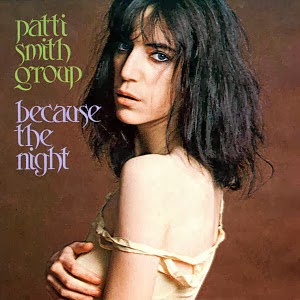
This double move is, I think, characteristic of many of Patti Smith’s lyrics, which often assert a confidently singular subject while gesturing to the iterative, collaborative and unsettled character of that voice, of her voice. The sexual ambiguity of “Gloria,” for example, as Patti Smith’s lyrics overtake and then fall into a cover-version, a repetition with difference, of Van Morrison’s original (sung, as the lyrics claim, to “twenty thousand girls” at an imaginary stadium concert), disturbs any clear sense of the erotic narrative in the song: Is this a woman ventriloquizing heterosexual desire? Does the song become a queer paean to same-sex desire? The indeterminate androgyny of Patti Smith’s stage persona unknits any normalizing of the dynamics between man and woman, suitor and ingénue. “Because the Night” (from Easter, two or three years later) thematizes desire as belonging, assembling want and succor into an amalgam of contrarieties that becomes more a testament to faith than its deconstruction: “Because the night belongs to lovers / Because the night belongs to us.” Notably, that belonging is shared, ours instead of mine. Smith describes herself as reluctant to listen to a demo cassette of an early version of the song, supplied through producer/engineer Jimmy Iovine from its composer, Bruce Springsteen. Taken by what she describes as its “anthemic quality,” she finishes the lyrics and “somewhat begrudgingly” presents it to her band to record (100). The resulting hit song, she says, is a “testament to Jimmy Iovine’s vision and the co-writer’s New Jersey heritage,” which is also close to her own. As with “Gloria,” what emerges on record isn’t so much a cover or a version of someone else’s song as much as it is a collaborative mix of voices and articulations. For instance, one line that I take to be closer to Smith’s idiom than Springsteen’s (though who can tell or separate them out?) offers in an archly poetic inversion a strong disavowal of the imperious first-person singular: “Have I doubt when I’m alone.” While such a declaration might easily be taken as an avocation of conquest (and assertions in the lyric about “the way I feel under your command” would likely only reinforce such a reading), it seems to me that what we also hear – given the ambiguity and even absence of gender markers for example – is an unsettled and androgynous collaboration, an affirmation that belonging consists in shared desires rather than in their satisfaction through erotic subjugation. When the song asks us to feel and to heal through touch, to “touch me now” in its performative moment, subject and object are inverted in the imperative form, as “I” becomes “me.” Demand and uncertainty produce a temporary hiatus, an almost: contact suspended in the looping repetitions of the refrain. For me, as a listener, this persistence of desire sounds itself in the rhythmic phase-shift of the chorus; because of where it’s placed metrically, “becáuse” becomes “bécause”, and the song gently but persistently jostles against its own formal limits.
Smith’s songs, though, are hardly ever so gentle. (There is nothing, nothing gentle about “Rock n Roll N****r,” an in-your-face provocation that offers a sort of blasphemous flipside to “Because the Night.” [The actual b-side on the 45 was “God Speed.”] I can’t bring myself to type the word without self-censoring: to me, it’s unredeemable and ugly, a verbal violence out of which Smith draws an insurmountable and irresolute alterity, a brutal vocal enactment of Rimbaud’s grammatically fraught claim that “Je est un autre.” There is a good discussion of much of the background to Smith’s reappropriation of the term n****r here.)
The sequence “Land” (also on Horses) begins with a spoken-word piece “Horses” that builds from rubato free-form narrative to four-on-the-floor incantatory, blistering rock. “Horses” sketches a tale of Johnny and his mirror-image, a nameless boy, who confront each other in an unspecified hallway. This doubling is also echoed, literalized, in the restrained overdubbing of another vocal track by Smith, out-of-synch with the lead, her words softly clashing and crashing into each other, as her delivery becomes more emphatic. As the boy approaches, “a rhythm was generating” the song tells us. Johnny is penetrated by the boy as he’s pushed against a locker. (Is this a high school hallway?) The boy disappears, but Johnny starts crashing his own head against the locker, a violence that seems to produce either delusion or vision, concussion or transcendence: either way, the “rhythm” Johnny now sees and hears with increasing intensity in his head, in his ears, sounds like the hoofbeats of fire breathing horses, a pounding verbalized in a chant-like repetition – similar to the chorus in “Gloria” – of a single word: “He saw horses horses horses / horses horses horses horses horses.” The surging drums and guitars behind Smith’s vocal reach a vatic climax – these are versions of the horses of the Christian apocalypse – only to find release into a high velocity version of “Land of a Thousand Dances.”
As with “Gloria,“ the group inhabits in the fierce present tense of their performances a dynamic trajectory through rock’n’roll history. The apocalyptic horses transform, in the first line of Wilson Pickett’s top 40 hit, into one of a set of teenage dance crazes: “Do you know how to pony like bony maroney” Smith wails. Whoever her Johnny might have been, as a representative disaffected teenager, he now appears to find a moment of catharsis and of shared vitality in the song’s hypnotic repetitions: it’s an old song recovered and made new, and it also asserts an insistently driven 4/4 rhythm in which you can’t help getting caught up and pulled to your feet – “Got to lose control and then you take control [. . .] Do you like it like that like it like that.” Spontaneity and self-control collide and smash; what you (not I and not even we, but the vocalist’s externalized other, her audience) . . . what you get to like in this music – liking taken both as likeness, as in the mirrorings and identifications inherent in popular music, and as Eros, as liking what you feel – what you get to like in this music are the conflicted pleasures of its own creative unmaking, its audible gristle. 

Short Take on Thumbscrew (Mary Halvorson, Michael Formanek, Tomas Fujiwara)

For the last four weeks or so, since its release on the Cuneiform label on January 21st, I have kept returning to the eponymous debut CD by Thumbscrew, a collective trio of Mary Halvorson, guitar, Michael Formanek, double bass, and Tomas Fujiwara, drums. It’s a consistently great album, offering up music that collides warmly responsive interplay with infectiously kiltered grooves. The opening track, a Fujiwara head called “Cheap Knock Off,” alludes texturally– you can listen for yourself and decide if this makes aural sense – to the early John Scofield trio with Steve Swallow and Adam Nussbaum, or, given the bell-like tone at times of Mary Halvorson’s guitar, even to the Jim Hall trio of the mid 1970s with Terry Clarke and Don Thompson.

But – despite the title – this is hardly derivative or imitative; it’s more of a music keenly aware of precedents and precursors but pushing forward along the leading edge of its own present tense.  What emerges sonically in these nine tracks is the trio’s shared practice of bending and unfolding time; they co-create in each piece a motile amalgam of historicity and futurity, gesturing (at least to my ears) at a rich set of musical antecedents from the jangling two-steps of Son House to the poly-intervallic melodies of Henry Threadgill, while simultaneously opening their improvised lines outward, palpably reaching, as Robert Browning once put it, to exceed their grasp. Michael Formanek’s big tone and rhythmic conception remind me of Johnny Dyani or Henri Texier: what’s remarkable is how he – and how the whole trio – manage to synch up with such metrical acuity (listen to those unisons) while driving so fiercely forward, right on top of the beat, meeting it head on, ahead. This trio, tightly together, gives the impression of an elastic looseness, a surge and release that’s a hallmark of the best kind of collaborative improvising. For instance, the toe-tapping shuffle of Fujiwara’s stick-and-brushwork on Formanek’s “Still . . . Doesn’t Swing” gives way to a raucously dehiscent free improvisation, as if the trio had momentarily lost its footing, only to reassert its cogency as melody at a slightly slowed tempo, transformed and tugged apart and then refolded onto itself again through Halvorson’s taffy-pull lines. Countable time comes unglued, seems to stretch and then reasserts its urgencies. Thumbscrew offers a music that moves, and that moves us along with them, listening: theirs is a remarkable and important record.

Profane Listening: Teaching Roddy Doyle’s The Commitments

In “A Valediction: Forbidding Mourning,” John Donne famously cautions his beloved to keep composed and quiet – like a dying “virtuous” man – as they part from one another:
So let us melt, and make no noise,
No tear-floods, nor sigh-tempests move;
‘Twere profanation of our joys
To tell the laity our love.
Rarefied, sinecured, privileged and private, their bond differentiates itself, at least as far as the poem’s speaker is concerned, from “[d]ull sublunary lovers’ love.” Refurbishing clichés of neo-Platonic idealism, Donne labours to distinguish their joys from vulgar heterosexual desire – his opening conceit enacts, literally, a mortification of the flesh – by linking love parasitically to a form of spiritually-ascendant class mobility. That elitism, moreover, is tied directly to a contradiction built into the poetic speech act: he’s telling her not to tell, creating an exclusive circle of two – speaker and listener – as his poem’s contingent public domain. Or maybe even a circle of one, himself, since the poem’s success depends wholly on whether his audience, the beloved interlocutor hailed by his lines, is even willing to listen, and to be correspondent to his desire, to do as he tells her to. There is a doubled model of listening articulated through the poem that seems to me to hinge on what its reader, its audience, is inclined to do with its profanity, its repurposing of the sacred for its own persuasive ends. Donne’s inflated coinage “profanation” casts our inner ears back, I think, to the word’s Latin etymology: the verb profanere (to desecrate, to violate, to make unclean) suggests being outside or before (pro-) a temple (fānum), which at least implicitly prods its listeners to consider the ersatz sacredness of this or any poetic text: how metaphysical, how hermetic, how divorced from this world, can such words ever be? The hyphenated compound nouns (“tear-floods” and “sigh-tempests”), while presented under prohibition, also make audible in their clashed, clumped consonants (rfl, dsn, stsm) the very – and very human, embodied – noise that Donne wants to suppress. The poem tends to profane itself, I mean.
         I am teaching The Commitmentsby Roddy Doyle  this week, and part of the reason I have started off with this excursus through Donne is that the novel is one of the most profane and noisy texts I have encountered. Reading excerpts and examples aloud in class, in public, activated some shame in me that’s most likely connected both to my own well-spoken intellectualism – despite common sense and academic privilege, it still felt a bit wrong and even a bit dangerous to utter all those “fucks” and “shites” and racist epithets in front of students – and to a hackneyed moralism circulating around how we listen to popular music, which is arguably the governing trope of the book as well as the focus of my course (and I’m thinking of how iTunes, for example, labels its downloaded songs, based on assessments of the lyrics, as either “clean” or “explicit”). The Commitments, at its heart, is an explicit, expletive text.
         It’s hard to gauge student reactions sometimes, but this class on the literature of popular song has tended so far to be a bit quiet, and who knows exactly why. Faced with reading Doyle’s novel, however, I can imagine they might feel a little shouted down, and a little affronted. In the book, as the band is cobbled together and starting to rehearse, they’re presented as Jimmy Rabbitte’s students. The book opens with Outspan and Derek asking for Jimmy’s musical advice, a moment that leads directly to the formation of The Commitments:
                  —We’ll ask Jimmy, said Outspan.  —Jimmy’ll know.
                  Jimmy Rabbitte knew his music. He knew his stuff.
Jimmy is the discursive centre for this particular configuration of Barrytown, this orchestration of their disenfranchised urban space, their north Dublin, and the vocabulary, the knowledge, in which he trades and which constitutes his cultural capital, is pop music. Jimmy, it’s worth noting, doesn’t play an instrument (well, none of them do, at first, except maybe for Joey The Lips Fagan), and he never performs on stage with the band; his music consists of talk, and his way of organizing the band involves giving lectures, correcting and managing what they “know” about and what they can learn through African-American soul music: “They loved Jimmy’s lectures,” the narrator tells us, although it’s not always clear that Jimmy has any more privileged access to Black music than anyone else. Even Joey The Lips’s stories of playing with Otis Redding, James Brown and just about any other “name” in R & B canon seem like a mix of fiction and wishful thinking; he claims to get a call to play with Joe Tex, but after he leaves Jimmy remembers that Joe Tex had died in 1982. When Joey The Lips confesses that “The biggest regret of my life is that I wasn’t born black,” the insurmountable disconnect, around race, between the given and the made, between provenance and aspirational self-fashioning comes crashing to the fore. The learning project in which Jimmy has the band engaged is doomed by its inherent dislocations, by its insurmountable, racially marked otherness. If “soul is community,” as Jimmy and Joey both contend, the success of their common project, the outcome of their commitment to any “real” provocation to social or cultural transformation through what Jimmy keeps calling “sex and politics,” remains inexorably out of reach.
         They can’t help but profane their lofty goals. The alteration they want to bring about by singing about “real” love is framed, as in the Donne poem, by the negation of overwrought, mundane clichés and by the evocation of a transcendent ideal – an African-American idiom that inherently resists the idioms of both saccharine top-of-the-pops and Irish folk: “—All tha’ mushy shite abou’ love an’ fields an’ meetin’ mots in supermarkets an’ McDonalds is gone, ou’ the fuckin’ window. It’s dishonest, said Jimmy.” But performing covers of James Brown or Wilson Pickett hardly seems any more honest, any closer to the lived realities of Barrytown: “— It’s not the other people’s songs so much, said Jimmy. —It’s which ones yis do.” Connection and commitment means finding material that somehow speaks to their experience, and for Jimmy, that speaking means a felt connection at the level of a pre-articulate viscerality, something he hears, for instance, in the rough “growl” of Declan Cuffe’s voice. Jimmy links this fleshy throatiness both to James Brown’s thoroughly sweaty, embodied performance – the grain of his voice, an association mired in sexual stereotypes around black masculinity – and, compellingly, to the band’s obvious inability to get beyond imperfect mimicry of that style; their cultural “politics,” inured in an experience of pervasive alienation, seems best represented by their failure to represent themselves musically in any idiom. Everything is imperfectly borrowed, mistaken, and troubled. In Jimmy’s bedroom, listening to the record of James Brown’s “Sex Machine,”the complexities and complicities of musical and racial appropriation emerge in a mix of sacrilege and idolatry, in a prose that both mimes what it hears and disrupts any easy mimesis:
         —Funk off, said Deco.
Outspan hit him.
Jimmy let the needle down and sat on the back of his legs between the speakers.
—I’m ready to get up and do my thang, said James Brown.
A chorus of men from the same part of the world as James went:  —YEAH.
—I want to, James continued,  —to get into it, you know. (—YEAH, said the lads in the studio with him.)  —Like a, like a sex machine, man (—YEAH YEAH, GO AHEAD.)  —movin’, doin’ it, you know. (—YEAH.)  —CAN I COUNT IT ALL? (—YEAH YEAH YEAH, went the lads.)  —One Two Three Four.
Jimmy positions himself dead-centre, as if to co-opt the sonic space of the recording, to claim it and manage it. The French-Joycean punctuation of dialogue with em-dashes tends to blur the distinctions between voices, to create a polyphonic overlay, a palimpsest. The identification of Jimmy with James manifests itself not only spatially but also in the collision of idioms from different “parts of the world”: James Brown’s sidemen aren’t Irish “lads” in any sense of the word, and when James Brown says “you know,” the point-of-view implicitly shared with Jimmy, the fella in the novel who, more than any other, presents himself as in the know, is both shared and dismantled; it’s worth noting how the transcription of the words in interrupted by editorializing and by typographical juxtapositions,  but also how the original record itself involves call-and-response banter that cuts across and disrupts closure. That disruption is also audible in the textures of the transcribed words:  “— GER RUP AH——“ they hear James Brown intone, abrading his words in a manner not too far removed from Donne’s noisy consonants. 
         If this record, though, is about affirming rough and vital cultural energies (YEAH YEAH YEAH), if it’s about the “politics,” of movin’ and doin’, Jimmy’s listening remains caught in a dynamic of negation and difference: “—No, listen, said Jimmy.” Making black music more “Dubliny” – by substituting, for example, the names of the stops on the DART line, moving North toward Barrytown, for the improvised train stops up the Eastern seaboard of the United States, tracing a kind of second-hand root for post-Civil War reconstruction, in James Brown’s improvised words for “Night Train” – enables what Jimmy wants to call “Dublin Soul” to be born, but those words also offer a fragile and finally untenable amalgam, as the band breaks up before it’s able to make even its first single on “Eejit Records,” and as Joey The Lips comes to realize that “Maybe soul isn’t right for Ireland. So I’m not right.” Their music, in its wrongness, is inherently profane, monstrous. But it also attains, in passing, in rehearsal, a kind of nascent greatness:
By now, The Commitments had about a quarter of an hour’s worth of songs that they could struggle through without making too many mistakes. They could sound dreadful sometimes but not many of them knew this. They were happy.
Though they’re unable to hear themselves, to “know” themselves for what they are – even when “[t]hey taped themselves and listened” – they still embrace the rough misprisions and imperfect “Dubliny” slippages and derive a happiness, a profane joy, in the struggle to connect with each other. The agonof music making, the profane and profaning effort to play together, forms a contingent community within that difficult nascence: “There were mistakes, rows, a certain amount of absenteeism but things were going well.” If the point seems to be not to put too much weight on the inevitable failure of their awful, unruly, “racialist” appropriations, neither is it to overlook or sanitize their offenses. Rather, we’re meant to bear witness to the possibility of creative coexistence, of producing a shared, poorly-recorded, mistake-ridden music that manages still, in its noisy and troubling way, to enact a poetry.

Hey, That’s Me: Bruce Springsteen and Audience, Part 1
Last week, I started off the current version of an undergraduate course I’m teaching on song lyrics and popular culture with a four-class unit about Bruce Springsteen. I have tried to use his music as an introductory case study in how popular music works, and in what it can do. One of the things we began to think through was the way in which his songs consistently thematize their own reception, representing both textually and musically a set of relationships between singer and audience. Specifically, I tried to read his songs as invitations not only into an erotic reciprocity – to touch and be touched, to feel each other’s presence – but also into a form of shared community: the nascent and loving democracy his “America” promises to be, even if maybe it can never realize that dream. These songs want to communicate, hopefully.
In what’s really the first essay in 31 Songs(2002), Nick Hornby asserts that his all-time favourite song is Springsteen’s “Thunder Road.” That song both addresses and enacts, for him, a durable and enduring moment of love, and it describes the living arc of his own long-term fandom:
I can remember listening to this song and loving it in 1975; I can remember listening to this song and loving it almost as much quite recently, a few months ago.
[. . .] So I’ve loved this song for a quarter of a century now, and I’ve heard it more than anything else, with the possible exception of . . . Who am I kidding? There are no other contenders.
This one song manages, whenever he hears it, to speak to him, for him and about him. I have to say, too, that I know exactly the feeling and exactly the identification that Nick Hornby maps out here, exactly what it is that “Thunder Road,” even despite itself sometimes, makes happen for listeners and for fans every time it plays. Hornby describes his experience of the song as a kind of mimesis, in its perennial capacity to “express who you are, perfectly”: who he is, he must mean, although the second person – in which the bulk of the song is written – is significant. The song itself begins – after a brief descriptive intro – with a series of apostrophes, of interpellations that present themselves as urgent invitations, open doors:
The screen door slams. Mary’s dress waves.
Like a vision she dances across the porch
as the radio plays.
Roy Orbison singing for the lonely,
Hey that’s me, and I want you only.
Don’t turn me home again. I just can’t face
myself alone again.
Don’t run back inside, darlin’ – you know
just what I’m here for.
So you’re scared and you’re thinking that
maybe we ain’t that young anymore.
Show a little faith there’s magic in the night.
You ain’t a beauty but yeah you’re alright.
The shift from the distance of romantic spectacle to something like discursive proximity – close enough to make yourself heard – hinges on another inset moment of audibility, and of interpellation: Roy Orbison’s “Only the Lonely” (echoed in the end rhymes) not only mimes the persona’s desire for Mary, but also hails him into existence, into audible range, as both a listening and a speaking-singing subject: “Hey, that’s me . . . .” Hearing Roy Orbison’s song on Mary’s radio gives him voice, and lets him talk, and also offers him a vocabulary and an idiom through which the rest of his own song can play out.
Professing desire beyond what he’s able or willing to say means for him returning to a literacy, to a kind of “talk,” a cultural field that the soundscape of rock’n’roll provides him with: “Now I got this guitar, and I learned how to make it talk.” Springsteen positions himself both as ventriloquizing fan and as nascent legend to produce a kind of proactive audience, a practice of listening that means trying to learn how to attend to others while still managing to talk for yourself, and to talk yourself up. The song offers an extended invitation to a feminized, idealized other; Springsteen, from somewhere within the heteronormative city limits of an imaginary Freehold, New Jersey, asks his own listeners – on this the opening track of Born to Run – to be like Mary and to get in the front seat of his car and pull out of the deadened space of here with him, to win. That idealization is also both fractured and resisted, even as it’s declaimed as an article of faith, by insistent disavowals and negations (“ain’t . . . ain’t . . .”), and by Mary’s coy but very real refusals. If she seems to be framed merely as an object of his desire, existing “only” for him to overcome his loneliness and affirm his masculine agency, his long cascade of pleas and poetic flattery, of goading and passive aggressive come-ons, also tends to undermine itself from the outset; after all, who in their right mind would accept a date from a man who tells you you’re not beautiful, but just alright? Sure, he’s just being honest, I guess, but the conventional hyperbole inherent in love song lyrics, diffused into something plain and mundane, also loses most of its persuasive tug, its “magic.”
What’s worth noting is that, even if we end up choosing not to go with him somewhere else (and as “Born to Run” puts it, to “get out while we’re young”), or if on the other hand we turn out to be willing to trade in our angelic wings for some very earthbound wheels, what we experience for the five minutes of “Thunder Road” is still a sustained and open invitation, a seemingly one-sided conversation that nonetheless keeps asking us to respond, and that leaves its requests unanswered, those imaginary responses as-yet and always unheard, either from Mary or from us: they’re all potential,  all unfulfilled promise. “The door’s open,” we’re told, “but the ride ain’t free.” And the return, that cost, is a commitment to reciprocity. So when Nick Hornby says the song expresses “who you are, perfectly,” what he must mean, what he can only mean, is actually opposite to perfection or to closure; the song’s conversant subject, the “me” who both listens for and sings to Mary, never coheres, but remains unfinished, a figuration of desire.

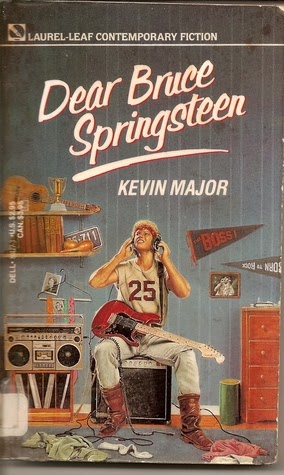
         When I was sixteen, I finished my grade eleven economics exam early, and I couldn’t leave the exam room, so I copied out from memory the lyrics to “Thunder Road” on the back of the exam booklet. It was a young fan’s act of mimicry, though I’m not sure what those lyrics might even have meant to me then, if I understood them or identified myself through them the way I might now, or might not. But what I do recognize in retrospect is that re-writing, transcribing, Springsteen’s words by hand was an initial gesture at that reciprocity. In those few free minutes, I started to write myself into a dialogue – a little like fourteen-year-old Terry Blanchard in Kevin Major’s YA novel Dear Bruce Springsteen – a conversation with whoever it was I’d always want to become. “My love, love, love,” he sings later and elsewhere, “will not let you down.” That’s not to say Springsteen’s songs will tell us who we are, but that they will always keep that reciprocal Eros, that mutuality, live and open, that invitation to join him heading down the road.