Flow, Fissure, Mesh

Home » Posts tagged 'poetry' (Page 4)

Tag Archives: poetry

Otherhood: Sina Queyras, Sylvia Plath and Negation

I haven’t received my print copy of this month’s issue of Poetryyet, but I have been reading around in the on-line issue. I’m caught by a new poem by Sina Queyras, “Sylvia Plath’s Elegy for Sylvia Plath.” It’s a remarkable poem, not least for its gutsiness in taking on the fraught legacy of Sylvia Plath, responding to the difficulty of her poetic, to what feels like Plath’s inassimilable otherness. Queyras makes a poem out of Plath’s refusal to be remade, out of her recalcitrant inapprehensibility. That refusal for me is also a version – though in a very different idiom – of Paul Celan’s practice of Widerruf (which means something like revocation, cancellation or retraction), which is itself I think a poetic version of Hegelian sublation, Aufhebung: the repeal, the resolution through negation. I’m not prepared, and I may never be, for a careful philosophical interrogation of these concepts, but I am fine about invoking them as tropes, as resonant elements of a poetic toolkit. “Sylvia Plath’s Elegy for Sylvia Plath” strikes me – given the come-and-go controversy around negative reviewing in which Queyras has been participating over the last year or so, mostly as a provocateur – as a kind of negative review of Plath’s poetry (and really of one poem in particular, “Tulips” from Ariel), but “negative” in a much more complex and nuanced sense than you might think. The poem, after all, functions at least on first reading as both tribute and celebration, as affirmative. But what it also does, and does very well, is revise Plath – that is, re-see her words – by conversing and debating with her poetry as poetry. It’s not composed, despite the circularity of the title, in anything like the critical meta-language of the review. Rather, it recasts the decidedly patriarchal lineage of the Widerruf (a lineage that might be heard as Oedipal contestation in, for instance, Harold Bloom’s Anxiety of Influence) as what Queyras, in her mini sonnet sequence published in this same issue of Poetry, calls “otherhood,” a portmanteau of otherness and motherhood. Queyras takes up and takes on Plath, I want to suggest, not to wrestle her way elegiacally past a predecessor (like Milton on Shakespeare, for instance, or Ashbery on, say, Stevens), but to address Plath’s own challenging relationship to canonization and patriarchy, and to reframe what it means, in Queyras’s terms, to be a “bad / Mother.”
         Here is what Freida Hughes says about her own difficult mother in the foreword to the “restored edition” of Ariel, published in 2004:
Since she died my mother has been dissected, analyzed, reinterpreted, reinvented, fictionalized, and in some cases completely fabricated. It comes down to this: her own words her best, her ever-changing moods defining the way she viewed her world and the manner in which she pinned down her subjects with a merciless eye.
As Plath seems to predict in “Tulips,” written in 1961 but carried forward to posthumous publication in Ariel, Plath sees herself as subject to both vivisection and autopsy, and not only as subject (patient, body, even victim) but also as her own surgeon, wielding a merciless scalpel. Plath, that is, casts herself as both mother and mothered, other and othering. “Nothing, not even death,” says Queyras’s poem, “frees mothers from the cutting board.” Her “Sylvia Plath,” though, is much less visual and much more tactile, more textural, than Plath herself tends to be. In “Tulips,” Plath’s reflexives, the negations, are characteristically optic: “Nobody watched me before, now I am watched.” Plath depicts herself, on a hospital bed with her head sandwiched between two pillows, as the “stupid pupil” of an eye “between two white lids that will not shut.” Queyras’s Plath, by contrast, is sculptural, material, rife with aesthesis, wanting to “feel the tulip’s skin, . . . the soft gravel / Of childhood under cheek,” her words given kinetic dimension, corporeal space and thickness as they are made to writhe “Across the page . . . ass / High as any downward dog and cutlass arms / Lashing any mother who tries to pass.” Echoes of barely suppressed violence seethe and twist through Queyras’s lines, much as they do through Plath’s; notice how the “firm rhyme” here around “ass” – hardly an instance of poetical diction, though Plath was often fond in her late poems of shocking sensibilities, of lashing out at her reader “lightly,” a little – is drawn off-centre, away from the line-ends of any ersatz “hard couplet.” Plath’s offspring, if that’s what these lines are, want to shred neatnesses, prying cracks in their verbal containers.
         “Tulips,” from which I’ve been suggesting that Queyras draws much of her raw material for this poem, was written after Plath underwent an appendectomy, following a miscarriage. The red tulips, presumably flowers sent to her in hospital, suggest both vitality and woundedness. Plath refuses remedy, the distant “health” at her poem’s close, choosing instead to worry metaphorically at her incisions, to use poetry to pull at her sutures. Craving the blankness of anesthesia (“I didn’t want any flowers, I only wanted / To lie with my hands turned up and be utterly empty”), she nonetheless builds and weaves text from her own troubled persistence; poetry consists in the refusal of her self-awareness to let go: “And I am aware of my heart: it opens and closes / Its bowl of red blooms out of sheer love of me.” Queyras picks up on the irresolution with which Plath’s poem contingently finishes:
                           The tulips were never warm
                  My loves, they never smelled of spring,
                  They never marked the path out of loneliness,
                  Never led me home, nor to me, nor away
                  From what spring, or red, or tulips
                  Could never be.
Performing their hiatus, these lines neither empathize with Plath nor refuse her. Despite the entitlement Plath’s readers’ often feel – our dogged identification with her cultural predicament as a woman caught between domestic codependency and urbane independence, between love and loneliness – this Plath settles for neither home nor escape, but produces, reproduces herself negatively, by refusing either option.
Hers is an idiom of ingrained melancholia, of resolute infelicity. Metaphor – consisting simultaneously of semantic slippage and connective bridgework – emerges from the roiling fractures of that refusal. In “Tulips,” Plath’s metaphors (falling into intemperate simile, for example) suggest both likeness and unlikeness, motherly bond and otherly dehiscence:
The tulips are too red in the first place, they hurt me.
Even through the gift paper I could hear them breathe
Lightly, through their white swaddlings, like an awful baby.
That disavowal, that sublation, is also enacted syntactically in Plath’s comma splices, which suture her open sentences together, like loose stitches, gating without cinching her red salt flow of words. Queyras picks up on this stylistic tic, as the set of run-ons that close her poem, which I have cited above, suggest. But Queyras also distances herself formally from Plath’s poem. The couplets, or perhaps the two-line bunches, that shape Queyras’s poem recall not “Tulips” but “Berck-Plage,” which also uses comma splices to create a sense of spontaneous overflow, of fractal rush. Plath’s texts hover between the immediacy of rough spontaneity (most of the poems in Ariel tend to speak, as manuscripts demonstrate, in a holographic present tense, as if addressing the moments of their own composition) and the considered formal mediations of obsessive revision, of the reflex of craft. The writing self, which in Plath often manifests as a cascade of first-person pronouns, is in Queyras’s text further withheld, suspended in an indeterminate second person for at least the first half of the poem: “If you can’t feel love in life you won’t feel it in death, nor / Will you feel the tulip’s skin . . . .” Any empathic connection to Plath, feeling as if you might feel what she might have felt, reaching imaginatively across the absolute barrier of her death (though “not how you imagine it will,” writes Queyras) to draw her voice, liminally, back into the living frame of your own poem, is also impeded – negated – by the mythopeic work of Plath’s posthumous dissection and monstrous reassembly as an icon of fraught womanhood, of otherhood. She refuses to be caught. “The vivid tulips,” as Plath herself proleptically puts it, “eat my oxygen.” The tropes will always digest their own maker, her vitality. “Let’s be frank,” says Queyras, but candour in a poem about Plath isn’t a matter of re-casting details from her biography, or reshaping lines and fragments from her poetry. Rather, it seems to consist in facing up to the cancellations and refusals that shape her voice and her sense of self, of self-elegy. And self in Plath isn’t something that, Yeats-like, you must remake. Rather, self comes to consist in the work of revision, in the negatives through which those rewritten poems emerged, and, in moments such as those of Queyras’s poem, still emerge.

Saving Anything of Value, on Carmine Starnino

The last lines of “Cornage” – the sixteen-part sequence of carefully-turned triple quatrains with which Carmine Starninocloses his 2000 collection Credo – frame the cultural work of a poem as an act of salvage, rag-picking language for splashes of unexpected colour (he has just rediscovered the resonances of the word “vermeil”):
                           Even this poem is one more example
of the usefulness in scavenging through
the day’s refuse, saving anything of value.
Starnino’s characteristic line, often an artfully balanced pentameter or (as if to register a little Gallic influence) hexameter, suggests at this point in the sequence a posture of measured resignation. The task he sets for himself isn’t so much to “purify the dialect of the tribe” (as T. S. Eliot once parsed and repurposed Mallarmé), although he might still aspire to breed lilacs out of a nearly dead land, a poetic labour that involves recovery more than rescue – to reanimate what he perceives, even in himself, as contemporary staleness with a mix of archival and ethnopoetic rummaging. The poet doesn’t so much conserve as curate, mindfully intervening in whatever lexical felicities cross his attention by unpacking etymologies and re-stitching phonemic meshes. (In part five, he lists the “[w]ords I’d like to get into a poem: eagle-stone, ezel, / cornage, buckram, scrynne, waes hail, sillyebubbe,” and proceeds to write poems that use most of them.) The idea is to “smuggle in / this fox-fire,” an audible and tangible vitality he feels missing from poetry. But the vatic intensity he craves is often either contained or held at bay in these poems by cautious and even anxious craft, a technical command I have to confess is also what I admire most in Starnino’s writing. He can be affronting – “gnarled turds” is quite a phrase – but it’s not shock that works best in these poems so much as their gently nuanced fabric of echoes and hums; notice above, for instance, how “usefulness” morphs and reduces into “refuse” or “scavenging” into “saving,” or how liquids and vowels from both words fuse in “value.” These words don’t so much flare up as entwine and accrete. I can call that meshwork anxious because I’m taking a cue from Starnino’s “Credo,” which remarks almost as an article of faith “the fear with which / a poem caskets away everything it wants to rescue.” Cultural and poetic rescue, as I said, seems closer here to recovery, a salvage rather than a saving. 
         What is it, then, that these poems do? What’s their function, their “usefulness,” in a contemporary cultural context, a Canadian context (if that’s not too much to demand of them)? Starnino already takes up the procedural challenge at the outset of “Cornage,” where he casts his ear back to a patriarchal medieval world to explain his reasons – as a poetics, in fact – for his choice of title:
Cornage was the duty of every tenant
To alert his distant master of approaching invaders.
I have thereby stationed this poem on a tout-hill, where,
In time of danger, it will blow a horn as warning.
He offers the recovered word as a moment of civic engagement, as cultural “duty”; more than that, the poem comes to act as a warning, as a ward – as portent, as monster (check the etymology, the Latin monstrum). But what exactly is the danger the poem confronts? A linguistic entropy? A verbal decrepitude? A lack of monumentality or durability, of poetic heft? I hear the problem Starnino wants to address, and I hear his trepidation. But I’m not sure how ultimately dire, even to a poet, this situation might be. And I am not sure that building a poetic casket out of that fear is the best way to go here.
         I’m looking back on these poems because I have been reading “An Interview with Carmine Starnino” from the most recent issue of CV2. Writing poetry, he says,
is a critical as well as creative act, and value judgements are part of any good poet’s skill-set. Just as a literary culture is the sum of all our actions, a good poem is the sum of ruthless decisions toward every word in a draft.

In the unflinching self-awareness of the poems in Credo, most of them written a good fifteen years ago, I hear prefigured this interlace of critical and poetic sensibilities. I admire an editorial ruthlessness in composition, evident in the deliberateness of Starnino’s formalism. But I have to say that I don’t accept his over-simplification of aesthetic value judgment, as if there were merely right and wrong, soft and hard choices to be made. (And frankly, I don’t think the best of his poems accept this over-simplification either; they’re much better than that.) Starnino sees a risk, even danger, in critical candour, and he defends his cohort of poet-critics – he mentions Michael Lista and Jason Guriel, among others – as deserving “our respectful attention,” which they do. But I’m not sure that candour – as opposed to acuity, perhaps – is what’s especially missing in recent poetry and recent reviews, Canadian or otherwise: the rigour of poetic attention has always been a sticking point for committed readers of poetry. The issue for me has to be not whether a poet pays attention, but defining the nature and practice of that attention, of that respect.  Saving “anything of value” needs to be made precise, carefully, and the diffuseness of that “anything” replaced with a materially substantive sense of what such value might be, and especially of what cultural and linguistic apparatus is producing that sense of value, of values. To this end, the poet’s task, it seems to me, doesn’t need to devolve into a parochial cosmopolitianism – ferreting out “the best” of what is thought and said in Canada and pushing it onto a fictional world stage – nor into a diffusely Canadian cultural nationalism, so much as to situate and to address, rigorously, the audible and tangible mediations between self and world that a poem – a good poem – wants to gather.

Half Sonnet for Nelson Mandela

I have been putting up the odd poem in this blog, self-publishing what feel to me like more public pieces, and maybe worth getting out there quickly enough, after they’re done. There’s an element of the improvisational in these ones, for me, because they’re pretty immediate, not heavily revised. So here is what I have done in memory of Nelson Mandela, who not only called for racial justice, for human dignity and respect, but lived that call. I was listening to Eddie Daniels interviewed last night on As It Happens on CBC Radio about his friendship with Nelson Mandela: powerful stories of Mr Mandela’s humility and the politics of care.

Half Sonnet for Nelson Mandela
Fact is,
Nelson Mandela died today.
Half a cold world away,
the pared-down moon
hangs like a tin cup,
like an upturned palm
low in the ecliptic.
He said: own up,
atone. Moonlight
pushes it blue fingers
through the chain-link back fence.
Fact is, he said,
it falls to us
to put this world aright.
5 December 2013

David McGimpsey and Daniel Zomparelli at Play Chthonics (Audio)

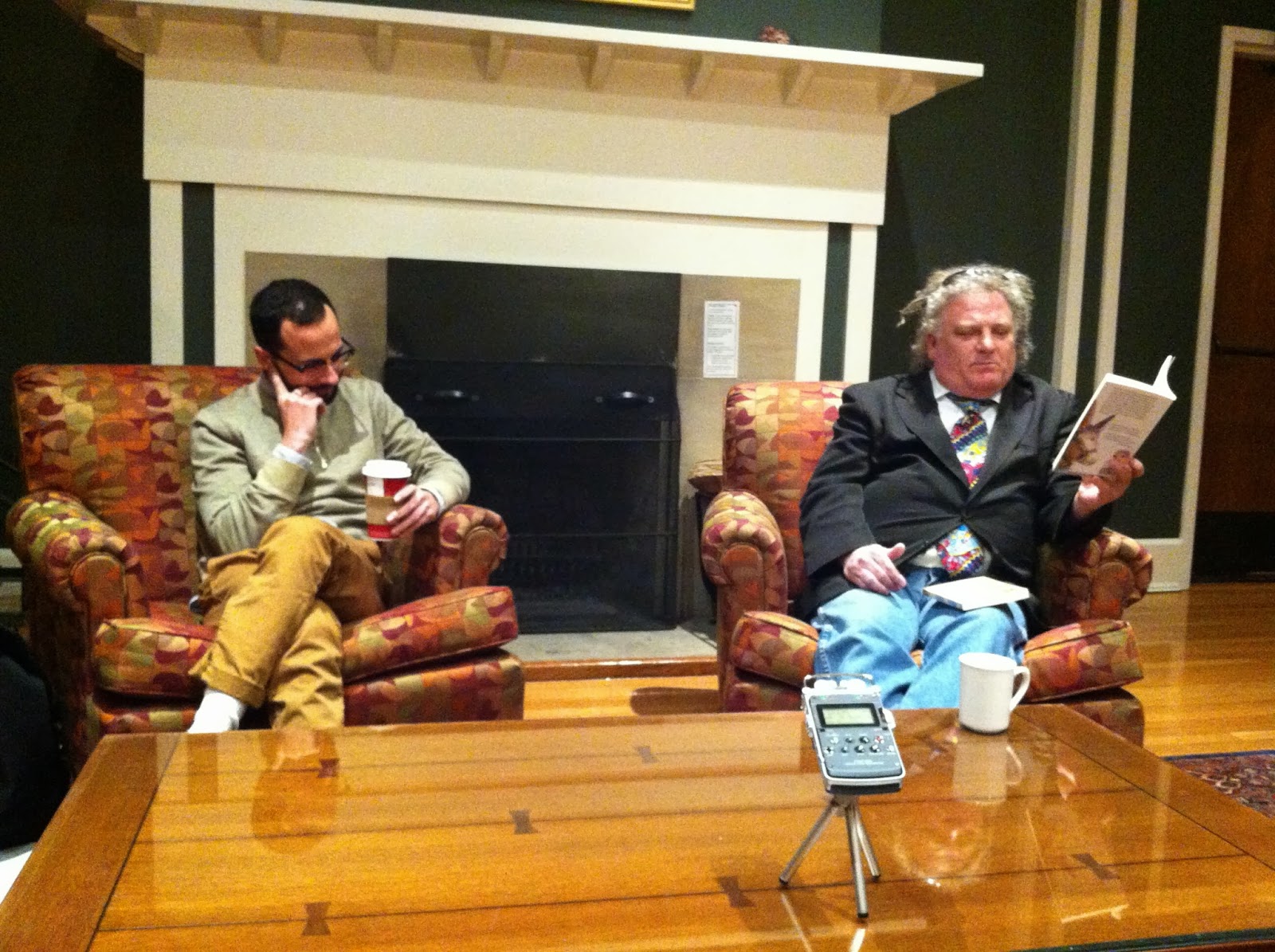
I am keen to introduce the poets: photo by Ryan Fitzpatrick
Daniel Zomparelli and David McGimpsey read at Green College yesterday, as the third pairing in this year’s series of Play Chthonics: New Canadian Readings at the University of British Columbia. Here is an audio capture of the reading, which includes their responses to questions after the reading. Daniel read new work from his iPad, including a poem about Kimmy Gibbler that he had written that day, dedicated, he said, to David McGimpsey. McGimpsey read from his recent collections: Li’l Bastard (2012), which he describes as a sequence of “chubby sonnets,“ and Sitcom (2007), some of which he noted involved re-casting text from Timon of Athens. Both poets engaged in their own versions of what I think is a kind of pop-culture code-switching, coaxing and inverting lyric from pulverized mass media language and image flows. Zomparelli read a pair of poetic synopses of gay porn films. His poems and McGimpsey’s play with the ways in which, as viewers, we’re alienated from experience by screen or headset and, as participants, we’re thoroughly immersed in and seduced by the variegated and empty textures of spectacle, of hubbub: “That Taylor Swift song is not about you,” McGimpsey writes in sonnet 11, “David McGimpsey likes – then unlikes – this.” The reflexive play, the give and take of mass culture that interpellates us (making us feel as if a song were about you, were calling you) even as it refuses us any shared humanity, informs McGimpsey’s poetics, and lends them something of a pathos of misrecognition: “I tried / to recall lyrics to a pop song once loved.” An “I” – like a dropped syllable – feels as if it’s missing from that last line, which is already metrically slightly ungainly, one syllable over its normal count: a spectre of subjectivity, of a self that wants to call itself into existence amid the tangle and meshes of discourse swirling from phones and pads and pods; but trying is not recalling, and recalling is not reanimating. Words, for both of these poets, seem to act as placeholders, markers of wanting, of what – remaindered and unrealized – might still despite everything get to be called human love.

Sincere thanks to Green College for their ongoing and generous support of this reading series, and to the Improvisation, Community and Social Practice research initiative for helping to sustain the series this year. Copyright for this work remains with the artists.

Without Lou Reed Around

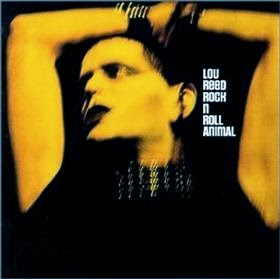
Here’s a short tribute piece, an elegy that came together quickly earlier this week – a small offering from a listener, in memory of.
Without Lou Reed Around
Without Lou Reed around
         the real world starts to feel
under rehearsed.
Without Lou Reed around
you’re going to get away
with less.
Without Lou Reed around
you’ll find out how much noise
those one-chord wonder boys won’t throw your way.
Without Lou Reed around to set you straight
you’ll wish you’d paid
a lot better heed the first time.
Without Lou Reed around
bootworn floorboards ought not
to rumble like the trashed cones of blown subwoofers.
Without Lou Reed around
any silk-screened bananas
on leftover album covers will likely turn brown.
Without Lou Reed around
dog collars and lampblack lipstick
become a hard look to pull off.
Without Lou Reed around you’ll never know
whatever else it was you once
needed to know.


Short Conditional Take on Anne Carson

If I attended “An Hour with Anne Carson,” at the Vancouver Writers Festival yesterday.
If Aislinn Hunter introduced her, using the unlikely but nifty words “betweenity” (purloined from the Brontës’ letters, she said) and “blacksmithery” (source unclear).
If Aislinn Hunter spoke of Anne Carson’s writing’s “fierceness, a fearlessness framed in exquisite craft.”
If Anne Carson then said she had never had an introduction that used the words “betweenity” and “blacksmithery.”
If her miked voice had what seemed to me to be intensity in restraint.
If Anne Carson said she was glad to be back in Canada if only to get a proper bran muffin.
If she then read an essay written in a kitchen in Ontario in winter.
If it was called “Merry Christmas from Hegel,” and if it was, post Nox, a meditation on stillness.
If she admitted, perhaps untruthfully perhaps not, to not understanding Hegel.
If she said she will paraphrase Hegel badly.
If the essay described, with what seemed to me to be aching restraint, what she called “snow-standing” amid the stillness of conifers.
If the text only mentioned Hegel briefly.
If she wrote something like, “The world subtracts itself in layers.”
If she also described that subtraction as something like, “shadow on shadow in precise velocities,” which might be an image of Hegelian negation.
If she said afterward that she wouldn’t be able to answer any questions about Hegel.
If people applauded because it was a beautiful essay and her reading was very beautiful.
         If she then read an essay on a painting by Betty Goodwin.
If the essay was called “Betty Goodwin Seated Figure with Red Angle,” and if it was written for an issue of Art Forum.
If the right title is “Seated Figure with Red Angle (1988) by Betty Goodwin (by Anne Carson).”
If Anne Carson said, “The form is kind of whacked out.”
If by form she meant her essay not the painting.
If she also said that she wanted to find a form or a syntax that suited her own inability to have an opinion about Betty Goodwin’s painting.
If she never said, Ut pictura poesis.
If the form she chose was to write the whole thing in conditionals, seventy-three of them she said, including mention of horses and Freud, each of the seventy-three beginning with the word “if.”
If the idea was to open up to the sentence “the space in your mind that is prior to opinion.”
If I heard in her sense of “opinion” what Plato calls pistis, “belief,” a subordinate form of doxa, “opinion,” but she did not say this, and I may be both pretentious and wrong.
If she said her conditional essay “was fun to do but will be intolerable to listen to.”
If no one believed her when she said this.
If it wasn’t intolerable, not at all.
If she wrote, “If body is always deep, but deepest at its surface.”
If this made me think.
If she also wrote, “If artists tell you art is before thought.”
If by that she meant Betty Goodwin specifically, but I also took it to mean herself.
If everyone applauded again because she was wryly brilliant and provocative.
If she went on to read from Autobiography of Red and red doc>.
If there was more heartfelt applause.
If she took a bow.
If people asked her questions.
If she took another bow.
If she autographed my book, “Respectfully, AC.”
If I could thank her.

Short Take on Paul Muldoon Talking, a Précis

Paul Muldoon was interviewed by John Freeman on stage at the Waterfront Theatre at the Vancouver International Writers Festival this afternoon, and he’ll be reading as one of eight poets at the Poetry Bash tonight at Performance Works on Granville Island. He was asked right off the bat to talk about his collaboration with Warren Zevon, which resulted in a song, “My Ride’s Here,” the title track on Zevon’s last record (and was then covered for a posthumous tribute album by none other than Bruce Springsteen). Mr Muldoon said he “kind of went to school with Warren Zevon,” noting “just how difficult it is to write a song” to make it sound so effortless, and praising Zevon’s genius. He found himself, in composing his lyrics, trying to locate a raw, emotional “angle of entry” into a song. Asked to differentiate between poetry and song, he said:  “I suppose at some level the pressure per square inch in that [Muldoon’s lyric, ‘You Say You’re Just Hanging Out . . .’] isn’t quite what it could be in one of the poems.” At the same time, he said how he wants to realize his own desire for directness and clarity, which lyrics can so better “at some level.” He said he was still “struck by Seamus Heaney’s (I think) successful attempts to pick up Yeats’s suggestion that ‘Myself I must remake,'” and also declared that “poems are more evidently (not necessarily more truly) made out of the core of one’s being.” He described the impact of BBC radio on his desire for clarity and “the need to be direct.” At John Freeman’s request, he read “Wind and Tree” from his first collection: “In the way that most of the wind / Happens where there are trees, / Most of the world is centred / About ourselves.” He read from Madoc, noting as well that he was a “big fan of our friend Laurence Sterne” and how he had also derived a “fascination with lists” from Robinson Crusoe, Defoe’s interest in “stuff.” He said he encouraged his students to develop “a sense of the resonances of every word in a poem,” the specificity of language. He read his song-lyric, “Elephant Anthem,” and noted how he used to pore over lyrics printed on lp sleeves.

Audio: Nicole Markotić and Louis Cabri at Play Chthonics

Nicole Markotić and Louis Cabri read at Green College at the University of British Columbia last evening, as part of the Play Chthonics: New Canadian Readings series. This is an audio capture of their reading. They each offered new work, as well as material from recent collections: Cabri’s Poetryworld(CUE, 2010) and Markotić’sBent at the Spine (BookThug, 2012). (There’s a reviewof Bent at the Spine from rob mclennan’s blog; a review of Nikki Reimer from an April 2010 edition of The Globe and Mail might give some sense of Markotić’s poetics. Louis Cabri has an essay, “Unanimism and the crowd: Early modern social lyric,” in a 2011 issue of Jacket 2 that suggests some of the ways in which he combines poetics with critical-theoretical work.) They also took questions about their poetics. Thanks to both of them for their excellent, engaging readings. The recording, like the one from September also linked to this blog, is fairly vérité, with some air-vent noise in the background, but the voices come through very clearly. The introduction is by Andrew McEwan. Copyright remains with the authors. Sincere thanks to Green College for hosting this event and for providing generous support for the series, and also to the UBC Department of English.

Audio: Jillian Christmas and Chris Gilpin at Play Chthonics
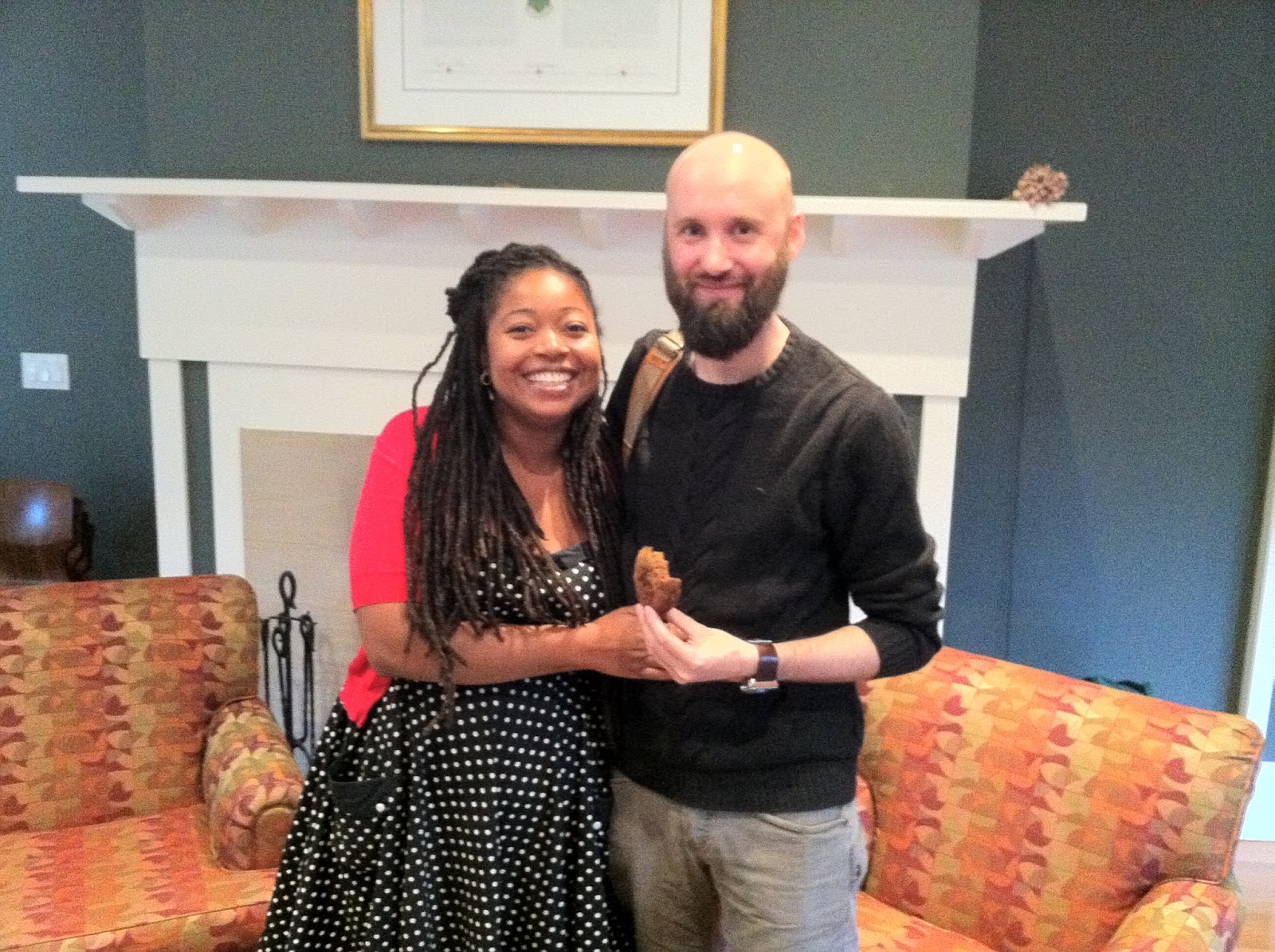
Jillian Christmas and Chris Gilpin read tonight (Wednesday, 18 September 2013) to a small but captivated audience, as part of the Play Chthonics poetry reading series at Green College, U. B. C. I have included an audio recording of their reading in this blog post, below. They alternated performing their own poems, and interspersed their readings with comments on poetics, and answered questions about spoken-word poetry and poetry slams. This was a warm and engaging reading, and it’s a real privilege to have been able to present their work.
         This is a vérité-style recording, but their voices come through very well. It’s just a little marred, just a little, by a noisy ventilation system, and — just to let all potential listeners know — by an overly enthusiastic cleaning person picking up coffee mugs near the end. Other voices you hear include mine and other audience members (among them Andrew McEwan and Carmen Mathes). Copyright for the recording remains with the artists.

         Thanks to Green College, to the U. B. C. Department of English and Faculty of Arts, and to the Improvisation, Community and Social Practice research initiative for their support.

Texture, Line, Frissure: Kathleen Jamie and Birgid Collins
In addition to reading her newest volume, Frissure, which is a collaborative set of mediations on healing and attention, I have been re-reading Kathleen Jamie’s 2005 gathering of essays, Findings, to prepare for a set of first-year lectures on prose non-fiction I am set to deliver over the next few months.  The earlier volume appears to lay some of the groundwork for her more recent prose poems. In the pages of Findings, Jamie consistently demonstrates a palpable gift for perceptive clarity, an attunement to visual and auditory detail: the eleven mediations on the “natural and unnatural world” – “world” meaning contemporary Scotland – that make up the book reflect on her own all-too-human need to accrete what she sees and hears, to hold and remember it, to catch something of her sensory drift and document it on paper before it skitters beyond her field of view. She listens and watches, she notes and collects. And what she often ends up attending to, in each piece, are the gaps and uncertainties in the apparatus of her own consciousness. She comes to observe herself wanting to observe, trying to see and hear her way toward a sublimity, a sense of the near-absolute alterity of nature, that keeps refusing her any absolute access. She often directs her creative energies toward collection and preservation, picking up souvenirs and compiling wrack and flotsam from shoreline scrapheaps, a tactic that recalls the poetic salvage of “Mr and Mrs Scotland Are Dead.” (“Do we save this toolbox . . .?”)
Salvage is also self-directed, when she visits, for example, the Royal College of Surgeons in Edinburgh and peruses the formaldehyde-filled anatomical specimen jars: the human form, a late version frittered from Da Vinci’s homo mensura, becomes a collation or an assemblage of posthumous, scattered parts, bottled samples and amputations. “At certain shelves,” she writes, “you have to bend and look closely, without knowing what you might see. It will be pale and strange, and possibly quite beautiful. It will be someone’s catastrophe and death” (from “Surgeon’s Hall”). Bodies are catalogued, labeled, textualized; she sees them as particular, uncanny artefacts, almost art-objects that, with their vestigial humanity, still resist the aesthetical gaze. Medical and representational objectivity is mitigated by empathy, by the traces of human suffering and of feeling – not affect, but feeling – that persist in these fissured bodies, at once remembered and dismembered: “a stranger’s arm with his [not ‘its’] corroding carcinoma, a diseased breast, a kidney taken from a man gassed on the Western Front, all call forth the same plain tenderness, “ for Jamie.
“Pathologies,” the first essay in her subsequent collection, Sightlines (2012), develops this empathetic scrutiny further, when Jamie describes her visit to a pathology lab to observe clinicians performing biopsies. What she thinks of, plainly, are the people with whose tissues she has gained, as she scrutinizes samples through a microscope, a strange and unbidden intimacy, an impossible closeness. This complex ethic in which she finds herself implicated had already been hinted at in Findings, in the essay I’ve been citing, where she offers a précis of one of the earliest accounts, in “an Edinburgh book” from 1863, of a Victorian surgery: a certain “Mrs Ailie Noble, suffering terrible pain from breast cancer[,] is taken into theatre, and in full view of the young medical students undergoes a mastectomy.” Jamie’s writing practice is often highly iterative – texts embedded into texts, marking the retreat of an abyssal subjectivity – and she quotes her source text to close her own essay; but her point is not to remark a futility, so much as to emphasize the shared pathos of loss even in the seeming detachment of patriarchal science:
He says “Don’t think [the students] heartless . . . they get over their professional horrors and into their proper work, and in them pity as an emotion ending in itself, or at least in tears and in a long drawn breath, lessens — while pity as a motive is quickened and gains power and purpose.
Pity converts from romanticized, narcissistic amour-propre into viable empathy for others, an intersubjectivity of care (to borrow a phrase from Julie Livingston), a call to feeling that Jamie seems to discover somewhere between the jars she observes and the archive she re-reads: reminder and remainder. 
Frissure emerges from Jamie’s collaboration with visual-tactile artist Birgid Collins. When she turned 49, Jamie notes in her preface, she was diagnosed with breast cancer, and underwent a mastectomy. For her, she writes, “it seemed ironic: a case of life imitating art.” She had written extensively, as I’ve just noted, on pathology labs and breast cancer, and now her own body was subject to medical scrutiny and intervention. Redirecting her own attention selfward, negotiating the now intimate collision of observer and observed in her own physiology, seems to come to mean, for her, finding some kind of balance point between the aesthetic and the lived, a means of sensible transcription that would become part of her healing. She ended up approaching Birgid Collins to draw her mastectomy scar, to try to find a means of inhabiting this intersubjective tension; collaboration entails both deferring to perspectives outside of your own, and simultaneously voicing yourself against that deference: both seeing closely and being closely seen, in this instance. The scar is an unruly line, not only in the literal sense of a mark on her skin, but also in both the visual and the poetic senses: “Whatever it was, it was a line, drawn on my body. A line, in poetry, opens up possibilities within the language, and brings forth voice out of the silence. What is the first thing an artist does, beginning a new work? He or she draws a line.” She and Collins, in their various media, begin from a contingent, shared understanding of line.
“With that, a line of Burns arrived in my head. ‘You seize the flo’er, the bloom is shed.'”
Jamie composes a number of prose-poems during her recovery, which become part of their collaboration; Collins pastes fragments of text into her constructions, and incorporates found matter and textiles described in Jamie’s texts into her compositions, which she comes to understand not as drawings but as dimensional constructions she comes to call “Poem-Houses,” which she creates in “conversation” or “exchange” with “K’s fragments.” Line here becomes a trajectory of intersections, an empathetic give-and-take (though not without difficulties and uncertainties). Collins begins with drawings, then introduces “natural” matter onto her paper, then builds dimensionality beyond the surface of page or sheet. The resulting hand-sized sculptures, if that’s the right word, have a raw, stunning beauty, an intricacy and a delicacy of texture that suggest an uneasy balance between the found and the made, the fractal and the formal, the aleatory and the intentional, the natural and the unnatural, that informs much of Jamie’s best writing. (You’ll have to buy the book to see photographs of these Poem-Houses; Collins’s website also has plenty of images of similarly-realized constructions.)
The sense of line in these prose poems, for example, is more latent than manifest: the rhythmic shape of each sentence remains insistent but not (yet) fully differentiated from the rhuthmos, language’s unruly cadence, its natural flow: there are no clean lines, but, like Collins’s art, an attention to the besmirched, the impure, the incipient. “What is a line? “ Jamie asks in “Line”: “A border, a symbol of defence, of defiance.” But a body, such as hers, isn’t healed by being defended, medically or poetically, against its own enmeshment in the natural world, by the surgical repair of its boundaries and limits. Rather, healing for Jamie involves a return to the permeability, to the interpenetration, of body and world:  “To be healed is not to be saved from mortality but rather, released back into it: we are returned to the wild, into possibilities for ageing and change” (“Healings 2”). The textures of Collins’s work derive from this enmeshment, emblematized at a number of points in economies of reciprocity, mutuality and interchange, as healing gifts mailed to Jamie from friends, and passed on to her, like letters written in natural scraps, from the landscape around her: “Spilling from an envelope, a get-well gift of silverweed, bog-cotton and thrift.” (The brief catalogues of found matter in these texts recall the collected flotsam of “Findings.”) To heal, for Jamie, is not to protect or to defend herself in art, but to open up her language to the textures of the inhuman, of the given, and to listen carefully for a “music at the edge of sense . . . the sound of the benign indifference of the world.” (“Healings 1”). Tacitly, and amid its contingent stillnesses, Collins’s work performs this same close attentiveness both for and with Jamie, and both for and with us.