
Home » Posts tagged 'Tomas Fujiwara'
Tag Archives: Tomas Fujiwara
Short Take on Thumbscrew Live at Ironworks (Vancouver, 7 February 2015)
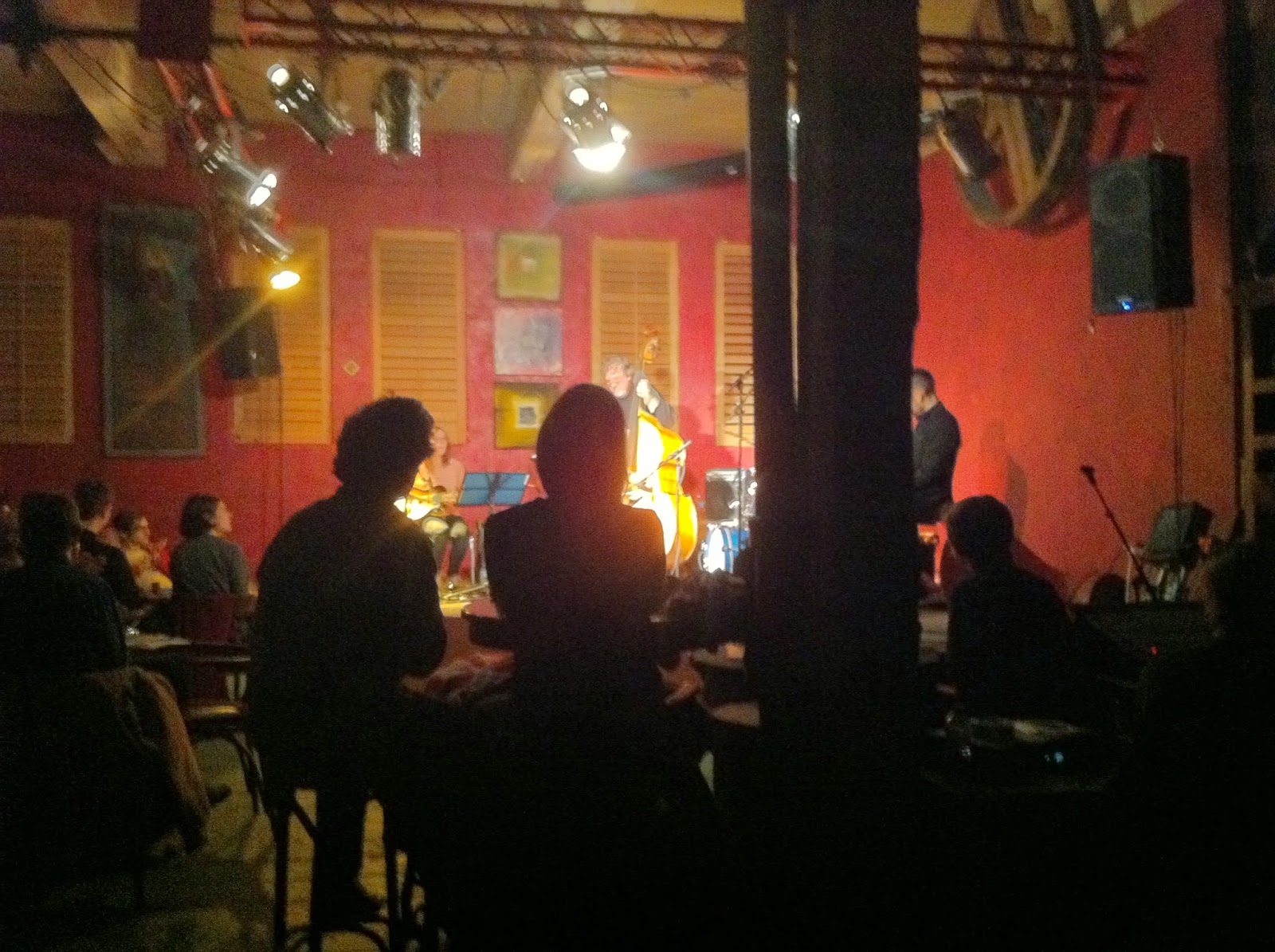 |
| Mary Halvorson, Michael Formanek, Tomas Fujiwara (obscured behind people and a post) |
Thumbscrew offered up two provocative and powerful sets at Ironworks on Saturday night. Building mostly on compositions from their eponymous album (released on Cuneiform last year), the trio’s music combines infectious come-and-go grooves with rhythmically angular, kiltering melodies and collaboratively deconstructive improvisations to create warmly engaged yet restlessly exploratory performances. Mary Halvorson’s guitar alternated between keening warbles and electrified growls, mixing bendy Johnny Smith-like chords with harder-edged Hendrixisms, cross-purposed and glassily recursive loops with tensile, open mellifluence. Her focus and calm demeanour on the bandstand seemed almost belied by the metallic, clarion fierceness of her sound. Michael Formanek’s firm, resonant bass prodded the trio forward, pushing at the leading edge of the beat. He frequently smiled, looking back and forth between his bandmates as his he drew reverberant, lithe lines from his instrument – which underlined the joyful intensity of their collaborative playing. Tomas Fujiwara’s drumming danced in and out of the pocket, by turns muscular and fleet, turbulent and tight. His body angled slightly back from his kit, he tended to face away from his bandmates, eyes closed, but only to increase what felt like his closely attentive, kinesthetic enmeshment in the group’s shared sound, their collective pulse. A few of the pieces were counted in – 1, 2, 3, 4 – but, still palpably embedded in a fixed metric, they were able to pull and surge and suspend and attenuate the beat to the extend that time itself became organically elastic, fluid, distal.
The first set list, as far as I could make out from their announcements, started with “Line to Create Madness” (Halvorson), followed by “Buzzard’s Breath” (Formanek), “Nothing Doing” (Fujiwara), a fourth piece the name of which I missed, something called (I think) “Barn Fire Slum Brew” (Fujiwara) and “Still . . . Doesn’t Swing” (Formanek). After the break, they returned with “iThumbscrew” (Formanek), “Falling Too Far” (Halvorson), “Goddess Sparkle” (Fujiwara), a new piece by Mary Halvorson called “Convularia” – which she said had been named at her father’s suggestion after a “sweetly scented and highly poisonous plant,” the contrariety suggesting something of the tensions between the lyric and the spiky in her own and in the trio’s playing – followed by a fifth piece that might have been “Fluid Hills in Pink.” They were called back by an enthusiastic audience to play an encore – “we have exactly one more song” in their repertoire, they joked – which was an edgy ballad, to close a terrific evening of music by a brilliantly innovative trio.
 Flow, Fissure, Mesh