
Home » 2013 (Page 4)
Yearly Archives: 2013
Deracinated
Mais, qu’est-ce que c’est donc un noir? Et d’abord, c’est de quelle couleur? (Jean Genet, “Pour Jouer Les ‘Nègres’” [1959])
Yesterday I heard El Jones on the radio. The community activist and current poet laureate of Halifax was speaking with Jian Ghomeshi on Q about an emerging controversy surrounding an upcoming concert by Chris Brown, and the building opposition in the city to his appearance there, because of his history of domestic violence. One of the key points she made, both eloquently and forcefully, was that this discussion had much to do with current debates around race and identity, particularly in Halifax, where the cultural politics and the cultural history of blackness has played a significant role in shaping the character of the city and its district (Dartmouth, Bedford and other linked communities).
Her remarks had me think back to the beginnings of my own engagements with the discourse and history of race in this country, how this trajectory of my education was set in motion. I was taught Canadian History in my last year of high school in Truro, Nova Scotia (about an hour’s drive from Halifax), by Wayne Foster, who had designed his course around what must have then been a risky and innovative principle in 1981: the first term presented the emergence of the nation filtered through the perspectives of a number of First Nations, while the second term focused on African-Canadian history. I know we had a textbook, although much of what Mr. Foster discussed came from his own research, and I know that he had us reading on our own, too: finding source material for ourselves, if we were able. But I’m sure I had no idea at the time how atypical and how genuinely provocative this class could prove to be. I’m sure he wanted us to think about the ways in which our own history, the history of our place, had been shaped, about how perspective mattered, and about how the recovery of racially-inflected – that is to say, non-Anglo-Celtic – viewpoints had the potential to radically shake up our senses of the given, of what we were told had really happened as our country was being formed, confederated. And I knew next to nothing about the history of the Black community in my own town. Looking back now, I truly admire Mr. Foster’s courage, and his willingness to take what were then substantial intellectual risks, and to invite his students to do the same: to raise consciousnesses, to make us more fully and carefully aware of who and where we were. At the time, however, as a slightly smug seventeen-year-old, I remember myself not so much being grateful as resistant. For some reason, and this is still a bit hard for me to explain to myself, I didn’t want to hear what Mr. Foster was offering us. I think I wanted to cling to a generic, comfortable and singular view of where my sense of language, place and belonging might have come from. This resistance, this recalcitrance, seems all the more peculiar to me given my reading and my taste in music at the time, which was thoroughly caught up in anti-racist punk, existential political philosophy, soul and post-Coltrane jazz. Really. Somehow, I guess I needed to keep the conceptual and the aesthetic separate from the historical, from the immediate experience of being from small-town Nova Scotia. My reading and my listening were idealized and remote from who and where I was, even though I know I identified powerfully with Miles Davis, with Rahsaan Roland Kirk, with The Clash, with Otis Redding, with Jean-Paul Sartre and Jean Genet. I now realize that, despite my rather artificial adolescent resistance, Mr. Foster’s history class has had a substantive impact on how I have come to think about race, about the collision of the aesthetic and the political, of the representational and the lived, in our social and cultural existences in this country. And I need to acknowledge and to thank him genuinely for that.
El Jones’s radio spot was one of several public interventions she has made in the past few days: she also appeared on The National on CBC television, and published, in a Huffington Post blog entry called “Protecting Canada’s Trayvon Martins,” a list of “some things Canadians can do” in the wake of the verdict in the George Zimmerman trial in Florida. Her work, here and elsewhere, voices itself – advocates – primarily in the imperative; here is the sixth of her eight calls to action:
Educate ourselves and our children about racism. Yes, it is important to tell children they can follow their dreams. But we also must give them information that protects them. This case showed us racism isn’t over, so let’s stop being scared to tell the truth to kids, leaving them vulnerable and confused. Teaching about racism also means teaching them Black Power principles. Don’t pretend race doesn’t exist for them, give them the knowledge to understand themselves.
The “Canadians” she’s addressing in entries such as this sound not like Canadians in general, but like those of us (not me) who identify as black: and maybe even more specifically as east-coast, an identity George Elliott Clarke once named “Nofaskoshan” or “Africadian.” A conceptual fracture emerges in the encounter with such an identity when we put a bit of pressure on what specific practice of education El Jones means to call for – despite the overt claim to candour and directness she makes, and even enacts stylistically in the feel of straight talk here. Educating “ourselves” can’t only mean discovering the presence of blackness in our Canadian midst, although that’s a starting point. That’s what I think happened for me thirty-odd years ago in Mr. Foster’s history class. While that discovery – that re-discovery – appears to have become a necessity again now for many, education also means going a bit further, I think. It means recognizing, and negotiating, our complicity in a general cultural and historical problematic around cultural constructions of blackness. For me, this fracture runs deep, and it’s crucial to acknowledge it and to inhabit it critically, thoughtfully.
Race, in my experience, comes to name not a framework for identity but the ongoing fracturing of identities. Despite its various corporeal and historical materializations, despite its difficult tangibility, despite its challenging lived realities throughout the human world, race – in this instance, blackness, which seems to serve as a synecdoche for race as such – remains largely a cultural and historical construct, a “floating signifier” as Stuart Hall argues. To emphasize the semiotics of race (against its genetics) is not to ignore or to obscure its reality, but to try to find a means – a poetic means, I’d say – to encounter it and to counter its nascent perniciousness, the slippery slope down which race slides into racism. I’m not starting to make a case “against race,” although I find Paul Gilroy’s approach to what he calls raciology both resonant and critically provocative. The pedagogical imperative to “educate ourselves,” as I read El Jones, means learning to face those conflicts, to recognize and to work through the often dire representational fractures that discourses of race tend to frame. But not necessarily ever to be done with that work.
So the imperative, as she recurrently characterizes it, is still a need, but more specifically “the need to have difficult conversations.” (I’m lifting this phrase from one of her Facebook updates, but she uses versions of it throughout the radio spot.) It’s a hard form of language-work, a poetics. That’s not to substitute aesthetics for politics, but to return to the uneasy craft of language a tangibility, an engagement with the what matters: to politicize the aesthetic. The difficulty of conversation, in my view, gets foregrounded in Jones’s return to the rhetoric and ideology of the late 1960s. A disturbing question lurks in and behind this call: that is, shouldn’t we have been done with Black Nationalism by now, more than 40 years on? (As El Jones rightly points out, it’s more like 400 years on. And who, by the way, constitutes this “we” I’m so glibly tossing around?) Perhaps our shame – pointed up by the discursive tangle surrounding Trayvon Martin – is that in North America we clearly aren’t done, and aren’t going to be done with it. I find I can’t accept El Jones’s call to return to “Black Power principles,” because my critique of race – enabled, no doubt, by a personal history of deracinated privilege, of not having to be subject to discrimination on a daily basis – involves challenging what feels like an under-interrogated identity politics; that challenge, for me, is in fact what it means to educate ourselves. Identity politics, in my experience, tends to shut down conversations, rather than to enable them. But the fact remains that my kind of academically privileged and rarefied critique might not be especially timely, not yet. The work of consciousness raising still, still, seems to require identifications, solidarities, nationalisms and ethnocentrisms. Even now. Perhaps especially now.
So, as I position myself here, I remain at least partially excluded from those adhesions and identifications, and necessarily so. I’m still working to find my way back through the resistance I felt in that history class thirty-odd years ago. But I think that’s exactly what I ought to be doing. Exclusions and differences are part of the needful difficulty of talking about race. I’m putting more pressure on El Jones than maybe her words have invited, but I think what she has said in the past couple of days represents an important intervention, and a significant provocation to public discussion and debate. And I’d like to thank her for that, as well.
[Edit: El Jones wrote an excellent article on race, violence and Chris Brown, published in the Halifax Chronicle Herald on July 19, 2013. You can read it here.]
Robert Bringhurst and Anne Carson Translating Antigone (Audio)
"We Jimmied the Radio": Brad Cran, Gillian Jerome and the Lyric in Public (Audio)
Video Intro for Arts One Digital
Here is a youtube video made by Jon Beasley-Murray (of Posthegemony fame) for Arts One Digital, a first year humanities program at the University of British Columbia in which I taught for the past two years. I mention, and try briefly to describe, something of the improvisational pedagogy I have been trying to develop on my own terms over the past decade. The video was taken in my UBC office on Friday, 5 July 2013. The other materials on the Arts One Digital website form an evolving digital humanities supplement to the Arts One syllabus. Two of Jon’s blog posts on MOOCs, pedagogy and electronic media appeared today re-published in The Tyee, and are well worth checking out.
On Lydia Davis, Doing Flaubert Some Justice
Short Live Take on Tim Berne Snakeoil
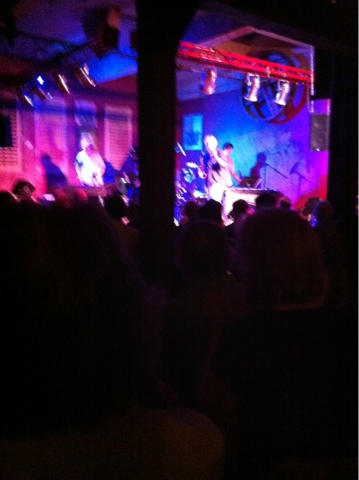
Mary Halvorson, "Songs that Get Stuck in My Head"
Just come back from an hour-long afternoon public workshop with guitarist Mary Halvorson at the Roundhouse Community Centre in Yaletown, part of the last weekend of the Vancouver International Jazz Festival. It was a real privilege to hear her talk and play. She was personable and articulate, taking questions and playing a handful of brief solo improvisations.
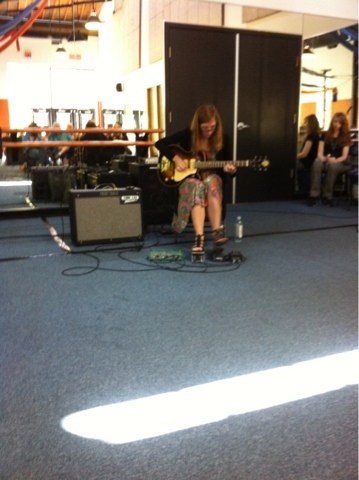
She confessed that she was in the midst of “working on solo guitar music,” and that she hasn’t really performed solo up until this point in her career as an improviser. She said that she had decided to base her nascent solo work on “songs that get stuck in my head,” which at this point were principally jazz standards, although she was also looking to various “compositions by other people” as source material. She admitted that she tends to focus on melodies and has a harder time “remembering the chords.” But there was nothing diffident or self-effacing in her aesthetic or in her performing; her spotty memory seems to offer creative opportunity rather than impediment. Or, as she put it, “I’m going to make up my own chord changes to these existing melodies.” She offered a foreshortened but compelling version of “Beautiful Love,” laced with pitch-bent burbles, halting twangs and lyrical turn-on-a-dime redirections. She likes, as she said, “weird left turns and falling off cliffs” in music–her version of the “sound of surprise”– but her playing also drew out a gently fraught lyricism in each of her lines. If this really was a hint of what’s to come, her solo work is going to be beautifully unsettling and eclectically brilliant. She talked at some length about some of the challenges she feels she is facing combining her own idiosyncratic approach to the instrument with a more idiomatically “jazz” approach to playing and to musical form. (In fact, before she began talking, she played us a track from her iPod, Johnny Smith doing “Moonlight in Vermont,” and admitted her love of Smith’s sound. Smith had passed away a little over a week ago.) She also played a track from her yet-to-be-released septet album, roiling layers of horn and guitar.
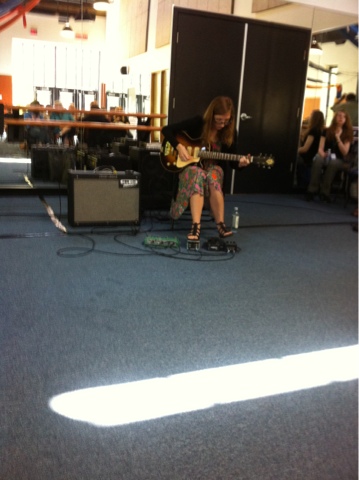
When asked about connections between her styles of band leading and composition, she said she tries to enable and to support the members of her group, and is keen “not to be too controlling.” She pointed to her experiences with Taylor Ho Bynum‘s sextet–the example was suggested by someone in the audience–as a possible model for relinquishing control and instead creating democratic interactions among the players. At the same time, referring to her studies with Anthony Braxton (whose music she said helped her decide to drop her courses in biology and pursue music) and with Joe Morris, she said she felt that “the teachers you have really shape who you become,” noting that both of these mentors encouraged her to follow their example in seeking out her own idiom, her own ways of making music. A brief improvisation built from cascading pulses closed out the workshop.
Julian Arguelles Quartet at Ironworks: a Live Short Take
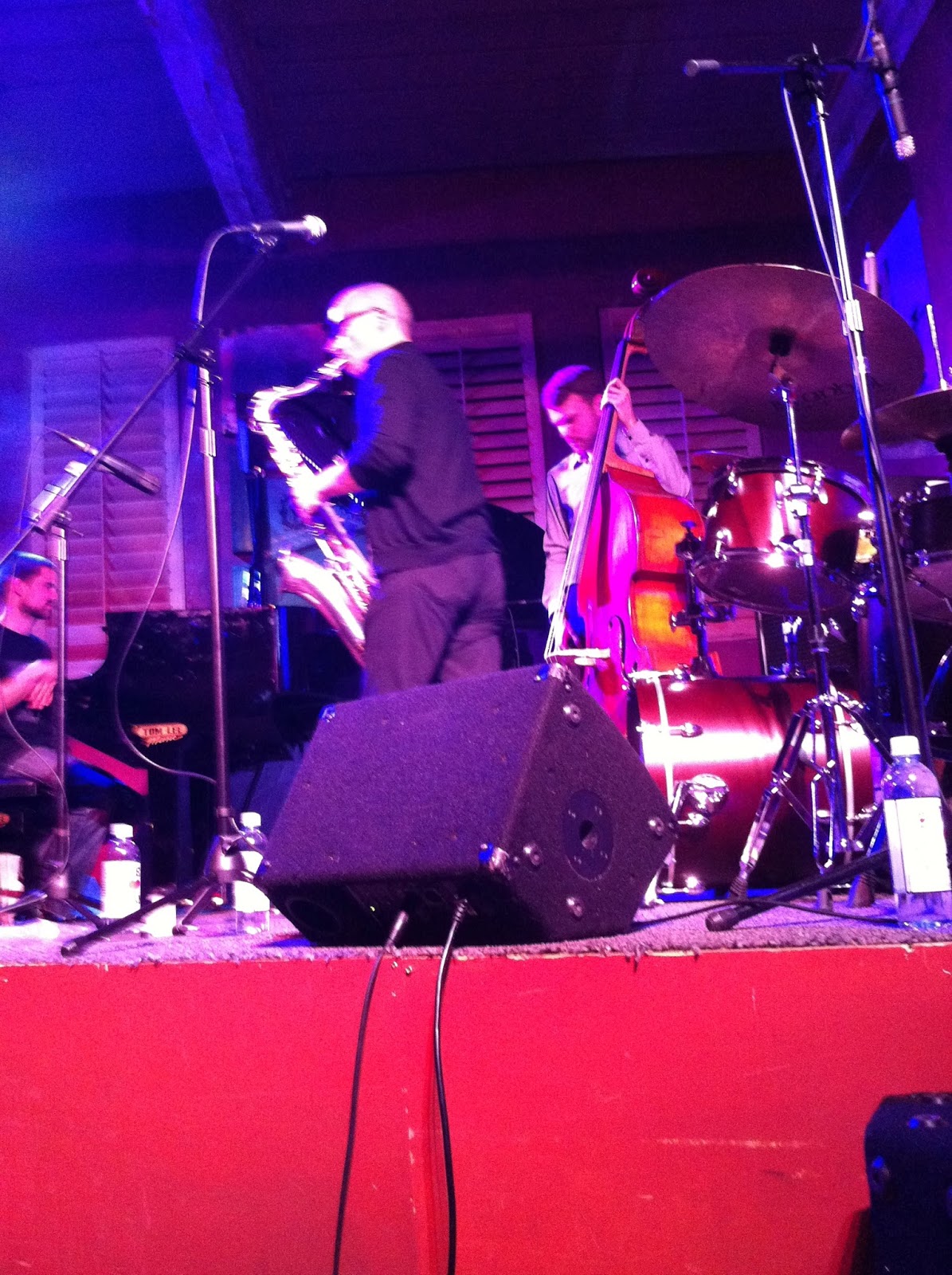
What John Coltrane Left Here for Us to Learn
Listening to jazz, to improvised music, changed my life, and for the better. The music started to matter to me early on, when I was still a teenager. It wasn’t that I had a particularly difficult life, but in the struggle through late adolescence to articulate myself as someone I hoped might become a coherent human being, the music was there, impelling. And I don’t exactly mean making music, since I was never a player. But for some reason, it presented me with a calling that has remained more or less insistent throughout my adulthood. Listening — actively, deliberately — to this music continues to offer me what feels like meaning. This kind of listening wants to be proactive and deliberate, a willful focusing of the ears and the mind. A concentration you have to work at. A version of this imperative, the call to pay attention, famously takes poetic form in the disjunctive closing line of Rainer Maria Rilke’s “Archaic Torso of Apollo” (hardly a jazz poem, I’ll admit — it doesn’t even mention music, but dwells instead on the visual and the spatial), where a broken classical sculpture conjures the capacity to look (or to perceive, to attend) back through its viewers — its shoulders curve down, Rilke says, “durchsichtig,” which means translucent but also, literally, through-sighted — and to invite if not to demand, as the poem finishes abruptly addressing both onlookers and its own readers in the second person, that “Du mußt dien Leben ändern”: “You must change your life,” you must other your life, live otherwise. Illusions and delusions aside, I always knew I was never going to be much of a musician myself. But I still hear it, and write about it. It’s the experience of listening itself that continues to impel me, as what I hope to become as some sort of a creative maker, a poietes.
One of the metaphors that attaches itself to this music is curative; it’s good for you because, as Albert Ayler puts it, “Music is the Healing Force of the Universe.” This kind of music makes the world — or at least my small corner of it — a better place to be. In “The Sick Man,” one of the poems gathered in Sascha Feinstein and Yusef Komunyakaa’s first Jazz Poetry Anthology, Wallace Stevens explicitly associates Southern Black American music — a mishmash of folk blues (“mouth-organs in the night or, now, guitars”), gospel choirs and jamming bands — with a capacity to heal an epigone (“late, late”), dispirited and ailing North, a cure that takes on a specific form of attention, a form of listening:
And in a bed in one room, alone, a listener
Waits for the unison of the music of the drifting bands
And the dissolving chorals, waits for it and imagines
The words of winter in which these two will come together,
In the ceiling of the distant room, in which he lies,
The listener, listening to the shadows, seeing them,
Choosing out of himself, out of everything within him,
Speech for the quiet, good hail of himself, good hail, good hail,
The peaceful, blissful words, well-tuned, well-sung, well-spoken. (206)
There’s an uncomfortable raciology here that needs to be acknowledged. Still, the seclusion Stevens describes as the generic solitude of the sick-bed is also uncannily analogous to the situation of the music fanatic, headphones on, volume turned up, listening to recordings. The poem attends, in the dual senses of waiting and listening, but it also promises to overcome in an imagined ideality the bifurcations of race, geography and history that both inform this music and mark its distance. What Stevens describes as healthy listening — betterment signaled repeatedly as “good hail” — is not musical imitation, trying to appropriate this music as his own, but verbal response, a mode of speech that wants to find its answerable style. The sort of listening that I find myself aspiring to practice, a listening invited and even provoked by jazz, impinges on the writing, critical or otherwise, here and elsewhere, that I’m trying to do. I aim to write out and to write through acts of listening, and to suggest how, in a number of crucial ways, we can come to recognize the temporal drive and the vitality of literary language — of the intensified, musical verbiage of poetry — by digging into the heft and flux of the improvised as it intersects with words, lines, periods: and by trying to feel, in some measure, the pull of its moment, the “choosing” for which Stevens’s poem calls.
On the back cover of Echoes of a Friend, a 1972 recording of piano solos of compositions by and dedicated to John Coltrane, in whose great quartet he played in the 1960s, McCoy Tyner cites an old Calvinist adage: “Many are called, but few are chosen.” His intention is clearly to honour Coltrane’s genius, to affirm the saxophonist’s singularity and to acknowledge with careful humility his own part in Coltrane’s legacy. But what emerges in this brief statement is a figuration of the instrumentalist not so much as co-author of the work, which Tyner clearly was, but as listener, as student, as apprentice: the passive voice — “are chosen” — suggests both a sidelining of artistic ego in the service of greater things and an erasure of artistic agency in favour of a more romantic notion of the artist as passive receptor, as Aeolian harp. Stevens, in a subtle but deft move, refigures the listener as an active presence, as hearing becomes a forging in the consciousness of the listener not just of sound but of aural form, and of meaning. Heartsick and passive though he — or she — may initially appear, the listener for Stevens intervenes in the music, which transforms from “singing without words” into a plenitude of speech. The change, the healing that jazz — that Black Classical Music, as Rahsaan Roland Kirk called it — affects in this outsider, is not a case of being called or chosen, but of choosing, of taking up that call and making it speak back, a form of existential call and response.
So then, here is a story about how I once missed my own calling. In junior high when they announced over the PA that anyone who wanted to be in the school jazz band was to come down to the auditorium, I must have been talking, because I missed the announcement. And it never occurred to me, naive and acquiescent as I was by nature, that I might have still been allowed to join up after that. When I found out after school about the call for the band, I figured that was it, I’d missed my big chance, although looking back now I can’t really blame anyone else, since I was probably just more interested in other things — other than music, I mean. (I was in the drama club that year, and worked on the yearbook.) I’ve always liked brass, and used to imagine myself with a trombone, an instrument my younger brother picked up two years later. (He was clearly the kind of guy who paid attention during home room.) Years later, at graduate school I used some of my scholarship money to buy a student-style Yamaha trumpet at a pawn shop; I still take it out of the closet about once a month, squeeze out a few awkward clams, then wipe it down and put it back in its case. If you don’t practice every day, you lose your lip. Like I said, I am no player. And, all things considered, I must never really have wanted to be one, or I’d have joined the band, somehow, long ago.
Taking part in improvised music, for me, hasn’t meant playing music so much as playing along, enacting a certain kind of participatory audience, of actively listening and responding, of aural interaction. Writing about jazz and improvisation, writing alongside, through and even against it, marks off some of the traces of that interaction, and also gestures at a language of enactment, of improvising critically and verbally, a form of what Ken Nordine and Rahsaan Roland Kirk, in different contexts, once called “word jazz.” (Reflecting on his 1957 LP Word Jazz, Nordine defined what he does as “a thought, followed by a thought, followed by a thought, ad infinitum, a kind of wonder-wandering”; essentially, as a precursor to the surreal monologues of Spaulding Gray or the transcribed monologues of David Antin, Nordine improvised serial text over a hard bop background, his first two records featuring a jazz quintet led by cellist Fred Katz.) What this meant, for me, was that there could be a viable intersection of language and music, of the written and the performative, of script and improvisation.
Things started, and kept on, with record collecting, a habit I acquired at fifteen from my friend who lived down the road from me and who had a good stereo. We used to hang around in his basement after school or on Saturdays, listening to his records and, later, some of mine. He got me into jazz. I don’t know where he heard about it. We lived in a small town in Nova Scotia, where the local AM station played a mix of country, the hit parade, and MOR rock. We were both pretty well-behaved middle-class fellows, but we were secretly hooked on punk, which was still around (this was about 1979 or 1980), though nobody knew Much about our two-person subculture, since we never actually dressed the part. But even if we never really walked the walk, we still tried to talk the talk. And we weren’t all that exclusive in our tastes, and would listen to anything with a bit of a rough edge: the Rolling Stones (Some Girls and earlier, none of that disco), the Who (anything with Keith Moon — and Pete Townshend loved the Sex Pistols, which was cool), Bruce Springsteen (The River was new), Elvis Costello (everything, which at that point amount to four records), and especially The Clash. And then, maybe out of boredom, maybe out of curiosity, we both bought some jazz. Well, I bought what he bought, which started out with two records. My Dad had some old albums by Dave Brubeck (Jazz Impressions of New York) and Al Hirt (On Broadway), but we disdained them as too mainstream and too tame — too middling white like us. We wanted something sophisticated, something unique. Something that didn’t fit. And I think in our own restrained way we wanted to rebel, we wanted out. So, we each got a copy of Miles Davis’s Kind of Blue — ironically, one of the best selling and ubiquitous jazz albums of all time. And a copy of The Vibration Continues, an Atlantic two-fer compilation of Rahsaan Roland Kirk — an album that hardly anybody had, or ever would, although Rahsaan’s music, it turned out even more ironically, was even more closely in touch with mainstream pop, from Marvin Gaye to Burt Bacharach, than Miles Davis’s dressed-up “social music” of the 70s and after.
More often than not, that Rahsaan record was, to my ears, just plain weird, some of it to the point of being unlistenable. (There was a three or four minute meander on the nose-flute — Rahsaan Roland Kirk had a notoriously huge and abnormal instrumentarium, most of which he wore dangling from halters around his neck when he performed — called “Rahsaanica” that I could never get into, no matter how hard I tried to force it: Joel Dorn’s liner notes said it was genius, but I just heard noodling. It took me a long time to connect with what he called his “natural black inventions – root strata.”) Not too many people outside of aficionados and devotees, even now, have likely heard much of Rahsaan. (Most of the liner notes to recent issues and reissues of Rahsaan’s recordings used to be by Dorn, on whose independent labels these recordings often later appeared; in almost every one, he cites listeners who have experienced epiphanies — what Rahsaan himself might have called “bright moments” — at one of Kirk’s concerts: “I was blind until I experienced Rahsaan,” one listener rethinks the saxophonist’s disability into his own version of an amazing grace: “blind to the infinite potential of the human spirit.” Interestingly such insight, such personal revision, comes from Kirk’s auditory presence, his sound. Rahsaan, Dorn notes, “wasn’t given his due during his lifetime. He died frustrated, but he knew that someday people would get it.” Enlightenment, getting it, has been closely tied to jazz listening since its beginnings, even when it was essentially a popular dance music; the apocryphal story of Louis Armstrong’s response to a reporter asking him to define jazz — “If you have to ask, you don’t need to know” — implies a closed, cultish elitism that both informs the trope of “getting it” we hear circling around Rahsaan’s unjustly neglected music and runs counter to its fiercely loose populism, its imagined capacity to reach out to anyone and everyone.
Rahsaan’s music did reach me, however. I know this, because when I listened to one track in particular from that double album — a medley recorded live at the 1968 Newport Jazz Festival, which originally appeared on the second side of his Volunteered Slavery record — something was to break in on me: and not just for the first time, but every time I’ve played it on the stereo since then. The recording itself is pretty low-end. Rahsaan is backed by a great trio of pianist Ron (later Rahn) Burton, bassist Vernon Martin, and drummer Jimmy Hopps, but the piano is tinny and remote, the bass nearly inaudible, and the drums a slurry wash. But the technical quality, it turns out, didn’t really matter, and may even have pushed up the intensity of my bright moment, since Rahsaan’s flutes and saxophones are (in contrast to his band) miked so closely that the sound sometimes overloads with wow and flutter. He gets right in your face. While some might hear aggression in this performance, I hear energy, intensity, and explosive vitality. It’s next to impossible to describe what happens in the mere twelve minutes that this track takes, and it seems to me you need to hear it to believe it. Not because it’s transcendental in some naive sense, transporting us to realms of consciousness beyond words, no. But because it marks an intense collision of form and content, of tenor and vehicle, of signifier and signified that simultaneously informs and defeats what Roland Barthes once called being “condemned to the adjective” (180) in music criticism. It’s meaning, for me, consists in an iterable and nearly infinitely reproducible overwhelming of the break between act and description, a break that — if you think about it — actually forms the necessary gap across which meaning in language always occurs; this performance produces meaning both for and in the listener by closing the hiatus that requires language to mean in the first place. But I also need to be clear that I’m not talking about music itself, whatever that might be, but about a kind of affect, a response in and by a listener. About the ways in which the music enables and even contains a practice of audition, of audience.
On the recording, Rahsaan announces to his audience that he wants to play “a memorial and a short medley of tunes that John Coltrane left here for us to learn”; this particular Newport Festival happened almost two years to the day after Coltrane’s death, and the anniversary may have been on Kirk’s mind, although he also makes it clear that he “was playing this before [Coltrane] split, so I dig him very much.” It’s noteworthy that Kirk positions himself as a somewhat epigone synthesizer, a latter-day traditionalist who gathers and configures even the immediate musical past, demonstrating important continuities and influences; he gives his audience a lesson in jazz’s living history. Only one of the compositions Kirk chooses is actually composed by Coltrane, so the idea that the saxophonist “left” these tunes behind might at first appear odd. (The songs are Billy Strayhorn’s “Lush Life,” Mongo Sanatamaria’s “Afro-Blue” — which has at times been miscredited to Coltrane — and Coltrane’s own “Bessie’s Blues.”) These tunes become Coltrane’s, however, not only in as much as he recorded them and put an almost indelible interpretive signature on them, so that they would be associated with him from that point on, but also because the first song in particular points to a continuity between Duke Ellington, from whose band book “Lush Life” comes, and Coltrane. Ellington and Coltrane recorded an impulse! album together in 1962, a session for which the pianist composed the infectious blues “Take the Coltrane,” its title signifying on another famous Strayhorn composition. The blues, as the basic idiom of an African-American folk tradition — Rahsaan called jazz “Black Classical Music” — also informs each of the compositions Kirk chooses from the Coltrane canon, but the blues is also variously skewed and rearticulated. Joel Dorn writes in his liner notes to The Vibration Continues that “Rahsaan was interested in preserving the music and reinterpreting it,” but his performance creates and sustains a more radical form of musical history than such banal statements indicate. Kirk invokes a complex network of associations and resonances that extend from New Orleans through swing and bebop to Coltrane’s avant garde output of the last years of his life; furthermore, he doesn’t simply replicate, as repertory, Coltrane’s style or sound, but reinvents this music as his own, accounting for Coltrane’s presence while freely — and even sloppily — adding in his take. Rahsaan’s classicism is neither staid nor fixed, but a renovation, an amicable and lovingly rough scouring of what has come before.
If his aim in revisiting Coltrane is pedagogical, if we are meant to learn something from this music and from Kirk’s revisionary re-performance of it, what we are taught, both by example and by participation, is how to listen. Kirk’s reworking of Coltrane is an act of directed listening, of “digging” what Coltrane played, but a listening that is also a musical performance to which we — the “us” Kirk invokes is both the audience at the live performance, who scream more wildly as his performance continues, and, because this is a recording, a more general evocation of his rather fallen and decrepit America (“Can you hear that yet?” Kirk asks Dorn, and, according to Dorn, also asks all of us) — are listening. His record becomes an occasion to relearn how to hear.
This insertion of the listener into the potential sound-space of the performance, the way in which the music makes room for response, for a kind of audience participation — or really, for audience as co-participation — emerges on the recording as the Coltrane medley gives way to a Kirk composition, “Three for the Festival,” which Kirk had originally recorded in 1961 for the album We Free Kings. Writing or playing himself into this medley might seem an act of egotism, working himself into the canon by attaching his own career retrospective to that of Coltrane, but “Three for the Festival,” as various bootleg recordings of Kirk’s performances demonstrate, was a staple of his live set. Nevertheless, Kirk clearly and unabashedly does write himself into that history, not only as an exponent but also as a living presence, its embodiment. This intervention is not, however, a form of hubris so much as a delineation in performance of that history, a lived iteration of the past not disguised as immediacy but reworked in a dynamic, present-tense, active mediation. “Three for the festival” is a show-stopper, which begins and ends with Kirk blowing a simple melodic line through three saxophones simultaneously. (Kirk continued to be charged by critics with mere gimmickry for showing off his multi-horn technique, but he was also clearly more interested in the musical potential of this kind of makeshift polyphony than in empty grandstanding.) This riff frames an extended solo on the flute, while the band double-stops behind him. The effect certainly centres the performance on Kirk and foregrounds his instrumental voice (as does the extremely uneven live mix of the recording, as I’ve already pointed out), but what happens during this solo has little to do with self-aggrandizement. Kirk customarily sang or hummed into the venturi opening of his flute, creating slightly detuned unisons or harmonies; the roughness of the collision between instrumental and vocal sounds isn’t so much a failing as a roughening designed to highlight what Barthes named “the grain of the voice.” Barthes’s essay focuses on operatic baritones, and on the demystification of a perfected tonality that essentially dehumanizes the voice itself. What we hear in Kirk’s tone is just the opposite, almost all grain. Breath, vocal cords, even musculature seem to sound across the mouthpiece of his flute, and because of the close-miking what we hear is the impact of air and lip on the surface of the microphone itself. As his solo continues, Kirk refrains from letting the flute sound, retracting his breath rather than blowing into the opening. Instead, a audible set of grunts, as he sings with his mouth nearly closed, along with the clicking of his fingertips on the flute’s pads, creates a species of musical mime, a refusal that sounds as music. The notes, held back in this way, become nearly pure percussion, rhythm without melodic content: we hear, in other words, the liminal background noise of the performance — the clicks and thuds of body and breath against metal that are usually covered over by the proper sounding of the instrument — now brought to the aural foreground. We hear the grain of his voice, as the voice holds itself contingently in abeyance; the grain, Barthes writes, is “the materiality of the body speaking its mother tongue” (182). “The grain,” he asserts, “is the body in the voice as it sings, the hand as it writes, the limb as it performs” (188). But there is more to this idea than a temporary reification of sound mechanics in Kirk’s solo; within seconds, the tension caused by holding back his breath leads to an explosion of sound, a slurry of spittle, ululation, laughter and unmusical noise into the flute. Kirk clearly loses control at this point in the solo, and as he works to find a tonality again, he starts speaking — well, cursing — into the flute. Here, not just sound but extramusical commentary enters into the performance; when we hear him stutter “god damn da da you [unclear swearing]” into his instrument, we also hear his struggle to reformulate his playing on the fly, and to acknowledge his failure to keep his music on track, in line with his intention. But that failure, importantly, also is his music at that moment: it’s still integrated into the solo, which never loses momentum, despite itself. Importantly, along with this collision of performance and commentary is a simultaneity of language and music, a simultaneity that Barthes (again, in a rather different musical context) suggests is the outcome of attending to “the grain of the voice, when the latter is in a dual posture, a dual production — of language and of music” (181). That grain, however, is better understood as friction than cohesion, “the very friction between the music and something else, which something else is the particular language (and nowise the message)” (185). Barthes posits a new kind of criticism that becomes immanent to the object or performance that draws its attention, that catches its ear: the engaged listener doesn’t decode a message from the musical performance so much as experience, in this duality of word and sound, a rethinking of the structures of message-making themselves.
This doubling is what (via Rahsaan) “word jazz” is all about. This kind of critical practice, in as much as its calls for a newness, still depends on the delivery of a message, however, but it is not a content in the common sense of meaning or message. What listening to this music delivers, its message, is essentially a pedagogy, a mode of apprehension that wants to be learned, and relearned, rather than unquestioningly or casually regarded. You have to hear it, rather than just listening to it; you have to listen instead of merely hearing it. Such imperatives cling to this music, and form the core of what it not only invites but even requires from its audience. On his 1963 album Mingus Plays Piano, the bassist and composer Charles Mingus has a brief tune entitled “Roland Kirk’s Message.” (Kirk had played with the Mingus’s group that recorded Oh Yeah the previous year, with Mingus also on piano instead of bass.) One of my own responses to Kirk’s music was published in Descant in 1995, and takes up this idea of content, of message in the music, pace Barthes. It’s called “Rahsaan Roland Kirk’s Message,” and it goes something like this:
Forget the word-jazz; tell it like it is.
Most people sleepwalk through their custard lives,
then waste what little snatch of breath remains
trying to talk their way out of waking up:
volunteered slavery. The world wears its chains
like a badge of honour. Nobody gives
a damn about nobody else. Who says
the blind’ll see? Darkness fills my cup.
Somebody tell me why. Charles Mingus said,
“Maybe someday they’ll hear,” but I doubt it.
The black and crazy blues pass on. We have
to bear the cross before the cross bears us.
The poem (I need to admit) is a tissue of quotations and intertexts from Kirk — including the titles of several of his compositions, as well as a modified line from his “word jazz” version of “The Old Rugged Cross,” which forms the last sentence of the poem. The lightly inflected African American idiom isn’t and can’t ever be mine, but remains an off-kilter ventriloquy of Kirk’s voice. This is my attempt, in a far more muted and formally constrained manner, to do something like what he did to Coltrane: not imitation, but tribute. The effort, as I know it, involves finding an answerable style; not trying to sound black, for example, but to collide my sense of my own subject position with Kirk’s to produce a tension between idioms, positions, languages. That tension, for me, also manifests itself as a refusal — again, ventriloquized through my imaginary, reconstructed Rahsaan — to accept the idiom in which the poem, as quotation, tries to cast itself; the call to forget the word-jazz, that is, is actually an instance, perhaps as best as I can contingently muster, of word jazz. The imperatives, miming Dorn or Kirk, also belie the demand for honesty, a demand that characterizes the canon of Kirk’s music and its interpretation quite thoroughly. An honest speech would, in at least one sense, be an embodied language that inheres in the grain of the voice, into which meaning collapses and from which it emerges as an undifferentiated manifestation of aural plenitude, as fullness. However, such a poem, as a demand, can never lay claim to any such completion. It opens a space, perhaps, but can never fill it, depending instead — whether as invitation or imperative — on the co-presence of another listener, to inhabit that gap.
One last note: the original publication of this poem carried an unattributed epigraph that I want to explain. When my friend first got The Vibration Continues, he played the Coltrane medley for a guy he knew, a trombone player from the school band. (Again, unlike me, he had paid attention during home room announcements.) After the trackfinished, my friend asked his buddy what he thought. “Well,” came the response, “I guess he made a few mistakes.” “Mistakes?” my friend said. “Man, that’s perfection.” The imperative, and even a certain elitism, in this statement sticks with me. Some people — well, all of us, really — have to learn how to listen, and listening — if anything can be said to be absolute about it, as an act — requires a renovation of expectations, and a willingness to open oneself to the possibilities of sound or text that isn’t necessarily cleaned up, even, rectified or fixed. “Perfection,” in this sense, names a phenomenology that is neither passively acquiescent nor egocentrically overbearing, but that seeks out a openings in structures of attention where self and other are held, contingently, in tension, as the technologies of making meaning, of meaning itself, are both produced and interrogated.
 Flow, Fissure, Mesh