
Home » 2013 (Page 6)
Yearly Archives: 2013
What This Thing Is Called Love: Helen Merrill, Part Two
I have heard Helen Merrillperform live twice, on two nights bookending a week-long gig at the Bermuda Onion in Toronto in August, 1990. If I’m remembering right, I was there for the first night of her run, which I think was Monday, August 20. The Bermuda Onion was a pricy dinner club, located upstairs above a few high-end shops, its floor-to-ceiling windows looking onto Bloor (somewhere, I think, near Bay); I believe it had a garish purple neon sign in the shape of an onion flaring out over the street. It had maintained a jazz booking policy, but with only moderate success. On opening night for Helen Merrill, the place was practically deserted. I went with my friend Peter Demas, who lived in the city, and we sat at a table close to the bandstand. There might have been five or six others in the restaurant. I don’t think we ordered much food – the price-point, as they say, was prohibitive – though we might have got a plate of fries, and maybe a drink. But we weren’t there to eat, anyhow.
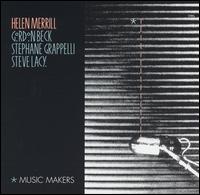
The Sunday Star had run a picture of her in headscarf and sunglasses, leaning on the restaurant’s piano beside her husband and accompanist, Torrie Zito, “American jazz great Helen Merrill, “ the caption read, “is weaving her wonders at Bermuda Onion until Saturday.” (I clipped it out.) That Monday night I remember her wearing basic black with pearls. Not that it matters too much how she was dressed, but my sense is that she had downplayed appearance, the show-biz aspects of a performance, because music came first, always. To drive this point home, her closer for each of her two sets that night was “Music Makers,” a tribute she had composed with Torrie Zito for her 1986 collaborative album of the same title (on Owl) with Gordon Beck, Steve Lacy and Stéphane Grappelli that speaks directly and with unadorned, faux-naif candour to the affective value of jazz, its weave: “Music makers / thanks so much / for the joy you bring.”
The other few faces in the restaurant that evening, who I would have assumed were dedicated fans like I was, must actually have been jazz reviewers; brief pieces on Helen Merrill appeared in the Star and The Globe and Mail in the next day or two. Geoff Chapman linked Merrill’s selective audience to the accomplished subtleties of her singing – even after so many years, not everyone had heard her or heard of her:
Helen Who? The one whose 1954 album with Clifford Brown was rated by one magazine the best jazz album ever made? Or is she the one whose recording 35 years later with Stan Getz was voted jazz album of the year?
Right on both counts. And thus it’s a matter of serious wonder that Helen Merrill is so lightly regarded in North America, save by jazz musicians, while European and Japanese fans can’t get enough of her.
[. . .]
Last night, overcoming a late arrival, a bothersome air conditioner and minuscule rehearsal time with the local bass-drums combo of Gary Binstead and John Sumner, la Merrill weaved wonders with a moody “Round Midnight” and a big, rangy version of an enjoyable tune that you realized, later, was good old “Autumn Leaves” in new guise.
[. . .]
The small, enthusiastic gathering, more aware than most perhaps of the thinning ranks of the great jazz singers [. . .] will treasure what they heard. (“Helen Merrill Weaves Wonders” Toronto Star21 August 1990: E2)
Mark Miller was a little less enthusiastic, but still drew attention to Merrill’s astounding handling of ballad form:
Some jazz singers have made their names by the number of notes they can squeeze into the four beats of a bar. Some have made a style out of the number of bars they can squeeze into a note. . . . The long notes are the ones to wait for, the ones that draw the whistles, in a Merrill song – there was a note in You and the Night and the Music that simply turned transparent as it drew out in mid-air. They give her interpretations a quietly dramatic, sultry quality and lend a variety of softened textures and subtle shadings to the most familiar standards. The good effect in Monday’s second set, however, was often undermined by the bruised quality of her voice, a voice apparently “sabotaged” – that was Merrill’s word – by the club’s air conditioning. (“Revival Act” The Globe and Mail 23 August 1990: C3 )
I was there, so I can confirm that she did complain about a problematic air conditioner; her voice remains a sensitive instrument, and the ways in which she re-shapes a melodic line, slowly unfolding notes like delicate origami blooms, means that her breath and her pitch are closely responsive to their immediate environment. In some ways, her style is more suited to the rarefied immediacy of a recording studio than exposed to the unpredictable elements of background and stage noise. Her performance that night was, indeed, much less subtle and nuanced than those I’ve heard on record, although there were moments – like those mentioned in the reviews, but also in her version of “Lilac Wine” – when you could feel your heart stop beating, when the room seemed briefly suspended in time.
Given that Peter and I were almost her whole audience, and the only ones sitting up close, when she left the stage after her first set, she came over to our table. Her manner was a bit wry and ironic; I think she asked us if we had a cigarette lighter, but neither of us smoked. I think I bungled saying something complementary, about how much I enjoyed her albums. She cocked her head a little, as if unsure as to whether or not I was putting her on, looked me in the eye, and asked: “Do you have the one with Thad Jones?” I didn’t. I think she told me I should try to get hold of a copy, though it was probably out of print (which it was). He was great, she said. “A Child Is Born” is a beautiful song. And then she left us for the back of the club.
Years later, Emarcy France would reissue not one but both of her albums with Thad Jones – The Feeling Is Mutual (1965) and A Shade of Difference(1968), although they soon dropped out of print again, until Mosaic Records put them together on one limited-edition CD as The Helen Merrill–Dick Katz Sessions. It’s not just the presence of Thad Jones, but the gathering of two groups of musicians’ musicians – Jim Hall, Ron Carter (with whom Merrill would later record an incredible duo album), Pete LaRoca, Richard Davis, Elvin Jones, Gary Bartz, Hubert Laws – makes these sessions astoundingly special. Alongside her albums with Gil Evans, Bill Evans and John Lewis, I think it isn’t a stretch to call The Feeling Is Mutual her masterpiece. In the liner notes to the second record, pianist and broadcaster Marian McPartland suggests that what makes these recordings so brilliantly alluring is a lyrical tension, both within Helen Merrill’s voice and in her subtle interactions (I’d suggest) with the other musicians:
I remember vividly the first time I heard Helen Merrill sing. It was some years ago, and I was listening to the radio, late at night, while driving to New York. Suddenly I heard a voice with an unusual timbre and such poignancy that I pulled over to the side of the road to listen more closely. [. . .] The contrasts in her voice are most intriguing: on the one hand, like eggshell china, and on the other a heartfelt cry, a depth-of-the-soul moan of deep feeling.
She was right, of course, about “the one with Thad Jones”; while her performance that Monday night might have been a bit marred, a bit “bruised,” there is something even in that heartfelt late effort that partakes of the idea of the cry, of crying: a grainy emollient pathos. A few years later, I tried to write about it, in a small lyric tribute of my own to Helen Merrill, which appeared in Descant in 1997; strangely, I used the same metaphor as Mark Miller, the bruise, although for him it was a fault, while for me, it is the essence of what Helen Merrill does. Late recordings, such as her duet on “My Funny Valentine” with Masabumi Kikuchi, only heighten the subtly attenuated grain of her voice, its lovely expiring.
The second gig I attended was the closing night of her Bermuda Onion run, the Saturday. My parents had come to town, to visit the CNE, and my dad offered to take us all out to dinner, so I suggested we go see Helen Merrill. He paid, which was pretty nice. The club was packed that night. She was great, a bit more showy, a bit higher energy, a bit less nuanced. Afterwards, I asked my mother what she thought. “Great legs for sixty,” she said.
Last year, I bought an autographed copy of a Japanese album, a session Helen Merrill did with Teddy Wilson – another significant pianist in the music’s history. (Helen Merrill produced a handful of solo piano albums in the seventies, including significant recordings by Tommy Flanagan and, my favourite, Roland Hanna – playing Alec Wilder.)

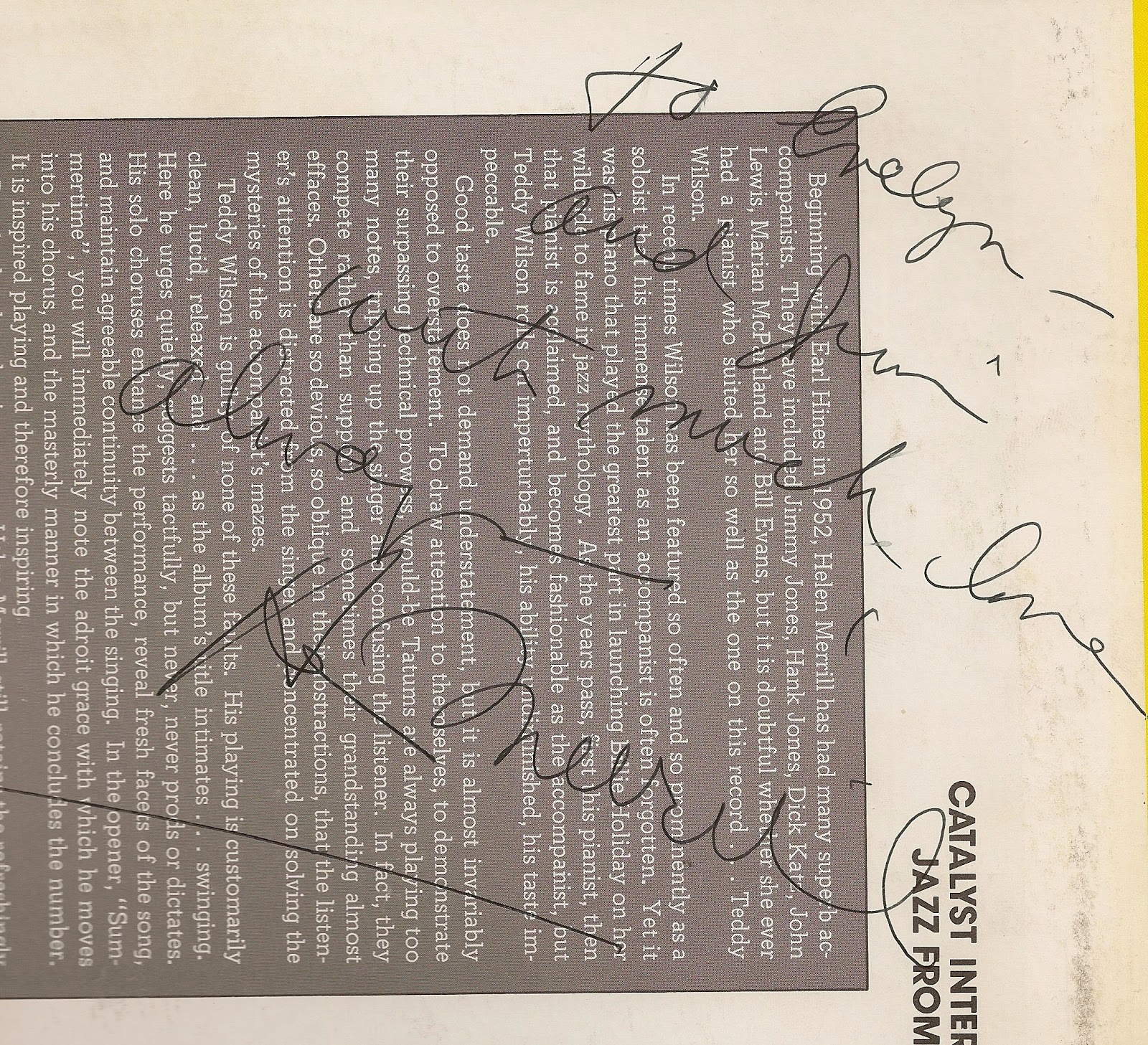
The signature, presumably for a couple she likely doesn’t know, reads “with much love always, Helen Merrill.” The thing is, I think she means it. What she does, what she gives, on these records and in those performances, despite whatever conditions there might be, is a genuine moment of feeling, a pathos that makes you pull your car over and listen. A kind of love.
Lilac Wine: Helen Merrill, Part One
This past week, I discovered one of the remaining records on my wish list of almost impossible-to-find music: Helen Merrill’s American Country Songs, from 1959. My find wasn’t on vinyl, though, but that’s still fine by me. I’ll take what I can get. Worn copies of this never re-issued LP have appeared occasionally on eBay in the last decade, going for fifty bucks or more, and I’ve never managed to come out on top of the bidding. I have found the occasional Helen Merrill disc at my local used record store, but American Country Songs has eluded me. (A few months ago, I came across another one on my list, the triple-LP version of Keith Jarrett’s 1979 Concerts, so it’s been a pretty good year for the collection.) Atco WEA-Japan put out American Country Songs on CD in mid-January, and iTunes followed suit with a download. And there the music finally was, widely accessible again after more than fifty years of relative obscurity.

This record’s a peculiar genre hybrid, and it’s certainly not Helen Merrill’s best album. But its rarity has made it hugely alluring for me, and anything, anything, by Helen Merrill is going to be revelatory, never short of pretty much excellent, so I’m happy to have access to it, and to hear it. Helen Merrill has defined herself for more than half a century as a quintessential jazz singer, so country-and-western isn’t going to be her forte. A few country-jazz hybrids were emerging at the turn of the sixties, notably guitarist Hank Garland’s recordings with Gary Burton; Sonny Rollins’s Way Out West (with its famous William Claxton cover photo and its versions of “Wagon Wheels” and Johnny Mercer’s “I’m an Old Cowhand”) had appeared in 1957. But I’m not aware of any vocalists melding idioms; Patsy Cline’s “Walking After Midnight” had been a country-pop crossover hit in 1957, and the arrangements for strings (by Chuck Sagle) on American Country Songs draw overtly on contemporary country-pop style. Guitarist Mundell Lowe, who had notable associations with Sarah Vaughan and recorded third-streamish arrangementsof Alec Wilder, performs on the album, along with George DuVivier, Milt Hinton and Jo Jones, lending the music an artful legitimacy, although there are no searching improvisations; as the title suggests, the record aims to link jazz and country as forms of Americana, styles rooted in the same musical loam.
The record starts off with a string-rich arrangement of “Maybe Tomorrow,” with Merrill’s smoky lines overdubbed in stereo harmony. (“Devoted to You” gets a similar vocal duo treatment later in the set, but with a small backing band – vibes, guitar, bass, drums – instead) The effect is to draw a light but palpable resonance from Merrill’s voice: a barely breathy, gently grained texture that had become a hallmark of her own style. “I’m So Lonesome I Could Cry” stands out, with its half-speed vocal (“when time goes crawlin’ by”) set against warbling electric guitar and a double-time steam train shuffle, the drum-line falling somewhere between Michael Jackson’s “Billie Jean” (no kidding) and a C&W version of “Cherokee.” She works with and against time, threading it like tensile gold, attenuating its viscosities like taffy. On the whole, the album sound is playful, the arrangements mostly commercial and a little kitschy (“I’m Here to Get My Baby Out of Jail” is plain goofy, but cute): a bouquet of late 50s MOR, mostly sweet and lonely ballads swaddled in strings. But Helen Merrill’s syllable-by-syllable melodic craft, feeling her way along the purr and pull of each note, makes this music work.
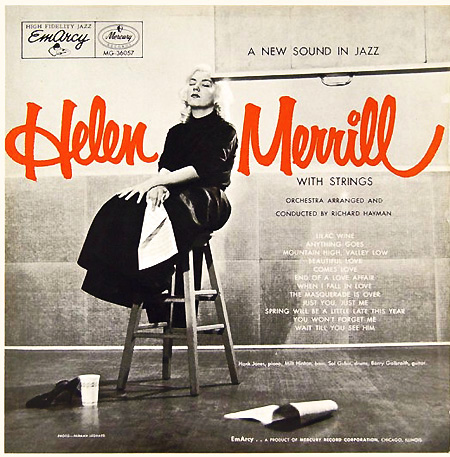
The string section also gestures back (though not formally, merely as a kind of auditory trope) to her more sophisticated Mercury albums, particularly Helen Merrill With Strings(1955) and her collaboration with Gil Evans, Dream of You (1956). The opening track on the 1955 record is “Lilac Wine” – a song she was still performing when I saw her live in 1990 (which she described as “unusual”) and which was the title track of her 2004 album (which, unusually, also includes a cover of Radiohead’s “You”). The lyrics describe lilac wine as “sweet and heady, / like my love,” which also suggests about the timbre of her voice, its veiled headiness, its honeyed closeness. In an interview with Marc Myers for his Jazz Wax blog, in 2009, she recalls working with Gil Evans in July, 1956:
JW: Your phrasing on that session sounds like the basis for Miles Davis’ approach with Gil a year later in 1957 on Miles Ahead.
HM: I have no idea. Miles used to love my sound and always came to hear me sing. We were dear friends. He told me he loved my whisper sounds. That’s a technique Iused by getting up real close to the microphone. I’d sing almost in a whisper, which created a very intimate sound. I developed this by listening to my voice and trying different things with the mikes.
JW: Do you think Miles learned from your whisper technique?
HM: Miles learned from everyone. He was incredible. He took the best from everyone and threw away the rest. He was brilliant. One of the things he told me he loved about my voice was how I used space—both in music and between my voice and the mike.
This is a pretty big claim, and it seems a little suspicious to call Miles Davis a “dear friend.” But the comparison of their articulations is also deeply apt; their ballad styles are strikingly similar, with an attention to the delicate surges, the intimate breath-pressures within each note. And while American Country Songs can’t achieve the layered depths of a Gil Evans record (or of a Gil Evans-Helen Merrill record), the seductively undulant sound-space that Helen Merrill can and does create makes it an album so worth hearing.
Ammons: A Sheaf of Words for Piano
I have put up on Sound Cloud a copy of a collaborative audio piece called Ammons: A Sheaf of Words for Piano, which as my notes below will tell you was recorded a couple of years ago with Montreal-area pianist Geoff Mitchell. I intend to publish the suite of poems as a chapbook, but for now the audio is out there; individual tracks will also soon be available for download via my website, http://www.kevinmcneilly.ca. Track listings and credits are temporarily available as a pdf here.

The poems in Ammons: A Sheaf of Words for Piano are linked idiomatically, for me, to the work I did for Embouchure. That is, they take for their subject matter stories of the life and music of an African-American jazz icon, in this instance the great boogie-woogie pianist, Albert Ammons. My friend Geoff Mitchell, as well as being an excellent sound recordist and artist (he did the cover drawing for Embouchure), is a brilliant pianist and improviser. He had told me when I was visiting with him in 2010 that he had been working on boogie woogie piano techniques and thinking about the historicisms of present-day jazz, and he mentioned Albert Ammons and his colleagues as influences; I wanted to collaborate with Geoff on a piece, so I started writing poems based on Albert Ammons’s music, taking cues from track titles, from events in his life, and from viewing the short film Boogie Woogie Dream, a peculiar mix of documentary and fiction shot on location in Café Society and featuring him, Pete Johnson, Lena Horne and Teddy Wilson, acting and playing.

I brought a suite of ten poems with me when I was next in Montreal, and we recorded together. (The eleventh poem, the Mondrian piece, is a typographical-visual text and is next to impossible to read. In any case, it was composed a bit later.) Geoff’s music was all freely improvised, but references the historical idiom in all kinds of interesting ways. The piano wasn’t meant to act as accompaniment, but more as commentary, and even critique of the words – at least, that’s what I think it was meant to do. The multi-tracked pieces are intended as homages to the two- and three-piano music of Ammons, Johnson and Meade Lux Lewis. All of the pieces, for me, are intended to be respectful homage. (The coda on Lena Horne was coincidentally composed around the time of her death, which I didn’t know about until after I had finished a full draft of the poem.) Race, gender and nationality are put at issue here, but because they form a crucial part of this music’s history. I necessarily come at this material as an epigone outsider, but I’m also drawn to the music viscerally, as a listener. That sometimes recalcitrant, sometimes negotiable tension between inside and outside, between deference and expression, between self and public domain, is what this suite intends to take on, at the level of voice and instrument: a conversation, a debate, a dialogue.

I’d like to thank Geoff Mitchell for his incredible music here.
Short Take on Interviewing Anne Carson
For my academic work, I have been trying to clean up and organize my curriculum vitae, which can be a depressing enough task, sorting through the welter of what I have done and what I have failed to do, what’s still available and what’s slipped from view. I interviewed Anne Carson for Canadian Literature in 2003 (ten years ago!), as part of a special issue on her work I was editing for the journal (number 176). I had been googling myself (embarrassing enough to admit) to see if I could find some electronic, on-line and/or accessible versions of any of my publications I could link to, and I came across UNSAID, which bills itself as “The Journal of New and Lasting Writing.” There you go.
And, in its issue for September 11, 2012, they have reproduced my interview with Carson, “Gifts and Questions.” You can check out the original issue of the journal here, too. It’s gratifying to come across things like this again. I remember Carson as gracious and wry, a real pleasure to speak with. And smart.
These Poems, She Said: Jan Zwicky and Robert Bringhurst
Jan Zwicky and Robert Bringhurst read together at Green College, at the University of British Columbia, on Wednesday, March 20, in the late afternoon: the last event in this year’s Play Chthonics series. I was set to introduce them to the 40-odd people who had come to hear them in the Graham House fireside lounge – a capacity crowd for a poetry reading, for that intimate space – and Jan reminded me about one of the first times we had met, which was in a two-term graduate seminar led by Don McKay at Western in the fall-winter of 1986-87. She was teaching philosophy at Waterloo, I think, but would come weekly down to London to audit the Monday evening class; her Wittgenstein Elegies had been published by Brick Books earlier that year. I was a master’s student, and was just getting underway writing what would turn out to be a thesis on the poetry and poetics of Robert Bringhurst, which McKay was supervising. The seminar was called “Poetry After 1945,” if I am remembering right, and each week was focused on a different book, a different poet – chosen, I’m pretty sure, not for any particular thematic or ideological reason, but because Don was interested in them, and he thought that theirs were poems that we ought at the very least to know about, to know: Robert Lowell’s Life Studies and For the Union Dead, Galway Kinnell’s Book of Nightmares, John Ashbery’s Self Portrait in a Convex Mirror, Ted Hughes’s Crow, Dennis Lee’s Civil Elegies, and selected poems from Denise Levertov, Daphne Marlatt, Seamus Heaney, Charles Olson, others. One guy in the seminar was keen to do something with Sylvia Plath. (I remember also discovering, through Don, Charles Wright’s The Other Side of the River that year.) And, near the end of term, Don had put on Robert Bringhurst’s The Beauty of the Weapons.
I don’t know what had drawn or what was drawing me into Bringhurst’s work at the time, whether I had picked it out from McKay’s syllabus, or found it on my own and then taken the seminar to hear more about it and to encounter those poems more fully. There was something that spoke to me quite forcefully and seriously in those days, from Bringhurst’s writing, something important. And he was also one of the few poets I had discovered who had a rigorous interest in philosophy, in thinking. What caught my ear was that Bringhurst didn’t ever merely namecheck Heidegger or Levinasor the Pre-Socratics, never merely rehearsed Zen traditions (via Gary Snyder) or First Nations mythtelling; he took these inheritances up with a keenness, a self-awareness and a deliberateness that I had never met before, and he did it not simply in but through poems, as poetry. Bringhurst aimed to have his work converse, materially and essentially, with what Kinnell called(in his brief “Prayer”) “whatever what is is.” Later poems would make this conversation more formally explicit – his “Blue Roofs of Japan” had just appeared in Pieces of Map, Pieces of Music, Bringhurst’s just-issued collection from McClelland and Stewart. The way I remember, it was this kind of poetically-informed conversation to which I hoped that seminar aspired.
By the start of second term, after I had been working at Bringhurst’s books for some time and with the in-class discussion of his poetry fast approaching, I was certainly aware that both McKay and Zwicky had been somehow more directly and closely implicated in his writing than I might have realized at first (although I knew McKay knew Bringhurst personally, and had sent him a few questions on my behalf about sources for poems). “Sunday Morning,” from Pieces of Map, is dedicated to them both, and suggests a kinship of thought and approach – around listening, around wilderness, around alterity and ontology – that Bringhurst characterizes as an interest, an inter-esse, in “the musical density of being.” Their poetry, in many and various registers, aspires to sing, to attain the condition of song. They were concerned, in the late 1980s, to reactivate a particular trajectory of the lyric, its noetic intensities.
So, what happened in the seminar was: one of the assignments involved presenting a close reading of a poem. I had chosen to examine Bringhurst’s “These Poems, She Said,” partly in response to an emergent line of questioning in the class around gender politics. Bringhurst placed the poem first in his selected, to enact a distancing irony, and to suggest a self-awareness about the contingency of the seemingly sculptural monumentality, the mythic reach, of the texts that followed:
These poems, these poems,
these poems, she said, are poems
with no love in them. These are the poems of a man
who would leave his wife and child because
they made noise in his study.
[. . .] These are the poems of a man
like Plato, she said, meaning something I did not
comprehend but which nevertheless
offended me. (Selected Poems 75)
The gesture at Plato isn’t just a philosophy joke about an authoritarian metaphysian’s aversion to the erotic. (It’s worth comparing Zwicky’s recent Plato as Artist, which recuperates an alternative Plato.) Bringhurst creates a miniature Socratic elenchus, replete with self-deprecating irony. Uncharacteristically for Plato, however, the interlocutor in this poem is female; the text’s antithetical manoeuvres, shifting from iterated critique to discomfited reaction, both sustains the authority of the male poet’s voice – everything remains filtered through him, and he is the one who affirms, at the poem’s close, that the woman’s voice has spoken “rightly” – and also dismantles any grounds he might have, other than a kind of empty verbal aestheticism (“You are, he said,/ beautiful”), to claim argumentative high ground. He sounds like he wins, but he can win only by losing, since the love he craves entails receptive openness rather than the abstract and detached rhetorical management of a well-turned phrase or line. In the seminar, I think it was difficult for me to hear the conflictedness at the core of the poem, and instead I focused only its apparent claim to rightness, its mistaken feel of surety. This reading, as you can imagine, didn’t sit well with Jan, and she told me so. What she valued in the poem wasn’t any feint of attention or pretense of listening, but a deliberate, intentional disavowal of ego; the poem, for her, in the white space that slashes through its penultimate line on the page, opens itself to what remains otherwise, to its ungovernable outside. (As I write this, I don’t think those would have been Zwicky’s terms; this is me, I’m sure, re-casting her critique. But however she put it, her point was a good one.) She argued.
What came out wasn’t just a corrective for me. More importantly, it was the sense that there were real stakes here, that something in this poetry mattered. And what mattered was the honing and the intensification and the acuity of thinking, of thought as an exacting, lyrical unknitting of selfishness, of self. That debate about poetics wasn’t just a remedial exercise, but an enactment of this rigorous openness, one that takes itself seriously. “Knowing, not owning” as Bringhurst puts in what he then called “Thirty Words,” which he would incorporate into his “credo” in later editions of his selected poems: “Praise of what is, / not of what flatters us / into mere pleasure” (Selected Poems 159). Neither Zwicky nor Bringhurst takes this demand lightly; poetry is careful, serious business, and since that evening seminar in 1987, I have tried to learn from and through their work – and I continue to do so – to correspond with, to be responsive to and responsible for, that care.
 |
| Robert Bringhurst Reading at Green College |
The Play Chthonics reading, for me, reactivated this commitment to a poetry that matters. Both Bringhurst and Zwicky presented principally new work, but their tactics and idioms were still closely and thoroughly enmeshed in the kinds of lyric thinking they have been practicing, in their distinctive ways, for decades, and for which I have, for decades, admired them. Bringhurst read from a set of what he called “language” poems, works that have little to do with idiomatic American experimentalism, but addressed themselves to the foundational becoming, the ontological pluralism, that he has pursued throughout his career. Zwicky’s poems, by contrast, focused elegiacally on the essential unknowability of things, on lost connections and on gaps and silences. But her poems also distill their music from that loss, a music that wants to draw out some of the human resonances with a world in which we are all implicated, to converse openly with the unvoiced plentitude of what we are not, which is also what we are. At different points, both she and Bringhurst coincidentally described encounters with a heron as an image of this attentive address.
After the reading, I picked up a copy of a CD that Zwicky had recorded (in June 2011) called, simply, Jan Zwicky Reads. I have been listening to it off and on for the past month. As at the live reading, I find that as I listen certain of her lines seem to hang in the air, to resonate: “that bare light not yet sweet with birds.” Zwicky’s melopoeic technique, her mastery of the phonemic music of language, evident here in the audible meshwork of consonants and gently modulating vowels, is more than “sweet” craft; what inheres in these voicings – I’m sure that’s the right term for this lyric practice – is more than the mere pleasures of listening. Zwicky offers in small, in lines such as these, a musical elenchus, a negation (“not yet”) that highlights the hiatuses and epistemological uncertainties that poetry seeks to bridge, as metaphor, but also construes as its substance, as its inevitable shortfall, again as metaphor, as approximation, as asymptote: a version, I’d say, of what Bringhurst has called, translating Paul Celan, “the caught light’s closeness / to audibility” (Selected Poems 143). The sweetness Zwicky’s poetry seeks out is never the sugary or the saccharine, but is consistently a resonance, a harmonic sweet spot, where the disparate textures of an unclosed world can briefly, barely, touch and argue, catch and hum, collide and sing.
A Short Take on Barry Long, Freedom in the Air
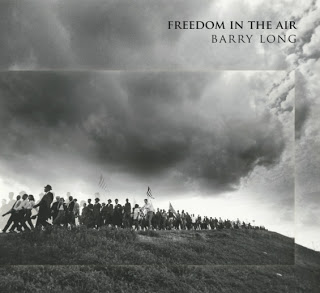
Freedom in the Air is a powerful suite for quartet, improvised to accompany a projection of iconic, historic photographs (by James Karales and others) of events in the American Civil Rights movement. A group led by trumpeter Barry Long, and including saxophonist David Pope, bassist Joshua Davis and percussionist Phil Haynes, performed the music at the Campus Theatre of Bucknell University in Lewisburg, Pennsylvania, on 23 February 2012; the performance was recorded on video, which can be viewed online through the university’s website. The compact disc or download is available for purchase from bandcamp.com. It’s a great recording, well worth buying.
The music is ekphrastic; sounds are keyed to visuals, sometimes providing auditory allegories – as in the fifth section, “Fifteen Minutes in Birmingham,” when the racial violence depicted in the photographs draws discordant, harsh responses from the players – but more often acting as reactive contemplation, a kind of aural commentary. For musical source material, Long draws on spirituals and protest songs, many of them from African-American religious and social traditions from the southern states, many of them performed by participants in the marches and protests to which the images bear historical witness. (Two pieces come from elsewhere than the American public domain, but both are deeply enmeshed in the civil rights soundscape: John Coltrane’s “Reverend King” – posthumously issued on his album Cosmic Music – and the song that provides the suite’s title, “Freedom in the Air” by Bernice Johnson Reagon.) Watching the video, you can see how attentive to and how focused on these images the members of the quartet remain, throughout the performance. The photos act not so much as score but as timbral palette, setting the tone.
Without the visuals, the music still works incredibly well, but as a meditative rather than a contemplative tone-poem. Things open with Long solo on flugelhorn, intoning Reagon’s melody as an autumnal taps, framing what follows from the quartet in a largely elegiac register. The music on the whole is consistently measured and self-aware, rarely venturing beyond a medium tempo, but it’s also deeply evocative, entrancing, awash in genuine pathos. I have been trying for a few days to think of an analogue for this group’s sound, and the closest I can come is, perhaps, Paul Motian’s trios with Charles Brackeen (whose firm, deliberate tenor saxophone tone David Pope sometimes seems to echo). Phil Haynes’s drumming can occasionally be subtly unruly, gently but firmly disrupting easy agreements. Collectively, the quartet tends to refuse sentimentality or nostalgia in favour of a lyrically incisive and open-eared historicism, giving difficult episodes in a shared national past a present-tense relevance, a contemporaneity. Improvisation creates a set of contingent segues between what’s been done and what still happens, and invites us to consider, to reconsider, how negotiating these cultural challenges can vitally matter to us even now, especially now.
The manoeuvres between the contemplative and the meditative, between the reactive and the expressive, that this performance undertakes can be better addressed, I think, by looking at the video, and paying attention to the intensity of the musicians’ focus – how they themselves look at the on-screen images. Three of the four members of the quartet are academics, and two hold doctorates: I mention this fact to suggest that, if this music is to be understood as scholarship, there is no sense of clinical detachment or analytic objectivity here. The historical engagements they undertake are, instead, consistently creative, vital and moving. It’s also worth noting – although it’s a bit presumptuous on my part – that none of the musicians appears to have a visibly African-American heritage; given that they are playing through such thoroughly racially-inflected terrain, they might tend to be positioned as outsiders or onlookers. But Long’s point in presenting this music, I’d say, is to suggest that we are all – regardless of where we might think we come from or how we look – implicated in this cultural history, and that we need not only to be self-aware of that enmeshment, but also to actively negotiate our social subjectivities, building communities not necessarily through unproblematic identifications – such as similarities of appearance or background – but through our encounters with difference, with our own inherent differences. Barry Long’s music makes one such set of encounters sing. The video ends with a minute-long spontaneous silence that the CD can’t include, but it’s also one of the most powerful musical moments in the performance: a space of thoughtful, respectful exchange onto which this fleetingly profound music opens, helps us open.
Improvising Diaspora: Fred Ho, John Coltrane and the Music of Radical Respect
Here is the principal part of the text of a fifteen-minute conference paper I delivered in September 2007 at the University of Guelph, speaking at the colloquium of the Guelph Jazz Festival, entitled that year “People Get Ready,” and focused on the community-building and political engagements of improvised musics.

Fred Ho wants a music that speaks, and he wants to speak through music: “The music,” he writes, meaning for the most part jazz-derived improvisation, “has to and will embody messages, either explicitly (in the form of lyrics and/or song titles) or implicitly (in the sound and in its spirit).” To start out, I think, there are at least two things to note in such claims, of which Ho makes many. The foremost is almost unremarkable for its transparency, as it’s probably intended to be: Ho writes and speaks about improvised music as much as he composes and performs. The series of manifestoes, polemics and mandates that he has delivered, in essays and addresses over the last two decades, are instances of musical embodiment, not just statements about what he thinks his music does, but language forms representing the state to which his own music aspires: it wants to say what it means, directly and transparently, to its audience, “the people.” Second is a stylistic and grammatical point, really, a feature of his characteristic language that tends to be read back, by listeners of various persuasions, onto his music, often as stridency or brashness: Ho’s language, if we mean to treat it as in any way poetically shaped, is inevitably cast in an imperative mood. My question today, which I want more to pose than pretend definitively to answer, is how concretely music works toward what we might take for meaning. I want to take Fred Ho at his word. Can a baritone saxophone solo, for example, of the sort you’re hearing now, be said to speak? [Fred Ho’s arrangement of “Naima” was playing in the background, as I presented.] How does music aspire, beyond obvious programmatics, to the condition of speech? What exactly is being declared?
Jazz journalist Bill Shoemaker has written, perceptively and with a somewhat troubling accuracy, that
There are many musicians throughout jazz history who have been labeled revolutionaries, but that’s usually because of their musical accomplishments. Fred is a revolutionary who uses jazz as his medium.
The presumption, coming out of Ho’s work as much as Shoemaker’s well-attuned audition, is that sound can carry political and social meaning directly, formally; that revolution isn’t a trope but an aesthetic practice, enacted both for and with audiences. Ho describes the reaction he wants from listeners as akin to those of a child, who can “be both spellbound and revolutionized” by a given performance; music at once enthralls and enables, two countervaling states of raised consciousness – piety and critique, mimetic wonder and diegetic detachment, in a sense – that inhere in his populist claims. To play for the people, if you think about it, is both to invite mimicry and to call for unruliness, to refuse that same invitation. How, if music means to speak, can “people” be empowered by the cultish image of the inspired soloist, by his polemic force, exactly to speak out, not to be silenced by the verbal or expressive force of that declaration?
There’s a deeply embedded formal contradiction here that speaks to the nature of a musical politics, and to the ways in which music operates, I think, as a cultural pedagogy, as instruction in democratic or revolutionary forms of critique. In a talk at the triennial conference of ACLALS on 19 August 2007, Henry Giroux spoke with some dismay about what he called “the politics of disposability” among American young people, calling for a renewed and hopeful cultural pedagogy, following Paolo Freire, a radical futurity that dignifies people “so that they can become fully free.” This is Fred Ho’s vocabulary. Not only is it necessary to foster critical engagement among students with the cultural materials in which they find themselves immersed, teaching how to “read critically,” but there is a pressing need, Giroux argues, “to prepare students to function as critical agents capable of understanding, engaging, and transforming those discourses and institutional contexts that closed down democratic public life” (119). They need to take part. Despite his deep suspicions of aesthetics, which he suggests is tainted by “the residue of nostalgia and elitism” and also “seems particularly out of date, if not irrelevant” given the pervasiveness of a largely debased popular culture (are there echoes of Adorno here?), Giroux insisted on moving beyond critical thinking toward enabling students as “cultural producers,” as makers, as co-participants. But what do such arts sound like? Should we still be cautious of aesthetics, given the barometers of taste and technique that tend to manifest in such contexts? How do we face up to the demands of a democratic or popular art, of its audience? We’re negotiating a tension over the declamatory and the formal here: the expressive and the well-made. Addressing the rigour of our engagement depends, if you think about it, on a set of standards against which the openness of that participatory dynamic mitigates.
Fred Ho’s music operates, I think, on versions of this tension, negotiating the uncertainties and challenges between naïve, expressive directness and aesthetic detachment. As a composer and improviser, Ho has pursued remarkable and effective fusions of Asian heritage and folk forms with African-American avant-garde jazz, and many of his ballets, operas and suites – as extended idioms adapted from their “legit” Eurocentric counterparts and re-imaged as culturally porous, collaborative events – have been realized in complex, poly-dimensional, multi-media productions. These structural and conceptual pluralities have become hallmarks of Ho’s creative enmeshment in the unsettled and unsettling irresolutions of his diasporic cultural status, as an Asian-Pacific American. Difference and contrariety are, in Ho’s work, not problems to be resolved but constitutive elements through which liberation, both as a raising of consciousness and as tangible political transformation, might be sought. At the same time, Ho openly acknowledges his debt to the social polemics of Black Nationalism of the 1960s. His work as a writer (represented, for example, in his contributions to the anthology Legacy to Liberation, 2000) remains seemingly bound up in identity-politics and Marxist apologetics, an often fiercely uncompromising discourse that appears, as I’ve noted already, stylistically and theoretically at odds with his radically destabilizing musical practices. At the same time, if you’ve been able at all to listen to the baritone solo and now to his arrangementof John Coltrane’s “Naima” playing in the background, you realize that his music, on the surface, is not premised on inaccessibility or difficulty, consistently, but repeatedly seeks out – through riffs, repetitions, allusions to popular idioms – to involve listeners in its unfolding. The baritone solo, while offered up as an extension of the lineage of Sonny Rollins, Anthony Braxton and Roscoe Mitchell, doesn’t aspire to Gunther Schuller’s musicological complexities or to radical serialism. Similarly, Ho’s admiration for poets such as Amiri Baraka or Kalamu ya Salaam appears to have much more to do with the verbal directness of their political interventions, with their emphasis on declarative immediacy, than with their linguistic or formal innovations. The title of the suite from which this music is taken bespeaks the politics of verbal directness and transparent engagement that Ho craves: “Yes Means Yes, No Means No, Whatever She Wears, Wherever She Goes.” Meaning, while at issue, wants to be denuded equivalence, unmarred by subtleties or doodads. The lyrics by Ann T. Greene, Andrea Lockett and others for the suite, a pro-feminist anti-patriarchal work commissioned in 1993 by WHAM! (Women’s Health Action and Mobilization) and BWARE (Brooklyn Women’s Anti-Rape Exchange), pull no punches. While resolutely opposed to sexual violence, the work, for Ho, has its roots in reactive physical confrontation: “My mother is a survivor of domestic violence, and as a young teenager, I physically fought my father to stop him beating her. I now see this as my first
revolutionary insurrection and challenge of patriarchal authority.”
Still, when Ho asks, in a recent artist’s statement, “how does music free us?” he draws attention to sonic texture and to poetic structure as inherently, crucially political, focusing our ears on how that challenge occurs, physiologically and consciously, rather than simply what it might be about. Ho’s apparently naïve preference for uninterrogated declamation – what some critics have dismissed as crude stridency – actually involves him, along with his listeners, in a difficult dialectic, a deeply rooted tension over the nature and practice of expression itself: of the interconnections between doing and saying. Paul Gilroy’s discussion of jazz and diaspora in Against Race – where he argues for “new possibilities and new pleasures” enabled by the fundamental dislocations of diasporic non-identities – provides a starting point for re-thinking Ho’s indebtedness to racial nationalisms, and for a more careful and attentive reading of his mesh of sounds and words. Coming to Gilroy might seem problematic in this context, given Ho’s overt attachment to what Gilroy dismisses as raciology, but Ho’s frequently discussed but still largely uninterrogated adherence to black nationalism – particularly as a non African American – finds one of its moments of coherence in the context of diaspora. How can a Chinese-American seriously compose a Black Panther suite, for example? There’s no reason why he shouldn’t of course, but the racial politics explicit in this work certainly trouble that allegiance, although trouble is exactly, I think, what Fred Ho might be about.
Working to define “the distinctiveness of diaspora poetics” (335), Gilroy cites Leroi Jones / Amiri Baraka’s (1967) poetic formulation of “the changing same”:
This changing same is not some invariant essence that gets enclosed subsequently in a shape-shifting exterior with which it is casually associated. It is not the sign of an unbroken, integral inside protected by a camouflaged husk. The phrase names the problem of diaspora politics and diasporic poetics. . . . Invariably promiscuous, diaspora and the politics of commemoration it specifies, challenge us to apprehend mutable, itinerant forms that can redefine the idea of culture through a reconciliation with movement and dynamic variation. (“Diaspora and the Detours of Identity” 336; Against Race 129-130)
James Clifford, among many others, criticizes this formulation inasmuch as it tends to abstract and to diffuse collective political and social agencies, the possibility of there even being a “people”:
diaspora discourses such as Gilroy’s refuse to let go of a “changing same,” something endlessly hybridized and in process but persistently there-memories and practices of collective identity maintained over long stretches of time. Gilroy attempts to conceive the continuity of a “people” without recourse to land, race, or kinship as primary “grounds” of continuity. What, then, is the persistent object of his history? How to circumscribe this “changing same?” (Clifford 320)
This is a serious issue for a version of what I’ve heard here start to be called social aesthetics, I think: how effective to locate and to speak to a popular audience.
Ho’s recording of John Coltrane’s “Naima” (1998) – with lyrics by poet and journalist Andrea M. Lockett – offers listeners an opportunity to address Ho’s deliberately conflicted relationship to the radical sixties, and also suggests how a dynamic critical relationship between Ho’s work and his multiple cultural and musical heritages – what he names a practice of radical respect – has the potential to enact a model for new and liberated human communities, an arduous and challenging idealism he calls, following Sun Ra, embracing the impossible.
Mixed Materials: Raymond Williams Meets Don McKay
Here is another review-essay that seems not to have made it into the pages of Canadian Literature during my time there as an associate editor, although it was written – the date-stamp on the document file puts it at January 2003 – about unsolicited review copies of books sent to the journal. I hope you can pardon the datedness of some of the references, but I thought it might be worth getting it out into the world, making it a little bit worldly, if only to mark one of my attempts to get Anglo-American intellectual work to resonate with some of its less-obvious Canadian counterparts – in this instance, trying to set up a reading of Don McKay through an overview of some reissued Raymond Williams (and some new-ish, at the time, Edward Said).
New Contexts of Canadian Criticism, a 1997 Broadview Press anthology of cultural analyses collaboratively edited by Ajay Heble, Donna Palmateer Pennee and J. R. (Tim) Struthers, offers more than an update of its namesake, Eli Mandel’s classic (and out-of-print) collection of cultural backgrounds; it also presents theoretically-informed forays, through a set of variously Canadian discursive lenses, into the concepts of context and worldliness: a spate of essays that gesture heterogeneously at the possibilities inherent in a distinctly Canadian materiality— which here suggests everything from historicism to autobiography, from socio-economics to bibliography. Still, the first name mentioned in the book – and a critic who, enmeshed in contradictions and pluralities of his own, appears to set the irresolute tone for the collection – is not a Canadian, but Raymond Williams, late professor of Modern Drama at Cambridge. In the last five years or so, Williams’s unstable and disputatious amalgam of Leavisiteformalism and Lukácsiansocial realism — which he had come to call “cultural materialism,” and which arguably gave rise to Cultural Studies in the English-speaking world — has undergone a recuperation that, national provenance aside, has a tangible, even material, bearing on practices of Canadian criticism, in its several and conflicted guises.
1.
Before I come to any overtly Canadian content, I want to touch on Williams’s worldliness, to suggest how his method might start to be dislodged from its British sinecure and beach itself on the other side of the Atlantic. Williams’s influence is audible (despite a paucity of direct reference) in Edward Said’s finely crafted Reflections on Exile and Other Essays (from Harvard UP). Williams’s impact registers more than in Said’s style, which has the transparent surety of a public intellectual at his peak; Said reads Williams as the voice of “an emergent or alternative consciousness allied to emergent and alternative subaltern groups within the dominant discursive society” (244), and — perhaps surprisingly, given Williams’s rather ardent Oxbridge traditionalism — as a figure of critical radicalism closely akin to Antonio Gramsci (from whom the vocabulary in the passage I have just quoted is drawn), Michel Foucault and Theodor Adorno. Williams probably wouldn’t endorse this reading, particularly the Frankfurt School associations, but it does speak closely to the recuperation of Williams in recent literary criticism, criticism that concerns itself with addressing, and moving non-regressively beyond, the impasses and stalemates of a postmodern condition. Williams, for Said, has been “responsive to the real material texture of socio-political change from the point of view not of what Adorno calls identitarian thought but of fractures and disjunctions,” of the “non-identitarian” thinking that Adorno’s own negative dialectics pursue; Williams writing is not, like Adorno’s, an especially philosophical or conceptual interrogation of these critical alternatives, but instead offers their verbal enactment:
To Williams, quite uniquely among major critics, there is this capacity for seeing literature not as a Whiggish advance in formal and aesthetic awareness, nor as a placid, detached, privileged record of what history wrought and which the institution of literature incorporates with sovereign, almost Olympian prowess, but rather as itself a site of contention within society, in which work, profit, poverty, dispossession, wealth, misery, and happiness are the very materials of the writer’s craft, in which the struggle to be clear or to be partisan or detached or committed is in the very nature of the text. (469)
Williams, as writer, reworks this struggle as he reads and responds; like Said’s, his criticism is suffused with a public, pedagogical imperative. Teaching, for Williams, whether in postwar night-schools or rarefied universities, is a matter of social justice and of the redistribution of cultural wealth, of access to empowerment and to the contingent, pressing formations of identity and self-worth that circulate in the world, and that find themselves embodied, better than anywhere, in the literature of a national tradition. Not that Williams is parochial: for Said, he is the best example of a worldly thinker, one who seeks to restore “works and interpretations of their place in the global setting” and to “engage with cultural works in [an] unprovincial, interested manner while maintaining a strong sense of the contest for forms and values which any decent cultural work embodies, realizes, and contains” (383). Williams’s essays, like Said’s, aspire not to dispense high-blown wisdom but to “teach the conflicts,” as Gerald Graff put it: to enable readers to enter crucial debates in cultural politics and to contest meanings and values, rather than to acquiesce to the false gods of scholarly and cultural authority.
Peterborough’s Broadview Press has also reissued, as “encore editions,” two of Williams’s important works from the 1960s: The Long Revolution and Modern Tragedy. In both, Williams takes up challenges facing the public intellectual, and takes those challenges seriously. He aspires not only to transparency in his prose — framing questions of cultural value in a style accessible to the common literate reader — but also to putting at issue the dynamics of societal transformation — through emergent literacy, through public education and through political heuristics — in writing itself.
He begins Modern Tragedy (1966) by describing a conflict built into the term tragedy, a tension between its literary and its common meanings; he notes how theoreticians and literary scholars have tried to narrow into a “particular kind of event, and kind of response” that is not merely “death and suffering,” or accident, or “simply any response to death and suffering,” the sense commonly called tragedies “in ordinary speech and in the newspapers,” a usage regarded as “loose and vulgar” by academics (14). As long-term readers of Williams will recognize, he never tosses off a word like “ordinary,” and it soon becomes clear that he stands apart from the academics he parodies, finding himself impelled ethically to discover what scholars and theoreticians tend to dismiss, the “actual relations” we “see and live by, between the tradition of tragedy and the kinds of experience, in our own time, that we ordinarily and perhaps mistakenly call tragic” (14-15). The so-called mistakes people make in everyday language, for Williams, are not so easily put aside, but point significantly to literature’s relevance: why it matters and how it materializes in the world. He doesn’t cast critical scholarship aside — the second half of the book is a survey, revised from his lectures on modern drama at Cambridge, of innovations in modern European theatre, a thoroughly academic enterprise — but pursues instead the historical, cultural and institutional conflicts built into both the genre and the concept of tragedy, and transforms what might on first glance seem like a dry piece of literary exegesis into a compelling profession of revolutionary dialectics.
In the book, we oscillate between literary and political problematics, as opposed to progressing from one to the other; it’s significant that Williams concludes with, rather beginning from, literary exempla. Literature, for him, is not as creative work separable from everyday life — as he puts it in The Long Revolution, art neither attains a transcendent priority nor dawdles as secondary, leisure-time activity, both of which, he asserts, are “formulations of the same error” of dividing the creative from the ordinary (54). Literature is for Williams concerned instead with “communication,” by which he means not simply its “transmission” but the “social fact” of the aesthetic, its recognition and re-inscription of “reception and response,” of audience, into its own fabric: “Art is ratified, in the end, by the fact of creativity in all our living. Everything we see and do, the whole structure of our relationships and institutions, depends, finally, on an effort of learning, description and communication. We create our human world as we have thought of art being created” (46, 54). Material and last causes, poetic making and revolutionary disruption, interweave in Williams’s cogent syntax; his critical method is deceptively banal, but his argument, if we attend to it carefully, is as disturbing as it is affirmative — not to draw art down to some lower level of the everyday, but instead to perceive “creative interpretation and effort” in living, to attempt to abolish all such levels and stratifications, as embodiments of social and cultural imbalances. His methodology neither reduces art to sociology, nor detaches the aesthetic from the lived, but pursues the communicative processes that link text with social or historical context, to see “works and ideas in their immediate contexts, as well as in their historical continuity” (16), a social aesthetics. His historicism evinces a kinship to Foucauldian genealogies, as we trace, for example, the evolving conceptual shifts in the term “tragedy”:
The tragic meaning is always both culturally and historically conditioned [. . .]. The essence of tragedy has been looked for in the pre-existing beliefs and in the consequent order [of a society], but it is precisely these elements that are most narrowly limited, culturally. Any attempt to abstract these orders, as definitions of tragedy, either misleads or condemns us to a merely sterile attitude towards the tragic experience of our own culture. (52-53)
Despite a shared humanist vocabulary, Williams’s work on the genre is diametrically opposed to the archetypalism of his near-contemporary Northrop Frye, which pursues exactly those “abstract orders,” abstractions Williams understands as historical products, rather than as structural fixities of a verbal universe that is ultimately divorced from real human experience.
By historicizing even his own critical apparatus, Williams hopes to push through the aesthetic — here framed as tragic redemption — toward a broader ethics he names revolution. In Modern Tragedy he appears at crucial junctures to inhabit a moment of critical reflex, at which the generic structures of classical tragedy overlap with the social forms of their communication: tragedy provides the structural basis for its own interpretation and application. For example, he takes the Aristotelian apex of anagnoresis, or recognition, and overlays a Marxian rubric of emergent class consciousness as revolutionary flashpoint, to explain the gap between the ideal of revolution and its repeated ossification and failure in real human societies, as well as the epistemic break between the literary and the ordinary:
At the point of this recognition, [. . .] where the received ideology of revolution, its simple quality of liberation, seems most to fail, there is waiting the received ideology of tragedy, in either of its common forms: the old tragic lesson, that man cannot change his condition, but can only drown his world in blood in the failed attempt; or the contemporary reflex, that the taking of rational control over our social destiny is defeated or at best deeply stained by our inevitable irrationality, and by the violence and cruelty that are so quickly released when habitual forms break down. (74)
Williams attributes this impasse to a self-defeating liberalism, that he regards as “hemmed in on all sides” (73). His attitude is never defeatist, however, and by reading the modern European canon of tragedy, he projects — progressing from Ibsen through Ionesco to Brecht — a “new tragedy” that refuses to accept the contradictions of human injustice as inevitable, and moves through that “recognition” to break down the “fixed harshness” of any regime, revolutionary or not, with the ongoing “struggle [to] live in new ways and with new feelings,” and by “including the revolution” in “ordinary living,” to “answer death and suffering with a human voice” (103-4). Admittedly, this insistence on the potentially revolutionary character of the ordinary, as redemptive, remains something of a sticking point for Williams’s readers, because of his mystification of “experience” as resolutely unassimilated by abstract or literary forms, even as those forms seek either to contain or to unleash it. Williams’s theory of tragedy, for this reason, is largely anti-cathartic, not because it does not aim toward changing minds, but because he does not want the energy of that change to be dissipated in aesthetic experience: communication, instead, transmutes pathos into ethos, affect into responsibility.
The resurgence of a human voice in literary forms even as arch as tragedy produces revolution, however “long,” subtle and attenuated, because it speaks to the fundamental emotive substructure of community (an argument closely akin to Herbert Marcuse’s aesthetics of liberation): “A society in which revolution is necessary is a society in which the incorporation of all its people, as whole human beings , is in practice impossible without a change in its fundamental form of relationships. [. . .] Revolution remains necessary [. . .] because there can be no acceptable human order while the full humanity of any class of men is in practice denied” ( 76, 77; original italics). That revolution should “remain” and endure, rather than find a sudden, violent social articulation, is for Williams a consequence of his New Left mistrust of revolutionary regimes and of revolution’s essentially cultural character; culture, as he defines it in The Long Revolution , names a “creative” process — the “long revolution” locates itself not a fractal shock, but in “the essential relation, the true interaction, between patterns learned and created in the mind and patterns learned and made active in relationships, conventions and institutions. Culture is our name for this process and its results, and then within this process we discover problems that have been the subject of traditional debate and that we may look at again in this new way” (89). This Leavisite insistence on the rediscovery of tradition and an Arnoldian vocabulary of true pedagogy, of what must be “learned,” hardly appears revolutionary at all. But Williams’s rhetoric is designed not to shock but to educate, to forge connections between his own ethical imperatives and a popular status quo enmeshed in histories — such as that of literacy, which Williams explores in this book — that have been misrecognized as stasis, as tradition. When Williams writes, with calculated banality, that he wants to look at culture in “this new way,” he is not falling back into the reactionary radicalism of Thomas Carlyle or Matthew Arnold, whom he often quotes approvingly, but trying to engage with what he calls “a necessary tension in language,” particularly in its popular manifestations in organs such as the press, “between powerful impulses to imitation and to change,” a tension that he understands as “part of our basic processes of growth and change,” and of the human movement toward fundamental betterment. Simply put, you need to speak in a language that can be understood, or you will get nowhere, and no change, revolutionary or otherwise, is possible; you need to discover, in the commonplace or the “traditional,” a revolutionary moment (a critical tactic that is closely reminiscent of Antonio Gramsci’s work on the “national-popular”).
The Long Revolution closes with an extended meditation on “Britain in the 1960s” — a period that was only just about to unfold — which Williams clearly intended as a gesture toward critical immediacy, an attempt to historicize his own present and to map its socio-cultural tendencies (as he does early in the book for the 1840s, the remoteness of which from his own time offers a more rigorous and clear-sighted approach to the selective and accumulative processes of history and historicizing; it is difficult to step back from your own present, even contingently). His critical project, however, is not so much utopian — a concept he associates with a liberal idealism content to proclaim the virtues of such things as education, participatory democracy and “common culture” while still “leaving our training institutions as they are” (176) — as it is hopeful, that “unevenly, tentatively, we get a sense of movement, and the meanings and values extend,” that language, in other words, gets put into practice, “keeping the revolution going” (383). To this end, Williams precedes his social and historical reflections with a call for renovated literary form, what he calls a “new realism” that is “not the old static realism of the passive observer,” a writing inured in regressive objectivity that, though “nostalgia and imitation” merely reinforces oppression, but is instead “necessarily dynamic and active,” not so much the mere representation of social reality as one means of its continual establishment, by which Williams means that writing enacts “this living tension, achieved in communicable form,” the process he calls “culture,” a negotiation between pattern and practice, imagined ideal and lived reality: the “achievement of realism” in the contemporary novel, as praxis rather than telos , is for Williams both “a continual achievement of balance,” the temporary resolution of this tension, and “the ordinary absence of balance,” the dialectical resurgence of a lived asymmetry, an ethical call (316).
2.
But Williams, sadly, does little better than gesture toward this form. The unavoidable conceptual haziness of “experience” in his work needs to be honed away, and the formal character of that realism more carefully articulated, if his hope is to be (no pun intended) realized. I think that Williams’s realism can be supplemented with a kind of late phenomenology to affect such a precising, specifically that of Emmanuel Levinas, and specifically its inflection in the work of a Canadian poet, Don McKay. There are certainly a number of significant caveats to such a claim: Williams had little sympathy for the privileged defamiliarizations of a phenomenological poetics, one that insists on personal consciousness-raising, poetic complexity or intellectual pretense; Levinas, at least in his work up to Totality and Infinity (1961, tr. 1969), expresses a fundamental distrust of the aesthetic, particularly poetry, and outright refuses any kind of socially or politically engaged writing; and McKay’s own poetics repeatedly discover their indebtedness to Martin Heidegger and, more recently, to Levinas himself, but leave Williams and other social realists largely unmentioned. Still, I think that a coalescence emerges from this conjunction, particularly when Williams is re-read in the way I have been suggesting, and on Canadian turf no less. McKay’s Vis-à-Vis (from Gaspereau Press) is a collection of essays and poems that ostensibly focuses on “nature poetry,” but in fact accomplishes this difficult conceptual mix, in discrete textual space.
McKay’s reflections gather around a set of recurrent concepts: wilderness, alterity, translation, apparatus, place. Poetry is not, for him, a form of apprehension — of consciousness as possession or appropriation — but a release, through language, into what cannot and ought not be completely grasped: a form of listening or attentiveness that honours, and pays homage to, what McKay calls wilderness, which he describes as “not just a set of endangered spaces, but the capacity of all things to elude the mind’s appropriations” (21). His work finds an imperative in the intersection of the ethical and the ecological, and seeks to revise our sense of home-making, as a collision of oikos with poiesis , to point to a fundamental form of human responsibility for the world, a revision and an extension of Heidegger’s shepherding of being. Where justice in Raymond Williams’s work adopts a human face, and seeks a better form of human society, for McKay justice must necessarily find a prehuman foundation, must at least gesture beyond its own narrow limits. While acknowledging the inevitable and obvious humanness of language and perspective — an echo of Heidegger’s insistence on the humanity of what the philosopher named Dasein — McKay rethinks this anthropocentrism in terms of response and responsibility, producing a version of what Levinas calls “l’humanisme de l’autre homme, ” the humanism of the other person: “nature poetry should not be taken to be avoiding anthropocentrism, but to be enacting it, thoughtfully. It performs the translation which is at the heart of being human, the simultaneous grasp and gift of home-making” (29). Writing nature, that which is outside or beyond the human, is an essentially human act for McKay, a practice he describes by taking up Levinas’s image from Totality and Infinity of the face — le visage , as in vis-à-vis — as wholly other ; McKay refuses the stalemated, dyadic archetypalism of Margaret Atwood’s “The Animals in that Country” (who have either human faces or “the faces of no-one,” a forbidding juxtaposition of mutual solitudes), and instead gestures toward an otherness that is both vital and responsive, as gift and grasp: “we can perform artistic acts in such a way that, in ‘giving things a face’ the emphasis falls on the gift, the way, for example, a linguistic community might honour a stranger by conferring upon her a name in their language. Homage is, perhaps, simply appropriation with the current reversed” (99). McKay doesn’t idealistically renounce human grasping — in the capacity of language, for example, to name and overwrite what it cannot finally possess, to give a human aspect, catachrestically, to that which is beyond it, making the stranger a familiar — but suggests that such forms of naming and writing, while unavoidable, need to be enacted thoughtfully, responsibly.
Heidegger’s definition of the tool, as that which is to hand, provides McKay with a crucial instance of how to produce such thoughtfulness, as he revises — in ordinary language, through anecdote and reminiscence — a defining human moment, the utility in taking up a tool, as an encroachment of the non-human, of wilderness: “That tools retain a vestige of wilderness is especially evident when we think of their existence in time and eventual gradation from utility: breakdown” (21). He describes the stuff we find at yard sales and in garages — a disused hand-turned meat grinder, for example — as evidence of this inevitable slippage, of what sounds like a vestigial otherness, as its apparatus, its techincal human contrivance, is foregrounded in its collapse into uselessness. (He attaches a military terminology for waste ordinance to this collapse: Matériel , a word that for him marks not only human appropriation but also, as apparatus, resurgent wildness, and that he defines as “any instance of second-order appropriation, where the first appropriation is the making of tool, or the address to things in the mode of utility,” an infliction of the human “rage for immortality on things, marooning them on static islands” as pollutants, as discards [20].) But McKay is careful not to slip into naive appropriations, by idealizing an otherness in language itself, whether common speech or poetry: “poetic attention is based on a recognition and a valuing of the other’s wilderness; it leads to a work which is not a vestige of the other, but a translation of it” (28). This, again, is a Levinasian claim, that hinges on a distrust of the illusion, within the aesthetic, of an incorporation of its outside, to make meaning of the world, to represent; poetry, for McKay, is an example of the foregrounding in language, lovingly, of its inability to represent, of its artifice, its apparatus, even as it describes the human necessity of representation or of making sense: “Poetry comes in here, as a function of language in its apparatus-nature, and not its crowning glory. Poetry comes about because language is not able to represent raw experience, yet it must; it comes about because translation is only translation, apparatus is apparatus” (65).
This separating off of language from world does not, however, occasion a move into post-structuralism, which McKay repeatedly acknowledges as his own philosophical reflex; but his writing takes up the Levinasian il y a (again, a revision of Dasein , there-ness) as opposed to the Derridean il n’y a pas (a accession to the pervasive texuality of the human), and language, for him, is not so much a giving in to limits as a gift, a gesture toward its outside: “The first indicator of one’s status as a nature poet is that one does not invoke language right off when talking about poetry, but acknowledges some extra-linguistic condition as the poem’s input, output, or both” (26). “They’re out there, the unformed ones,” he opens “The Canoe People,” a reworking of a figure from Robert Bringhurst’s Haida translations (77), linking that sense of place, there, to displacement, a floating outside, as these mythical strangers maunder “their wayless way/ among the islands, and now even/ into English with its one-thing-then-/ another-traffic-signalled syntax” (77-78). The point of Bringhurst’s complex work, he implies, is not and cannot be appropriation, but rather, as translation, it manifests an honouring of what it is not, and an insistence on that alterity as the foundational stuff of poetry: an offering of gifts, as thanks, as listening. Poets, McKay claims — and by these he must mean poets such as himself, since he excludes by implication much of the work of those inured in post-structuralism, from the language poetry of Christian Bök to the ideology-critique of Steve McCaffery, even as he shares their vocabularies — “are supremely interested in what language can’t do; in order to gesture outside, they use language that flirts with its destruction” (32). McKay’s terminology is, again, Heideggerian, and he echoes the concept of Destruktion , which Derrida translates into deconstruction ; that flirtation, however, is neither playfully ironic nor dead-ended in itself, but hopeful, a saving grace.
The image of lichens, with which the book concludes, offers a metaphor, which is to say a translation, a mutuality of word and world, as the rock plants both embody and represent “that tiny, shocking, necessary invasion; that saving of language from itself” (106). Poetic language — and this, for me, is how McKay both supplements and refines the problematic posed in Williams — materializes the attempt at what Williams calls “communication” and McKay writes of as gift, the responsiveness and mutuality that clings, like lichen, in words. Both Williams and McKay can be, as I have already pointed out, deceptively colloquial and quotidian. They seek out, in the everyday and in common speech, a “new way” that was always present, an ordinary revolution.
The Books
McKay, Don. Vis-à-vis: Field Notes on Poetry and Wilderness.
Kentville, NS: Gaspereau P, 2001. Print.
Said, Edward. Reflections on Exile and Other Essays. Cambridge,
Mass.: Harvard UP, 2002. Print.
Williams, Raymond. Modern Tragedy. Peterborough: Broadview
P, 2001. Print.
– – -. The Long Revolution. Peterborough: Broadview P, 2001.
Print.
stones that need not: Short Take on Colin Stetson & Mats Gustafsson
I’m starting out this post on my mobile phone app while waiting in line for Red Cat Records to open on this April Saturday morning for Record Store Day. So it seems like an appropriate occasion – standing iPhone in hand to pick up some new vinyl – to write about the copy I received by mail-order, yesterday, of the Rune Grammofon LP stones, a live recording of an improvised duo performance at the 2011 Vancouver International Jazz Festival by saxophonists Mats Gustafsson and Colin Stetson. It was their first meeting in this configuration, although both have played for years in similar alt-music circles, and seem to share a sensibility for mixing post-punk and avant-jazz in their playing. They also both have a well-established thing for low horns: on this occasion, Stetson plays alto and bass saxophones, Gustafsson the tenor and baritone. The concert itself was fairly brief, a 45-minute set at a packed Performance Works (there was no admission charge) on Granville Island, on a Sunday afternoon in late June. And I was there, too.

The four pieces on the record – which clock in between five and twelve minutes each – have been titled retroactively, and presumably by the Swedish Gustafsson, with fragments “inspired by” (adapted from?) the poetry of his compatriot, the modernist Gunnar Ekelöf: “stones that rest heavily”; “stones that can only be”; “stones that need not”; stones that only have.” I don’t recognize the references, but I don’t know Ekelöf’s poetry well enough, not at all. But even as a set of post hoc cues, the titles not only lend the slightly-edited set on record the feel of conceptual coherence, which it actually has, but also suggest something of the improvisational aesthetic at work here. I haven’t been able, with a cursory search, to locate any of the source-texts for the titles, but stones are a recurrent image in Ekelöf and are associated with enthropy and death, a trace perhaps held over from his early-career “suicidal” poetics, as in these lines from “The Sea is the Greatest Sculptor” (translated by W. H. Auden and Leif Sjöberg):
The sea and death
There is no stone so jagged
the sea won’t rub it smooth
or grind it to sand
or finer
But I don’t hear in the duo’s music either lapidary patience or worried foundations. The emphasis on low fundamentals, the long drones and overtones with which the first and longest track on the record begins for instance, gives way to tongue flutters and plunked finger-pads, vocalized growls and arpeggiated counterpoint: interruption and cross talk, as much as the meditative convergence of lines. The music is essentially dialogic, but that conversation is driven by antithesis as much as it is by accord, the verso of Ekelöf’s poetic, his “Non Serviam,” a biblical phrase which can translate a duplicity, a contradiction, meaning both I will not serve and I will not transgress, an amalgam of refusal and deference. Or, as Ekelöf frames this disavowal poetically, as a fraught relationship to identity and belonging,
I am a stranger in this land
but this land is no stranger in me!
I am not at home in this land
but this land behaves as if it where at home in me!
[. . .]
I cannot live in this land
but this very land lives like venom in me!
A version of this admixture of contrariety and ecstasy informs Stetson and Gustafsson’s interplay. The second track moves through echoes of Harry Carney-like Ellingtonia to sonic gesticulations at Roscoe Mitchell‘s angularities. The stuttering upper partials at the opening of the third cut recall Pharoah Sandersin Coltrane’s “The Father and the Son and the Holy Ghost,” while fragments of a Mancini-like caper theme cycle through the fourth. The music is live, in situ and a little noisy; people murmur, a child speaks, other music from a distant outdoor stage thumps softly underneath one piece. But the duo only seems to draw more energy from the hubbub. They take possession of their bandstand, committed and aggressively vital, making the place speak, making it happen. Not as homecoming, no, but as an evocation of creative estrangements, the coincidence of resonant differences: the audible collisions of what need not and can only be.
An Unlikely Sameness, Alias Myself
She is importunate, indeed distract (Hamlet IV.v.2)
Michael Robbins has fast become the laureate of American culture trash. Fast, in the contrary senses that his work confronts both the disjunctive velocities of the non sequitur and the tenuous monumentality, the making fast, of whatever might still remain of the well-turned poem in these late, noisy days. Positioning himself, with the recent publication of a spate of reviews and of his own provocative poetry, as an ornery aggregator – an alien-predator hybrid, maybe – of media flows, commoditized tag-lines and discursive meshes, he repurposes packets of worn, oversold language into brutal, keen lyric, making out of the deliberate anachrony, the untimely music, of rhyme and of vestigial stanzaic form both a temporary stay against confusion and a plastic word-bin to hoard our swelling cultural clutter.
I say “our” with some trepidation, because I’m not even American. As a reader, I still want to stay a little outside of those ineluctable surges of images, music, and text stemming from the plugged-in United States, still want to maintain a bootless resistance to the manifest destiny of its whelming literacy. Robbins’s poems might be read as articulating just such a resistance, but from somewhere inside its pervious borders:
The coyote drives her in a false-bottomed van.
He drops her in the desert. The bluffs are tan.
She’ll get a job at Chili’s picking up butts.
I feel ya, Ophelia, I say to my nuts.
And there is pansies. And that’s for thoughts.
Erotic lyricism has degenerated to bathos, and here – in the final lines of the recently published “The Second Sex” – discomfiting literary pleasures (in the reiterated highbrow melopoeia of Shakespearean misogyny) collide with the craven vocabularies of yellow journalism around “illegal” immigration and the clichéd lyrics of YouTube pop bands. The disjunctive quotations echo Eliot’s technique in The Waste Land, and enact an ironic distancing of self – the fraught “I” that enounces this poem, and for that matter most of Robbins’s poems – from its own broken voices. From this angle, Robbins might be understood as a late modernist, in as much as his ostensive love poem consists of ventriloquized stock phrases and hollowed-out figures of speech, a brief constellation of fragments shored against itself, redeployed in the service of ideology critique, parodying the commodity fetishism of literacy itself, of our sense that we’ve been sold this wordy bill of goods before. “These love poets,” he jabs in “The Learn’d Astronomer,”
couldn’t write their way
out of a bag of kitty litter. The genitals, the heart,
the burning fantastical heavens themselves–
just junk in a Safeway cart I’m pushing
down to the recycling center. (Alien vs. Predator 31)
Any Romeo-and-Juliet-style romantic transgression of boundaries, any hint of the hyperbole of “love” and tragedy, degenerates in “The Second Sex” into exploited “illegal” janitorial labour, at best some recycled junk.
This contrariety informs the “vs.” of the title of his viral New Yorker poemand of his 2012 collection, Alien vs. Predator. Picking up cigarette butts at a Chili’s (even the restaurant name suggests mestizo-mestiza cultural commodification, capitalist appropriation) literalizes the work of gathering culture trash that I am associating with Robbins’s poetry; I’m suggesting that the resistance to commodification – again, from this particular reading’s angle of incidence – takes part in the remainders of a late modernism that emerges from, say, Theodor Adorno’s assessment of Samuel Beckett in “Trying to Understand Endgame” (from which I’ve poached the whole idea of “culture trash”):
The objective decay of language, that bilge of self-alienation, at once stereotyped and defective, which human beings’; word and sentences have swollen up into within their own mouths, penetrates the aesthetic arcanum. (281)
Or, as Adorno puts it otherwise, “because there has been no life other than the false life” (275), Beckett can do little but try to confront his own, and our, ontological impoverishment, and to shock us into recognizing, if only temporarily, that falsity. (“All of old,” he would write in Worstward Ho, some two decades after Adorno’s passing:“Nothing else ever. Ever tried. Ever failed. No matter. Try again. Fail again. Fail better” [Nohow On 101].) Those small, particulate shocks, I’d say, are exactly what Robbins’s poems aspire to generate – like how, for instance, his Robert Frost gets bent backwards over an In Touch magazine: “I kiss your trash. My boobs are fake. / I have promises to break” (“Plastic Robbins Band,” Alien vs. Predator 15).
But this reading of Robbins as fusty modernist is belied in those same lines, because he doesn’t merely trash his literary forebears, but also kisses that trash, embraces it with what I read as genuine vigour. In a review of John Ashbery’s Quick Question for the Chicago Tribunein December 2012, Robbins implicitly acknowledges his indebtedness to Ashbery’s mixed technique, colliding cartoonish daftness with lissome lyric, concatenating “lucid sentences” from “marooned pronouns” and “mismatched adjectives.”Ashbery, he asserts has been replicating himself in successive publications, suggesting a certain self-parody in his work. But that auto-iterative tack, making poetry (new?) out of its own garbling memes, is what Robbins says he admires in Ashbery: “Lots of poets write the same book over and over, of course, especially as they age. Why complain about Ashbery’s sameness when it’s so unlikely?” Ashbery might be read as a latter-day modernist, a holdover, but it’s his recovery of creative disjunction from the relentless sameness of Anglo-American literary culture, from its overflowing virtual trash bin, that gives his poems their vitality. And it’s in this ardour for the unlikely that Robbins finds his own poetic purchase.
I had planned to say plenty about some of Robbins’s new poems, and as with all of his work there is probably too much to say. Instead, I’ll just return to “The Second Sex” for a moment, to its aphoristic opening line: “After the first sex, there is no other.” He’s toying with the cult-value of chastity, as a marker of moral or existential purity, and as a figure of authenticity (shades of Adorno, again?); he’s also gaming the gender-politics of the heteronormative love poem, front-loaded with patriarchal idealizations of a passive and commodified femininity, which Simone de Beauvoir criticizes in The Second Sex – the source of Robbins’s backhanded title – as a projection of masculine horror of the flesh. The poem precipitates into a set of gender-b(l)ending quips, but I want to hang on to the first line a little longer. The balanced cadence – it’s an end-stopped iambic pentameter – gives the line a monumentality, a closure that might seem at odds with making it the poem’s opening gambit. It also sounds like you may have heard it before; it sounds like poetry with a capital P – because it is, or rather, it’s an un-likeness, a turned echo, of the last line of a modernist masterwork, Dylan Thomas’s “A Refusal to Mourn the Death, by Fire, of a Child in London” (1946): “After the first death, there is no other.” Some might read Robbins’s substitution of sex for death – Freudian Eros for Thanatos, a very Thomas-like pairing – as crass, but what Robbins accomplishes with this detournement blurs lyric into trash, not to choose between them but to make them vacillate and phase. If I had to name this kind of intertextual figure, I’d suggest that it might be best understood not as epigone allusion but as distraction, as an unlikeness, a tangential negation that hangs unresolved in a hiatus of semantic duplicity, or even multiplicity. In a review-essay published in the January 2013 issue of Poetry, Robbins seems to trash Dylan Thomas by comparing his overcooked verbiage to the names of heavy metal bands:
The best metal undercuts its portentousness with self-awareness —
if your major tropes include corpse paint and Satanism, you’d better not take yourself too seriously. In Thomas’s work, self-seriousness is the major trope.
But you have to remember that Robbins professes to love heavy metal. Apparently disavowing the influence of Dylan Thomas – alongside his early enthusiasms for James Wright, Rilke (“the jerk”) and Neruda – Robbins comes to recognize the impact of Thomas’s poetic clutter:
That’s what I hate most about Thomas: if you care about poems, you can’t entirely hate him. Phrases, images, metaphors rise from the precious muck and lodge themselves in you like shrapnel.
The love-hate, the un-likeness, which Robbins registers here as influence has a visceral, palpable and (I would say) shocking aspect, because it marks what remains, amid the distractions of too much to say and hear and register, of lyric impact, of language making something happen. I think there is a connection to be made with Walter Benjamin’s prescient juxtaposition of modern, mass-culture distraction and late romantic aesthetic concentration, in his investigation of media viewership in “The Work of Art in the Age of its Technological Reproducibility” (1935-36). In the collision of art and commodification – in photography, in dada poetry, in newspapers and especially in film – Benjamin perceives a shift into distraction that ultimately politicizes the aesthetic (another modernist fantasy of redemption and recovery), but which nonetheless still entails a revitalization of perception rather than the anaesthetizing of viewership (and, I would suggest, of reading):
For the tasks which face the human apparatus of perception at historical turning points cannot be solved by optical means – that is, by way of contemplation. They are mastered gradually – taking their cue from tactile reception – through habit.
Even the distracted person can form habits. What is more, the ability to master certain tasks in a state of distraction first proves that their performance has become habitual. The sort of distraction that is provided by art represents a covert control of the extent to which it has become possible to perform new tasks of apperception. Since, moreover, individuals are tempted to evade such tasks, art will tackle the most difficult and most important tasks whenever it is able to mobilize the masses. (40)
Overcoming habituation is not simply a matter of the shock-work of ideology critique, but the discovery of a mode of apperception – a more fully and technologically mediated embodiment – that can master the uptake of aesthetic and cultural shrapnel. You can look, all the signs used to say, but you’d better not touch. On the contrary, yes, you’d better, says Benjamin. Touch this, says Michael Robbins. “A cheap knockoff, the night / proved to be,” he writes in “Be Myself” (a retooling the grandiloquent “multitudes” of Whitman’s “Song of Myself” into recirculated “platitudes,” an epigone diminishment, perhaps, but definitely a knockoff): “Nokla / not Nokia on the touchscreen.” The poem becomes touchscreen, rife with distracted tactility, rendered apparent – and apperceptive, if you read carefully enough – in the fracture that opens in an uncertain, ersatz, out-of-country brand name. Unenglished.
More Stuff
Adorno, Theodor. Can One Live after Auschwitz? A
Philosophical Reader. Ed. Rolf Tiedemann. Stanford:
Stanford UP, 2003. Print.
Beckett, Samuel. Nohow On. London: John Calder, 1989.
Print.
Benjamin, Walter. The Work of Art in the Age of its
Technological Reproducibility and Other Writings on
Media. Ed. Michael Jennings, Brigid Doherty and
Thomas Y Levin. Cambridge,Mass.: Harvard UP,
2008. Print.
Robbins, Michael. Alien vs. Predator. New York: Penguin,
2012. Print.
 Flow, Fissure, Mesh