Flow, Fissure, Mesh

Home » Articles posted by kevinmcneilly (Page 14)

Author Archives: kevinmcneilly

My Poem of Ruins

(In February, I lectured on T. S. Eliot’s The Waste Land for Arts One, a first-year undergraduate humanities program at the University of British Columbia. Video versions of that lecture, which is an overview of the poem with an eye to the course theme of the “monster in the mirror,” can be accessed here. With my colleague Jon Beasley-Murray, I also discussed the poem, along with J. M. Coetzee’s novel Foe, in an audio podcast, that can be found here. This brief essay is an attempt to come to some personal terms with a poem I’ve been reading for over thirty years.)
Amid the iterative crescendo, the torrent of abstruse and fractured references with which The Waste Landbuilds toward formal closure (citing Arthurian legend, the Book of Isaiah, nursery rhyme, Dante Alighieri with Arnaut Daniel, the Pervigilium Veneris, Gerard de Nerval, Thomas Kyd, and the Brihadaranyaka Upanishad, almost all at once), one line stands out, anomalously clinging to a reflexive, lyric plainness and to a rhythmic heft that would soon come to characterize much of Eliot’s nascent liturgical poetry: 
                                             I sat upon the shore
         Fishing, with the arid plain behind me
         Shall I at least set my lands in order?
         London Bridge is falling down
            falling down falling down
         Poi s’ascose nel foco che gli affina
         Quando fiam ceu chelidon—O swallow swallow
         Le Prince d’Aquitaine à la tour abolie
         These fragments I have shored against my ruins
         Why the Ile fit you. Hieronymo’s mad againe.
         Datta. Dayadhvam. Damyata.
                  Shantih  shantih  shantih
 “These fragments I have shored against my ruins”: for me, and I’m sure for many late readers of Eliot’s poem, this line offers without too much irony a small key to the interpretative challenges of The Waste Land’s broken whole; it encapsulates, with as much directness as the poem can manage, its difficult and seductive music. Not that this line stands alienated from any cultural intertext, as some nonce moment of romantic originality; I hear echoes of the autumnal decrepitude of Shakespeare’s Sonnet 73, where the leafless and bird-abandoned branches of a deciduous tree – themselves part of a sustained conceit, an ingrown metaphor comparing the poet’s aging aspect – are compared to “[b]are ruin’d choirs, where late the sweet birds sang.” Eliot’s line offers an instance of what the poem elsewhere names “that Shakespeherian rag,” when the allusive backbone of poetic canon begins to shred itself; the pentameter-based sureness of the sonnet is not lost, but starts to give way – with its missing end-stop and outriding unstressed final syllable – to its own audible ruin, shored up but crumbling. In a way, the line stands as a next-to-last gasp, a feint of vestigial originality, the expiration of the uninspired: Eliot briefly, nostalgically culling one more time, out of time, what Ezra Pound had called a “penty” lyricism from the shards of his trans-Atlantic English.
         There is also an internal iteration, a dying echo: the line picks up and semantically retools the word “shore” from the mention of the fisher-king just above it. The western shores of Albion, the Atlantic verges of both promise and twilight, figure the sea both as mortal desert – the saline whirlpool picking the bones of the Phoenician sailor; the stale sea of Coleridge’s Ancient Mariner, water everywhere but not a drop to drink – and as creative protoplasm – the transformative bath of Ariel’s song, the pearls that were his eyes. To shore fragments against one’s ruin is both to beach the shards and remainders of self and culture, but also to shore up, to secure, to gather, and even to culture the scattered pearls of what might be left of Western European wisdom. What gets shored here on the poem’s formal terminus, at its ragged edge, is also subjective, personal: whoever this speaker is – and it’s tempting, given the scattered references to Eliot’s troubled private life in the poem (like the shoreline at Margate mentioned in “The Fire Sermon”), to identify this last “I” not as a persona, not some overdetermined Tiresias, but with Eliot himself, speaking candidly – whoever this speaker is in this particular line, he or she links those ruins directly with subjective agency, a reflexive capacity in language identified with a moment of intervention, of productive action: the lyric first-person staking its claim (“I at least”) as a speech act, in the iterative stuff of the poem: “my ruins.”
In a poem that appears to declare the exhaustion of its own means, and of poetic means generally, this one line offers a tenuous but palpable moment of verbal surety, of measure. Readers come to The Waste Land in these late days, ninety years or more after its first publication in The Criterion, with a sense of trepidation, of being culturally intimidated. But I think this trepidation has been carried alongside the poem since the inclusion of the footnotes two months after that first appearance: what was ever left to say about a poem that tries to say too much, and knows it does, making its bed in its own overwhelmed and overwhelming wreckage? Not much. But what does remain, for me, what lets me make these ruins also mine, somehow habitable for me as a reader, is the poem’s pulse, its measure, that music. In a 1988 speechintroducing a celebratory reading of The Waste Land, Ted Hughes remarks on “the curious fact” that “this immensely learned, profound, comprehensive, allusive masterpiece is also a popular poem. And popular with the most unexpected audiences.” (I tend to trust Hughes on Eliot, pretty much on the strength of his recorded readings of Eliot’s poetry; his Yorkshire intonations, much more than Eliot’s mid-Atlantic accent, resonates for me in these lines.) Its accessibility as poetry, Hughes declares, rests on a reader’s capacity to listen to and to hear its cadences, as well as its deeper music(s): “this notoriously difficult work is wide open, in some way, to those who can hear it as a musical composition.” Early on in the poem’s critical reception, F. R. Leavis noted that the poem’s order is essentially musical rather than logical or thematic, so in this regard Hughes isn’t saying anything that hasn’t been said before, but what he does reaffirm, for me, is the sustained immediacy – despite all the critical wear and tear – of Eliot’s “whisper music,” or what Hughes identifies as the poem’s “assemblage of human cries”:  
A woman drew her long black hair out tight 

And fiddled whisper music on those strings
And bats with baby faces in the violet light
Whistled, and beat their wings
And crawled head downward down 
a blackened wall
And upside down in air were towers
Tolling reminiscent bells, that kept the hours
And voices singing out of empty cisterns 

                                        and exhausted wells.
Reminiscence and nostos, the pool of cultural memory, may be exhausted, fraught, depleted, but those voices still sing. And they don’t merely seem to sing; they do it. The poem doesn’t just thematize song, but aspires to it, to a condition of music. The iterative echolalia out of which the poem fabricates itself – drawn out in the eighteen-syllable last line of the passage above, which gesticulates toward its own extension, its excess – isn’t so much a set of traces or afterimages as it is a persistence, a choral sustain. Something like what Gilles Deleuze, thinking of late modernist composition, might have called an assemblage (though I’m sure this isn’t exactly what Hughes might have had in mind when he used the term). No matter how many times I come back to The Waste Land, I keep thinking that I can hear it. Still.
         A last note about Hughes, Eliot and – incidentally – me: in his speech, Hughes compares Eliot to what he transliterates from Gaelic as fili, a composer-bard. “Ideally,” Hughes says, the fili “carried the whole culture of the people. He was the curator and the re-animator of the inner life which held the people together and made them what they were.” Big boots for a late modern poet to step into, but boots that Hughes, a little extravagantly but appropriately, suggests that Eliot, with his Mallarméan ambitions to purify the dialect of the tribe (and which Hughes had echoed in his own acceptance of the laureateship), might fill. One possible Celtic etymology for my own last name is mac an filidh, “son of the fili.” Which means something like I might come after them, trying to find a few of their footprints.

Short Take on Nicole Mitchell, Solo

I spent the day yesterday off and on with Nicole Mitchell‘s remarkable new cd on my player. Engraved in the Wind, released on the French Rogueart label, is a set of compositions and improvisations for solo flute (with a track or two overdubbed, but most cuts using a single live instrument). Nicole Mitchell has worked in a number of musical contexts, from collaborative ensembles and AACM repertory groups to her own Black Earth Ensembles, but here she is in many ways at her most vulnerable — and also, her most moving. This album doesn’t merely showcase her virtuosity, which is thoroughly impressive; she is hands down and unquestionably one of the most accomplished and brilliant flautists in the world, working now in any idiom or sub genre, from classical to jazz and beyond. Mitchell’s huge instrumental technique, whether focused on fundamentals or developing an extended sonic palette, inevitably serves the musical demands of a given moment. The disc intermingles commissions from colleagues (and one piece from the emerging contemporary repertoire for solo flute, Alvin Singleton‘s “Agoru III”) with a series of improvisational explorations of various elements in Mitchell’s instrumental language, a concept akin to Anthony Braxton‘s For Alto, although Mitchell’s rhythmic and harmonic senses are entirely her own; her playing sounds little to nothing like Braxton’s, and she prefers (to my ears, at least) a more folk-based and lyrical melodic tactic. There is a debt here, perhaps, to James Newton‘s Axum, and Newton is one of the composers to offer an original composition, in this instance “Six Wings,” for Mitchell’s recital. But while she often acknowledges her indebtedness to traditions of Afrological music-making — “Great Black Music, Ancient to the Future” — her voice, at this point in her career, has become fully her own. (Joe Morris provides excellent liner notes that speak to her technique and to her musical approaches much more eloquently than I can here.)  On the album, she explores a wide range of textures and timbres, but my favourite cut so far is “Dadwee,” a folksy (even blues-ish) line co-composed with Aaya Samaa that demonstrates the almost buttery richness and harmonic density of her flute tone. Her music nourishes as it unfolds. The recording, done at UC Irvine, is intimate and full, very present, which helps, of course. But what most impresses me, as I listen, is the warmth and closeness of her music. Nicole Mitchell has created a definitive album of solo flute music, one to which I am sure I will return again and again. 

A Windy Boy and a Bit

[This is another review essay that never made it into Canadian Literature. I delivered a version of part of this text as a paper to the Dylan Thomas Society of Vancouver in October 2003, I think.]
A Windy Boy and a Bit: Dylan Thomas at Full Volume
1.
When I was fifteen — in tenth grade in Truro, Nova Scotia — poetry started to matter to me. What held me was the built-in abstraction of any poem, what I took to be its inherent difficulty — something that appealed to my pretenses of alienated sophistication, one of the worst of teenage vanities. Small town adolescence creates a dire need to believe in your own young genius. You end up driven by palpable faith in your unheralded yet overwhelming significance, and you’re pushed by cosmic injustice to be, for a flash, “famous among the barns,” singing tragically in your local chains.
Late in that school year I horned in on a song by Pete Townshend, longstanding bard of teenage wastelands, a song I thought nailed my predicament dead-on (from Rough Mix, a record he made with Ronnie Lanein 1977): “I want to be misunderstood, / Want to be feared in my neighbourhood. / I want to be a moody man, / Say things that nobody can understand.” Well, maybe I didn’t want to be feared, but at least found out, remarked for my cryptic and appallingly contrived bitterness. The poetry I liked — and I was very particular about it from the get-go, although I’d barely read enough of anything — resonated with what I thought I absolutely knew, the crux of my goofy, half-baked intellectual machismo. I craved poems with a kind of latter-day masculine bravura, perhaps to offset what I wrongly assumed were the frailties of artistic work, and I wanted hard and strident voices to make their way into my breaking, pubescent croak.
So, there were three writers to whom I gravitated immediately. Robert Frost’s formal elegies, his temporary stays against confusion, bespoke an untenable paternity setting its teeth against its own inevitable collapse: it was heavily Oedipal, and I heard in Frost’s arch lines a way to wrestle with the laws laid down by all the fathers, my own or anyone’s. (For Christmas that year, my mom and dad gave me A Tribute to the Source, a Frost selected with misty New England photographs by Dewitt Jones; I couldn’t ever get past “Buried Child,” and still can’t.) The second of my triumvirate was John Newlove. I had found his selected poems, The Fat Man, in the high school library, and their chiseled ironic edges cut at the world the way I thought I wished I could, grimacing through the hellish existential manhood of his Samuel Hearne. (I had also asked for a copy of Newlove for Christmas, but the cashier at the bookstore sold my mother Irving Layton as a substitute, telling her it was “the same sort of thing.” Not exactly. Although Layton’s “Cain” — a poem of restrained father-son violence — is still one of my favourites, for some reason.) And then there was Dylan Thomas.
I bought a used copy of Thomas’s Dent Collected Poems from the “Nu to Yu” shop. I’d also saved some money from my summer job as a boxboy at the IGA, and bought Quite Early One Morning — a scrapbook of reminiscence, poetry and radio scripts — and, probably the first book I can say I really valued as a book, as an object: a sandy-colouredNew Directions hardback of the 1930s Notebooks, edited by Ralph Maud. This rough and unready Dylan had a sprawling immediacy that seemed especially ripe in my own meager time and place. He had remained suspended on the page young enough to be relocated to small town Nova Scotia, I think, because of the way those obscure and elitist performances, an adolescent brashness finding and wagging its tongue, tended and still tend to lift themselves out of history, out of context — even, or especially, as the material aspect of those unfinished holographs in scribblers, tends to reassert those very limits. These books unknotted and then retied their lacings, and became Truro poems, teenage poems: mine.
For me, as for many readers, Thomas’s recorded voice offered a form of verbal religiosity, of spirit possession; the man himself long dead, his speech could nonetheless carry forward from the spiral scratch of a phonograph track to animate and stir our tenuous present. I found a Caedmon double-album of Thomas readings in the Truro public library, and kept renewing it. (I had recently progressed from the Junior to the Adult card, a major shift in borrowing possibilities.) From this compilation, however, I found I leaned toward the later poems of ecstatic resignation, flush with fractured verbiage and hobbled by overripe nostalgia; the spittle-cloyed choruses of “Lament,” the hawk- and curlew-heavy upheaval of “Over Sir John’s Hill,” and the chiming, verdant bluster of “Fern Hill.” Harper Audio has issued Dylan Thomas: The Caedmon Collection, an 11-CD set gathering all of Thomas’s spoken-word recordings released by Caedmon. Thomas’s records, as many will know, were both the foundation and the mainstay of Barbara Cohen and Marianne Roney’s Caedmon label, which went on to release some of the most significant recordings of poetry and prose in the mid-twentieth century. Thomas also recorded a number of poems included in this set both live and in the studio for the CBC at Vancouver in “late May 1952,” as the notes to the collection point out, when he was on the second and last of his two reading tours of the West Coast. (This date, however, remains problematic; according to some sources, Thomas read and recorded — in conversation with Earle Birney — on 6 April 1950; his second appearance in Vancouver was on 8 April 1952, and he was not likely here in May of that year. Surviving letters and postcards place him and Caitlin on a ship at sea that month.) The transplanting that I managed to effect as a teenager, carrying Thomas across time and the Atlantic into my own embrace, retooling “Wales in my arms” for Canadian reception, was already ghosted into the recordings themselves; his voice had already arrived here, only to take flight again into the false eternal present of the stereo lp.
The Caedmon Collection reproduces in CD-sized miniature the covers of Thomas’s albums. As anyone who collects records knows, their particular material presence, their 12-inch square glossy cardboard, matters a lot, and the Caedmon compilation gestures at this nostalgia, in a conveniently reduced format; you can hold all the transcriptions of Thomas’s voice, his digitized remains, in your hand. This wan materiality emerges in Seamus Heaney’s poem “The Bookcase,” from Electric Light. In his lyric, Heaney eyes the coloured spines of his books, and remembers not merely voices but encounters, intersections, coursings; the thickness of paper and binding melds with the poems themselves, their verbal textures:
Bluey-white of the Chatto Selected
Elizabeth Bishop. Murex of Macmillan’s
Collected Yeats. And their Collected Hardy.
Yeats of “Memory.” Hardy of “The Voice.”
Voices too of Frost and Wallace Stevens
Off a Caedmon double album, off 
                                           different shelves.
Dylan at full volume, the Bushmills killed.
“Do Not Go Gentle.” “Don’t be going yet.”
Unlike the Heaney of this reminiscence, or Thomas, I was never much of a drinker — in fact, when I was wearing a groove into “Do Not Go Gentle into That Good Night,” I remember being more often than not strangely prudish; poetry seemed to fill the same selfish gaps as Heaney’s Irish whiskey might, that indulgent loneliness every boy wants to pickle in — but I know exactly what he’s writing about here: the poem that wants not to fade away, to keep going, even as it manages to sustain nothing but, nothing much more than, its own bald longing.
In “Dylan the Durable?” — the interrogative title is significant, and suggests much of the unresolved duplicity of “The Bookcase,” where the invitation to stay that remains largely unanswered — a 1991 lecture reprinted in part in his Finders Keepers: Selected Prose 1971-2001, Heaney reads in Thomas’s villanelle a formal reflex “turning upon itself, advancing and retiring to and from a resolution”:
The villanelle, in fact, both participates in the flux of natural existence and scans and abstracts existence in order to register its pattern. It is a living cross-section, a simultaneously open and closed form, one in which the cycles of youth and age, of rise and fall, growth and decay find their analogues in the fixed cycle of rhymes and repetitions.
While Heaney seems keen to fall into step with mid-century mythopoeic interpretations of Thomas — the Biblical archetypes, books of nature and Blakean contraries that saturated the first flush Thomas criticism — he nonetheless finds the vital instability at the core of this thoroughly formalized not-yet-an-elegy. But where Heaney abstracts and generalizes this uncertainty into a thematic of “youth and age,” the poem is actually more specifically gendered: it is about fathers and sons, a refusal to relinquish the bond to his father, even as it takes up the poetic work of fathering, of parthenogenesis: the poem itself, rather than merely producing formal analogues, rages against a deathly, stultifying parental stricture even as it affirms, in that contradiction, a fierce and fatherly imperative. And it performs that rage, most famously, in the contradicted doublet of its penultimate verbs: “Curse, bless, me now.” The child, as Wordsworth says, is now father to the man; Jacob and Isaac exchange places, and then trade again, in the urgent pleading of Thomas’s blasted prayer. This demand, as simultaneous question and plea that refuse not to be put, seems to me best grasped as adolescence. It cannot accept its dutiful forms, and chooses defiance of the paternal in order to affirm its surging and unruly life-force that drives its green age, even as it wants only to inhabit those forms for itself, and discovers itself blasted and made dumb by childishness. It wants, like all adolescents, to be both adult and child at once. If we scan Heaney’s selected essays, we discover too what is obviously a need for poetic maturity and respect — he tends to write only about the poetry of Nobel laureates, Harvard lecturers and old friends, to position himself within a kind of transnational academy — coupled with a pervasive nationalist pastoralism, all those Irish vowel-meadows where he ran and the peat-bogs where he dug in his youth. I don’t mean to deride Heaney, but instead to point to the necessary and vital adolescence of what he does. And to use such a claim to look back, and forward, at my own willfully unresolved reading practices.
2.
Heaney mentions no Canadian (and very few commonwealth) writers, and we could hardly expect him to. Or maybe we could. But he does provide a hinge into a more localized nationalism, one that inheres not in artificially stabilized cultural thematics, a Canadian-this or Canadian-that, but in its own ardent instabilities, an adolescent discomfort that is not to be overcome but embraced. This sweetly duplicitous craving permeates Albertan (now Mexican-resident) Murray Kimber’s illustrationsfor Fern Hill (from Red Deer College Press), the middle volume — from 1997 — in what now appears to be a trilogy of work commencing with his brilliant 1994 collaboration with Jim McGuigan, Josepha: a prairie boy’s story, for which Kimber won the Governor General’s Award for Illustration , and concluding with The Wolf of Gubbio, a retelling of a legend of St. Francis of Assisi by Michael Bedard, published in 2000. But where both of these texts are narrative, and lend themselves to a kind of captioning, as events from story are depicted by brush, Thomas’s “Fern Hill” has, at most, only shards of plot, and coheres musically rather than descriptively, in the relative abstraction and obliqueness of time remembered, a blurring of present recollection and past recollected in incantatory pastoral surges: “Now as I was young and easy under the apple boughs . . . .” Temporal modalities collide in this famous opening gambit, interlocking the immediacy of the poem’s writing, the jetztzeit of that conventional “now,” with its historically orchestrated and orchestrating subject, “I was.” Kimber intensifies this interlace of here and there, now and then, both in the arrangement of his sixteen illustrations and in their subject matter.
Kimber’s work focuses on two principal figures, represented in two small watercolour cameos that frame the main text: on the title-page, he offers us the head and shoulders of a prepubescent boy, rendered in reddish fleshtones against a purple wash; on the recto of the last page, facing a page-sized reprint of the complete text of “Fern Hill,” he sets his counterpart, a patriarch in tweeds and cap, whose open eyes and quiet pinkish smile suggest a knowing serenity. This final image echoes the first illustration, apposite to the first three lines of the poem, which shows the same old man, now rendered in light blues with oils on canvas, but now with his eyes closed and mouth gently crimped. Kimber’s intention is to suggest the poem’s tenor of reverie in age, despite the fact that Thomas was in his early thirties when he wrote it, and to link memory both to aestheticized wonderment — the “darling illusion” of recollection as Charles G. D. Roberts once put it — and to pastoral vitality; the green apples that decorate the old man’s red scarf (their tones in sharp contrast to his pallid complexion) displace the real apples of those sagging boughs onto textile pictorial, past life sustained as lovely wearable art. In the second illustration, we see this capped figure walking, but now the boy and a horse run forward from him, surging right toward the next page of the book. The palette, too, shifts from blue to peach, yellow and deep green, as the present is revived in “the heyday of his eyes,” that splendid driven vision.
Kimber’s fourteen oils (not including the watercolour miniatures) form a visual sonnet, structured in a nested frame. The image for the first three lines, the solitary face of the dreaming man, are recapitulated in the image for the last three, the same figure, now shown head to toe in the middle ground walking alone with his bare feet in the surf; the second image — man, boy and horse — is replayed in the second to last illustration, where these three figures are rejoined, although now to close the loop as we go “riding to sleep” under an equine constellation, the forward push of the former image moderated by dark purples, as man and boy, his old and young selves, walk homeward hand in hand, their backs to us as they depart across the pasture into a shadowed, moonlit farmhouse. Thomas’s poem, though highly formalized, bears little resemblance to a sonnet, but Kimber’s visuals nonetheless uncover a version of the form, dividing the first and last stanzas in three, and the remaining four stanzas in two (grouped mostly in clusters of three or four lines, with no illustration crossing between the existing stanzas). In effect, Kimber’s illustrations surround a core octave, made up of four pictorial pairs, with two tercets or triptychs, creating a recursive envelope (3-[2-2-2-2]-3) that, as I’ve already tried to indicate in my description of the opening and closing illustrations, affirms a fixed architecture. The strong outlines and lapidary textures of Kimber’s figures confirm this essentially sculptural, even monumental tendency to his style, an effort I think to stay the mutable, and to arrest the ragged arc of time. Recurrent motifs — farmhouse, ladders and fences, a married couple holding hands or standing kissing, burnished barns, even the vertical trunks of trees — solidify this stasis, a circularity that emerges from the almost obsessive repetitions of motifs and even whole phrases in Thomas’s poem: “green and golden,” “nothing I cared.”
Simultaneously, Kimber energizes this visual torpor, the viscosity of his oils, with diagonal flashes and unresolved tangents: river flow, shooting stars, floating drapes, running horses that refuse to be contained by borders or grids. This kinesis, too, comes from Thomas’s poem, in the ungraspable syntax of the third stanza, for example: “All the sun long it was running, it was lovely, the hay/ Fields high as the house, the tunes from the chimneys, it was air/ And playing, lovely and watery/ And fire green as grass.” The run-on, thematized in the poem itself, distends and stretches Thomas’s closed, formal architecture like so much verbal taffy.  Time, though chained and bound, sings excessively, testing the tensile bonds of poetic enchainment. Kimber’s paintings embrace what Thomas appears to understand as the creative push of memory, the force that drives his green age, in their lovely dehiscence, as they catch at the fraying of time itself, at the doubled assembling and dismantling that inheres in the sustained “now” of the image.
So, this is much more than a children’s book; perhaps the music of this sometimes confused and difficult poem would attract a child’s ear, though the nostalgia of the text itself is fully that of an adult. It is best thought, perhaps, as an adolescent work, the text and visuals hovering between the child-like wonder the writer craves and the deathly adulthood he wants to refuse. It is a fine and engrossing work of male desire, of longing.
Kimber’s work is also mindful of its history; his landscape style echoes primarily the post-impressionists, especially Paul Cézanne’s rectangles and triangles, although his green forests clearly draw on Emily Carr’s vortices and his fields on the horizontal plains of Illingworth Kerr (perhaps something of a carry-over from his work on Josepha ). His portraits fuse the blue ovals of early Picasso with the ripe colours of Frederick Varley, I think.  I’m not suggesting that Kimber’s work is derivative, nor do I wish to claim that he has merely Canadianized early European modernism. Rather, like my own youthful transport of and by Thomas, Kimber’s paintings position themselves in a kind of negotiated middle, resolutely of this place and yet thoroughly conscious of their own displacement. Thomas’s poem, Welsh though Fern Hill itself may appear, actually takes place nowhere, or rather in the many imagined nowheres of memory from afar. It can’t quite be grasped, but can only be, to take Pete Townshend out of context, misunderstood, misprised and, as Heaney suggests, respoken at full volume, reintroduced into your own place and time. Just as the poem would have time stretched into the present, and across it like a screen, so too can Thomas be reimagined, remade in the crucibles of eye and ear, as he and you and I go running together “out of grace” and into a world where, however much unheard, we can still somehow sing.

Evan Parker Live at the Western Front

It was a privilege to hear Evan Parker play last night, Friday March 22nd, at The Western Front. The concert was a return to a venue that has become a Vancouver landmark for the avant garde, presenting cutting-edge music, dance, film and visual art for 40 years. It also marked the release of Vaincu.Va!, an LP version of a recording from The Western Front’s archives of Evan Parker’s first solo concert there on November 8, 1978, which was the last performance in his North American tour that year,  a tour that Alexander Varty credits as “the first of its kind to be undertaken by a European improviser, paving the way for an invasion of exciting new music.”  In the unfolding of this music, its trans-Atlantic dissemination, last night’s concert was a significant moment, reinvigorating an important improvisational archive, making a history happen. Again.
Evan Parker played two sets, each under three-quarters of an hour: one, an extended solo improvisation on soprano saxophone (echoing the 1978 concert), and the other in an improvising trio with Gordon Grdinaon electric guitar and oud and Kenton Loewen on the drumkit. The Front’s recently refurbished Grand Luxe hall, upstairs, was packed to capacity; there must have been close to 150 people in the palpably supportive and expectant audience, a mixture of neophyte listeners for whom this would be a first experience with Parker’s music live and others who had been following Parker’s music for decades, some of whom I even overheard saying that they had attended the first concert there 35 years ago. I felt a very real sense of a listening community, not only because I was able to reconnect with friends I’d first encountered years ago at events like this, a fairly dedicated long-standing following for improvised music in Vancouver, but also because, before the concert and at the set-break, people seemed genuinely keen to talk with each other, not just about the music they were hearing, but about themselves; it seemed to me that, whatever the aesthetic gifts and challenges that this particular music offered us, it also occasioned a sense of bonding, a coming together, however briefly, of good shared human energy.
The solo soprano set was a single continuous piece that was sui generis for Parker. “Well,” I think I heard him say quietly before he began, “here we go.” Hearing his solo soprano music feels to me like stepping into a thick stream of layered arpeggios, intersecting torrents of 32ndnotes and harmonics that Parker sustains without pause through circular breathing for half an hour or so, at which point he stops; when he plays he doesn’t produce a finished work so much as enter into an ongoing process, a rivulet of shared aural time. The rapid shifting among at least three registers on his horn produce a kind of counterpoint not unlike the compositional practices of Steve Reich (who, like Parker, acknowledges John Coltrane as an early influence), but where Reich’s music seems marked (and this is not a criticism, but an observation) by sculptural calculation, Parker’s polylinear music seems to me not so much an effect of abandon or looseness, but more accommodating than Reich’s to the unpredictabilities and small excesses, the momentary remainders and overflows, of body and breath. I could hear, I could fell the fleeting intensities of those cascading lines resonate and pulse in my ear canals. Resonance: that’s exactly the right term, I think, for what Parker’s solo music seeks, and moment by moment what it finds. He stopped playing as unceremoniously as he had begun, just taking the horn out of his mouth (as Miles Davis had told Coltrane to do back in the heyday), and was met with huge applause for that small room. I have never attended an Evan Parker performance that was less than great, but this short improvisation felt tremendous. He returned to the centre of the stand for what seemed like an encore, but instead of more, he played a 20-second head of a Thelonious Monk tune – I’m not sure what it was, maybe “Ugly Beauty,” though I’m sure that’s wrong – during which his tone shifted markedly, more rounded and plainspoken; he was hearkening back, if only for only a passing instant, to Steve Lacy. At the set break, James Coverdale (I was sitting beside him and Lynn Buhler) said he thought of Lacy too, and that it was something like an invocation to Lacy’s spirit, Lacy who has played the same room so many times, solo and in duo with Irene Aebi and others, in the past. Again, he had sounded an improvisational historicity, in the present, in our presence.
At the beginning of the break D. B. Boyko, the Western Front’s artistic director, presented Parker and artist Eric Metcalfe with copies of the LP, which they autographed for each other. (Metcalfe’s artwork adorns the album cover. He mentioned that he was one of those present who had attended the original concert.)
The second set consisted of two improvised pieces by the trio. For the first, Grdina on hollow-bodied electric guitar sometimes traded flexible lines with Parker, now on tenor saxophone, and sometimes provided resonant string texture; his tone, I thought, was sometimes reminiscent of Joe Morris, although his melodic and harmonic conception was certainly all his own. Kenton Lowen’s percussion – speaking of echoes and allusions – recalled for me the multi-directional playing of Sunny Murray (as on his sixties recordings with Cecil Taylor or Albert Ayler). Loewen started the second piece with sparse bowed metals (although I was back in the audience and couldn’t actually see what he was doing with his hands). Grdina switched to oud, and the idiomatic character of the instrument seemed to affect the playing; Parker offered what I think were largely Phrygian lines, a sort of Spanish-Moroccan tinge: lovely, moving, instantaneous world-music. There was no encore.

Bud the Spud at the Boy Scout Jamboree
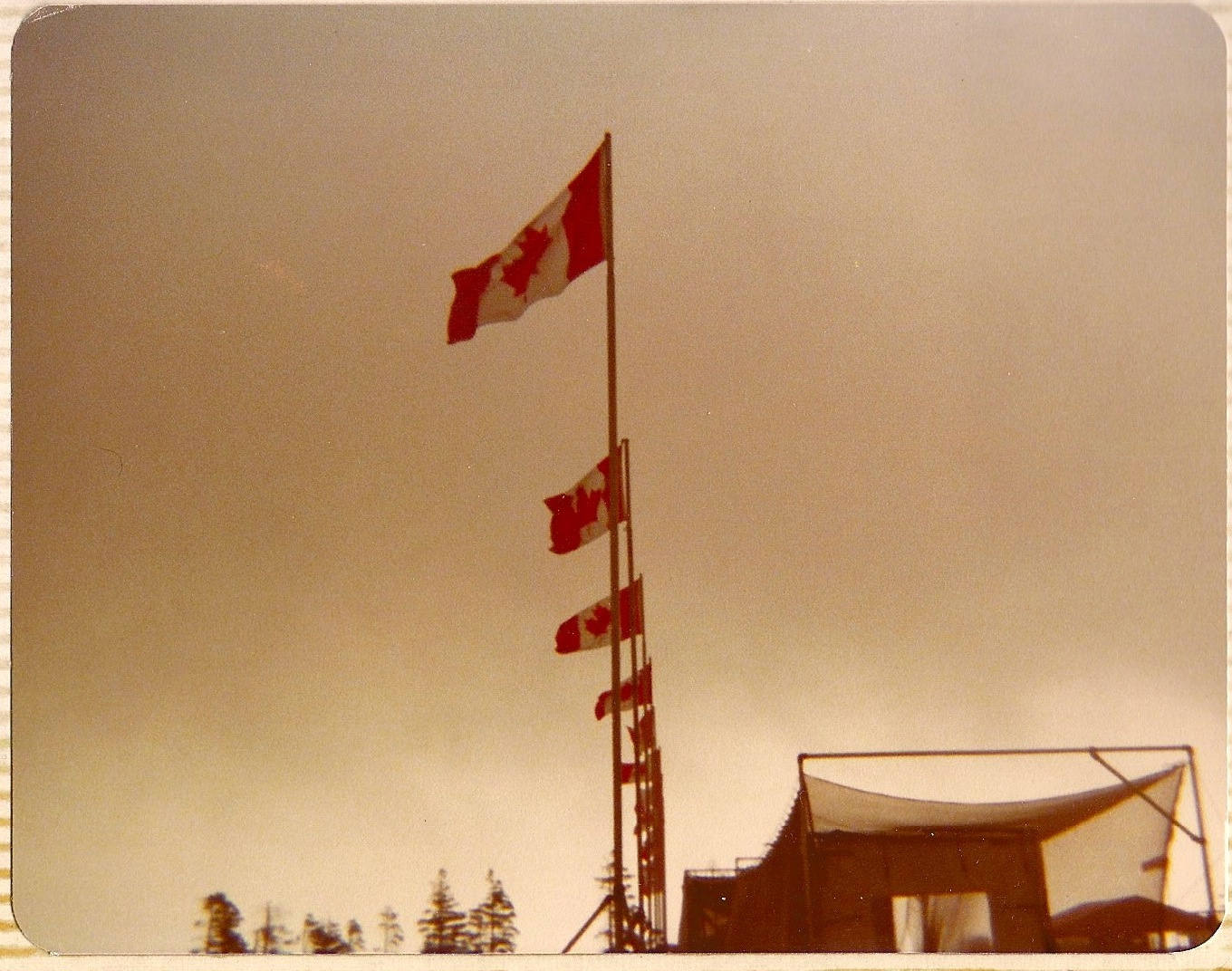
When Stompin’ Tom Connors died a week or so ago, I thought back to the time I saw him perform live at the Canadian Boy Scout Jamboree at Cabot Beach, Prince Edward Island in July of 1977. His abbreviated concert now seems to me to have been both apt and inappropriate: a contradiction that haunts most of Connors’s music, at least as I hear it. For me, it’s hard to listen to the thudding polka beat and reedy vocals of “The Ketchup Song” – for instance – and not be utterly embarrassed by the bathos and yet wholly enthralled by his strangely unshakable commitment to Canadian regional quiddities: Stompin’ Tom’s quirky lyrics voice a wryly ardent poetics of his, of our places, and of our brands. 
Foxed snapshot of a row of flags near the entrance to CJ’77
A duplicitous adolescent nationalism attaches itself to this mid-seventies moment in my own life, like an ideological push-me-pull-you, epitomized in my participation in Boy Scouts that summer. 
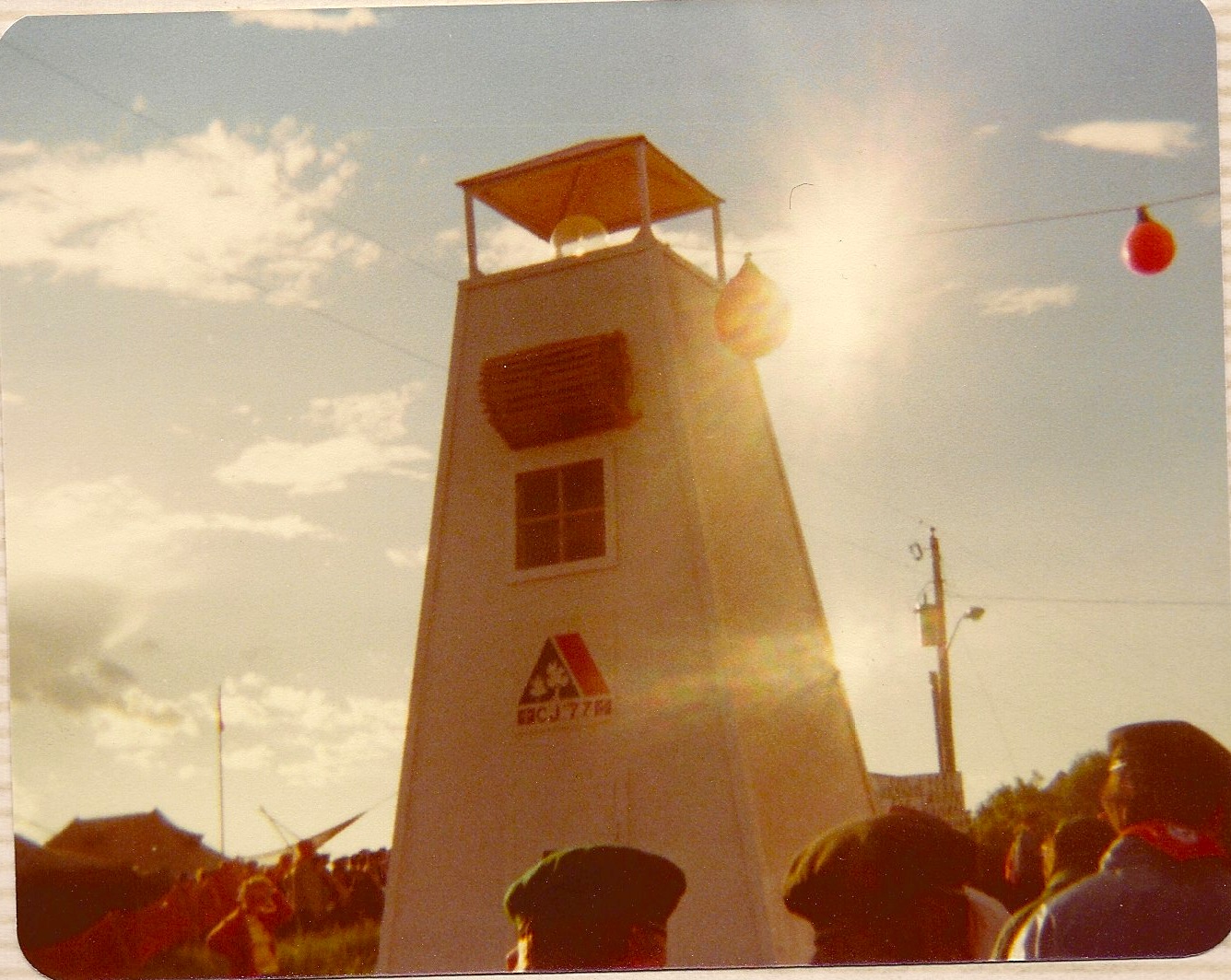
Lighthouse tower with the jamboree logo
I wore the uniform, happily and a little proudly and doubtless naively, but was also (more by preadolescent instinct than conscious choice) a bit of a skeptic and a cynic. Wanting to believe, as the troubling Friedrich Nietzsche says somewhere else and about somebody else, is not the same thing as believing. I wanted the buy-in, and tried hard, but could never fully manage it. And that’s how I hear my own version of Stompin’ Tom, then, for what must have been the first time, and now, for the umpteenth: with ambivalence, as a sound wanting my buy-in, but me being finally unwilling or unable to let go and do it, to just “tune [my] attitude in.” 
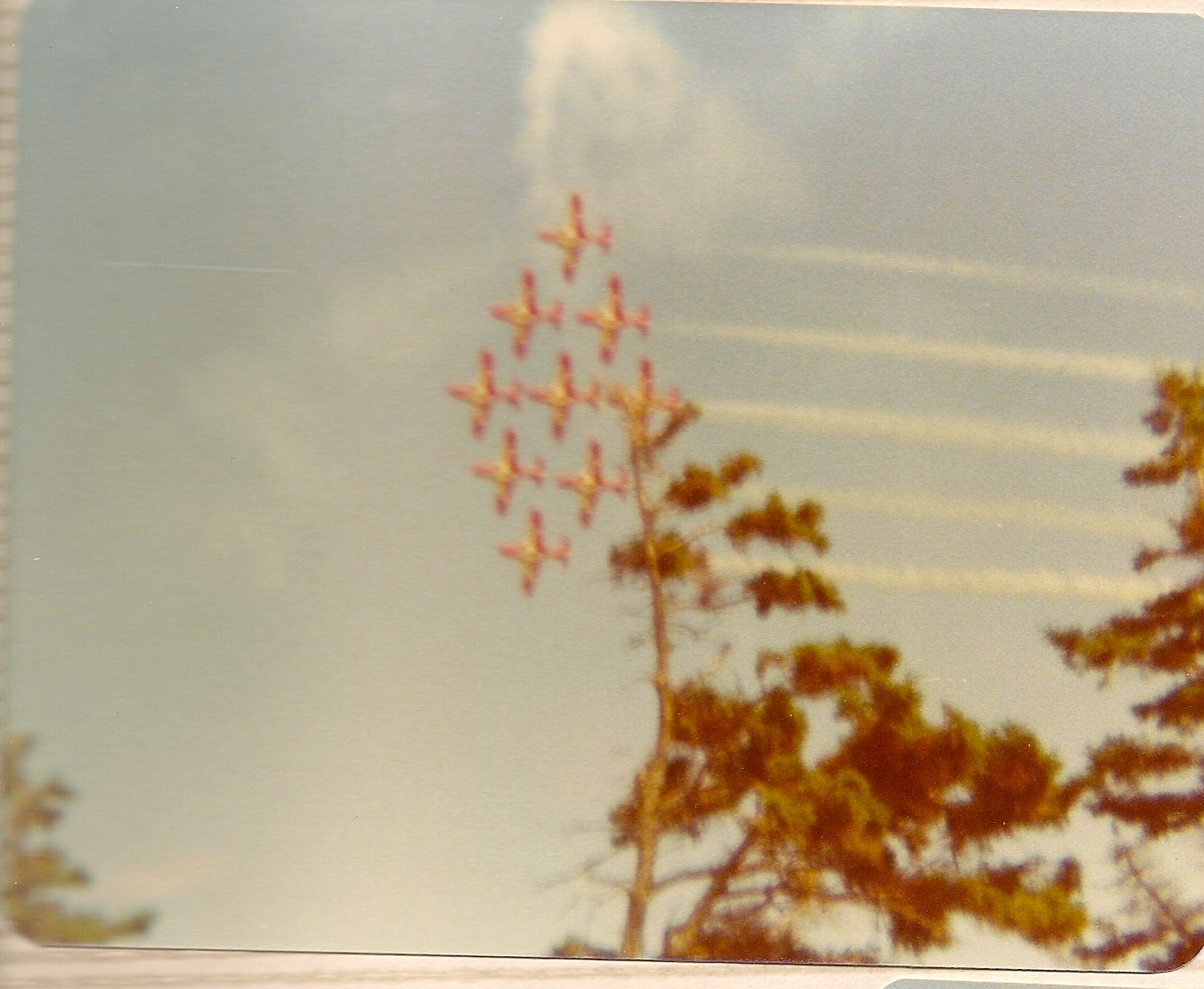
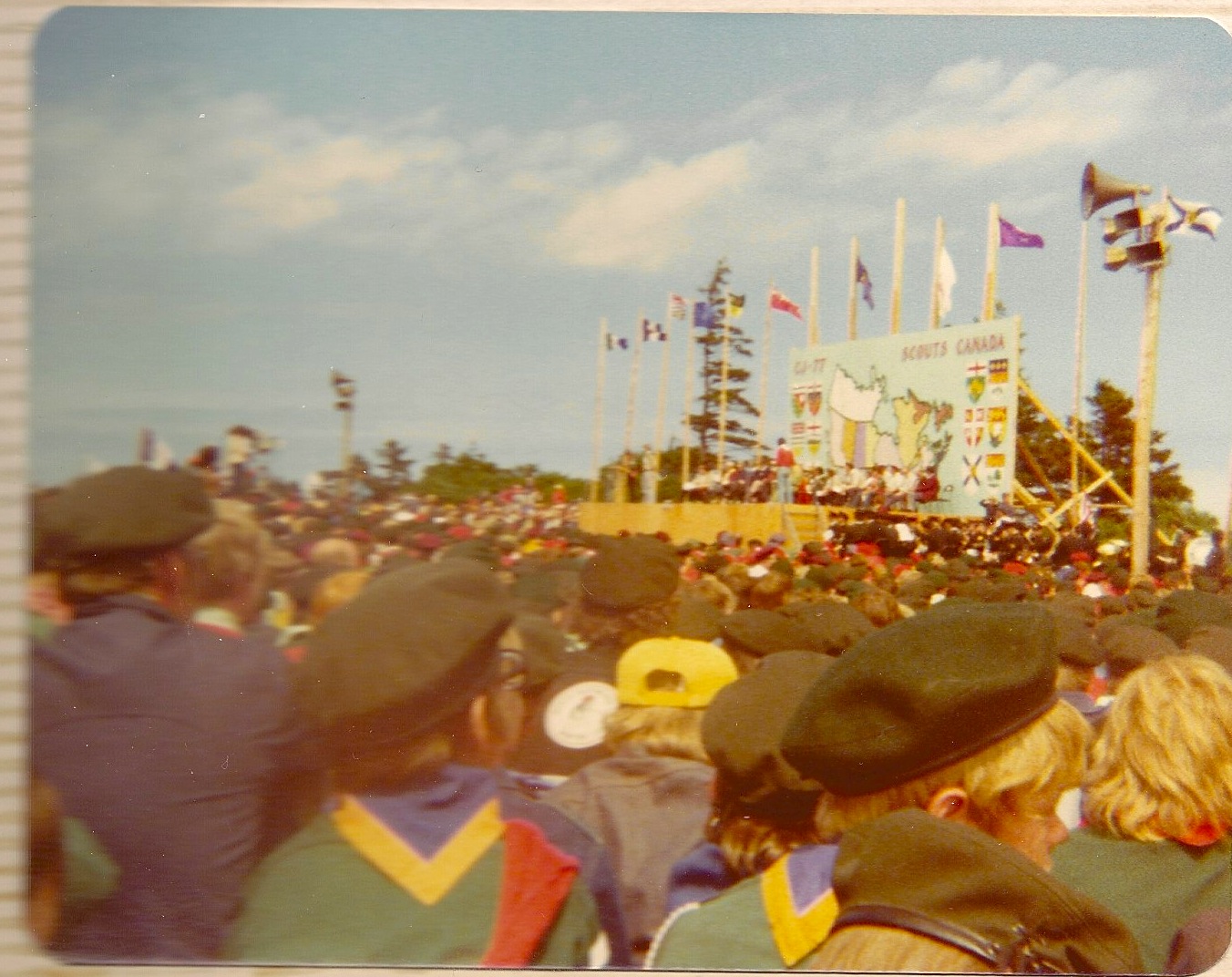
So, I have been clicking and surfing now for a few days off and on, but can’t find any electronic evidence that Stompin’ Tom actually performed at the jamboree. My memory might be faulty, sure, there’s always a chance of that, but I’m sure, sure it was also real, that this concert happened and that I was there, one among 16000 uniformed, preadolescent boys and their leaders. There must be others who remember him. As I recall things, he might have been the opening act for Anne Murray, who was an even bigger deal then than she might be now, and who had come to the jamboree to film part of an Anne Murray and Friends specialthat was to air on CBC television maybe that fall. This was the first national – even international – scouting event of its kind in Canada since 1961, and the fourth jamboree ever to have taken place. (They now recur at four- to six- year intervals.) The tent-city of boys near the Atlantic seaboard represented a resurgence of idealistic, late colonial Canadian nationalism, ten years after the centennial, for which we were both constructive participants and captive audience. The backdrop of the main stage offered a map of the country, with the provinces coloured in pinks and greens reminiscent of the elementary school geography class wall-hangings we all knew by sight, but enlarged. At the outdoor spectacle – which was staged like an oversized set of “campfire” songs – we heard Anne Murray and experienced a flyover by the Snowbirds jets (which now seems to me like a kind of parodically sentimentalized Canadian militarism). 
Snowbird flypast, over the ocean.
Apparently, a kilted and uniformed Prince Charles – as the movement’s and the dominion’s “chief scout” – addressed us, although I can’t remember what he said or even that he was there. 
The outdoor stage. It is too small to see who is talking
or performing, but I think it’s Prince Charles.
(I was even interviewed on tv – it might have been ATV or CBC – as some sort of representative boy scout; I think my scoutmaster had some connections in Nova Scotia, and he was kind enough to get some of his scouts out into view. Sadly for me, there’s no tape I know of to prove that this happened, but my parents saw it, all five seconds of it.) But I do remember Stompin’ Tom.
         This must have been the biggest crowd he ever played to. He would have just turned forty, although he had, as he always did, the worn, pinched thin-lipped face of a perennially older man. He looked country. I don’t know how I can picture these details. I was pretty far back in the welter of boys, but I think I can see how he was dressed: black hat, peglegged black jeans, flowered polyester cowboy shirt, tall-heeled cowboy boots, belt with ornate silver buckle, bolo tie, black vest, maybe real leather maybe imitation leather. His own uniform. He played some of his PEI songs I’m certain, “Bud the Spud” and “Lester the Lobster.” We all knew these songs, knew the words, and sang along if we weren’t too ashamed to sing. They were stupid, they were beautiful, they were awful, they were great. I don’t know how it was that we had heard them all before often enough to know them, but it was true that we had. Small-town country radio was almost all there was where I came from. He also did “Sudbury Saturday Night,” I think, and some inappropriate drinking songs. He may not have realized he was playing to amassed twelve year olds. Then again, he might have. It was, the way I remember it, a short concert, which is why I think it may have been the opening act. For maybe 30 minutes, he really kicked the heck out of his plywood stomping board, his left leg flailing at the stage: Stompin’ Tom had still come stompin’. In the end, he hadn’t played enough to wear a hole in the board. So he and the emcee just picked it up, and he finished punching a hole through the middle by hand. It had to be done.
         There was one kid in my scout patrol called Huey. His father owned some construction business or other around town; he was a boy-child of privilege, as most of us were in that troop. As we walked back from the concert to our tents, and for the rest of the trip, he must have been cued by the music to ask everybody within earshot over and over again the same two questions about the current top-forty: “Do you like ‘Sir Duke’?” “Do you like Fleetwood Mac?” For days afterwards, he wouldn’t stop. “Do you like Fleetwood Mac?” “Do you like ‘Sir Duke’?” Now I couldn’t admit it, but I actually kind of liked Stompin’ Tom. Uncool as he was, and so far off the un-Canadian charts, he still kicked it around. The sound of Tom Connors from Skinner’s Pond had got into my head, a relentlessly nasal, driven throb that no needy kid’s voice could ever dislodge.

lovellevellilloqui: Short Take on Thomas Chapin

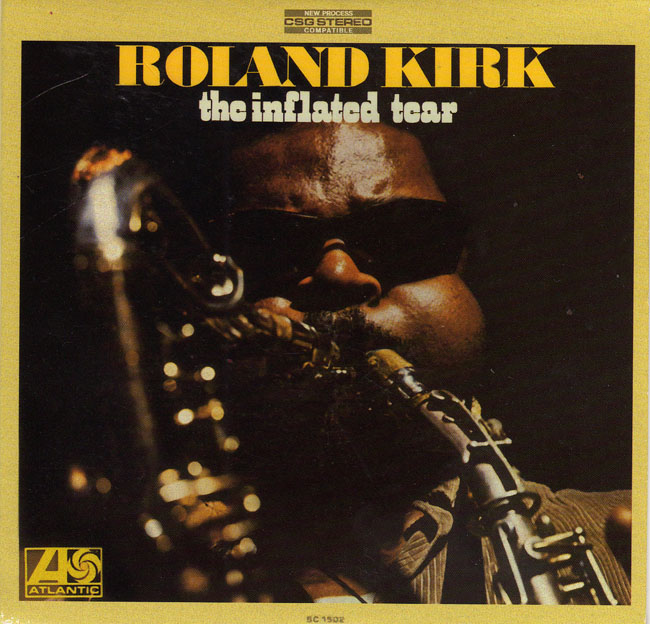
Yesterday I received in the mail a copy of Never Let Me Go, a three-disc compilation of two performances by Thomas Chapin‘s nascent quartet (with Peter Madsen on piano, Kiyoto Fujiwara [’95] or Scott Colley [’96] on bass, and Reggie Nicholson [’95] or Matt Wilson [’96] on drums), a recording of some of Chapin’s last concert appearances before his illness the following year and his death in 1998. The recordings are good, and seemed to have been clarified and cleaned up a little; the first two discs, sets from Flushing Town Hall in NYC in November 1995, are reminiscent acoustically of a high-end bootleg: the music is present and immediate, but there are still a few recalcitrant rough edges. The piano, for instance, sounds a bit rubbery, like a poorly tuned upright. Not that I’m complaining: I think the sound suits the vital exuberance of the playing all round, its ardent velocities. (In fact, on the better recorded Knitting Factory gig, the upper register of the club piano is also pretty detuned, but Madsen makes a virtue of necessity, on “Whirlygig” for example, producing metallic percussive textures as if this were a “prepared” instrument.) This quartet as I understand it was a new and evolving formation for Chapin; principal reference points for this music include post-Coltrane hard bop — Madsen’s left hand plumbs the lower registers and jabs at chord substitutions much like late-60s McCoy Tyner, and also Jaki Byatd — but the group also takes up Chapin originals, some penned for his long-standing trio. (I really like their version of his “Sky Piece,” with a terrific solo intro by Colley.) Chapin’s alto seems at times to find its lineage from Charlie Parker sieving through Eric Dolphy, maybe with a touch of Lou Donaldson, but his most obvious influence here, if influence is the right word, is Rahsaan Roland Kirk. Like Rahsaan, Chapin is a virtuoso of excess: he never has anything short of too much to say, too many more notes to play. His improvisations are flush with as much music as he manage, and his saxophone tone is reedy, robust and fully blown. He enacts extemporaneously, in track after track, what Giorgio Agamben variously calls resto, excess, remainder, outside, the open–a kinetic space of vital negotiation between animal Eros and creative will, aisthesis and aesthetics, feeling and making, body and soul. In a word, his sound strives to express. The quartet’s version of Rahsaan’s “lovellevellilloqui ” (originally from The Inflated Tear) both re-enacts and bears witness to, as a now-posthumous recording, what made and makes Thomas Chapin’s music so important to hear: its virtuosity of abundance, its intensely sounded love.
Live Short Take on Jen Currin and Ken Babstock

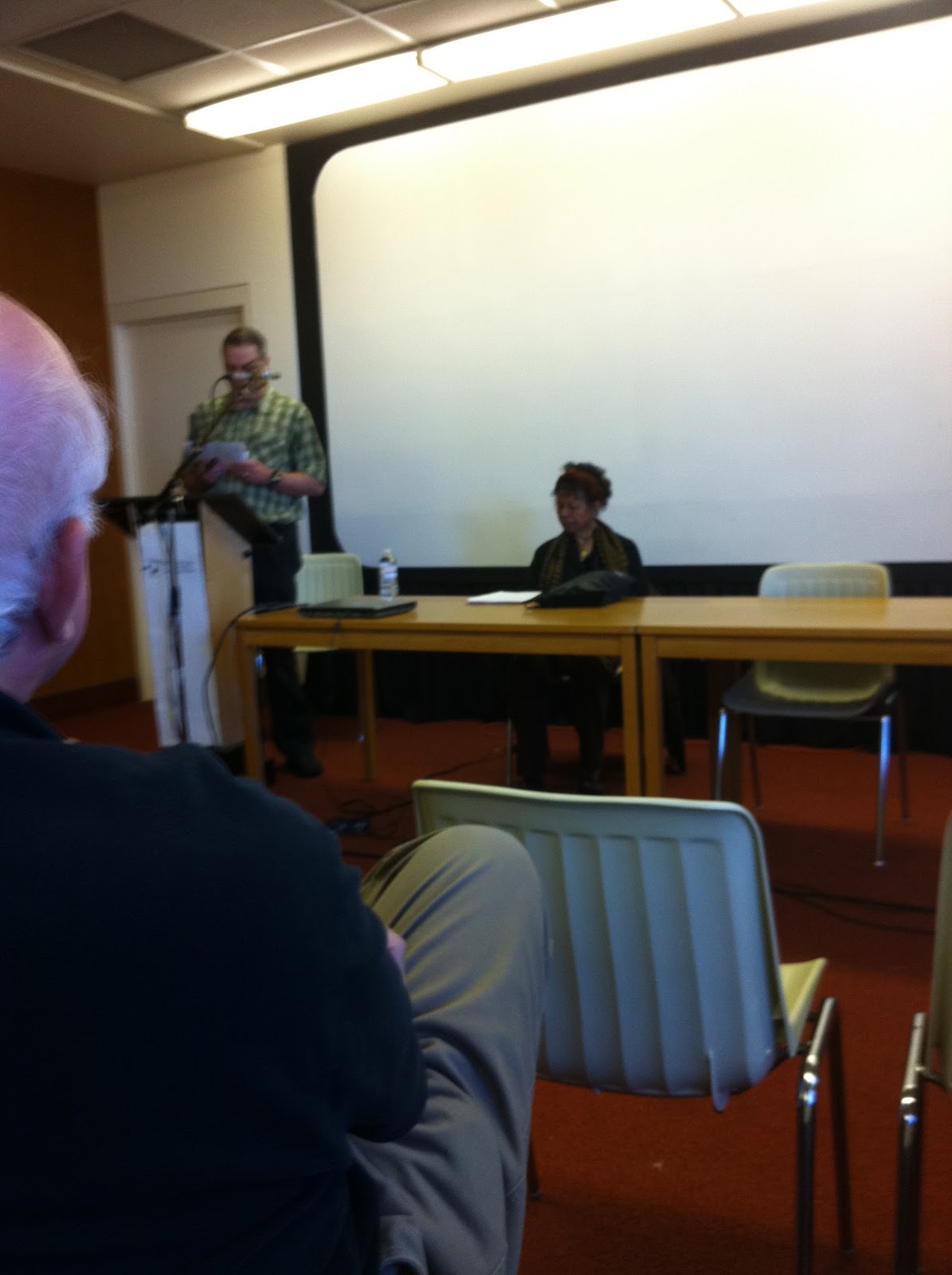
Last night, I attended a poetry reading by Jen Currin and Ken Babstock, part of the Play Chthonics series here at Green College, U. B. C. As an experiment in listening, in refocusing a divided attention, or maybe in overwriting distraction, I thought I would try blogging live, drafting a post as a transcript and as a reaction. I find I have trouble hanging on to the lines of poems at readings; there is no rewind, no pause, and if things seem to resonate and to hang in my ear for a moment or two, the succession of coming lines overwrites and pushes them out of my immediate memory. I tried to write the odd line down as the reading happened, tapping it onto the virtual keyboard of my smartphone blogging app. I hope I didn’t distract from the experience of those around me. Some people find the technologies of social media inherently abrasive, rude. And maybe they’re not wrong. Those technologies are at least distracting, and distracted. It was a great reading; both poets offered up innovative, paced, striking poems. There was too much to catch. But I tried to hang on to bits as they flowed passed:

Jen Currin is reading poems chosen by chance from her books. This: “Night arrived in the form of a candle.” This, not given at a reading before: “Dogs on film and no one wants to hold her hand in exile.” And this, from somewhere in her Hagiography: “To make it sane I planted poppies.” New pieces: “Photo Booth” (“You’re a descriptive kind of girl”); “The Oceans” (“I feel your seaweed body bending my way”); “Taking an Intuition Class” (“We understand a little, just a little of us”); “The Emergencies” (“We must listen”); Our Face on the Cover”; “Fear is Not a Body Part.” “The Art of the Spiritual Headache” ends with a gesture at freedom, freeing. Applause.

Ken Babstock is trying sitting rather than standing: harder to breathe, but less jittery. The necro lyric or the zombie lyric: writing continuing to write lyric beyond its end. “Are songs litter?” Reading like Jen some things that he doesn’t normally. Randomized choices? An elegy for Vic Chesnutt, “I Think I Will Go to Bakersfield”: “What can I say? I’m done.” “Hoping Your Machine Can Handle the Big Image”: a response to Karen Solie’s “Tractor”. Ken says solipsism gets a bad rap. Rep? Rap. Now a sequence of sonnets, procedural constraints, hybrids, holes. Not wholes. Nostalgically treating Cold War surveillance. Low frequencies.

During the question session, Jen discusses her interest in Elizabeth Bishop, and talks about a project for which she uses the words of Bishop’s poems as a source vocabulary to make new poems, rearrangements. Ken is asked about the connections between his new sonnets and John Berryman’s Dream Songs.

There was more. You can hear it on the recording. But I wanted to listen rather than transcribe so I stopped. Interesting how little clings to such a transcription, though my impression was that the act of copying did intensify the memory of the words, of lines. But much fell away, as well. 

If you look closely, you can see my smartphone open and lit up on my lap. (Photo by Karen Correia Da Silva)

Voicings

Jayne Cortez passed away—went flying home—on December 28, 2012, so this small tribute comes a month or two late, but I did want to record publically my sincere admiration for and indebtedness to her poetry and her performances. There was a proper obit in The New York Times, and there have been many warm tributes, including one from critic Howard Mandel.

Karl Coulthard introducing Jayne Cortez
at the University of Guelph, September 2011
I met Jayne Cortez only once, and only recently, when she gave a keynote talk about her own work at the 2011 Guelph International Jazz Festival. She presented selected recordings she had made over the past 30 years with her band The Firespitters (whose revolving personnel often included her son, percussionist Denardo Coleman, as well as members of Ornette Coleman’s electric ensembles), and her comments focused on elaborating the chiasmic chant from the title piece of her recent Best of CD: “Find your own voice, and use it. / Use your own voice, and find it.” This sounds like advice for new performers – and it is certainly that – but the aspirational panacea of self-discovery these crossed lines offer is only part of their intention.
I have to admit that I am well trained to be suspicious of the expressive, and for better or for worse I incline toward an arch poetic technique that finds its touchstone in Martin Heidegger’s maxim, Die Sprache spricht: language speaks itself. Wimsatt and Beardsley’s affective and intentional fallacies are difficult beasts for me to shake. It can be perilous for a non-African-American like me to associate the expressive with racially marked text, and to implicitly divide it off from canonical, oblique, academically-mediated and difficult Poetry with a capital P; black identity, down that slippery slope, gathers in the emotive and the embodied, while technical linguistic prowess remains the provenance of a white cultural dominant – a racial bifurcation with which I’m not just uncomfortable but which also belies what most poetry, for me, wants to accomplish, to speak. I think George Lewis’s conceptof the Afrological – which he links principally to musical practices – is useful  to invoke here, in as much as it aims to foster dialogue (“Gittin’ to Know Y’All”) without necessarily enabling cultural or racial appropriation.
            My memory of Jayne Cortez isn’t so much her talk as of a conversation we had the next day, by chance. We were both staying at the same hotel in Guelph, and ended up riding in the same Red Car van to the Lester B. Pearson Airport in Toronto, to catch our flights home. The trip takes nearly an hour. Ms. Cortez remembered me being at her talk the previous day, and asked politely after my own poetry, which I’d read at the colloquium. We talked about emerging writers, and about her husband Melvin Edward’s sculptures, and I remember she praised William Parker’s generosity and musical vision. But most of all, what I recall is her tone and spirit; she talked with you, not to you. She, too, seemed generous and open; she smiled almost the whole time we talked. I admire her greatly that she would so happily and freely engage with somebody she’d just met and hardly knew. It was like she genuinely wanted to know about you and your inclinations, and to share hers. Respectful exchange, a crossing.
            One of my favourite pieces on her compilation CD is a duet with baritone saxophonist James Carter, an improvised blues (called “I Got the Blues,” recorded in 1994) involving, as her notes put it, “verbal call and response between the poet’s voice and the baritone saxophone sound.” Neither she nor Carter is hesitant or diffident; they know their voices. Cortez doesn’t offer any sort of phonemic sound-poetry, but sticks to the declarative, what she does best: an edgy, passionate, and fierce lyricism. Still, the piece is as much interchange as exchange; they listen and speak to – with – each other, and it is the alternately assertive and yielding textures of that conversation, as much as its content, that come to matter. Cortez says that writing a poem is a matter of getting your mouth on the paper, of expression finding its way over a page. But I think that the reverse might also be true: to find a way to sound out off the page, to make those marks speak—mouth to paper, paper to mouth. Jayne Cortez’s work, for me, offers a model of committed self-expression, a finding.

Short Take on Tim Daisy & Ken Vandermark

Found a copy last week of Light on the Wall, a double LP by Tim Daisy (percussion) and Ken Vandermark (reeds), recorded as a duo and both solo in Poland in May 2008, and issued on Laurence Family Records. The sound, both live and in the studio, is excellent. You can really hear Daisy’s distinctively open sense of space in the live duo set; Vandermark offers a set of solo “Etudes for Jimmy Giuffre,” but to me their duos not so much build on Giuffre’s chamber-ish conceptions, as recall duos by another Jimmy, Jimmy Lyons, with Andrew Cyrille–not that there is anything derivative in this music, but rather that both are thoroughly cognizant of their position in an emergent sense of a building tradition of forward-thinking sonic experimentation, the extemporaneous edge where the performing present takes up its audible pasts: a historicity of the avant-garde, coming on. That, and it’s a great record.

Dead Paper

In an essay revised for the second edition of her Nomadic Subjects, Rosi Braidotti takes up the fraught question of men in feminism, somewhat ironically I’d say, by building on Michel Foucault’s concretizing of the conceptual, the “materiality of ideas”:
One cannot make an abstraction of the network of truth and power formations that govern the practice of one’s enunciation; ideas are sharp-edged discursive events that cannot be analyzed simply in terms of their propositional content. (264)
What this means, for Braidotti, is that
heterosexual men are lacking intellectually […] a reflection on their position in history. The politics of location is just not part of their genealogical legacy. They have not inherited a world of oppression and exclusion based on their sexed corporal being; they do not have the lived experience of oppression because of their sex. Thus most of them fail to grasp the specificity of feminism in terms of its articulation of theory and practice, of thought and life. (265)
The politics of sex and sexualities, for Braidotti, needs to account for the materiality of ideas, and to address and even to enact not merely propositional or conceptual empathies, but the interactive negotiation of differences, or better, of pluralities; her Deleuzian nomadism, sieved through Luce Irigaray, wants to work through an amalgam, an admixture, an assemblage of intellectual deference and embodied resistance to his “becoming-woman”:
For Irigaray, as for Deleuze, the subject is not a substance, but rather a process of negotiation between material and semiotic conditions that affect one’s embodied, situated self. In this perspective, subjectivity names the process that consists in stringing together—under the fictional unity of a grammatical I—different forms of active and reactive interaction with a resistance to these conditions. The subject is a process, made of constant shifts and negotiations between different levels of power and desire, constantly switching between willful choice and unconscious drives. (274)
This blend of situated excisions and unraveling sutures characterizes Braidotti’s repurposing of Deleuze, but what I’m hearing here also resonates with my current reading of Charlotte Perkins Gilman’s “The Yellow Wallpaper” for my Arts One class. I have to confess that I bristle – just as she appears to predict I might – at Braidotti’s foreclosed feminism, at my preemptive and summary exclusion from feminist critique by virtue of a generalized bifurcation of human sexual anatomy into a male-female antinomy, a division which, despite her philosophical pluralism, Braidotti still maintains. But I don’t want to appear to be a resentful, if privileged reader, grumpy about some area of gendered experience that he can’t finally appropriate or even access. And I do think Bradotti has a point: that sexual politics must emerge from materially succinct, and distinct, lived subject positions, to which we have incomplete access at best. (I am concerned, still, about the seemingly unimpeachable gender solidarity, however, that she continues to claim.) 
Rather than resentment, I want to suggest that this incompleteness, this dis-closure (as opposed to foreclosure) might be more productively understood as an unnamable and inassimilable source-point, a singularity, around which surges of differential and even creative energy might be said to accrete.  As a man in feminism, or at least in its sights, what I want is to think toward those gendered exclusions, those singularities, not to appropriate any vital differences – what makes other lives others – but to participate, even if only tangentially, in what Gilman characterizes as an economy of difference, what she calls (in the story and in her tract) work:
Those who object to women’s working . . . should remember that human labor is an exercise of faculty, without which we should cease to be human; that to do and to make not only gives deep pleasure, but is indispensible to healthy growth. Few girls today fail to manifest some signs of this desire for individual expression. (Women and Economics 157)
Labor – which she distinguishes from the “morbid, defective, irregular, diseased” and pathological work of human motherhood, the reduction of women to reproductive and domestic vessels (181) – is for Gilman essentially expressive, inasmuch as it entails an instrumental – that is to say, a poietic – and even causal relationship between what Braidotti calls “theory and practice” or between the propositional and the active. Gilman’s critique is as site-specifically and as historically gendered as Braidotti wants feminist work to be, but it also generalizes itself and its “lived experiences” in contradistinction to Braidotti’s exclusions, to introduce women’s experience into an aggregate of the human, to produce a still fraught but nonetheless accessible, differential humanism. The exclusion of women from the purview of the human is for Gilman something to be overcome – in the act of writing, no less – rather than a set of exclusions to be materially reversed and re-instantiated by a reactive, if just, politics:
What we do modifies us more than what is done to us. The freedom of expression has been more restricted in women than the freedom of impression, if that be possible. Something of the world she has lived in she has seen from her barred windows. (Women and Economics 66)
The determinisms of oppression need to be overcome, but it is in the eruptive and disturbing – and decidedly material – acts of resistance, including a resistance on and through paper, as much as the utopian teleology of a better, just and “modified” world, that Gilman values: the work, the lived and living process, of pushing back and of tearing down and of breaking through.

(public-domain image of Charlotte Perkins Gilman from the Library of Congress on-line collection)


The bars in the passage I’ve just cited echo the bars on the windows in the abandoned, “atrocious” nursery that Gilman’s unnamed narrator inhabits in the rural house her husband has rented out (apparently to enable a rest-cure for his wife’s incipient hysteria) and to which she is provisionally confined, a space that sharply inverts Virginia Woolf’s “room of one’s own,” in which the patriarchal benevolence of her husband (and other “doctors”) effectively bans expressive work of all kinds, especially writing: “There comes John, and I must put this away,— he hates to have me write a word” (13).  Even the narrator doubts her own expressive capacities, scare-quoting her first mention of “work” both to trivialize her own labor and to accede to her husband’s will that she deliberately distance herself from the unruly action, especially writing.
That she remains existentially trapped in a nursery speaks to Gilman’s critique of married motherhood and of the limitations it imposes on women’s capacities for self-expression. (The narrator has had a child, but she defers its care to “Mary,” admitting that she cannot be with her infant son because it makes her “so nervous” [14].) She is infantilized by her husband – “’Bless her little heart!’” – and effectively mastered by his “care.” He presents himself as the intimate physician of her psyche, but also doubts the reality of her feminine pathology:
John is a physician, and perhaps—(I would not say it to a living soul of course, but this is dead paper and a great relief to my mind)— perhaps this is one reason I do not get well faster.
You see he does not believe I am sick! (9-10)
Her tentativeness to assume the defiant agency of a speaker, to even suggest that her husband’s wishes might be detrimental to her health – and not, perhaps, only “one reason” but in fact the reason she cannot get better – is ameliorated by the confessional dead-space of the page, its inaccessibility to him both as secret diary and as empirically “dead” paper. Gilman juxtaposes the propositional and the lived, the representational, abjected deadness of words on paper and the lived realities of the narrator’s oppression outside the bounds of the page: a juxtaposition crucial to Braidotti’s materialism. This bifurcation is sutured in the tale – cinched, perhaps, without necessarily being healed or remediated – in two ways.
First, in the impossible horizon of the present tense, as the narrator’s descriptive account verges on speech act: “I am sitting by the window now, up in this atrocious nursery, and there is nothing to hinder my writing as much as I please, save lack of strength” (13). These moments of reflexivity suggest that the act of handwriting, as an assemblage of corporeal effort (or “strength”) and propositional or thematic matter (whatever our narrator is describing or writing about) are drawn increasingly closer together. Her clipped style, with its journalistically brief paragraphs, affirms this aspiration to immediacy, to assemble action and description into the same written, subjectively-permeable moment. The penultimate page comes closest to this impossible presentism, when the narrator seems to be recording events in her journal as they happen around her, effectively making them happen (again?) on the page as her account unfolds:
                        Why there’s John at the door!
                        It is no use, young man, you can’t open it!
                        How he does call and pound!
                        Now he’s crying for an axe.
     It would be a shame to break down that beautiful door! 
    (35)
This torrent of clipped paragraphs is meant to represent an hysteric break, but what it accomplishes in fact,  on the page, is expressive plenitude, an enlivenment. The potentially violent breach of that nursery door, behind which she has deliberately locked herself in an effort – a labor – to  exclude, and to exclude herself from, patriarchal mastery, is avoided by her admission to John of where to find the key, but it’s worth noting that her deference involves an immediate shift into the past tense:
            “John dear!” said I in the gentlest voice, “the key is down by the front steps, under a plantain leaf!” (36)
The expressive collision of word and event lapses into narrative distance, objectified and written down in retrospect, as soon as her husband’s access to her closed psyche is (however contingently, however much “perhaps”) is re-enabled.
             But the question of when and where – after the fact – the narrator continues to transcribe her experiences remains troubling here. The monstrous creeping she describes – creeping over her husband prostrate form, after he has fainted in his own moment of appropriated hysteria – does not entail a muted or inexpressible femininity, but is given voice through her:
“I’ve got out at last,” said I, “in spite of you and Jane. And I’ve pulled off most of the paper, so you can’t put me back!” (36)
She tears down the suppressive yellow wallpaper, behind which she has been imagining – perceiving – the trapped spectral figures of creeping women, but her account of this culmination of her self-assertion is recounted from a transcendental point-of-view, outside of the narrative time-frame. That paper, too, is the second image of subjective suturing that I want to take up. The narrator has become pathologically fixated on the “unclean,” torn, irregular, repellent, yellowed wallpaper leftover on the nursery walls. She scans it for “patterns,” in an effort to read and interpret it, to master what it says; it reduplicates a species of domestic panopticism, even – “those absurd, unblinking eyes are everywhere” on its surfaces (16).  The narrator links the wallpaper, at least overtly, not to oppression but to expression: “I never saw so much expression in an inanimate thing before, and we all know how much expression they have!” (16). The wallpaper, that is, becomes a metonymy for the “dead paper” – to which it is tied contiguously in the tale as a writing surface – onto which the narrator pours out her life, animating the inanimate page over which our own eyes pore. Still, that paper is suppressive, as the shadows of the window-bars play across its surfaces. Visual layers emerge as the narrator tries to make sense of what she sees, the elusive arrhythmic “pattern”: “If only that top pattern could be gotten off from the under one! I mean to try it, little by little” (31). Held under the surface, the submerged “pattern” is an irregularity, the repeated figure of a creeping woman, who starts to push at the paper’s outer membrane – trying to emerge from the amniotic wall – as she “takes hold of the bars and shakes them hard” (30). Writing as écriture féminine – in secret, excluded behind closed doors, in an atrocious rented room – both stitches a subjectivity onto the dead page, a monstrous graft, but also tears at those sutures, pushes viscerally through the page to touch the material quick of the reader’s living world. This is the marvelous horror of Gilman’s tale, its vital creepiness: that it tears at its own pages the way our narrator tears through that paper.
Cited Things
Braidotti, Rosi. Nomadic Subjects: Embodiment and Sexual Difference in
          Contemporary Feminist Theory. 2ndedition. New York: Columbia
UP, 2011. Print.
Gilman, Charlotte Perkins. The Yellow Wallpaper. Old Westbury, NY: 
          The Feminist P, 1973. Print.
– – -. Women and Economics: The Economic Factor Between Men and
         Women as a Factor in Social Evolution. 1898.  Ed. Carl Degler. 
         New York: Harper, 1966. Print.