Flow, Fissure, Mesh

Home » Articles posted by kevinmcneilly (Page 15)

Author Archives: kevinmcneilly

Short Take on Petra Haden

I can’t seem to stop listening to Petra Haden‘s newest album, Petra Goes To The Movies (Anti-), which I bought two days ago. Brilliantly moving versions of various film musics, from John Williams to Bernard Herrmann, made by overdubbing her voice using a similar approach to her cover of The Who Sell Out. The layered, shifting densities of her voice, her voices, her voicings — alternately playful and ardent — are really and truly moving. She has a way of finding the heart of a song, of making it breathe. Her simple duo with Bill Frisell, “I Might Be You” (the Dave Grusin song from Tootsie) is a standout. She feels her way along the melody, bouyed up by the spare chords and fragile twangling of Frisell’s guitar. A fantastic record.

Hungry

Hungry” was composed in the last few days in reaction to the hunger strike by Attawapiskat Chief Theresa Spence. As a non-Native Canadian, I’m concerned to express solidarity with her cause while trying to avoid as far as possible some of the pitfalls of advocacy. The Attawapiskat were among the last to sign the adhesion to Treaty 9on July 28, 1930. Stan Dragland offers an important reading of Duncan Campbell Scott’s often disturbing poetry around this treaty in his Floating Voice (Anansi, 1994).

Brief Prose Alap, Remembering Ravi Shankar

When I was a first-year undergraduate at Western, I didn’t have many friends and I didn’t really try all that hard to make any. I spent much of my time between classes the same way I spent my evenings at home, sitting at a stereo with a pair of headphones on, listening to music. The university’s music library had maybe twenty listening carrels, surrounded by shelf loads of records, mostly classical, but there were no restrictions preventing non-music students from using the collection, so when I had a free hour I would walk down the snow-covered hill from the arts building to the music faculty, and sit through a couple sides of whatever interesting lps I could find. It was here that I first heard the great Bill Evans Trio (with Scott LaFaro and Paul Motian) at the Village Vanguard in 1961; the library owned a twofer compiling most of the tracks (except “Porgy,” I think) from the two albums, and I remember being blown away by the surging, elastic rhythms of their version of “Milestones,” needle again and again. I can’t say how many times over I played the first side of Keith Jarrett’s Köln Concert; those gospel-tinged, life-affirming cadences have been incised into my aural memory, as they have been for so many people – although, for me, those sounds are also marked indelibly by the context of their first hearing, at a turntable in one of those carrels. I also found a copy of John Coltrane’s Live at the Village Vanguard, which I didn’t own at the time, and could give “Chasin’ the Trane” the sustained close attention its deserves. I tried new music – they had a complete set of Stockhausen’s Aus den sieben Tagen – and found some rarities (a great set by Anita Ellis, elegantly accompanied by Ellis Larkins, which I’ve never seen again or since; an amazing Elvin Jones-Richard Davis duo on “Summertime,” which was long out of print at that point, though it’s since been re-issued). There was a pile of Smithsonian recordings of American folk: my ears were opened, my aural horizons maxed.


         There was one other record I found myself coming back to, a 1981 Deutsche Grammophon release called Homage to Mahatma Gandhi by Ravi Shankar, which combined two side-long sessions with the sitarist and tabla master Alla Rakha. With Ravi Shankar’s death a week or so ago, I started to remember hearing this music, and to think about its impact on me – immature, solitary, arty – a quarter of a century ago. I came to this music via my enthusiasm for Coltrane’s “India,” a sort of minor-modal adaptation to Western ears of Indian idioms. I knew and I know next to nothing about the technicalities of form and structure in Indian classical music, but I do know something about what I thought I heard and can still hear in Ravi Shankar’s recording. He apparently composed Rāga Mohan Kauns, the four-part raga that takes up the first side, extemporaneously and live, at the request of a radio producer in Bombay in 1948, a handful of days after the assassination of Mahatma Gandhi. (The note-sequence that acts as a modal basis for the raga, Ga Ni Dha, is based on Gandhi’s name, a musical code from which Shankar’s extended improvisations gradually take flight.) The first section of the raga is an alap, a slowly building encounter with the basic melodic materials for the piece in non-metered time, without percussion. What I take away from Shankar’s recorded performance – with its tensile, wobbling tones, his languorously whelming, softly metallic attack coupled to a strangely inverted and resilient decay – is a stretching and even a suspension of time. In the encounter with mortality, in a public act of musical mourning, of grief, Ravi Shankar finds for me a pathos, a held poignancy that recalls both the resistance to and the inevitability of death. Rhythm, as he feels his way fingertip by fingertip into his notes, emerges not as virtuosic dominion but as a vibrant elasticity, an opening of the self that bears tactile witness to its calmly passionate refusal of extinction.

Breathturn

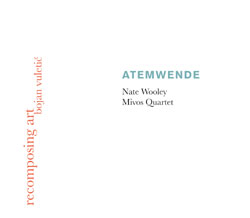
I have been listening to Atemwende, a recent CD of music composed by Bojan Vuletić for string quartet and trumpet. His work is new to me, and I bought the CD because of the presence of Nate Wooley on the recording. The composition is a suite in nine movements, and each section is derived from Vuletić’s reading of a poem by Paul Celan. These aren’t settings of text, and there is no vocalist, but Wooley’s idiosyncratic trumpet lines often cleave close to the range and timbre of the human voice, and the music sometimes seems to aspire to the condition, to the textures, of speech, particularly in the trumpet obbligatithat occur in most of the movements. I can’t really comment knowledgeably on Vuletić’s compositional method, although there are times when the textures he achieves remind me of the chamber music of Giya Kancheli, or of Krzysztof Penderecki in a rhythmic mood. But that’s just an impression: the music is accomplished and well-crafted.


It’s very tempting to hear the suite as a series of sonic allegories, as mimicking the collapse of meaning in much of Celan’s later work – a poetry that skirts the epistemic and phonemic edges of its own language. Vuletić invites exactly such an interpretation when he cites, in lieu of a liner note, a key passage from Der Meridian, Celan’s 1960 acceptance speech for the Georg Büchner Prize (the translation, uncredited on the package, is by Rosmarie Waldrop):
Poetry is perhaps this: an Atemwende, a turning of our breath. Who knows, perhaps poetry goes its way—the way of art—for the sake of just such a turn? And since the strange, the abyss and Medusa’s head, the abyss and the automaton, all seem to lie in the same direction—is it perhaps this turn, this Atemwende, which can sort out the strange from the strange? It is perhaps here, in this one brief moment, that Medusa’s head shrivels and the automaton runs down? Perhaps, along with the I, estranged and freed here, in this manner, some other thing is also set free?
Celan’s challenging poetic, I want to say, ties neither to inspiration – to the romanticizing of personal transcendence – nor to expiration – to a fraught modernist teleology of collapse. Instead, it seeks in the dissolute fraying textiles of his own language (a dire and lyrical German that offers him both enmeshment and estrangement) a semiosis, a graining of air across the larynx. Celan’s voice, the “I” that finds itself estranged poetically from itself, that appears to inhere in that very estrangement, can also temporarily – extemporaneously, for “one brief moment” – find the means to sing: es sind / noch Lieder zu singen jenseits / der Menschen (Faddensonnen, “Threadsuns”). That passing contact with a music other than or “beyond the human” can happen so fleetingly it’s hard to trust it happens at all: it’s worth listening to Celan himself read to hear if that breathturn can be made audible in his own elocution.
Eric Kligerman reads Celan’s Atemwendedifferently, as the moment in a poem when mimesis dissolves into a terrifying, stony silence; representation, as achieved semiosis, collapses into empty phonemes (as it does, literally, at the close of Celan’s Keine Sandkunst, “No More Sandart” – Tiefimschnee, / Iefimnee, / I – I – e), a loss which for Kligerman can be mapped over “the horror of an historical erasure” (118-9), an address to the unspeakable event of the Shoah. Celan’s poetry, for me, offers no simple redemption, but neither does it fall to pieces before the unspeakable; I take Kligerman’s point, but I still want to claim that Celan’s words effect a contingent but necessary return to the aural grounds, the sound-loam, into which human speech roots itself and from which it emerges. It’s risky, I think, to attempt what Vuletić attempts in recasting Celan musically, in as much as those settings might pretend as glib heurisms to give voice to the unspeakable, rather than, as Celan seems to seek to do, to find a language that takes up a fraught alterity at its core. “After Auschwitz,” as Theodor Adorno puts the problem in Negative Dialectics, “our feelings resist any claim of the positivity of existence as sanctimonious, as wronging the victims; they balk at squeezing any kind of sense, however bleached, out of the victims’ fate,” because such sense-making, for Adorno, is altogether too bleak, an “absolute negativity” (361).  Celan’s poems, I believe, respond to this terrible linguistic quandary, this crisis in sense itself, not by refusing to speak, but instead by attempting to voice that resistance as feeling, as such.


It’s tempting for me to hear Nate Wooley’s untempered trumpet lines in Vultelić’s suite as a tense, unruly sound-commentary on the through-composed string quartets. Wooley sounds very occasionally like a kind of Maurice André-Chet Baker hybrid, but more often produces a species of brittle, breathy, steel-wool (pardon the pun) sound. The seventh section, named for an early Celan poem Zähle die Mandeln, opens with a single tone (a concert G?) attenuated through circular breathing and played into what sounds like an aluminum pie-plate (I have seen Taylor Ho Bynum produce a similar timbre using a CD-R as a mute); the quick, resonant rattle not only picks up overtones, but also essentially de-tunes the sound, shivering the harmonics into a myriad of metallic threads; when the note moves a whole step, and Wooley’s starts alternating between G and A, the effect is to overlay a stannic breathy wash onto the audible effort of embouchure and string to find the sweet spot in their given pitches, to make their notes resonate and sing. At those brief moments, as  sound-grain and resonance pull at each other, I think I hear a kind of breathturn begin.
Stuff
Adorno, Theodor W. Negative Dialectics. Trans. E. B. Ashton. New
York: Continuum, 1973. Print.
Celan, Paul. Collected Prose. Trans. Rosmarie Waldrop. Manchester:
Carcanet, 1986. Print.
Kligerman, Eric. Sites of the Uncanny: Paul Celan, Specularity and the
         Visual Arts. Berlin: Walter de Gruyter, 2007. Print.
Vuletić, Bojan. Recomposing Art: atemwende.  Nate Wooley and the
         Mivos Quartet. Ignoring Gravity Music IGM 12-13. 2012.
         Compact Disc.


December 6

On my web pages yesterday, I posted a version of a sonnet I have been working over for some time – and I’m still not convinced of its success, but I feel like it needs to go out into the world – occasioned by the anniversary of the so-called Montreal Massacre, the killings of 14 young women at l’École Polytechnique on December 6, 1989. I think I remember the night – I was in Toronto at the time. It was bleak and dark and there was heavy mucky snow. I chose the sonnet for its deliberate and slightly archaic formality, a bit of the distance of craft. And because the fourteen lines correspond. The lines themselves have been rhythmically foreshortened and fractured, which seemed appropriate. There are some references to Paul Celan’s “Todesfugue,” which for me find a fraught kinship in response to atrocity; they’re not meant in any way to be glib, or to collapse one horror into another. Or to re-appropriate the grief of others. At the time, in December 1989, the news broadcasts focused on naming and identifying the gunman; like many of the ceremonies and memorials that have happened in the wake of these killings, especially around the National Day of Remembrance and Action on Violence Against Women, the full importance of honouring and naming those women has become increasingly apparent – something that, to me, a poem can in its small way try to do.

Human Touch

I have only, only seen Bruce Springsteen live three times, and all of them since I have lived here in Vancouver. I discovered Springsteen when I was fifteen, through a friend who had a copy of Darkness on the Edge of Town – my own first album was The River, although by 1980 I had bought all there were, and even found a bootleg – but I lived on the Canadian east coast and didn’t really have the means or the access to find my way to a concert back then. Springsteen was in the distance. Like so many, though, I know I felt as if his raw, fiercely lyrical and driven songs both belonged and spoke directly to me. One of my finest possessions was and still is a small, cheap mirror I won playing whack-a-mole at the Nova Scotia provincial exhibition in the summer of 1980; it has a brownish screen print of Springsteen’s headshot from the cover art of Darkness on its reflecting surface. You can check your look in the mirror, and have Bruce himself look back at you. As you. It changes your clothes, your hair, your face, and lets you remake yourself temporarily in his image.
(“I check my look in the mirror.”)
The concert last night at Rogers Arena in Vancouver was pretty tremendous for me. Springsteen at one point admitted into the mike that he was getting to be “an old man,” but his energy, his commitment to the music, or better to the event of that music never flagged or wavered. His songs, as tenacious anthems calling for renewal, express a vital need to keep going, and draw their energy in performance from a committed, fully engaged crowd that wants to share in what he famously and romantically, no doubt about it, calls a last-chance power drive. His audience desires him, and desires what he desires – buoyed up on waves of all that faith, that hope, those dreams. His lyrics seem to have become over the years increasingly pious or religious, often in Wrecking Ball, for instance, as he acknowledges his musical and cultural indebtedness to African-American traditions and idioms, but his music was always overflowing with religiosity, a form of belief that sometimes seemed even to turn back on itself: “I believe in the faith . . . .” Of course, he’s singing not about any one American religious tradition, but about music itself as participant belief, about forging communities in and through song, as we sing and clap and shout and woah-woah along with him. You need to be there to experience it.
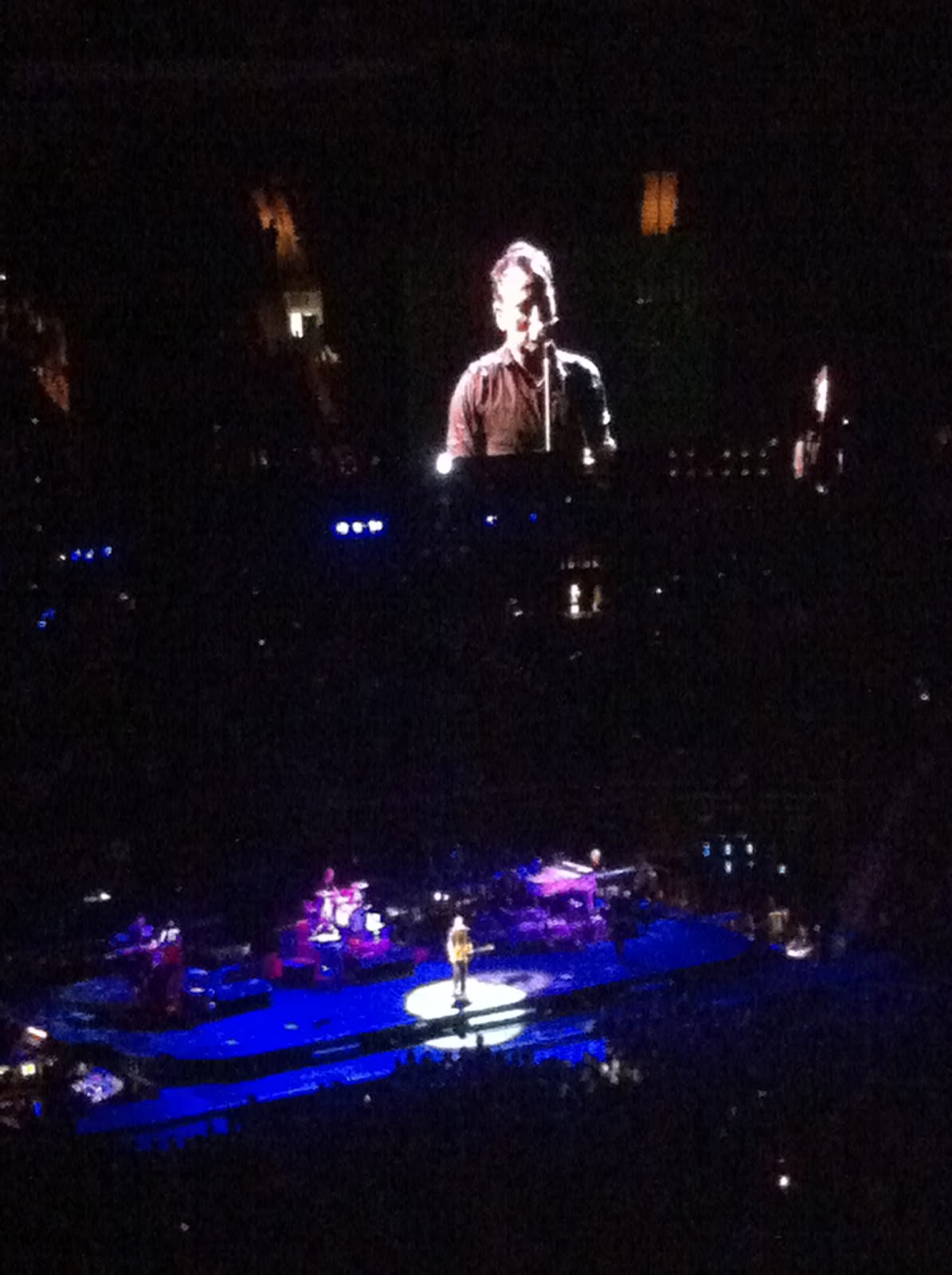
(I snapped this shot of the stage just as the lights surged; 
I think they were playing “Streets of Fire.”)
This immediacy is undoubtedly better experienced in the mosh-pit near the stage. This past year, Springsteen appears to have been even more inclined to ford out into his audience, shaking hands and high-fiving his way through the crowds – “in the crowd I feel at home” he sings in “Out in the Street.” But he has also taken to body surfing, which he did last night early in the show, during the third number, “Hungry Heart.” Like so many others, it’s a song about recovering desire after loss, but as people’s “strong hands” (as he puts it) pass him bodily overhead, supine in the arms of a multitude of strangers, that desire soon converts into contact. What people want most is to touch him, to feel just a little of his humanity, his human touch.
(Springsteen with overhead screen.)
Our own seats, however, were high up in the nose-bleeds. Our closest contact with him could only be virtual, through his image projected on huge screens suspended over the stage. These monitors are a ubiquitous feature of any stadium-sized rock concert, letting everybody see what’s happening far off and loud down there. And they work: my memories of this, and all, of his concerts are of seeing him close up, of proximity not distance. The screens are a version of social media in situ, of concert YouTube videos being put up for everyone to take in in the immediate present. They function, I think, a lot like my Springsteen mirror, as a kind of overlay, but they work as virtual surfaces, as image, in a way that’s very particular to Springsteen, to the experience of him. His concerts have become not rituals of counter-culture or rock’n’roll rebellion, but of shared community – they’re all-ages, family affairs. Last night, he pulled a girl who looked about 12 or 13 on stage to sing “Waiting on a Sunny Day,” and he danced the “Courtney Cox” coda of “Dancing in the Dark” with an 80 year old woman. Springsteen sings for everybody, becomes everybody. A key moment in the concert happened during “Born to Run,” when they had turned the house lights up as they do whenever they play it; after the saxophone and guitar solos, when the music is surging in a kind of chaotic miasma, Springsteen – his iconic, wood-grained Fender Stratocaster strapped on – leaned out over the lip of the walk way, and let the crowd strum his guitar. A welter of wild, arrhythmic fingers stroked at his instrument, making it growl, twang and hum: a feedback antiphon. The screens over the stage caught and projected this moment of flailing hands up close; the whole stadium roared. The music became, in that passing moment, not an illusion of the virtual, but a noisy, shared promise, a human bond. For real.

Happy Man

I heard Bill Frisell’s Richter 858 Quartet perform last night at the Vancouver Playhouse (Frisell, with Hank Roberts, cello, Jenny Scheinman, violin, and Eyvind Kang, viola). They played two suites, composed specifically by Frisell for the group. The first half of the concert offered Sign of Life, a recent (2010) piece that seems to me to sum up much of Frisell’s deep enmeshment in Americana, with plenty of what sounded to me like overt gestures to the folksy melodicism and harmonic richness of Aaron Copland. That’s not to suggest that the music is merely derivative – the improvisational virtuosities in play in this quartet give the music, even when it seems to be through-composed, an immediacy and a vitality that never allow it to settle or calcify. Rather, their music moves – in the sense of kinesis, yes, but also with the emotional engagement that successive moments of aural intensity can offer. Frisell’s music has a melancholy brilliance that seems to me to depend on his, and his group’s, ability to accrete small surges of sound, and to carry listeners with them. They tap into a shared ruthmos, a flow. Even when he applies distortion effects to his guitar, or turns it up to produce a metal-laden snarl, Frisell’s vertical, fractured notes still incline toward this essential pulse, a give-and-take within the fabric of a common time. I think I heard a version of this movement, as rhythm, in occasional riffs from Hank Roberts, whose strummed cello seemed to blend the textures of a Gambian kora and Kentucky bluegrass plucking: human time at play. But what was most noticeable was how, amid all of what could have been serious and pensive high-brow stuff, Frisell kept smiling, at his bandmates and to himself. Despite the textures of pathos and wistfulness we were hearing, he found – and I think we did too – a kind of common joy in this music. In an age rife with cynicism, these sounds and songs still manage to affirm, and even heal.

(blurry i-snapshot makes the quartet look made of light)
After the intermission, the group played Richter 858, Frisell’s 2002 composition for this group. It’s based on his viewing of a set of paintings – 858: 1-8 – by the German-born artist Gerhard Richter, and images of the paintings are projected and enlarged on a screen behind the group as they play through the eight-part suite. As the music unfolds, the visuals appear to work as a form of graphic score, as melodic lines and colours seem keyed to the striations, smears and tonal palette of Richter’s non-objective images. They’re not playing the paintings, but they feel as if they are, and this too is an effect of rhythm, of a musical rhythmatizing of the gaze. I felt my eye drawn across the projected swells of pigment by the quartet, as if the music were trying to find its own through swathes of light. I’m not trying to romanticize the experience too much, but, like Sign of Life, Richter 858is fundamentally affirmative rather than ironic – it affirms, for me, the potential, if fleeting, power of art to move us, to move.
For an encore, the quartet gave us a version of what was at first for me an unplaceable but uncannily familiar bebop tune. They staggered and looped the melody, played with it, to create a fleet four-part canon: the quick, improvisational melody – along with improvised counterpoint – skittering and weaving back through itself, upbeat, joyful. I thought it was a Charlie Parker line, but when I got home – the tune still in my head – I realized it was Tadd Dameron’s “Hot House.” Jazz, American folk and long-haired legit idioms intersected with and tugged at each other in this short coda to the concert, succinctly summing up how this group approaches history, approaches its own timeliness: by singing it, by making it sing.

Welcome to Us 1

In recent, post-Olympic months, Carol Ann Duffy has published what appear to be two of her laureate poems in The Guardian, poems that I want to gloss here and in a subsequent post. “Translating the British, 2012” was printed on August 10, and is an in-country paeon to the multinational London Summer Olympics. “White Cliffs” showed up on November 9, and is a celebration (in the guise of a crumbling sonnet) of Britain’s famous stretch of channel shoreline.
Her Olympic poem presents a postmodern species of choric ode, counterpointing an almost – almost! – saccharine, hyperbolic nationalism (“we … we … we …”) with a set of incisive swipes at the contemporary British banking crisis. At first pass, her mixed, even duplicitous tone can seem confusing, although it’s not out of keeping with the antithetical form of the classical ode. Duffy deliberately mimics, I’d say, the confused and contradictory reception of Danny Boyle’s opening ceremonies for the 2012 London Games, openly gesturing at Boyle’s spectacularly over-the-top dramaturgy: “The queen jumped from the sky / to the cheering crowds.” Erik Simpson notes what he calls the “double-edged weirdness” of Boyle’s “presentation of British cultural history,” a presentation that both feted and (playfully) excoriated English accomplishment. Duffy’s poem zeroes in on the crux of this contrariety by pointing, slightly more obliquely, to Kenneth Branagh’s peculiar recitation during the ceremonies of Caliban’s “The isle is full of noises . . .” speech from The Tempest: “We speak Shakespeare here, / a hundred tongues, one-voiced.” She’ll return to the nationalistic textual iconography of Shakespeare in “Dover Cliffs,” but in “Translating the British, 2012,” name-checking him serves as a metonomy for the globalization of English language and culture, or, even further, for what Harold Bloom grandly names the “invention of the human.” Translation, from this angle, means the assimilation and absorption of all that is other, as we come to re-discover – while we watch and listen, and even read – the genesis of a universally propagated figure of humanity in our own proxied and simulated Englishness; Britannia still rules the airwaves: “Welcome to us.” Branagh’s elocution provoked uncertain reactions, particularly from the English-speaking – especially, American – cultural establishment; writing in USA Today on July 27, Michael Florek can’t decode what’s going on (“Well,” he shrugs, “at least [the words] sounded nice”) and turns to James Shapiro, Columbia University professor and Shakespeare expert, for an explanation, which he doesn’t really give. In the segment, Branagh is dressed as Victorian railroad builder Isambard Kingdom Brunel, and recites the speech from what appears to be a cloned pastoral hillside, visual evidence of some “green and pleasant land”; historical, dramatic and ideological frames seem to have collided and smeared:
“Why you would choose Caliban’s lines as — in a sense — a kind of anthem for the Olympics, I’m not sure,” Shapiro said. “If you gave those lines some thought, especially in the light of the British Empire, it’s an odd choice. . . .The lines are quite beautiful, and I guess they wanted to rip them out of context and talk about how magical a place the British Isles are.”
Shapiro is quoted, by way of clarification, inconclusively:
“Why give him the lines Shakespeare wrote for a half-man, half-beast about to try to kill off an imperial innovator who took away his island? I don’t know,” Shapiro said. “You would probably have to ask the people who designed the opening Games ceremony what their thinking was.”
Duffy’s apparent précis of the speech at her own poem’s outset seems intended to meld a welter of noises and voices into a univocal nationality, a definitive “we” that wants to collect a listening world attentive to their noise into a latter-day empire, the Anglo-human globe. But if that’s really the case, then, like Boyle, she has quoted Shakespeare badly, confounding literary-historical and cultural frames: in the play, Caliban remarks how “a thousand twangling instruments” hum at his ears, “and sometimes voices,” which is the text we might think we hear repurposed in Duffy’s lines. But it isn’t. Her thinking, like Boyle’s, is actually a bit crooked. The reference to a “hundred tongues” gestures at Cecil Day-Lewis’s version of Virgil’s Aeneid, not Shakespeare. Another nation-founding cultural hero, rendered by Day-Lewis in idiomatic English (and, notably, his translation was broadcast nationally over BBC radio in the early 1950s), Aeneas in Book VI of the epic is confronting the Sybil, asking for information about the horrifying noises – not the sweet sounds – he can hear coming from Tartarus:
                        Scared by the din, Aeneas halted; he could not move: −
                        What kinds of criminals are these? Speak, lady! What punishments
                        Afflict them, that such agonized sounds rise up from there?
This is, in many respects, the antithesis of Caliban’s speech, although it bears remembering that Caliban is also pinched and tortured by the very spirits who serenade him. The Sybil – and Duffy, it seems to me, positions herself wryly in her poem as a vatic “lady” – catalogues as many of the tortured cries as she can, but finds her speech limited when faced with describing atrocity after atrocity, and so breaks off:
                        No, not if I had a hundred tongues, a hundred mouths
                        And a voice of iron, could I describe all the shapes of wickedness,
                        Catalogue all the retributions inflicted here.
The “hundred tongues,” that is, refers not to univocal plenitude but to the failure of the voice to be iron, its incapacities; these lines offer not a celebration of collective joy, but the refusal of pervasive and overwhelming agony. We should, in other words, be more afeard of what we see and hear, more than we are likely to be. But, like Boyle’s sensational kitsch, Duffy’s poem seems – seems – to want to smother our critical anxieties in swathes of triumphalism.
            Or does it? If Boyle’s staging of England was able to introduce a degree of historical-social critique, Duffy’s double edge is all the more forthrightly presented, as she deftly shifts registers between the descriptive and the metaphorical, around the intersections of political economy and participatory spectacle in sport. The London Olympics came on the heels of one more crisis for the English banking system, the so-called Libor scandal. For Duffy, the “we” into whose midst her readers are welcomed is a scandalized and angry body politic, a British version of the 99%:
                        We’ve had our pockets picked,
                                                                                    The soft, white hands of bankers,
                        bold as brass, filching our gold, our silver;
                        we want it back.
The subsequent medalling by the roll of British athletes she names in the poem becomes payback in a number of senses, both an affirmation of national muscle-fibre and metaphorical reimbursement, the filched sterling and Anglo-Saxon geld imagined returned to the people.
            It’s worth remembering that this return is linked to the translation evoked in Duffy’s title, which isn’t just a question of the – albeit, gently ironic – global dissemination of Britishness but also of the poetic work of metaphor. (Both trans- latio in Latin and μεταφέρω in Greek mean approximately the same thing, to move or to carry across.) Duffy’s text quickly recognizes the obfuscation inherent in all metaphor-making, particularly around the media language of the banking crisis: “Enough of the soundbite abstract nouns, / austerity, policy, legacy, of tightening metaphorical belts.” Even while her poem retains traces of Tennysonian bathos (in the smugly haughty, over-the-top “Enough . . .”), it also dismantles its own inclination to establishment-sanctioned poeticisms and substitutes for metaphor a strong claim on common reality, shared and propagated through in our investments in sports heroes: “we got on our real bikes, / for we are Bradley Wiggins, / side-burned, Mod, god.” The glancing nod to Quadrophenia(and The Who also performed in the Olympic closing ceremonies) suggests working-class disaffection and also images of natty mods on scooters, but this exaggerated haling of cyclist Bradley Wiggins is more than a sentimental investment in the distraction of sport. The reality of “our bikes” isn’t a hypostatizing of false consciousness, but a debunking of another of those bankers’ metaphors by actively literalizing, by a knowing public. The Telegraph on 11 July 2012 carried a story debunking the Bank of England’s absurd “idea for tackling the financial crisis: six bicycles”:
The Bank of England considered buying bicycles so that its officials could continue to move around in the event of a full-scale financial meltdown, the former City minister disclosed last night.
The national bank wants to appropriate another form of translation – the forward motion of the Olympic cyclists and of everyday people in bike lanes – to secure that its rarefied system of schemes and exchanges, its economy, keeps moving. Duffy’s poem, by re-appropriating the bicycle, converting it into nationalistic metaphor and then refusing its own tropes in favour of contingently returning to, of expressing something of the realities of daily life – “we want school playing-fields returned” – offers not an assimilative or appropriative nationalism, but an invitation to start again, better. Togetherness and community, even as they sometimes rely on a cliché-ridden and potentially reactionary language of public address, can also emerge from the revitalizing work of excavating that very language for the remaindered kernels of “our” historical realities at its core – for its cultural purchase. At her poem’s close, which is really an opening, a beginning again promised by the sensing of “new weather,” Duffy positions “us” (both the English and her English-speaking readers) “on our marks,” which is to say both in a position metaphorically identified with “our” athletes and in a critical relationship to the marks on her page, poised to write back to her text.

Singing in Public

Last night, I saw and heard John K.Samson (of The Weakerthans) perform for the second time this year, at the studio theatre of the Chan Centre at the University of British Columbia, where he has been appointed writer-in-residence in the Creative Writing program for this school year, 2012-2013. The first had been on May 12 at the Biltmore, on tour with a band (including Shotgun Jimmie) supporting the release of his solo record Provincial. Both performances were remarkable, not least for his ability to connect directly and feelingly with his listeners. The May show was high-energy and electric, and turned me into a fan, if I wasn’t one already. The previous fall, I had started supervising an undergraduate thesis by Bronwyn Malloy on Samson’s lyrics, and the enthusiastic conversations I had been having with her had really affected my growing belief that Samson was an undeniably powerful poet with a startlingly original sense of line and voice; Bronwyn’s essay turned out to be one of the best pieces of creative criticism I have read in my twenty-odd years as an academic, and I’m happy to admit that many of the better insights into Samson’s work that I want briefly to outline here must derive from my interactions with her writing and her thinking.
To start with, “powerful” is probably the wrong word to apply – at least, without some qualification – to Samson’s art, despite how unreservedly laudatory I’m trying to be here. The actual power of his songs and lyrics derives, I think, from their ability to tap into a pathos of powerlessness, of the social and linguistic disenfranchisement that the characters both represented in and speaking through his texts all seem to share. He voices the weaker than. At the Biltmore, he closed out the set by unplugging himself from the PA – my ears, I have to tell you, were ringing that night; some of those songs, casting back to Samson’s early days as a Winnipeg punk, still asked to be thrashed – closed out the set by unplugging himself and his guitar, climbing up onto one of the monitors, and doing a stripped-down acoustic version of “Virtute the Cat Explains Her Departure.” That song is the sequel to the “Plea from a Cat Named Virtute,” a song about his cat composed in response to a request, as Samson explains it, from Veda Hille. The subject-matter might at first glance seem incidental and patently lame. (A catsong? Really? Two cat songs?) But this veneer of weakness is belied not only by the cat’s Latinate moniker – derived from the motto on Winnipeg’s civic coat-of-arms– meaning “strength,” but also by both songs’ reach into a common human experience, the tenuous uncertainties around returns on our investments of affection: both lyrics ventriloquize an anthropocentric projection of meaning onto a mute and vanished animal – the cat pleads and explains. But those explanations are hardly conclusive or satisfying, and the latter song ends with the cat’s detachment from language, from meaning, and from human connection, as it struggles to recall what its unusual name might even have been: “But now I can’t remember the sound that you found for me” (Lyrics and Poems 80). The attachment to a name, to a verbal guarantor of a distinctive personhood, reduces to semiotic dehiscence, to sound and sense coming apart. But, what was amazing at the Biltmore show was that, as Samson reached the song’s close, his audience – many of whom had his words by heart and were singing along anyway – turned this line into a choral refrain; unplugged, he became for a time a kind of latter-day balladeer, singing with not just to the sum total of his listeners. Undifferentiated by the electric trappings and apparatuses of performance or broadcast, Samson became a part of his public. (Became his admirers? At last night’s event, he talked about the influence of W. H. Auden early in his life. Maybe so.) And there was nothing saccharine or maudlin, and more importantly nothing cynical, about singing for a lost cat; instead, what he managed was genuinely affective: feeling, shared. He closed out last night’s performance with the same tactic, a version of this same song delivered standing on a chair, unplugged from any amplifiers. Reaching quietly out.
Still, Samson’s songs often doubt, or at least call into question, their capacity to cross through this daunting alterity, this public divide we all seem to share. In “Pampheleteer,” he repurposes a line from Ralph Chaplin’s famous 1915 union anthem, “Solidarity Forever,” turning political call into a lament for lost love:
Sing, “Oh what force on earth could be weaker than the feeble strength of one” like me remembering the way it could have been. (37)
As tempting as it might be smart to re-appropriate Herbert Marcuse’s collision of revolution and Eros to explain the doubled trope here, I think it’s better to see the feeling represented in these lines as an unsteady amalgam of alienation and community. The inherent weakness of failed or failing desire becomes what binds us, erotically and socially becomes a name for the absence we all appear, in a kind of contingent solidarity, to feel. In this song and in “Virtute,” that strength in weakness depends on the shortfall not only of memory – of knowing for certain what might have been – but also of re-membering, of picking up the disparate pieces of a civic body in disarray: cats, friends, acquaintances, lovers . . . all the inhabitants of a particular home or place or city, whether hated or great.

          Last night’s concert included two on-stage interviews with John K. Samson by novelist Keith Maillard, the current chair of UBC’s Creative Writing program. When Maillard asked about how he composes his songs, Samson remarked on his slowness, on the agon-like struggle he goes through writing and finishing songs. He said something close to: “The process of trying to remember how to write a song is how the song gets written.” Again, it’s the sometimes effortful reconstituting of failing memory that’s key in his conception. Samson’s songs both thematize and enact the approach of expression, of saying something, to the constantly retreating and collapsing edges of language, the unsayable. Part of his humility, I think, is a recognition of a pathos of the failure of meaning at the core of the lyrical. As one of his characters, a broken-hearted dot-com entrepreneur, puts it in a one-sided overheard plea to an former lover, “So what I’m trying to say, I mean what I’m asking is, I know we haven’t talked in a while, but could you come and get me?” (77). A lyricism of the colloquial emerges in these lines through missed connections, through tentatively expressing the desire to be heard and to make contact with someone else. Community, that is, starts to consist in desire rather than realization, in the mutual recognition of our absences, as both speaker – or singer – and listener. We start to empathize across, and because of, our mutual distances. When in another lyric Samson obliquely defines his poetics, his practice of making, in terms of utility and labour (“Make this something somebody can use” [86]), the insurmountable ambiguities of everyday language convert into common weakness, into lyric public address.
           (I have left out specifically discussing the deftly crafted, mercurial imagery and evocatively kiltered phrasings that are hallmarks of his style. Most of what I’ve cited above are examples of moments of colloquial diffusion rather than of poeticism. But he’s great, trust me. Take a close look at any of his lyrics. You’ll see what I mean.)

Book
Samson, John K. Lyrics and Poems 1997-2012. Winnipeg: Arbeiter Ring Publishing, 2012.

Illustrated with Photographs 2

When I teach Heaney’s translation of Beowulf, I like to use the “illustrated edition,” which includes a set of museum and archeological photographs assembled and collated by John D. Niles, along with some of Niles’s own landscape images. It works as a kind of populist-scholarly archive, and gives the students a good sense both of the context of the poem and, importantly for me, of the constructedness of our historical sense – the fact that that the feel of any past context has to be recovered, reconstructed and reshaped in the course of translating and disseminating the poem. There is a specific archival poetics, I think, at work in this volume in particular, indicated in no small measure by the font-size of Heaney’s name, his signature, on the cover:

This is not just any version of a big old poem: this is Seamus Heaney’s text. In his afterword on the illustrations, Niles of course and rightly praises Heaney’s “outstanding” translation, but remains often quaintly aware of Heaney’s presence, as poet and intervener, in the work; noting that the Beowulf poet “often stretches reality to its limits,” he remarks appositely how Heaney “never uses a cheap word when an extravagant one will do” (220). I’m not sure how to take that, given that I don’t hear Heaney’s voice in Beowulf, through Beowulf, as either extravagant or cheap.
In an essay called “The Impact of Translation,” re-published in The Government of the Tongue (1988), Heaney assesses what for him amounts to the challenging and difficult presence, in English, of translated poems from Eastern Europe and Russia. While post-war modern poets, through to Robert Lowell, were often able, he argues, to render non-English texts “with an unbroken historical nerve,” their voices cushioned, despite the dire social upheavals of the mid-century, “by the poetic tradition inside which they worked,” poems translated, carried across, from outside that zone of homeland confidence both disrupt its comforts and, with that shake-up, revitalize its poetic potentials: “the note sounded by translated poetry from that world beyond – pitched intently and in spite of occupation, holocaust, concentration camps and the whole apparatus of totalitarianism – is so credible, desolating, and resuscitative” (43-44). Poetically appropriating the suffering of others for aesthetic or emotional gain sounds troubling to me, but – not to excuse anything – I think such appropriations are probably what any serious translation undertakes and confronts. “We,” Heaney writes, “are all the more susceptible to translations which arrive like messages from those holding their own” amid desolation (44). That “we” proleptically looks forward, for me, to the porous “we gar-dena” of Beowulf‘s first line, which, notably, Heaney elides in his translation until we reach the community of listeners in the third line of his version, “We have heard . . . .”How exactly that ethic or national collective constitutes itself in the poem is to becomes an issue rather than a given.
Such inherently difficult if seductive claims for poetic translation pervade his Beowulf, and I mean the translation itself as much as its paratext. Heaney claims to concern himself as a translator with making the voice of the Beowulf-poet sound through him, but it’s important to recognize that he doesn’t understand himself, his voice, as either disinterested or transparent. He connects himself to the Anglo-Saxon Denmark of the poem, as he notes in his introduction, by adapting its language to the “big-voiced” colloquial speech of his Northern Irish rural boyhood, the idioms of aunts and uncles. He translates the recalcitrant “Hwaet!” with which the poem begins as “So.” He recasts the formal archaism of the original into what he calls “Hiberno-English Scullionspeak”: it’s the way in which one of his relatives might start a conversation, a pitch that’s neither cheap nor extravagant, but has a weighty plainness and a throaty aural loading to which his text aspires. He builds his own verbal genetics into the translation when it comes to the Old English verb tholian, to suffer. He confesses in his intro that when he heard an aunt use the word “thole” (and the resemblance to the “tundish” episode in Joyce’s Portrait is striking here), he found a homey Anglo-Irish equivalent to an entry in C. L. Wrenn’s Beowulf glossary, a small collision of the word-hoards. While it sounds as if a temporary sharing of linguistic ethnocentrisms were allowing Heaney essentially to bring the poem home, to find an imaginative correlative in what Tolkien among others remarks as its inherent nationalism, I feel more persuaded by Richard Kearney’s reading of Heaney not as a sentimentalist of place, of home, but as a anxious lyricist of displacement, of what he calls “homecoming,” a sustained deferral: “never the actuality of an event but the possibility of an advent.”
Kearney is more sanguine, I think, about the rather lush lyricism of that deferral, and makes of Heaney a kind of late Heideggerean aesthete, melopoeically embracing the open resuscitative draft of each successive nostos, but I feel this unsettlement in Heaney’s poems – perhaps against the grain of all of their seductive vowel meadows, to which I need to confess I am nonetheless susceptible – as much more fraught and troubling, a wounded word-music that concocts its own linguistic agon as much as it wants to salve it. It’s no coincidence, for me, that it’s the word thole that pries open a crack, for Heaney, in the foreign yet familiar Anglo-Saxon linguistic sphere. Poetic translation doesn’t find its equivalents and echoes unproblematically, but enacts, in its own textures and verbal substrata, a tholing, an agon.
The opening line of the first of his “Glanmore Sonnets,” from Field Work, counterposes chthonic (maybe turfy) nostalgia with a fraught, violent and particulate narrative: “Vowels ploughed into other: opened ground.” The internal, rounded assonances here – gleanings from an Ulster sound-palette (palate?) – are disturbed and unsettled by being ploughed together – o into o – and by plosives and nasalized dentals. The colon cuts a typographical furrow, a visual hiatus, off-centre, down an almost middle.The audible lyric tissue of a Heaney line, I mean, is both woven and sutured, a cut in the verbal turf, but also pulled together by being laid open, as wound, as unapprehended other. The patrilineal “digging” with which Heaney’s collected poems begins becomes here both a homing and a dehiscence.  I’d like to say that this doubled unsettling of the poetic line, the furrow traced by the pen, offers a means of coming to terms with the unstable nationalism that floats through his Beowulf, but for now I want just to point to a picture associated with the illustrated edition: an image of the Tollund Man. Niles obviously includes this close-up of the iron-age sacrificial victim’s preserved head as a shout out to Heaney’s poems of the 1970s that emerged from his reading of P. V. Glob’s The Bog People,  and the image both connects Heaney’s poetic to the Iron Age culture of Beowulf, giving his translation a kind of anthropological-archeological authority. Niles connects the image rather tenuously to a reference in Beowulf to Hrethel’s grief for Herebeald being “like the misery felt by an old man / who has lived to see his son’s body / swing on the gallows” (lines 2444-6). More significantly, the throat of the Tollund Man –whose tarry corpse has fused with the peat in which he was cast –  still bears an obvious slash wound. His voice, box iconically, has been cut open, like the turf of Heaney’s northern farmland. If he can be made to speak, can be translated, if he speaks at all, he can offer only one long, nearly inaudible, open vowel, a tenuous exhalation from the tear in his dark neck. A tholing wound.
Quoted Things
Heaney, Seamus. The Government of the Tongue. London: Faber, 1988. Print.
—. Field Work.London: Faber, 1979. Print.
—, trans. Beowulf: An Illustrated Edition. New York: Norton, 2000. Print.
Kearney, Richard. Transitions: Narratives in Modern Irish Culture. Manchester:

 Manchester UP, 1988.