Flow, Fissure, Mesh

Home » Articles posted by kevinmcneilly (Page 16)

Author Archives: kevinmcneilly

Illustrated with Photographs 1

So, I once took a snapshot of Seamus Heaney himself. I was a graduate student attending the Yeats International Summer School in Sligo, Ireland, in 1989, and after the two weeks of lectures, workshops and performances were done, I decided to take the train south to Dublin to look around and do my own version of the student- tramping-though-the-old-country thing. (And it worked out for me, too; for years after, and even now, I have been mining that experience and producing whole series of McNeilly in Ireland poems, tourist-as-genealogist stuff. Some were published a decade ago in The Antigonish Review.) I had even called ahead to the hostel there to book a few nights. I was prepared and pretty organized.
There had been a number of important speakers at Sligo, including Richard Kearney, Declan Kiberd, Elizabeth Butler Cullingford, Terry Eagleton, Edna Longley, as well as poets such as Richard Murphy and Michael Longley, so it was quite an intensive and academically rich gathering. On the train to Dublin, I ended up sitting with Helen Vendler, who had given a talk at the school and whose graduate student I had befriended – although I haven’t been in communication with him since that trip, neglectfully. It turned out she was being picked up at Connolly Station – honestly, I remember it as Heuston, but the ticket stub says Connolly – by Seamus Heaney. Her piece in The New Yorker had appeared a few years earlier, and she was probably his chief advocate and apologist in America; he has of course since dedicated poems to her. She invited her student to come meet him, and, I’m sure because I was sitting next to him and had been chattering about Canadian literature, she felt a little sorry for me and, politely, invited me come along too.
Sure enough, there Seamus Heaney was on the platform, waiting. She introduced us both, her student first. Heaney was gregarious, smiling, welcoming, generous. For the few minutes I can claim to have been in his presence, stories of his warmth and kindness seemed more than true. I had a foxed Faber paperback of his Field Work in my knapsack – I think I bought it in Sligo at a small bookshop there – and he signed it, holding the book open in the air with his left hand and scrawling half-wildly on it with what I remember as a Bic stick-pen. Professor Vendler was coming to stay with him, and her student had booked a bed and breakfast somewhere across town. Nicely, Seamus Heaney turned to me and offered me a ride. I should have lied and said I was staying somewhere out in the country or something like that, but stupidly I told him that the hostel where I was staying was right across the street, which it was, so I declined the lift. “Okay then,” he said, and we all walked out into the parking lot together. I thanked them and waved goodbye, turned, and headed across the street. At the last minute, it occurred to me that I hadn’t taken a picture, and that nobody would believe that I had almost got a lift from Seamus Heaney himself. So I quickly pulled out a disposable plastic and cardboard camera I had bought, likely at the same store as his book, wound and cocked it, pointed it in the general direction of his car, which they were just getting into, and snapped.
When I got back to Canada and had the pictures developed, I found that the picture I had taken was actually of a fairly tall hedge in the train station parking lot. Peeking over the hedge is a shock of greyish-white hair, the face turned down and away. “That’s him,” I have told people when I showed them the snapshot. “That’s Seamus Heaney’s hair.” Sure, they tell me. Sure it is.
Sadly, too, I have since lost the photo, and can’t find the negative to replace it, which is a drag. Now, I don’t even have the inconclusive proof. I have hope it will turn up someday. And, I did find my copy of Field Work, with his signature on it. Mercifully, he wrote my name too. 

Poetry as Needed: David Solway’s Contraries

What follows is a lightly trimmed (from what was, in fact, an unfinished document) and revised version of a review-essay intended (in 2005) for publication in Canadian Literature, but which never made it (not for reasons of quality, I hope, but because – I’m assuming, I’m assuming – of space constraints and special-issue themes, which caused it to be bumped until it became too dated.) I think it still raises some relevant issues, though, and also engages with David Solway’s poetics and poetry in what I hope is a disinterested and rigorous manner. It also bears on current debates over negative reviewing in Canada.
David Solway was fast becoming our Alexander Pope. In the introduction to the 1936 Oxford Book of Modern Verse, W. B. Yeats disparaged T. S. Eliot as “an Alexander Pope, working without apparent imagination.” My intention with this echo isn’t some sort of elaborate literary name-calling, but to describe what I hear as divisiveness informing much of Solway’s work, both poetry and polemic. In the preface to Director’s Cut: Essays (Porcupine’s Quill), Solway acknowledges that his sharp-edged and aesthetically partisan writing may draw “charges of self-righteousness, presumption and pontifical imperiousness of temper” from academic critics who, in his view, immerse themselves in “diffidence and complicity” by praising and promoting the work of inferior or insubstantial writers; he excuses his often harsh, even vindictive tone by claiming the ethical superiority of the satirist, the judiciousness and balanced erudition of a witty man-of-letters — whose crafted, caustic voice is uncannily close to that of Pope’s “Essay on Criticism.” There are several direct and approving citations of the eighteenth-century poet in Solway’s essays, but their relation is more than occasional. Solway’s insistence on rationality and mastery, fitness and form, not just in his own poems but in any good writing, suggests on first pass a transplanted neo-classicism that draws heavily on both Pope and Eliot as its forebears.
            Separating the sheep from the goats, as narrowly and as rigorously as he can, appears to be what Solway understands as “responsible” criticism. To seek out “quality work,” he asserts, is to ply “the counter-discourse of antithetical discrimination,” by which he means to be thoroughly and carefully withering toward any Canadian poets whose work he dislikes — which, he openly admits, is most of it. To pull his punches would be “a way of evading responsibility,” and he strives “to cease trading in the usual velleities and placebos that double for criticism in today’s literary environment and embark on a process of audits and disclosures to reveal the real value of most of the work now being mass-produced.” The wool, in other words, needs to be pulled from most of our eyes, and the sloppy populism and prosaic flatness of what passes for poetry needs clearing: so we are invited, rather forcibly, to trust in the surety of Solway’s ear and eye, and in the acuity of his shit-detector. (Irving Layton’s deluded Neruda comes to mind.) And many times this trust pays off. Solway’s enthusiasm for his fellow poets of Anglo-Montreal and environs, including Michael Harris, Robyn Sarah, Peter van Toorn, Eric Ormsby and Carmine Starnino, is catching. And while much of his effusiveness smacks of nepotism and cliquishness — most of those he praises tend to be personal friends and acolytes, a network he openly acknowledges in “Double Exile and Montreal English-Language Poetry” — his exactitude and unflinching engagement with their texts nonetheless sustain his approval, and encourage mine. And while none these poets (perhaps with the exception of van Toorn) is as obscure or unlauded as Solway claims, the very fine poems he cites certainly call out for fuller critical engagement and a wider, thoughtful audience: as wide as poetry might have, these days. Solway makes me want to read more of them than I have, and to keep reading.
            There is, however, a backlash to the lauds, which I think is truly unfortunate and which detracts from all this well-deserved praise. Solway seems so invested in contrariety as to be unable to resist attacking, without serving any substantial critical purpose, those whose writing he cannot, usually for merely ideological reasons, abide. His thinking is antagonistic, and often casts him, as the apologist for his cohort, in the role of scrappy underdog. In “The Great Disconnect,” the long-winded ramble from poetry sample to sample that closes his prose collection, he contrives an extended set of duels between counterposed pairs of poets in order to prove the neglected worth of less famous but, in his view, more technically and imaginatively accomplished writers: Ricardo Sternberg defeats Margaret Atwood, Brent MacLaine out-writes Anne Michaels, Norm Sibum takes down George Elliott Clarke, Mary Dalton pins Christian Bök, Carmine Starnino routs Jan Zwicky and, in the final round, Rodney Jones conquers Michael Ondaatje. (There are other crucial matches, although it takes three poets — Ormsby, Harris and Sarah — to overcome Anne Carson, which doesn’t seem sporting, and the spectres of W. H. Auden and Al Purdy grappling for linguistic supremacy is patently absurd.) What strives to pass for critical acuity in such writing is, sadly, too contrived, too forced. Solway seems to me to displace his own need to wrestle with those “bad poets,” this “crowd of mountebanks” (he must have been feeling vaguely Shakespearean), as he tries to labour “in defiance of the aesthetic and political orthodoxies of the times,” and to produce, at times in spite of his contrarian rhetoric, a reactionary orthodoxy of his own; insisting on the artificiality of poetry — on the character of its making — leads him to insist that the poem is a “shapely utterance, . . . a constructed linguistic object irradiated by lexical joy no matter what its subject” (original italics), but I fail to see much of a critical point in such a truism. All of the writers he cites, both pro and con, surely recognize this assertion as a given, and find themselves called to their work by an irreducible love of language. And an insistence on “lexical” joy, while conceptually attractive, is also a troubling blurriness from a writer who insists on verbal precision; I hear next to no joy in Solway’s writing, which leads me to worry over what he might mean by it here, amid the smirking. Given, for example, Jan Zwicky’s pervasive desire to uncover joyous, vital ecologies in poetic metaphor, I can’t help but suspect Solway of being wilfully tone-deaf to the obvious virtues and to the achievement of her writing, and of covering his tracks in misleading mystifications. I still take his enterprise seriously and sincerely, and admire his astringent demand to hear, from any poet, words in their fullness, but I can only deplore the lack of humility or of any willingness to listen beyond his own narrowly drawn poetic confines. For instance, “The Trouble with Annie,” his extended attack on Anne Carson, whom he regards as a poetic imposter, comes off not as “a reality check” but as whiny petulance and petty jealousy at the success of another writer, trying in vain to justify itself as objective critique. (He tends to be hoist by his own pedantic petard, questioning the accuracy of Carson’s scholarship while — when he mistakes a quotation from Virginia Woolf’s manuscripts for Carson’s fragmentary postmodernism, for instance — his own reading turns sloppy and uninformed.) Any possible joy in words ultimately gets reigned in by an astringent measure, his hard critical yardstick. Despite his acclaim for colleagues and mentors, Solway refrains too often from praise, from teaching us how to praise, a task Auden once assigned the poet — and, I think, the poet-critic. Instead, stymied amid so much critical potential, and so richly varied a national poetry, he finally strains to direct his considerable sensitivities toward an ignominious end: picking imaginary fights where he could be discovering imaginative vitalities.
            One last point on Solway’s criticism. I think that he would probably be unhappy with the possessive in the opening sentence of my remarks, that “our,” which implicates his work in a kind of cultural nationalism. His essay “The Flight from Canada” offers a cogent and persuasive alternative to what he calls the “Canadian content syndrome,” a canonizing of Canada’s national literature based not on qualitative discriminations but on the mere fact of its being Canadian. Still, Solway doesn’t actually refuse a national cultural thematics so much as re-think it, carefully and provocatively. It isn’t, for him, a question of poetically formulating, or adhering to, an identity but of inhabiting its negation: “it is precisely the comfortless absence of a secure identity, the rootlessness, the sense of radical alienation which is our greatest gift and blessing.” He wants, he asserts, identity “solidly founded in difference.” He becomes ours, in a sense, by refusing us. But claiming a solidness for that foundation also distinguishes his work from more openly alternative poetics; difference, for him, means “that each poet can work up the materials of place and language into that signature alloy we call individual style”; flight is predicated on a thoroughly conservative cosmopolitanism, a flight made radical, in other words, only by its rootedness in the solid ground of a distinctive poetic diction. This conceptual mix may be, at its base, self-contradictory, but surely Solway has managed at least to point up a viable means of confronting poetically, formally, the question of a late nationalism, of the differential ethos of the Canadian.
            This somewhat fraught cultural nationalism is inflected by historical narrative in Franklin’s Passage (McGill-Queen’s UP), a book-length sequence of poems by Solway that map out an attempt to re-discover and make sense of John Franklin’s doomed Victorian expedition through the fabled Northwest Passage. Much has been written on, and overwritten, Franklin — including Margaret Atwood’s recent lecture in Strange Things, in which the expedition becomes an archetype for the alienated Anglo-Canadian psyche, more finely developed than her early efforts at a national literary thematics in Survival, but still part of the same cultural project. Rather than contribute more of the same, Solway produces not so much countermyth as a series of reflections on the processes, both solitary and collective, of myth making. In the face of his professed distaste for postmodern antics of pastiche and self-consciousness, Solway appears to want to show us how it’s done: a finer tuned, better turned reflexivity. The collective first-person – some form of a communal Anglo-Canadian voice – shows up, despite Solway’s difficult nationalism, in the first line of the first poem, a “dedicatory” sonnet:
We voyage as companions in ships
                        there’s no way to abandon or desert – on
                        authority of Mowat and Berton
                        who chart our encounters with the weathers
                        that beset our soul. (2)
Almost emblematically, “Dedicatory” appears as the verso – the flipside – of the collection’s first page, which reprints a set of four epigraphs, as if this poetry were at its best an epigone commentary, an act of coming after if not too late.  Years earlier, in “A Poem for my Sons,” Solway cautiously thanks his children “for the rejuvenating faith in epigones” (Selected Poems 59), suggesting both the inevitability of his own position in whatever literary history may come as a late arrival, compelled to be retrospective and deferential, and the poetically empowering humility, of all things, of the afterword, overwhelmed but also revitalized by the long burden of a past. Here, too, faced with the task of retracing not only Franklin’s steps but the tracks of all those who have already written (populist historians like Farley Mowat and Pierre Berton, say), Solway nevertheless affirms the poetic necessity of rewriting, of continuing the process and of remarking the passage of his own work as a writer. He may suspect the tiredness of an thoroughly assimilated Canadian myth, of telling the same old story over again, but he also asserts, plainly, that we have no alternatives but to re-confront what we’ve been told, and to remake something vital of it.
The project, after all, never closes off, as succeeding generations of writers inherit, interpret and retell, driven by a desire for veracity that can never be satisfied by this or that brief hypostasis: “We are always at least one chronicle from the truth.” The need to rectify the fragmentary and unkempt details of human experience into pattern, into the fixity of form, is not predicated, for Solway, on the neatness of fictitious national, cultural or literary archetypes or on any claims of achievement; rather, his formalism remains projective and aspirant, a “dream,” a longing for a completion he recognizes that, however neat or succinct appearances may be, he cannot finally claim:
One way or another we are stuck here,
clenched in the dream that drove us far from home
to confront the narratives we’ve come from
and try to make asymmetries cohere.
Despite the enclosures of the envelope rhyme here, for example, the spectral chiasmus of rime riche and slant rhyme (“. . . from home / . . . come from”), alliteration, vowel echoes marks both an aspiration toward symmetry and the unfinished business of writing itself, as it traces a sustained counterpoint of formal elegance and common, loose chat, the promise of coherence set against “a process called decoherence.” For Solway, Franklin can only ever be “partially intelligible,” which is to say both interpreted and fragmentary; the poet wants to take what remains beyond account, “beyond the imagination / of the present moment,” a vague outside that slips from verbalizing, and give it an accounting: if he can’t ever confirm or uncover historical truth, converting the unknowable “into something / decipherable, / a legible report,” what he can do is account for himself as a mediating, intervening presence in that uncertain history. His measured verse, as he puts it, also “resists the illusion of measurement.”
Even if  “there is no way to tell” what happened, even if the writer can only strain to produce “a forced passage,” “as if listening for the sound / that no one else can hear” when faced with an insurmountable barrier of silence, “we can always,” Solway asserts “photograph ourselves,” acknowledging openly that history is never a given but is always made by – and inflected by, fabricated by – somebody doing the telling: “We can always tell another story.” This accounting becomes far more than deferential acknowledgement in Solway’s text; out of  “the kingdom of contingency” – a moniker, it sounds to me, for the postmodern condition and for an attendant dearth of cultural literacy and historical sense lamented by academics such as Fredric Jameson – Solway draws both healthy refusal, that inherent formal resistance, and a renewed vitality; even if poems appear to become “a casting of words / accounting for nothing but recurrence,” that accounting also finds its passage in the same “arc of discovery and loss” that Solway imagines in Franklin, a reflexive vacillation that “bear[s] us back, astonished, to ourselves.” Poetry can still astonish, even amid the self-involvement of a deprived and faltering present. There isn’t much of the historical Franklin in Solway’s book; it’s mostly about Solway, trying to compose for himself viable historical poetics, and to enact it. But, frankly, that’s the point: poetry as aspiration, effort, remaking – poetry as needed, as need.
Poet Yves Gosselin, despite his candid admission in his preface that “[il] connai[t] peu David Solway,” offers a fine and representative overview of Solway’s work, translating forty-odd poems as Poèmes choisis 1963-2003 (Éditions du Noroît). Solway had for some time published translations of Québécois poetry in Books in Canada – I am not sure if he has translated Gosselin’s work or not – but in some measure these translations return the favour. While Gosselin’s own poetry tends (to my ear, at least) toward concision and declarative rigour generally in a rather clipped short line – peruse such volumes as his Programme pour une mort lente and Les guerres sont éternelle, or the more recent La mort d’Arthur Rimbaud  (the latter also from Noroît) – his versions of Solway are much less compact or honed. For example, Solway’s “Pip” – a lyric from his 1979 collection Mephistopheles and the Astronaut that describes the “slow disintegration to his elements” of a man lost at sea, a figure, perhaps, for Solway himself as disillusioned poet-critic – loses much of its sonic craft, its carefully worked echolalia, when provocative and sharply edged conceits like “lonely in the frantic vatican of himself” get converted by Gosselin into prosaic précis: “solitaire au milieu de sa proper agitation.” The sense is there, but the poetry has fallen away. Compare
            Encompassed by the hard horizon, he pondered
            his gradual declination to the void,
            his northless destiny, his loony afternoons
            and slow disintegration to his elements
to
                        Cerné par l’horizon impityoable, il a pris la mesure
                        de sa derive progressive vers le néant,
de son destine sans direction, de ses après-midi de folie
et de sa disintegration lente, réduit à ses elements[.]
Cerné” – encircled or surrounded – is a nice choice here, and suggests, I think, a certain tightness or enclosure against the deathly limitlessness of the ocean, but it also elides the sustained metaphor that surfaces in Solway’s lines, that of magnetic north; Gosselin’s version is literally north-less, which essentially catches Solway’s drift here but loses its textures. While I can’t expect Gosselin to reproduce Solway’s phonemic music in French, I think it’s fair to ask, given Gosselin’s obvious verbal craft in his own work, for more than a crib or gloss on the original. The hardness of the poem is, I think, an essential aspect of its presentation, and something of that sculptural deftness needs to come across in translation. The opening of Solway’s earlier “New England Poets” – “New England poets grow tall and coniferous. / They are famous for their disciplined metres / and their evergreen intelligence.” – articulates with measured irony the uncompromised relationship to poetic discipline that Solway’s criticism also constantly pursues: he notes the poets’ metrical regularity in a line that both lightly and deliberately overwhelms its rhythmic containments. Gosslelin’s version, however, seems to lose its boundaries altogether:
                        Les poètes de la Nouvelle Angleterre sont grandes, ce sont des confères.
Ils sont célèbres pour leurs poésie bien sage
et leur esprit de conservation séduit toujours les generations d’étudiants.
Again, key tropes – “evergreen” – get dropped and over-reaching glosses – what students are those? – get introduced, but these things happen in any translation; what concerns me, though, is the rhythmic incoherence of the lines themselves, their relinquishing of muscle-tone or definition. To be fair, Gosselin’s translations offer moments of intensity, of thick poetic cross-pollination, but all too often the crisp edges of Solway’s lines are lost in Gallic sesquipedalian diction. Still, in returning the favour of translation, Gosselin gestures toward invigorating a key trajectory of Solway’s cosmopolitan cultural flight.

Ear Trumpet

What follows is pretty much the text of a 12-minute presentation I gave on 19 October 2011 at the Vancouver 125 Poetry Conference. I thought I was supposed to talk about poetics, but most of the other presenters gave short readings. As if to compensate, I very presciently included two poems in the talk: “Embouchure” and “The Clash Takes Kerrisdale.” An audio file of the presentation can be heard if you’re so inclined on my website, www.kevinmcneilly.ca. And here is the presentation.


So, there is a lot to be said and very little time to say it. Which seems to me, to start with, to be one of the prime virtues of poetry, or at least of the poetry that I think I want to practice: its intensity.

Vertu (not its near-homonym virtu) once meant, in Geoffrey Chaucer’s urbane Middle English, something like strength or intensity, or maybe life-force. (Machiavelli even takes up a latter-day, more cynically urbane sense of the term in The Prince.) April rainshowers, say the famous opening lines of Chaucer’s big prologue, have “bathed every veine in swich licour / of which vertu engendred is the flour.” Closer to us, Dylan Thomas translates and refigures vertu, almost as famously, as “force”: “The force that through the green fuse drives the flower . . . .” When I first heard Thomas reading that exact poem on LP – checked out from the public library in Truro, Nova Scotia, for two weeks when I was fifteen, in the midst of my own green age – I began I am sure now to feel that force, that intensity, not simply as a kind of pubescent, sappy, erotically-charged nature, but as something more essentially verbal, as a particular sort of audible wetness, a mouth music. I liked how he sounded.
I have a story. I was once in a bar with Don McKay. This sounds like a repurposed Al Purdy story, but it isn’t. Don was my teacher, and I was a graduate student at Western; the bar was an ersatz English pub called Chaucer’s, in London, Ontario. This was a while ago, at a point in my life when I know I was consistently trying too hard. I was trying to impress Don by telling him spiffy things about poetry, and he was politely listening to whatever it was I was saying. I somehow got on to Dylan Thomas, about whom I knew Don had written. I thought I might impress him with my newfound graduate student dismissiveness, which I believed he might take for a sign of burgeoning critical acumen. I made some offhand remark about “all that Dylan Thomas shit.” I actually meant it as a kind of complement to Thomas, in a sort of punk-jazz streetwise argot, which for some reason utterly lost on me now I thought seemed appropriate. Now that I reiterate it, though, it’s more or less just plain shameful, but that’s pretty much how I said it. And as soon as the words left my mouth, I knew I had miscalculated. So. Don set his beer down, gently, and, still looking at his glass, said calmly, “Well, I wouldn’t say that.” At that moment, I think I learned two important things. First, you shouldn’t pretend to say things you don’t mean. And, second, the poets I admire take poetry, all poetry, seriously. It’s something like an article of faith to them. (I want to say, to us. But I can`t quite.) Those poets tend to mean what they say.
Jayne Cortez says that saying what you mean, that voice, is a matter of putting your mouth on paper, which is an idea I like plenty. But I also think that voice is a matter of lifting your mouth off the paper again, and of maybe having left a bit of yourself – a little slaver, say – behind: phonic fibrils, a dissolute, salivary ink. Voice is a species of contact or exchange, fleshed out liminally and even awkwardly across the page. Swapped spit, an embouchure. This poem, “Embouchure,” opens a collection of the same name, which is a sequence of historically-minded impersonations of jazz trumpeters from the early twentieth century. For me, the poem lays claim to a kind of embodied poetic.
You get as good lip
service as you give.
Chops will ever out the fake:
                           the put-on
line never cut grace
notes from a sloppy
wad of clams. Trued up,
a well flubbed phrase ought
to betray nothing
more than lacquered horn,
the schwa blat of hand-
polished, open brass.
Style takes care of its own;
chops make the rep.
An off mouthpiece can cut
you like shrapnel.
Know the hard limits
of your instrument,
and work its righteous edges.
Be the pro.
Then come the call,
let rip a proper lick.
Commit.
It seems like this poem might just be about the difficulty of playing a trumpet, which is a notoriously hard instrument from which to get a deliberate, workable sound, and on which to find something like a voice. But this poem is actually more or less about how I think I want to write. It feels to me like, whether or not you can finish it out, the poetic gesture begins, as this poem ends, with a specific commitment. As Charles Wright puts it in his elegy to another trumpet player, Miles Davis, we need to confront “those two dark syllables, begin,” as syllables, and commit to the verbal arc of line, of strophe, of page. Mouth to mouth.
Commitment often has its politics, hazy though they may sometimes be. My other main source of poetic drive, and of its cultural politics, when I was adolescent, was Joe Strummer, was The Clash. I like music. When Jacqueline Turner was convening this panel, over e-mail, she suggested we read new work. Here is an unpublished, narrative piece called “The Clash Takes Kerrisdale,” which is – as you might be able to hear – also a response to some other forebears, whom I try to take seriously, and at their word.

The Clash Takes Kerrisdale – 26 June 1982 
                                                                              Du mußt dein Leben ändern. —Rainer Maria Rilke
                                                                              Will the dead poets notice our lines appearing among them,
                                                                               Or are their ears filled with their own music?
                                                                               —George Bowering, Kerrisdale Elegies, 2
            With Topper sacked, Paul and Mick wouldn’t stop
bickering backstage like a pair of married wanks.
            The whole set pretty much sucked now. When Joe
                        snarled “Career Opportunities”
                                    into his taped-up mike
            nobody in the makeshift mosh pit looked
as if they’d ever get wise to the in-joke: four
                                    self-styled punk rock warlords
                        who’d eviscerate all comers
from naff dandies to mohawked hypocrites, slagging
            the replicant rock stars they couldn’t help
becoming even if they’d wanted to. They talked
            the roadies and stagehands into scrawling
the band’s last will and testament in red spray-paint
            on a backdrop of quilted flags they had
suspended from the arena rafters (beside
            the minor-league pennants and a mock-up
                                    of local hockey jock
                        Cyclone Taylor’s retired jersey):
            a graffiti patchwork of song titles
like “Clash City Rockers,” “Safe European Home,”
            “Jail Guitar Doors” and “Police on My Back” —
                        the greatest hits they never had
                                    and never thought they would.
            When Mick asked, “Should I Stay or Should I Go,”
they all knew the answer. A Kerrisdale skating rink,
            somewhere in white-bread west coast Canada,
was no substitute for the Hammersmith Palais.
            True to form, Joe finished by mouthing off
                        about the art of politics,
                                    the politics of art.
                        Each show like this left them less sure
                                    they’d ever changed the world.

The point, for me, isn’t the despair of quietism, but to confront, poetically, the very possibility of commitment, this time as a poetic article of faith, but of a very particular kind. “Art and the planet tell us,” P. K. Page writes in her Simon Fraser convocation address, “change your life.” She’s translating Rilke’s archaic torso, as he attends to his own artistic imperative, but if you look to the original German Du mußt dein Leben ändern – the poem’s demand is not only that we change, poetically, but also more literally that we live otherwise. You must make yourself other than who you are. And it’s that otherwise, the discomfiting of self and of voice, that haunts me, both as an earful of gentle shame and as a mouthy plenitude. It’s what makes me want to write.  

Shares

The cheap contrarian tactics that permeate Michael Lista’s recent National Post blog entry, “The good in bad reviews,” do more to provoke acrimony than to invite the kind of genuine disagreement he appears, in the piece, to crave. To his credit, he has succeeded in provoking me, as a committed reader of poetry (and as someone who worked for a number of years as an associate editor, responsible for book reviews, at a scholarly journal, Canadian Literature), to reconsider what I think a well-crafted review needs to do. “The purpose of a review, good or bad, is to begin a conversation, not to end it,” he writes, an assertion that sounds as inherently laudable and reasonable as it is slippery. (I’ll come to what I think are some of the buried complexities in such claims in a moment.) He certainly has, well, not so much initiated a conversation as needled me – and, I’m assuming, many other readers – into reactive self-critique: no one, after all, likes to be called out as uninformed or misguided, which is what his short editorial frequently does. (I’m pussyfooting: what I mean is, when Lista declares “Enough of this bulls–t,” I can’t imagine anybody wanting to admit to themselves that they might be knee-deep in complicity.  —Or would they? The rhetorical feint in such “straight-talking” faux-bluntness presumes, after all, that a reader won’t be inclined to push back, but prefers to be led, and to be told directly: that he or she likely won’t have the temerity to call bulls–t on Lista’s bulls–t.) Straight up, his review of reviewing made me mad, which is why I have taken a few days to reconsider what I actually do think, so I won’t feel like I’m being pulled, in my own small way, into a non-starter of a debate I’m somehow predestined to lose, and that, really, I don’t want or need to have.  That’s not to say that there isn’t a lot to think about, to re-consider and to re-view, here. But I won’t have Lista’s article setting the terms or trajectories of that discussion: he’s wrong, and wrong-headed, and his text should serve as no more than a point of departure, and as an entry into a wider cultural conversation from which, on the evidence of invectives such as this, he has effectively excluded himself.
            Lista’s piece is occasioned by the re-posting on the CWILA (Canadian Women in the Literary Arts) website of an essay by Jan Zwicky on “The Ethics of the Negative Review,” which originally appeared in the fall 2003 issue (no. 144) of The Malahat Review. (Both Zach Wells and Carmine Starnino offered rather mean-spirited rebuttals to this essay some years ago, doing what Starnino calls “speaking truth to stupidity” but which, from my vantage point, only comes off as misconceived and unconvincing harangue. Lista has now joined their sidelined and fading fray, as its new epigone.) It’s Zwicky’s thinking I really want to engage now, because her essay deserves the sort of careful and considered attention that she invites from herself, poetically, as a reviewer and as a reader of the work of others. But first, I feel like I have to get this Lista business out of the way. The key failing of his meta-review, and what I believe in the end got my dander up, is a lack of strength in the writing. Lista’s approach and prose style are consistent throughout; for instance, he gets up a head of steam when he takes on Zwicky’s opening mention of Byron’s lament that “the critics killed Keats”:
Cue the violins, folks. The essay, woozy with Romantic anemia, begins by paraphrasing Byron’s idiotic diagnosis that “the critics killed Keats” (Keats died of an infection of the tubercle bacillus, TB), and along its way manages to summon every black-beret cliché about the poetic temperament, so that by its conclusion we can all but smell Chatterton’s extinguished candle. And beneath those black berets are the empty heads of red herrings and straw men.
 The flippant evocation of “folks” and the pointless correction of Byronic hyperbole with smug fact-mongering point up his attempt to produce a kind of audience solidarity in elitism, the sort of bluster I mentioned above that appears designed to silence rebuttal. More significantly, Lista seems to mistake his own meanness and invective for candour and critical acuity. “Call me old-fashioned,” he opines, “but I think the truth sounds beautiful, and there’s an intrinsic value in discovering what writers think of each other’s work.” I don’t think this is discovery, nor that the writing evinces even the sort of Leavisite clarity it purports to desire. His version of the Keatsian collision of beauty and truth – a collision that, with considerable philosophical heft, informs much of Zwicky’s poetry, it turns out – doesn’t convince me; Lista’s “truth” needs to be put in scare-quotes, because it presents a narrowness of vision – the hypostasis of a very particular Anglo-American positivism, I’d say – as truth itself, and elides the varieties of aesthetic experience, experiences, in a misdirected yen for what reductively offers itself up as fact, but turns out to be deeply and thoroughly socially and culturally coded: masculinist, old-fashioned and contrived. Zwicky, in the essay confronted in Lista’s piece, laments that “we are a culture, perhaps a species, drunk on a narrow notion of assertiveness and virility.” It’s hard not to see this brief National Post rant as a case in point. (Zwicky has since published a response to Lista, well worth reading.)
            So, as I said, I’m using that text as a point of departure rather than as a substantive interlocutor, and I’m happy to leave it behind now. I can’t hope to be critically thorough enough in a blog entry such as this one, but I want to take up three issues arising out of Jan Zwicky’s take (pace her title) on the ethics of positive engagement, of poetic listening. They’re biggish abstractions – truth, gender and community – but they connect in specific and situated ways in what I understand as her poetics. That conceptual ecology also partakes in some of the work being done in and around the CWILA site, as members of and adherents to this loose, emergent collective start to reconsider and reframe – to review – what constitutes a listening community.
            Okay: truth.  And, notably, truth with a down-case t. It might appear on first pass as if I might be trying to ally Zwicky – and that’s my Zwicky, the Zwicky I read, not the real Jan; the poems not the person – with a more relative conception of truth, of truths plural: that cultural and social and biological differences produce a multiplicity, and that it is dangerous and ethically fraught to lay claim to any sort of unified or holistic truth. But, postmodern relativisms are very un-Zwicky; she has, from the outset of her writing career, consistently sought out, not merely alterity, but  “Absence,/ Clear, still space where truth might echo” (Wittgenstein Elegies23). Writing wants honesty, clarity, truth. It’s important to recognize that this isn’t a call for a mere rhetoric of candour, for sounding like you’re being direct. Zwicky might not agree, and my reading of her is certainly coloured by her reading of Robert Bringhurst, but I hear Parmenides in these early lines as much as a mystical version of Wittgenstein: that truth has no negative.  This Parmenidean ontology isn’t anodyne, but instrumental: ex-istence as outward making, as productive, or – in a refabricated and ancient Greek-ish sense – as poetic, poieitic. Absence (and I’m starting to sound like E. M. Forster now) is not non-existence, but opening, an acoustic space (note the “echo”) into which attention – particularly poetic attention – can enter. Representation and semiosis – and this is Zwicky’s understanding of metaphor, I think – become compiled soundings, resonances. This all might seem a bit murky the way I’m articulating it, but it’s important to acknowledge Zwicky’s insistence on the laser-like precision of metaphor, its absolutely non-Romantic quality. There is nothing woozy or anemic about her work, ever. At least, there is a precision to which she aspires.
            That exactitude, moreover, is not dialectical – not an excrescence of negation – but responsible. That is, it tends to engage its objects, whether textual or material, with both responsiveness and respect. Such responsibility is what I take to be the ethical dimension of reviewing, of the art of reviewing.  The conversation, the call-and-response into which the poem or the review enters, is not characterized for her by antithesis – not by “answering” in the Old English sense of and-swerian or rebuttal  – so much as by a flexible and porous mode of address, not merely talking to but talking with. This coexistence, which is not passive but interested, seems to me to open up a means to talk about gender that doesn’t immediately lapse into antithetical binaries (and so to offer me some sense of why I want to participate in work such as that being done by CWILA, which seeks practically to redress gender inequity in literary reviewing). Gender tends by us all to be understood antithetically, femininity as the negation or contrary of the masculine. But the sort of strength, the virility, that Zwicky wants to offer poetically against narrow negations – to offer as truth – refuses that binary in favour of outward gesture, of the act of opening as constitutive of another, better sense of what gender might be, might become. Like many readers, one of my favourite and much-revisited Zwicky poems is “Brahms’ Clarinet Quintet in B Minor, Op. 115” from Songs for Relinquishing the Earth, a meditation on musical meaning, on rural Saskatchewan farmland, and on Johannes Brahms’s passion for Clara Schumann.  It confronts the erotics of absence, and frames the vital inclinations of one human being for another as the stuff of gender. What I mean is, with its inherently relational declaratives –That we shall not forget to honour brown / its reedy clarities” – the poem constitutes a mutuality of difference (reductively put, woman to writing man writing to woman) both as honorific and as corresponsive. The promissory syntax – this poem is highly illocutionary, a largely self-constituting speech act – opens into a layered verbal ecology, which I have noted thematically but which can also be seen here acoustically, in the network of phonemic echoes (listen to the rs in the lines I’ve just cited) and structurally, as a form of hailing or prayer. Tellingly, the poem provisionally ends with a beginning, with a gesture outward from the verbal to the intentional: “That a letter might honestly / begin, Dear beloved.” If the poem itself can be understood as a (Brahms-like?) love-letter, still held in abeyance, still virtual and absent, it also prays for, and effectively derives, strength – honesty, clarity, truth – from the relational work of saying itself into existence. Gender, constituted in the  beloved, is an opening to mutuality, a beginning.
            That’s all a bit abstract, I suppose, but it does suggest something about why Zwicky, in her discussion of reviewing, tends to separate the aesthetic and the political: hers is an aesthetics of engendering rather than a gender-politics. But I also think that a case can be made for a politicizing of that aesthetic, insofar as the thoroughly lyric language pushes, I’d say, toward a form of community: not an anodyne, flattened out gathering of allegiances, but community in difference, community as difference, as a sharing of what we don’t exactly hold in common, a set of convergences and of divergences. I seem to be tarrying with negatives here, a hazard no doubt of trying to write about alterities.  It might be best to understand this promise of community, this community-to-come, as shared listening: listening not as deference or as passive reception but as co-participation in the human. Which, it turns out, is how Zwicky seems to understand the art of the review:
The discipline of the appreciative review is, I believe, among the great unsung arts of our culture. I suspect it remains unsung because, appearances to the contrary, it is not actually a species of speaking, but a species of listening; and our culture tends to regard listening as a passive activity. But listening — real listening — requires that we give over our attention fully to the other, that we stop worrying about who’s noticing us, that we let the ego go.
I don’t agree completely; I don’t accept that the ego disappears in listening, so much as that it collaborates with its others, that it remakes itself amid their echoes. But Zwicky’s gesture, at responsive and responsible sharing, sets that conversation in motion.

A Poetics of Listening

I have been reading about Lavinia Greenlaw’s Audio Obscura, an installation in Manchester’s Picadilly Station that invited participant listeners to overhear the voices of people passing through the train station and, I think, to begin to reassemble that human noise into a vestigial poetry. The work is currently “on tour” in London’s St. Pancras Station as well. These works are site-specific, of course, and I can have no direct experience of them myself, but the concept is resonant, for me. Listeners wear earphones as they circulate in the councourses of the stations, which seems to me to create, with a very tactile apparatus, a blur of public and private audition. The enclosed audio world of the iPod/earbuds wearer opens itself up, as what is heard — what they’re eavesdropping on — is the audio mix of the passing voices around them. The earphones become something like prosthetic membranes. Greenlaw herself (in a column about the work published about a month ago in The Guardian) associates this permeability with what she calls “unsettlement,” and in reworking some of the recorded overheard material into script or text or poem, she re-positions herself, as a poet, more closely in the role of orchestrator or listener rather than ego-centric speaker: “By listening instead of speaking, and orchestrating instead of editing, by doing everything I always do but differently, I prolonged the unsettlement in myself. I thought it was taking me to the edge of what I do as a writer but I can see now that it has taken me to the heart of it.”

This concern with the poetic work of listening has been a key part of her writing for a long time now. I have taught The Importance of Music to Girls several times, and one of its significant aspects is the refashioning of self in listening, in the byplay of fabrication and physiology. One of my favourite of her poems in “Millefiori,” in which she addresses an audiovisual-tactile mix by encountering a moment of resonance in glass, a glass eye. In a poem from The Casual Perfect, just published, she writes something like: “We have no choice. It is in our particulars and variables to write noise.” (I have this only via an audio version, in an interview; I still need to buy the book.) Making noise into poems doesn’t mean righting it, editing it out; it means turning an ear actively toward the in-betweens where audio reaches toward form, where it emerges into audition.

Command Line Prompt

In a brief essay in the latest (October 2011) issue of Poetry, Boing Boing’s Xeni Jardin writes that “Poetry is, you might say, the command-line prompt of the human operating system, a stream of characters that calls forth action, that elicits response.” Nice. But she also makes a sharp, blunt distinction: “I am not a poet. I am a blogger.”

Still, I like the idea of a poetics of blogging. Its particular species of flow. That stream.

Fronts

I heard Wayde Compton at the Vancouver Public Library on September 20, 2011, giving an inaugural reading as the VPL’s seventh writer-in-residence. Rather than poetry, he read from a manuscript version of a short story he’d been working on, part of what he said was an emerging collection of fiction that was likely to see publication in the coming year. (He would read another story from this set at The Word on the Street that coming Sunday, as part of Event magazine’s event there.) My notes are faulty — I was trying to listen rather than copy things down — but I think the piece was called “The Front,” and consistent of what he called an annotated bibliography for a fictional — meta-fictional? meta-non-fictional? — art-movement known as “rentalism,” which he imagined had emerged around Vancouver in the past decade or so, cued by a passage from an obscure black British Columbian writer (“Nothing’s for sale, but you’re free to browse . . .”), which decribed storefront arrangements of goods and objects as art installations. Wayde C. said in response to questions afterward that he is interested in hoaxes and false histories, and the intersections between fiction and history, but his narrator (as I heard it) in some ways put things more succinctly: “When I read this now I don’t know if I believe it anymore.” This wasn’t, for me, an articulation of some post-modern knowingness, but instead a kind of celebration of creative uncertainties, how voices inhere, often unacknowledged but still making themselves nearly heard, in the cracks and fissures of the visible and the audible, as small but signficant “hacks” of the apparant surfaces and walls of sound that surround us. This story seemed to me to be a significant development on something like what Linda Hutcheon called “historiographic metafiction,” working to restore something of the experiential textures of hand, eye and ear, of sensory apparatus — which Compton seems to find displaced metonymically into the material contacts of stylus and tapehead and dial — to its often disembodied archeologies.

Lip Shake

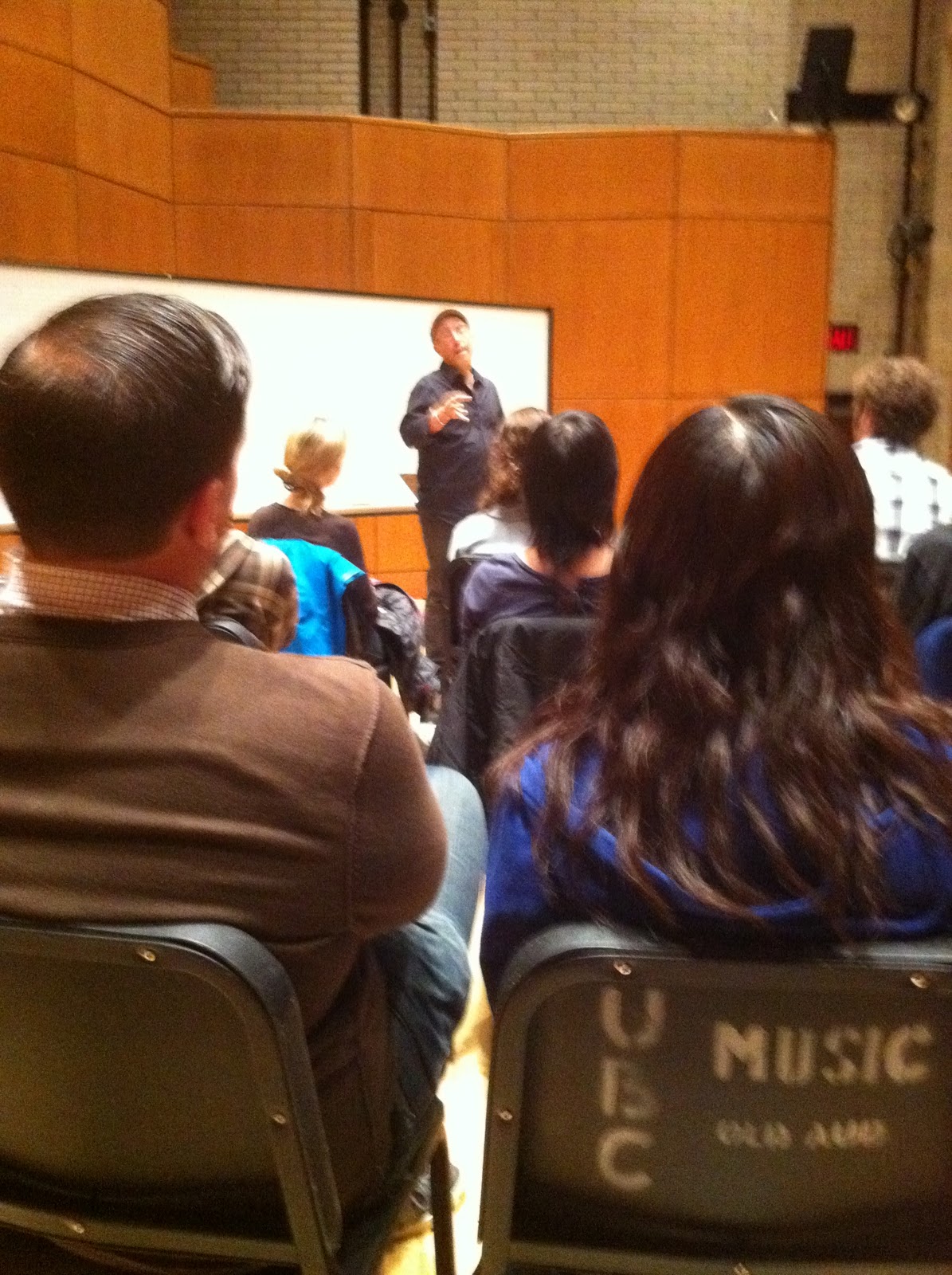
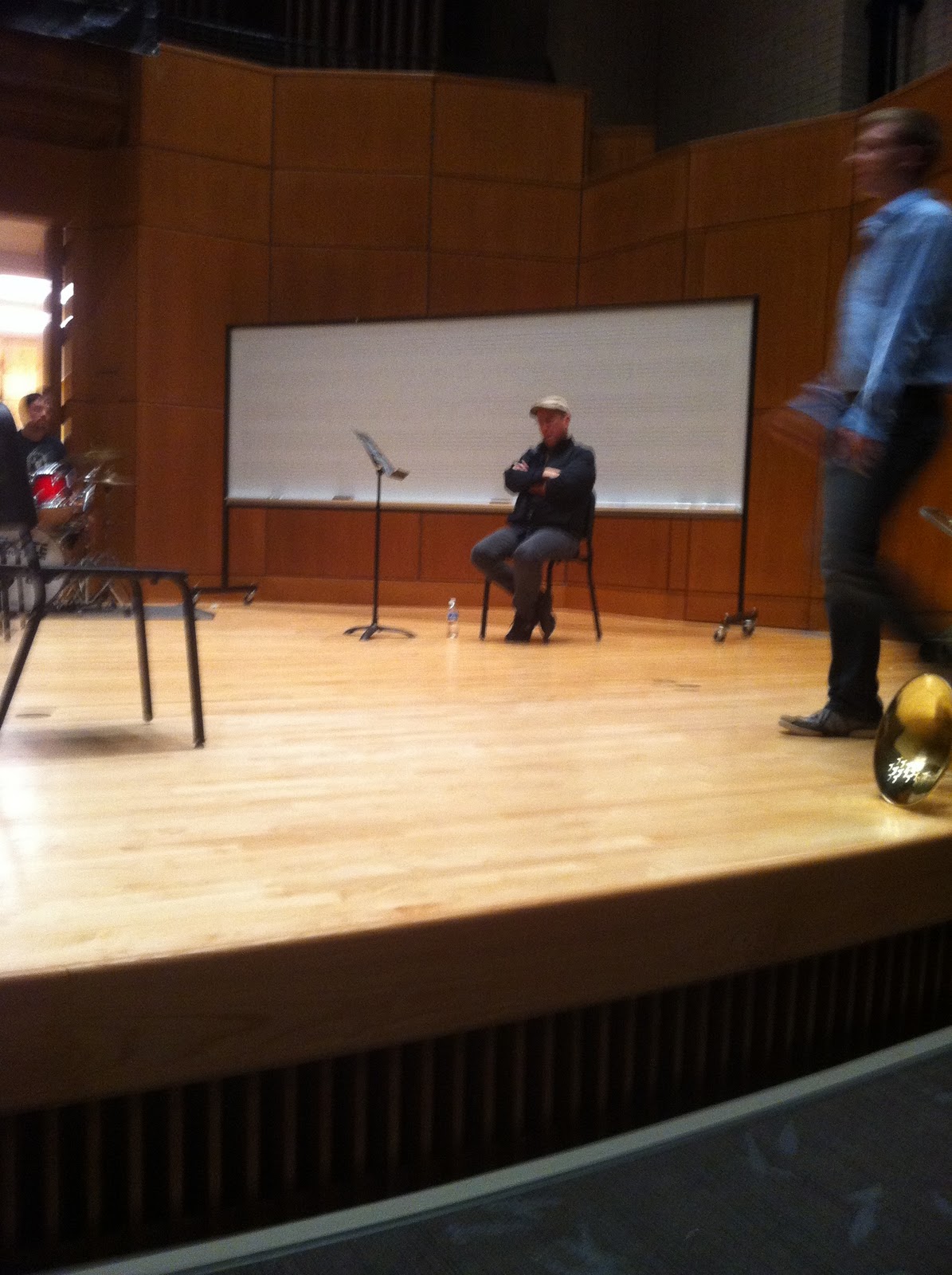
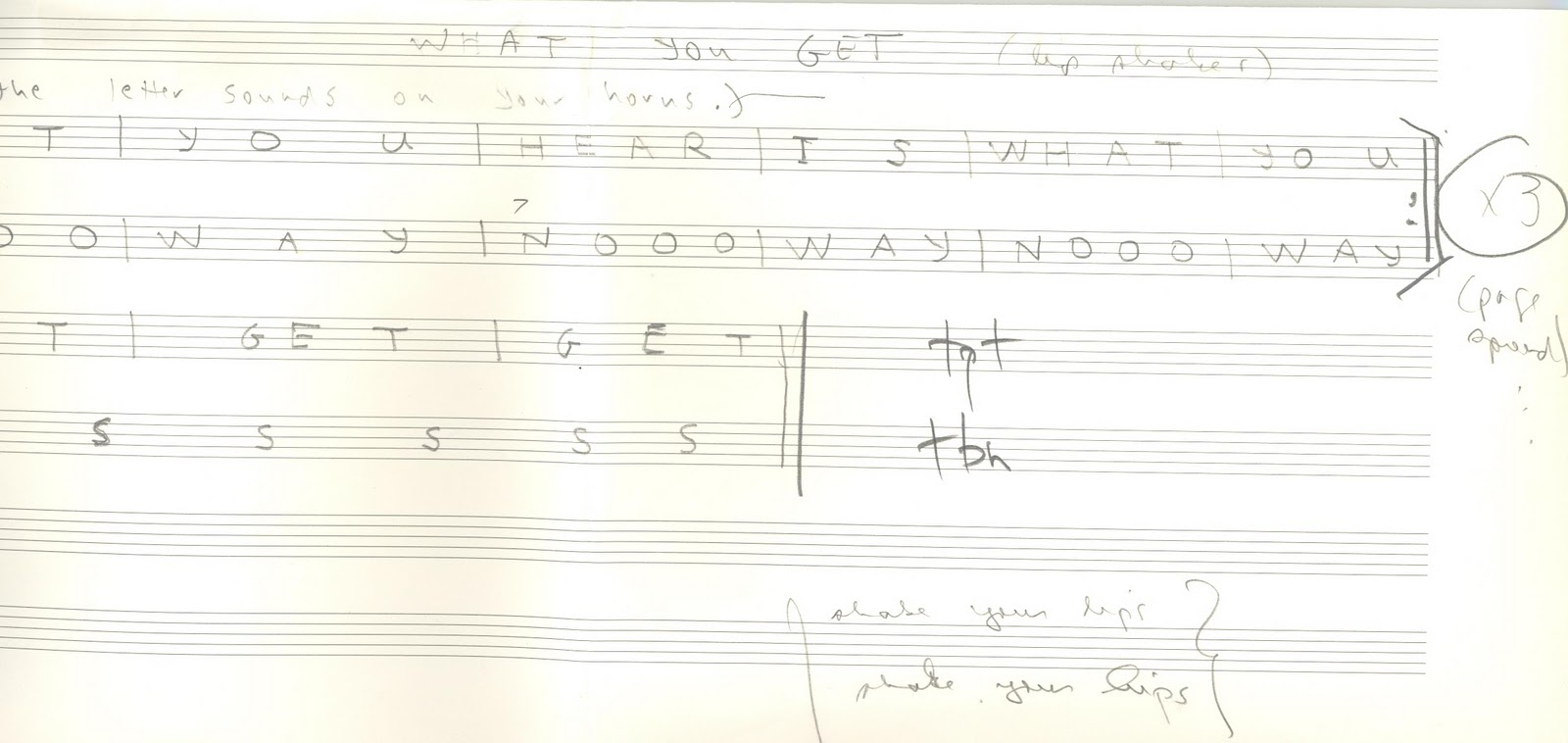
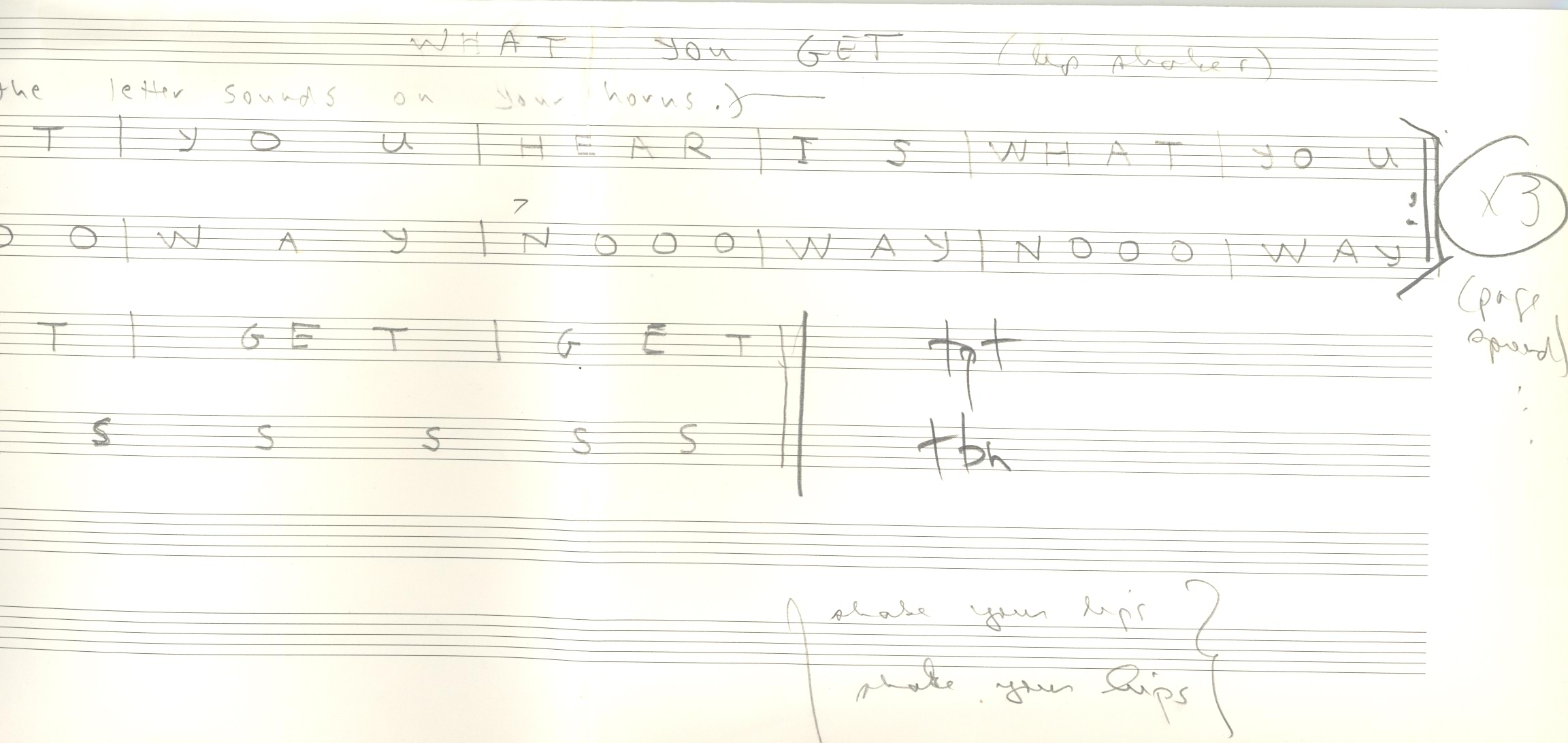
Lip Shake” is a brief piece composed for and during a master class with Dave Douglas at U. B. C., on 22 September 2011. Dave Douglas was in town working on a commission for the Turning Point Ensemble. The master class was a hands-on discussion of composition, during which Dave had everyone present — mostly music students and academics — write a composition for the available instruments, a trumpet and a trombone, with trap percussion, in about 9 minutes. I tried some notated music, but quickly realized I had no ear for sight-reading or sight-writing at all, so I wrote some words on the supplied manuscript paper instead. The poem, which I think of as a score for saying words through a solo trumpet, was revised from this draft later. (A reproduction of this draft can be seen in this post, below; the finished poem-score can be found by clicking on the title link above. You can see if you squint hard at the image how it was originally intended as a duo for two horns, but I don’t think the counterpoint worked, and I also like the idea of the solitary voice as horn and as sort of cracked a little, as inherently not quite itself.) Needless to say, I found I was a bit shy about offering it up to be played at the session. Despite the encouragement to experiment, there seemed to be a real expectation both from Dave Douglas and from the attendees for conventional notation and performance styles; by conventional, I mean generic, I think. We were certainly encouraged to think a little bit outside of our cognitive boxes. What I saying isn’t a complaint about the class. I was an interloper there, and really didn’t want to stand out in any way, or be thought of as intruding. I find I can learn a lot about word music, melopoeia, by paying attention to musicians and composers, particularly around texture and rhythm. And particularly musicians and musical thinkers of this very high calibre. I’m really grateful to have been able to attend the class, and to hear a little bit about how those present thought about sound, both theoretically but — really more pertinently — practically. The idea, for instance, of rhythmic duration, of a beat having extension rather than being some kind of singularity, I find fascinating.

The class was great, very useful. Dave didn’t do a lot of lecturing, but encouraged feedback — not just from him but from everyone there — on the material that had been instantaneously composed and played. He even produced his own on-the-spot composition, for which he invited feedback, as if he too were a nearly-equal particpant in the various compositional processes unfolding around him. The point was, he said, to try to really write what you’re hearing in your head. In music, as he put it, “you can’t outrun who you are.” He quoted something he’s heard from Anthony Wilson: that composing is “the process of transcribing a melody that already exists in your mind.”

For me, in some ways, treating the poem as score means both something linked to this idea of noetic transcription — getting your mind onto the paper — and something opposed to it: opening the page up to the unruly aspects of imaginary performance, leaving space amid and even within the phonemes and dipthongs for alternatives to sound. Potentiality as typographic space, as leading.

This score is called “lip shake” because Dave Douglas mentioned different kinds of trumpet sounds during the class, and that one stood out, and because making the phonemes sound down the brass tubing is going to involve particular kinds of manipulating of your lips, tongue, teeth, windpipe, embouchure, against the mouthpiece. If, that is, you decide to perform it that way.

Audio

Recording audio text can be difficult. Everyone has experienced, I think, a kind of shameful distance from their own voice in playback. Hearing yourself without the contiguities of resonant skull bone – ear sockets, jaw, nasal cavities, sinuses – makes your voice seem higher, more insubstantial. Not exactly yours, not you. At such times, you are not what you hear yourself to be. And I think the feeling, the affect, produced in playback, in the looped recurrences of any recording, is a form of shame. Shame inheres in the membranous displacement between articulate and receptive selves, in what Jean-Luc Nancy seems to me to call “resonance.” Sounding oneself across the temporal gapping in the present tense – the extended moment of any given now, a materialized Jetztzeit, an extemporaneity – creates for me not bliss but a discomfiting. Listening carefully, listening well tends not so much to enlighten as to embrace the embarrassing bathos, the awkwardness, that circulates through the heart of the verbal.