Flow, Fissure, Mesh

Home » Uncategorized (Page 10)

Category Archives: Uncategorized

"We Jimmied the Radio": Brad Cran, Gillian Jerome and the Lyric in Public (Audio)

Here is the audio of a conference paper I delivered at Mount Allison University in Sackville, New Brunswick, on September 21, 2012, as part of the Public Poetics conference. It’s called “’We Jimmied the Radio’: Brad Cran, Gillian Jerome and the Lyric in Public.” Although it makes some gestures at what might pass for materialist analysis – as any work that addresses the idea of a public purview, of relevance or of engagement probably needs to do – my approach locates itself pretty firmly in outlining a phenomenology of the lyric, or maybe in describing the collision of the lyric with a phenomenology of commitment, or of community. At the time I wrote this, I was reading Jacques Rancière’s study of Mallarmé– as well as other work by him that seemed to me to be interrogating the intersection of the poetic and the political – so for me some of that matter gets echoed here, though not overtly mentioned. I come near the end of the paper to the founding of CWILA (“Canadian Women in the Literary Arts”) and to what was in the summer of 2012 a controversy around gender and negative reviewing. (I mention Russell Smith at the beginning of the paper, a gesture at some of this debate.) An expanded version of this essay – about double the length – is currently under consideration for publication. (I seem, as well, to have taken a little more than my time on the panel: The talk clocks in at 27 minutes; I thought I was briefer.) One last plug: check out the poetries of Brad Cran and Gillian Jerome. Buy their books.

On Lydia Davis, Doing Flaubert Some Justice

I used to read faster than I do now. The decreasing velocity of my own literacy has become a bit of a pain, though, particularly when it comes to novels. I’ll admit I have preferred short stories, essays and poems because, when it comes to blocks of printed words, I know I’m impatient. I have always had the sense that I can get through a single poem or story in the discrete packets of reading time I seem to be granted. But I have to plod through novels, and often get mired. I keep restarting Proust and Dostoevsky, but I never finish. I read in pieces, in fragments and fractures.
Well, that might not be true exactly. I do read some big old novels, and do manage to finish after a stretch, but I no longer feel impelled to rush them, or to close things off. I don’t even appear to care if I finish a chapter or not at a sitting. I remember hating The Ambassadors because Henry James just kept taking way too long to make anything happen: middle-aged Lambert Strether hung excruciatingly in hiatus, suspended for page upon page at an apex of reflexive dithering. I like it better now, at least I think I do, but this shift is an effect of my own decreasing speed, that I’m much happier to take the reading experience sentence by sentence, and to try to enjoy the gradual unfolding of a declarative arc, the drift and cadence of James’s or whomever’s prose. I like to let words feel their way toward a period, to find their legs on a page.
Maybe this narrative viscosity offers a provisional antidote to the whelming blur of electronic media, their inherent speed. Fat novels slow you down. The fleetingness of screening text might be offset by the thickening materiality of words on a page, by verbal style. The stylist sine qua non for Henry James, his “novelist’s novelist,” was Gustave Flaubert, who also lamented, in his own era, an acceleration of reading to the detriment of the chewy experience – the degusting – of language. In a letter to Mme. Roger des Genettes dated May 27, 1878, he voices this exact complaint, this pretension:
Je crois que personne n’aime plus l’Art, l’Art en soi. Où sont-ils ceux qui trouvent du plaisir à déguster une belle phrase?” (I believe that no one loves art any more, art in itself. Where are those who find pleasure in savoring a beautiful sentence?) (Cited in the Gustave Flaubert Encyclopedia 15).
He articulates not an abhorrence of the empirical or the technical, but a kind of delicious exactitude, famously encapsulated in the phrase attributed to him as “le mot juste,” the precise word. I’m no expert, no Flaubert scholar, but I can’t locate this exact phrase anywhere in Flaubert, though his insistence on directness and exactitude in writing – and on savouring that exactness in reading – permeates his letters. He wanted, as he put it, a style “as rhythmical as verse and as precise as the language of science” (this from a letter to Louise Colet dated April 24, 1852, during the composition of Madame Bovary). Flaubert was a notoriously slow writer, and he makes a slow reader of me: sentence by sentence, word by word.
Reading Lydia Davis’s recent translation of Madame Bovary, I come across a famous passage at the end of the fifth chapter when Emma, a newlywed second wife for Charles Bovary, begins faintly to realize her romantic mistakenness:
Before her marriage, she had believed that what she was experiencing was love; but since the happiness that should have resulted from that love had not come, she thought she must have been mistaken. And Emma tried to find out just what was meant, in life, by the words ‘bliss,’ ‘passion,’ and ‘intoxication,’ which had seemed so beautiful to her in books.
Avant qu’elle se mariât, elle avait cru avoir de l’amour; mais le bonheur qui aurait dû résulter de cet amour n’étant pas venu, il fallait qu’elle se fût trompée, songeait-elle. Et Emma cherchait à savoir ce que l’on entendait au juste dans la vie par les mots de félicité, de passion et d’ivresse, qui lui avaient paru si beaux dans les livres.
By way of comparison, here is an earlier (1886) translation – now offered freely and electronically worldwide through Project Gutenberg – by Eleanor Marx Aveling, the English daughter of Karl Marx:
Before marriage she thought herself in love; but the happiness that should have followed this love not having come, she must, she thought, have been mistaken. And Emma tried to find out what one meant exactly in life by the words felicity, passion, rapture, that had seemed to her so beautiful in books.
Although contextually and historically more proximate to Flaubert (and also including unfortunate racial language of the time, for example), Marx Aveling’s version also misses a crucial resonance in this passage. That is, it’s here – for me, as an amateur rather than a trained reader of Flaubert – that the terms mot and juste actually appear, ghosted into his sentences. (I can’t be the first to notice this: I’m just ignorant of the reams of commentary on Flaubert.) Davis translates au justeas “just what,” I think, rather than as “exactly,” so we can still hear Flaubert’s mantra echoed in her English. Ironically, the passage surveys Emma Bovary’s infelicities, her poor calibre as a reader, unable to decode key words, or to know precisely what, if anything, they signify. Notice how Davis puts in scare-quotes the italicized romantic vocabulary Emma finds in her reading, in “books.” The passage, as translation, wants to slow us down, to invite its readers to consider how terms are invested with significance, and who does that investing. It puts at issue verbal seeming, the liminal apparition of words, as mere style: their ghostings. Davis, effectively translating here a moment when Flaubert indicates the vacuous untranslatability of words in books, their inherent paucity of meaning, produces – with concisely cadenced prose – an allegory of reading, a paradox that opens up from the demand for exacting language coupled with the refusal of all words, with their porosities and their unsettled and multiple definitions, ever to meet that demand. Her fine tuning of her own language to source text ends up exposing – I’ll say it again – its infelicities, which is what I think makes language interesting as language: its inherent dissimilarity from itself. That’s what meaning consists in, what it is (the strikeout’s intentional). Davis’s confident brilliance as a translator opens up the polysemous substance that Flaubert wants to hone and foreclose, even as the embedded ironies of his prose play against its definitive periodicity. Acknowledging this fracture at the level of the sentence, of the word, is a way of doing justice not only to Flaubert, as his translator, but to language as such, to languages.
Books and Such
Flaubert, Gustave. Madame Bovary. 1856. Trans. Lydia
Davis. New York: Viking, 2010. Print.
Porter, Laurence M., ed. Gustave Flaubert Encyclopedia.
Westport, CT: Greenwood P, 2001. Print.

Short Live Take on Tim Berne Snakeoil

[A headnote: I’m coming back to this post a day later to do a little revising and correcting. My intention with these “short takes” was to do as little revising or reworking as possible, but in this case there were some small issues that really needed to be fixed. I had the titles of the compositions wrong in my first pass, so these needed to be amended. (Thanks to Matt Mitchell for kindly letting me know the real titles.) I’m also sure that I misperceived some of the music, hearing Berne’s new pieces as versions of older work on the issued recording. Such misprisions are a hazard of being less than intimate with the scores, and of hearing this music for the first time. But the fact remains, as well, that – given what I hope is a genuine effort to map out my own auditory affect, to explain and to frame as cleanly as possible what I thought I heard and about how I was hearing it (and given, also, the challenges of the adjective, of being as descriptively accurate as I can) – that a mistaken listening seems to me as potentially interesting to think through as an attention that’s either distracted or that falsely claims acuity or expertise. I’m no music reviewer, and don’t want to pretend to be. But writing through and about the situated reception of music, particularly the immediacy of an improvised performance, which is inherently non-repeatable or, as Vladimir Jankélévitch suggests, irreversible, strikes me as a possible practice, if it works, of an active “cultural memory in the present” (a phrase I’m lifting from Mieke Bal, who repurposed it from others). So, okay, here is the revised piece.]
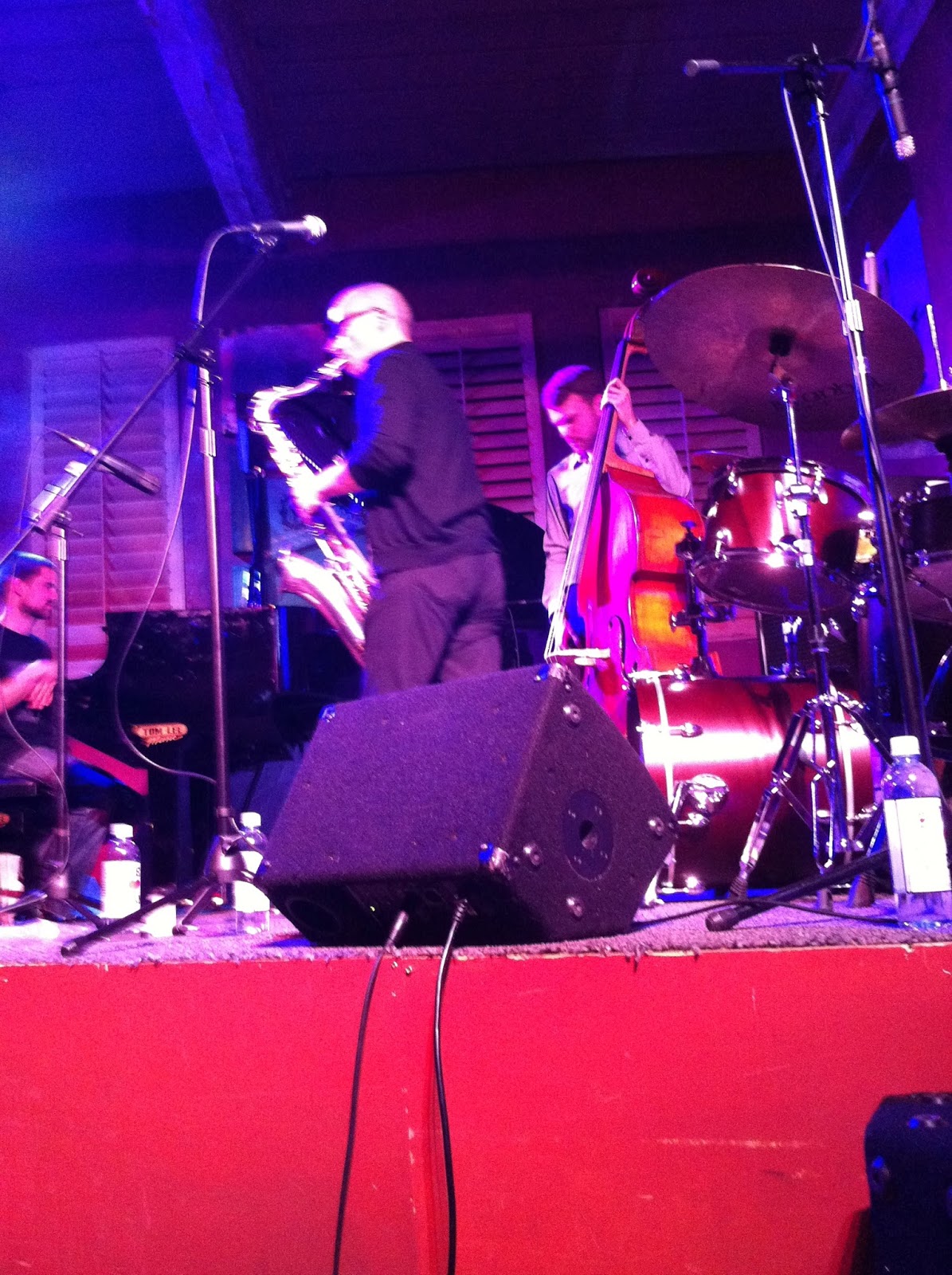
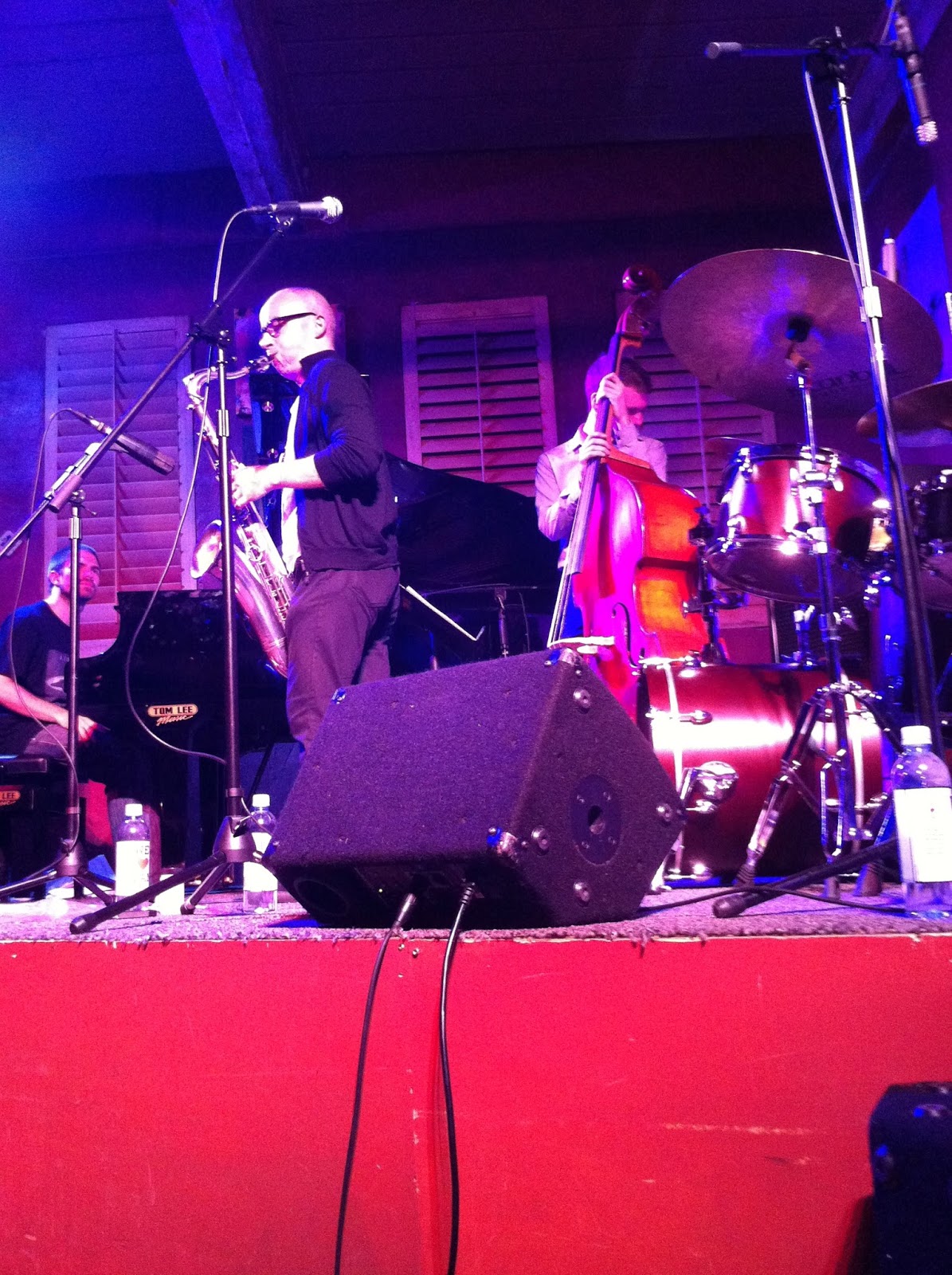
Tim Berne‘s quartet Snakeoil (with Oscar Noriegaon clarinet and bass clarinet, Matt Mitchell on piano and electric piano, and Ches Smithon drums, vibes and hand percussion) played a four-tune, 75 minute set at Ironworks on the final evening of the Vancouver International Jazz Festival. Berne announced the first three compositions as something like “Lamé #2,” ” Lamé #3″ and ” Lamé #1″ (in that order), but he was also slightly, well, mumbly and off-mike, so I could easily have misheard. “Don’t judge me by my titles,” he told us. It’s not that the titles had any obvious meaning for me (Berne’s music is hardly proximate to flashy pop or disco, and I’ve never seen him dress in gold lamé), but that Berne was indicating how each of the pieces formed part of a larger conception, and there was definitely a sense in which all four fit together rhythmically, harmonically and texturally. As with his earlier Bloodcountbook, his compositions tend to use long, sinewy lines — angular, deliberate meanders often taken in unison or at least in parallel paired horns and (in this band) piano. They are also constructed — again, as far as I can make out, as a listener  in sections that, like shifting puzzle pieces, seem to lock together in various kinds of timbral juxtapositions and sequences. He counted in each piece in four, but as the quartet joined in the music instantly became more metrically dense and polyrhythmic. Overlapped sonorities created fluctuating densities, an alternately thickening and winnowing counterpoint. With his move to ECM for his latest recording (by this quartet), his open-form compositional style — mixing structural exactitude with free improvisation —  seems to me to draw at times on the work of Jimmy Giuffre, although the performances leave aside any latter-day chamber music feel in favour of harder edges and more aggressively articulated extemporizing. The fourth and last composition was announced as “OCDC” (maybe?), but listening back to the Snakeoil CD it felt to me – wrongly, as it turns out – that it was an expanded, roomier version of “Spare Parts”; I thought in retrospect (again, mistakenly) the third piece they played was also a re-arrangement of “Scanners” from the same disc. (The bass-line in Matt Mitchell’s left hand sounded remarkably close to what I can hear on the recording.) I’m sure that this sort of musical re-purposing was not really what was going on (and I’m not at all asserting that this music is somehow recycled), but what my perception of these echoes does suggest to me is not only the continuity, the organics, of Berne’s concept but also that the audience was hearing not so much product as process, compositions built from predetermined cells and segments that also relied on formal elasticity and focused improvisation to expand, to animate and flesh out a given set of sounds into new and immediate music. I was very impressed by the unthrottled drive of Matt Mitchell’s playing, by the rough ecstatic energy of Oscar Noriega’s solos, by Ches Smith’s expansive and propulsive sense of time, and by Tim Berne’s own brilliantly knotty phrasing. Berne’s group offered us an object lesson in colliding composition and spontaneity, the made and the making, to intensify a performance, and to bring it creatively, with measured noisy poise, to life. 

Mary Halvorson, "Songs that Get Stuck in My Head"

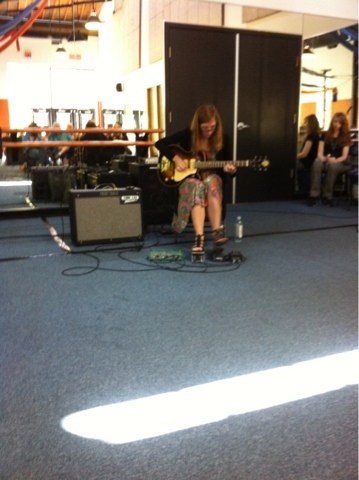
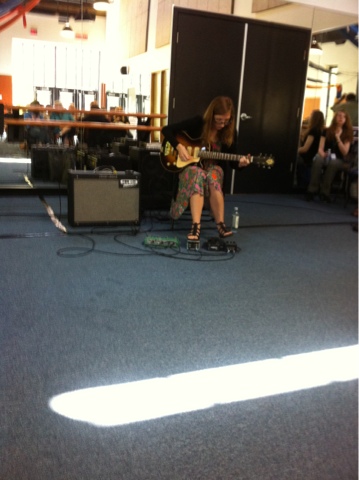
Just come back from an hour-long afternoon public workshop with guitarist Mary Halvorson at the Roundhouse Community Centre in Yaletown, part of the last weekend of the Vancouver International Jazz Festival. It was a real privilege to hear her talk and play. She was personable and articulate, taking questions and playing a handful of brief solo improvisations. 

She confessed that she was in the midst of “working on solo guitar music,” and that she hasn’t really performed solo up until this point in her career as an improviser. She said that she had decided to base her nascent solo work on “songs that get stuck in my head,” which at this point were principally jazz standards, although she was also looking to various “compositions by other people” as source material. She admitted that she tends to focus on melodies and has a harder time “remembering the chords.” But there was nothing diffident or self-effacing in her aesthetic or in her performing; her spotty memory seems to offer creative opportunity rather than impediment. Or, as she put it, “I’m going to make up my own chord changes to these existing melodies.” She offered a foreshortened but compelling version of “Beautiful Love,” laced with pitch-bent burbles, halting twangs and lyrical turn-on-a-dime redirections. She likes, as she said, “weird left turns and falling off cliffs” in music–her version of the “sound of surprise”– but her playing also drew out a gently fraught lyricism in each of her lines. If this really was a hint of what’s to come, her solo work is going to be beautifully unsettling and eclectically brilliant. She talked at some length about some of the challenges she feels she is facing combining her own idiosyncratic approach to the instrument with a more idiomatically “jazz” approach to playing and to musical form. (In fact, before she began talking, she played us a track from her iPod, Johnny Smith doing “Moonlight in Vermont,” and admitted her love of Smith’s sound. Smith had passed away a little over a week ago.) She also played a track from her yet-to-be-released septet album, roiling layers of horn and guitar.

When asked about connections between her styles of band leading and composition, she said she tries to enable and to support the members of her group, and is keen “not to be too controlling.” She pointed to her experiences with Taylor Ho Bynum‘s sextet–the example was suggested by someone in the audience–as a possible model for relinquishing control and instead creating democratic interactions among the players. At the same time, referring to her studies with Anthony Braxton (whose music she said helped her decide to drop her courses in biology and pursue music) and with Joe Morris, she said she felt that “the teachers you have really shape who you become,” noting that both of these mentors encouraged her to follow their example in seeking out her own idiom, her own ways of making music. A brief improvisation built from cascading pulses closed out the workshop.

Julian Arguelles Quartet at Ironworks: a Live Short Take

The Julian Argüelles Quartet played a warm, uplifting set at Ironworks last night, the second of three North American jazz festival dates. This new group, which has yet to record, features a rhythm section of emergent next-generation British improvisers: pianist Kit Downes, bassist Sam Lasserson and drummer James Maddren. (Maddren is also a member of Kit Downes’s current trio, and plays on Downes’s recent quintet record, Light from Old Stars, just out on Babel.) The quartet instantly demonstrated their responsiveness to each other from the get-go; the first tune, “Mr Mc,” had a calypso-like feel loosely reminiscent of Sonny Rollins, and, although Argüelles’s approach to tenor seems to me a little more angular and restrained than the colossus, his improvisations clearly drew on the thematic tactics that (according to Gunther Schuller’s reading) Rollins pioneered in the 1950s. Argüelles dedicated the piece to South African expat Chris McGregor, which might also explain what sounded like its (again, loosely) Afro-Caribbean leanings, but it also showcased Argüelles inclination toward odd meters (11/8?) and off-kilter phrasings. The quartet negotiated complex, prime-number pulses with alacrity, and teased out vamps and grooves that drew their audience in and held them, heads nodding, feet tapping. The music was thoughtful and sophisticated, but also contagiously dynamic, and I don’t think the drummer stopped smiling through the entire eighty-minute set. The second number, which Argüelles said was a “twelve-tone piece” called “A Simple Question,” started with Downes playing solo reminiscent of Paul Bley (whom he name-checks on his own CD’s second cut, “Bleydays”); Argüelles also offered lyrical and measured solo playing, but as the quartet entered the music took on a Phrygian feel and things morphed into what he described after as something “half Spanish” – his composition “Unopened Letter.”

But it was the fourth tune – called “Redman,” he said, and dedicated to “what could only be one of two saxophone players,” who turned out to be Dewey not Don – which clarified the influences on Argüelles’s conception of this group. I was hearing what I thought were echoes of Kenny Wheeler’s melodicism and – especially in the piano – of John Taylor’s latter-day harmonies, but “Redman,” both in the composition and in the improvisations that followed, hearkened directly and unabashedly to Keith Jarrett’s American Quartet, with Dewey Redman, Charlie Haden and Paul Motian. The resonances were almost uncanny. I’m not charging Argüelles with derivativeness, but rather suggesting that Jarrett’s quartet music presents a lineage, and a potential, in quartet music that rarely if ever gets taken up by recent players. The groundwork laid by Jarrett’s group in the early 1970s brilliantly drew together groove and edginess, form and freedom; Argüelles seems to me, at least in part, to be taking up the provocations offered by the American Quartet in ways that are musically compelling and still, even this many years later, forward reaching. (Both “Mr Mc” and “Redman” were recorded in 2009 with an NYC trio – Michael Formanek and Tom Rainey – but those earlier versions seem to echo less the Jarrett group than Redman’s work with Ornette Coleman. The addition of Downes’s piano makes a huge difference in the overall texture of the music: Downes is among a youngish set of British pianists, including Liam Noble, Gwilym Simcock and Nikki Iles, who seem to me variously to have appropriated and repurposed some of Jarrett’s more open – and more polydirectional – musical trajectories, an inside-outside conception parallel to and even filtered though the work of longer-established players such as Paul Bley, John Taylor and perhaps even Stan Tracey.)
Of the remaining numbers in the set, “Phaedrus” seemed to draw on the idiom of Steve Kuhn’s ECM quartets with Steve Slagle, while the waltz-like ballad “A Life Long Moment” was affectingly lyrical. The alternately falling and lifting cadences of the oddly-monikered “Lardy-Dardy” produced a sinewy, organic swell and flux. “Triality” was built around a Dave Holland-like freebop line, while the quartet’s encore – called “Pick It Up,” I think – offered a floaty, looping shuffle. The concert felt like witnessing the emergence of a historically savvy, formally propulsive and musically progressive ensemble. It was a warm, involving and affirmative performance.

A Little Bit Late About Bettye Lavette

Like many listeners, I have come to Bettye Lavette’s music a little bit late. Just a few months ago, in a bookstore in Tsawassen, we picked up (for music to listen to in the car on the trip back home) the Bob Dylan tribute Chimes of Freedom, a January 2012 release that bills itself on its cover as “honoring 50 years of Amnesty International.” There are some great (and some mediocre) versions of Dylan spread over its 4 CDs, but when our player cued up Bettye Lavette’s cover of “Most of the Time,” I have to say that I was brought up short: it’s a powerful, fierce, committed, startling transformation of the song. “Who,” we had to ask ourselves, “is THAT?” It turns out that 2012 also marks 50 years in music for Bettye Lavette herself. Her first single, “My Man, He’s a Loving Man,” was recorded and released in 1962, when she was sixteen. Her career, for subsequent decades, seems to have been a long struggle for recognition, a story she tells in her forthright autobiography (also published in 2012, though titled after her first album for Anti-), A Woman Like Me. Her concert Saturday night at the Vogue, as part of the Vancouver International Jazz Festival, was a revelation for me, a brilliantly orchestrated overview of that career, featuring songs from her early days to recent versions of Gnarls Barkley, but every song infused with aspects of that struggle to be heard and acknowledged, and given an edgy vitality, a moving immediacy and a grainy depth that lent her performance moment after moment after moment of true greatness.  As Marke Andrews notes in an omnibus review in The Vancouver Sunof the festival’s opening weekend,
Despite 50 years in the music business, [Bettye Lavette] remains largely unknown (“We’ve just completed the ninth year of our Who The Hell Is She Tour,” she joked to the audience), and seems determined to prove herself with each performance.
But there was nothing strained or effortful about her singing, only a fierce and unwavering commitment to the emotional substance of each song she chose. She engages lyric and melody on their own terms, but she also remakes them on hers. At one point in the concert, she admitted that she “wasn’t a writer,” but I think that might be exactly what she is. Most of her source material (from standards to Motown classics to country ballads to carnivalesque Tom Waits numbers) is so utterly and radically transformed that it becomes wholly her own; her re-casting of Neil Young’s “Heart of Gold,” which she first covered in 1972, is nothing short of stunning, as she turns his frail nostalgic folk anthem into a tragically affirmative lament for lost days. The highlight of Saturday’s concert, for me, was a version of Pete Townshend’s “Love Reign O’er Me,” which was the song she performed at the Kennedy Center in 2008 that seems to have secured a position for her in the pantheon of epochal voices. Slowing the song, almost to the point of fissure, at the verge of coming apart, drawing out the melodic line syllable by syllable as she felt her way along and through the notes – “Love … reign … o … ver … me …” – she made the music do what it needed to do for her, to allow us to recognize her, that is, to connect with her as a powerfully felt and powerfully feeling human being. I don’t mean to suggest that her voice was especially serene; any saccharine critical platitudes would be belied by her take-no-shit attitude toward her own 50-years-overdue canonization. I think there is something to be said for hearing her performance in relation to what Edward Said called “late style”:
The accepted notion is that age confers a spirit of reconciliation and serenity on late works, often expressed in terms of a miraculous transfiguration of reality. . . . But what of artistic lateness not as harmony and resolution, but as intransigence, difficulty and contradiction?
Bettye Lavette offers us neither one of these alternative alone, but sings instead with a resilient, difficult beauty. “Late style,” as Said puts it, “is what happens if art does not abdicate its rights in favour of reality.” In her voice, I hear a collision of fierce self-awareness and commanding aesthetic presence. For real.

Keith Jarrett, Yard Sales and the Commodification of Genius, Part One

In the next handful of posts, I’m going to parcel out some revisions of a sixty-odd-page draft of what remains of a chapter for a book (once called Earmarked) that was never to be, maybe never meant to be. The chapter, which I called “Keith Jarrett, Yard Sales, and the Commodification of Genius” was occasioned by me finding (about ten years ago now, maybe longer) a fairly pristine LP copy of Keith Jarrett’s famous and well-circulated Köln Concert album at a yard sale in Vancouver, and also by a brief and really unremarkable exchange I had with the seller over the right price. The chapter was intended as a recuperation of a Marx-influenced formalist materialism, close to the sort practiced by Theodor Adorno about forty years earlier; as an implicit plea for the necessity, in our own time, of a kind of critical archaism, a deliberately out-of-step temporality; and as an interrogation of the figure of the postmodern genius, or of the virtuosity of the extemporaneous thinker. How does improvisation either resist or accede to becoming cultural capital? Is its cultural capital, in fact, inscribed or encoded into the work of resistance?
I’ll start with two quotations, to set the project up, the first from music critic John Corbett:
One of the things I like most about LPs is the way they absorb history. By that I don’t mean the history of the music, but also the history of each record as an object; records are repositories of music’s material culture. CDs seem less historically palpable than LPs. Collectible CDs? Maybe, but not for me.
And the other from Karl Marx, the eleventh of his theses on Feuerbach:
Die Philosophen haben die Welt nur verschieden interpretiert; es kommt darauf an, sie zu verändern. (Or, something like, “Philosophers have merely and variously interpreted the world; the point is to change it.”)
Despite my hopes at academic relevance, it seemed quaint to me then and its seems quaint now to begin with such a citation from the “Theses on Feuerbach,” particularly this one, the eleventh, which has been flogged like a dead horse at the crossroads of interpretation and action, of what thinkers do and what they think they ought to. To me, now, it sounds more like an excuse than an imperative, a means of translating the feint of engagement in critical and academic writing into something that really matters, that changes the world. Marxism now, however various and unruly it might be, however impossible to frame as a coherent movement, has also come to appear dated at best: notions of socialism and social reform, class consciousness, commodification and exchange, property and value, have shifted so drastically in the last century, many to the point of conceptual dissolution, especially in the rather privileged Western European sphere. With multifarious levels of access to and exclusion from investment (everything from bank accounts to mutual funds), the blurring of ethnic and national identities, the suffusion of global capital into uncertain and contingent oligarchies like multinational corporations and free-trade alliances, the diffusion of a complex body of worldly information through the mass media, the idea of an economically determinate class, for example, seems historically remote, out-of-date. All this seeming is no doubt at least in part a function of my own economic and cultural privilege; I have the luxury and the leisure to release myself from the imperatives of social transformation, a comfort zone established by my rarefied – if still tenuous – position within many networks of value. Certainly there are haves and have-nots, the well-to-do and the poverty-stricken, but the boundaries and divisions are no longer so easy to determine, if indeed they ever were. Participation in the mechanisms of consumption and exchange is neither uniform nor closed, and the forms of consciousness and solidarity on which Marx might have depended for the renovation of labour and worth have become permeable, plural and radically indeterminate. It is truly difficult, for instance, to ascertain who exactly might constitute a proletarian body. Most late and post Marxisms, from Adorno on, have winnowed away the categories of Marxist analysis (from class to ideology) to the point that they can no longer find much of a purchase in the contemporary economic and political morass. It would be fatuous to dismiss Marxism as irrelevant; indeed, given the transformation of an orthodoxy of political economy into what Michel Foucault once characterized as “divergences” in a foundational “discursivity” (Rabinow 114-5), I should note instead how Marxism has come to designate a limited but prolific body of intersections, a master canon continuously inflected and re-written by an array of theoretical and critical modes:
Annales school historians, Frankfurt School theorists, Poststructuralists, Reader Reception Theorists, New Historicists and Cultural Materialists have reformulated Marxist principles and extended them by drawing more and more widely on other ideas from other texts — texts of philosophy, ethnology, anthropology, linguistics, psychoanalysis and religion. They have produced a variety of transformations, inversions, displacements and reformulations, resolving some of the impasses they inherited and reinscribing others. And they have made Marxism perhaps the most imperialistic discursive formation today. (Bannet 2)
I think I tend, however, to lose sight, in the wake of this permanently self-revolutionizing theory, of what might still be said to constitute the core of a Marxist critical praxis. (Bannet appears unwilling to grant the positional solidarity of a proper name to her “Marxism,” given its decentred plurality.) Returning to canon, to the classic statements of value and revolution we might associate with Marx himself, doesn’t prove particularly satisfying, either. The demand that workers of the world unite, for example, would serve as well for a slogan for Benneton advertising as it might for union bureaucracies, and clearly re-inscribe a deeply problematic collective determinism that is deeply endemic to the hegemonic forms of western politics. (What workers do we mean? What constitutes work? How is a proletariat demarcated? What world do we mean — first, second, third or fourth? Unite on whose terms? How?) It is difficult still to hear a deeply felt call for socialist revolution. Manifestoes date themselves, locked into their own inevitable anachrony.
The flipside of such anachrony, its camera obscura inversion, has to be nostalgia. I remember when I was fourteen, or fifteen at the most, I bought from our local bookstore a blue-spined Pelican paperback version of The Communist Manifesto. It’s short, a quick enough read, but it is also so historically and materially specific in its frames of reference, with its welter of dated prefaces and that its smallish scholarly apparatus (by none other than A. J. P. Taylor), that I had a hard time feeling anything of the insistent presentism of its famous opening: “A spectre is haunting Europe . . . .” but a spectre that felt, at least as an adolescent reading experience, more archaic than disturbing. I wasn’t a particularly careful reader, sure, but I seemed to know that the book, that this particular book, could have very real transformative power as a material object. I could use that manifest spectre, I mean, to scare my parents. Which is exactly what I think I did. I remember announcing to them from the back seat of the family car, book in hand, that I had become “a communist.” I hadn’t joined any political organizations, of course, and I don’t think I even knew anyone who was especially political. I think my parents took my declaration fairly calmly, assuming I had next to no idea what I meant, which wasn’t exactly true. I knew some things. I think, looking back, that this announcement offered me a point of Oedipal differentiation, a small shock I could leverage into separating myself from the everyday security of a safe middle-class paternalism. I’m not sure why I wanted to do this; privilege will feed and clothe you. Maybe I liked the idea of risk, without any experience of it. This moment, when saying “communism” offered me the literary pretense of action, a very small-scale moment of teenaged shock-and-awe, was also the moment when politics – at its very outset, even – deteriorated almost instantly into mere style.
In Why Marx Was Right (2011), Terry Eagleton reacts to this political anesthesia, symptomatic of late-stage capitalism, by arguing for – or at least asserting, declaring – the necessity of Marxist thought in a seemingly post-Marxist world, a world that appears to have left Marx behind. Marx’s “archaic” quality, Eagleton asserts (making a point about a return to “Victorian levels of inequality”), “is what makes him still relevant today,” that Marx still offers a means to regard capitalism, critically, from a contingent but critically-viable outside (Eagleton 3). “In these dire conditions,” Eagleton writes, citing Fredric Jameson, “‘Marxism must necessarily become true again’” (8). Marx is right for our own time, for Eagleton, because of his vatic prescience, because – against the odds, perhaps – in Adorno’s formulation, he threatens to be right, because we don’t want him to be. Eagleton suggests that Marx foresees the contemporary consequences of globalization, for example, and also offers a still-viable conceptual path for the critique of the massive commodification of experience. I think Eagleton is following Friedrich Engels, in a famously deferential note in the last chapter of Engels’s late book on Ludwig Feuerbach:
Here I may be permitted to make a personal explanation. Lately repeated reference has been made to my share in this theory, and so I can hardly avoid saying a few words here to settle this point. I cannot deny that both before and during my 40 years’ collaboration with Marx I had a certain independent share in laying the foundation of the theory, and more particularly in its elaboration. But the greater part of its leading basic principles, especially in the realm of economics and history, and, above all, their final trenchant formulation, belong to Marx. What I contributed — at any rate with the exception of my work in a few special fields — Marx could very well have done without me. What Marx accomplished I would not have achieved. Marx stood higher, saw further, and took a wider and quicker view than all the rest of us. Marx was a genius; we others were at best talented. Without him the theory would not be by far what it is today. I[t] therefore rightly bears his name. [Italics mine.]
Praising the genius of Marx, for Engels, is obviously a way of acknowledging both his intellectual brilliance and his visionary acuity. The Latin etymology of the term genius – a transliteration of the Roman name for something like a guardian angel or “tutelar spirit” – is linked (my old companion W. W. Skeat suggests) to the idea of the genus, genetic kinship, creative or generative origin, maybe even to push things a bit, something like a muse, an instructive spirit. Marx’s genius, along these lines, makes him into a corrective spectre who haunts our world, and who persistently speaks against the oppressive tendencies of our times, a counter-episteme. Eagleton explicitly states that this Marx isn’t the one he wants to recover, the Marx of “moral and cultural critique” who seems to him next to impossible to dismiss as foundational to most critical projects in the humanities. And maybe this means leaving Eagleton behind now in my current trajectory; but it’s important to acknowledge how even Eagleton’s doggedly practical and political recuperation of Marx depends upon and is haunted by that genius.
         The political and the cultural, that is, are difficult to disentangle, which seems like a banal enough claim to make, hardly a claim at all, except that the question of how that interdependency articulates itself, particularly across the domain of the aesthetic, becomes both crucial and vexed – bewitched, Adorno might say. Aesthetic abstraction, the rarefication of artistic material and experience, takes on the quaintly archaic appearance of privilege and withdrawal, but that rarefication can also be understood as an at least contingently foundational moment for political engagement, the fraught origin of what Fredric Jameson calls, potentially, “a radical intervention in the here-and-now and the promise of resistance to its blind fatalities” (The Cultural Turn35). I hear Adorno’s negative dialectics all over Jameson’s argument:
In the old days, abstraction was surely one of the strategic ways in which phenomena, particularly historical phenomena, could be estranged and defamiliarized; when one is immersed in the immediate – the year-by-year experience of cultural and informational messages, of successive events, of urgent priorities – the abrupt distance afforded by an abstract concept, a more global characterization of the secret affinities between those apparently autonomous and unrelated domains, and of the rhythms and hidden sequences of things we normally remember in isolation and one by one, is a unique resource, particularly since the history of the preceding few years is always what is least accessible to us. (35)
Jameson is talking about theorizing the postmodern, but – and I don’t think I’m out of synch here – he is also outlining a poetics here, at least implicitly, and even – in his gesture at rhythm – a musical aesthetic. And he’s talking, for that matter, about how Marx’s genius might materialize in contemporary language, how it might sound itself.
What’s emerging, I think, is an aesthetic of relevance, of creative urgency that matters. How is it, the question goes, that Marxism might remain, as Marxism, relevant if not contemporary, given its archaism, its ineluctable entanglements with “the old days”? Douglas Kellner argues, following both Adorno and Herbert Marcuse, that Marxism is defined by its persistent field of crisis:
Marxism still has the theoretical and political resources to provide an account of contemporary history and strategies for radical social transformation. In a sense, Marxism is always in crisis as new events emerge that require revision and development of the theory. Marx himself and subsequent Marxists were always revising and reconstructing the theory to take account of historical developments and to fill in the deficiencies in the original theory. In this sense, “crises of Marxism” are not so much signs of the obsolescence of the Marxian theory as a typical situation for a social theory facing anomalies or events that challenge its theories. (16)

For Kellner, scientific or orthodox Marxism can only be misapplied and inappropriate, but critical Marxism remains relevant (especially Frankfurt school, especially Marcuse): “Because no competing economic theory or critique of capitalism has emerged to replace Marxism, it is still an indispensable part of radical social theory” (18). But what constitutes the core of a theory, the theory, which is wholly self-renovating? For me, it’s the collision of the archaic and the nostalgic – that is, in a sense of the ideological and the utopian – in textual-materialist engagements with the historical. Historicizing Marxism itself, which asserts its relevance as a theory of historical crisis and transformation, refigures its quaintness. Responding to critiques of Adorno’s Marxist anachrony, Jameson argues that “if you reproach Marxism with its temporal dimension, which allows it to consign solutions to philosophical problems to a future order of things, . . . a vision of postponement and lag, deferral and future reconciliation,” you are in effect assuming an a-temporal critical posture he associates with the postmodern:
it may be admitted that this future-oriented philosophy — which prophecies catastrophe and proclaims salvation — is scarcely consistent with that perpetual present which is daily life under postmodern or late capitalism. (Late Marxism 231)
The radical critique proffered by Marxism has remained, for Jameson, its “genuine historicity,” the insistence upon historical renovation — even to the point of facing its own immersion in the historical, its own perpetual theoretical anachronism — to which Kellner also holds.
      So, I want to use Marx as a point of departure for at least two reasons. First, my initial object of study, the yard sale, operates like a peculiar pocket of capital production and exchange both within and outside the complexes of regulation, distribution and control that constitute the wider market. Like Marxism itself, yard sales are inherently quaint. They are highly localized, interstitial formations at which nascent commodities, in the Marxian sense, are able to gestate, baldly exposed to view: yard sales offer an immediate display (an aesthetic) of capitalism in its infancy. Marxist critique, for a moment, applies. Second, the actual ideologeme that I want to isolate and interrogate – the production of “genius” – feeds back into the dialectic articulated by Marx’s eleventh thesis, tired as it may seem. How is it, I want to ask, that an acquired object – in this case, a particular record by Keith Jarrett – shifts from a thing interpreted (as valuable, as meaningful) to a political manifesto, an immediacy which no longer simply represents but enables participation in a kind of community of action, a shift, as Keith Jarrett might say, from the passivity of audience member to the activity of listener. An apparently trivial, everyday act – buying a used album in somebody’s garage – presents a potential moment to call radically into question the structures of consumption and determination that almost invisibly and nearly inaudibly govern and shape us.
         More to come. (Next, theorizing yard sales, then acquiring, and listening to, Keith Jarrett.)
Works Cited to This Point
Bannet, Eve. Postcultural Theory: Critical Theory After the Marxist
Paradigm. New York: Paragon House, 1993. Print.
Corbett, John. Extended Play: Sounding Off from John Cage
to Dr. Funkenstein. Durham: Duke UP, 1994. Print.
Eagleton, Terry. Why Marx Was Right. New Haven: Yale UP,
2011. Print.
Engels, Friedrich. Ludwig Feuerbach and the End of Classical German
Jameson, Fredric. Late Marxism: Adorno, or, The Persistence of the
         Dialectic. London: Verso, 1990. Print.
– – -. The Cultural Turn: Selected Writings on the Postmodern,
1983-1998. London: Verso, 1998. Print.
Rabinow, Paul, ed. The Foucault Reader. New York: Pantheon,
1984. Print.

Torn Daisies and Drift

Here are live recordings, from a concert this past Friday evening, of soprano Phoebe MacRae and pianist Rachel Iwaasa premiering two new art songs, each using text taken from my poem “First Person Shooter.” The first, “Drift,” is a setting by Vancouver composer Alex Mah. The second setting, “Torn Daisies,” is by Winnipeg composer David Betz. The premieres were part of the Songfire Festival’s “Playing with Fire” concert, showcasing new music emerging from this year’s collaborative Art Song Lab, part of the Vancouver International Song Institute. My sincere thanks to Ray Hsu, Alison D’Amato, Michael Park and Rena Sharon.

VISI Art Song Lab 4, Sprechstimme

What came to mind watching and listening to the rehearsals, the workshops and then the performances of art-songs created this past week was a tensile interdependence of cantus and poesis. The poems, as song-text, were written first for the most part, although during the week some alterations and revisions happened, as words were adapted for and inclined toward the music. In some cases, the same poem developed into two distinct versions; in my own case, the words didn’t change, but one of the two composers working from it, David Betz, used an earlier draft (which I had sent him by e-mail, to let him see the progress I hoped I was making coming up with suitable text) as the basis for his composition, so a few words and phrases don’t appear in the finished poem. (For instance, the title of his art-song, “Torn Daisies,” uses an adjective I changed [to “shredded”] in the final copy.) But I am very happy to let these slippages stand, partly because they work in his setting, and partly because I think that such misprisions, whether deliberate or inadvertent, cut to the heart of collaborative interdependence: the words take hold in the music, but also have to be let go, partially and partly, by the poem from which they originate. In David’s case, his setting deliberately mines the original poem for phrases and word-clusters that he seems to have felt resonated with his own textural sound-palette, but he almost wholly disregards the narrative or even syntactical order of the poem itself (although he does end his song, for example, with the last line of the poem, so some structural imperatives could still be translated, for him). In this instance, the poem has to be released from its formal bands, as speech, to adapt to the melodic contours of song.
This tug between cantus and poesis, between song and speech, can be read as a species of translation, but it can also be set apart from translation in its mundane sense, as derivative or secondary language, if by working between media we want to pursue a more primordial pathos. In À cor et à cri (Hue and Cry, 1988) the poet, ethnographer and surrealist Michel Leiris attempts, in a book-length collation of notes and lyric fragments, to map an alchemical genesis, a passage (cri-parole-chant) from visceral cry winnowed through words toward a condition of song: chanterfor Leiris means not merely to put words to music, not melopoeia, but also to materialize a perceptual intensity, gathered by and diffused through poetic language. He juxtaposes this heightened, conceptually genetic (that is to say, phenomenologically vital) modality to the servility of translation:
Peut-être est-ce quand les mots, au lieu d’être en position servile des traducteurs, deviennent générateurs d’idées qu’on passe de la parole au chant?
In practical terms – that is, in terms of the realization of an art-song and not merely its conceptualizing as an idealized poetic state of language – I think one element that might enact this tension performatively, audibly, is the technique of Sprechstimmeor song-speech (literally, speech-voice). In Alex Mah’s setting of the middle section of my poem “First Person Shooter,” which he titled “Drift” after an early version of the text, the vocal literalizes (as a kind of active reading, a lettering) this tension in phonemic stutter and repetition at the outset of the song (“st . . . st . . . stalled . . . stalled”), as if the grieving singer were unable to find her words, as if singing itself, as keening, were an act of verbal grief, stalling on itself. This stutter suggests both semantic shortfall – not having the words – and creative agon, a voice contesting its existential impediments to find an expressive diction. The words of the poem initiate and thematize this agon, but it can only fully realize itself in musical performance, becoming song rather than recitation. A little further along in the setting, Alex introduces Sprechstimme, and even produces a performative version of what Paul de Man named an “allegory of reading” or what J. Hillis Miller might call a “linguistic moment,” as the vocalist falls back into her speech register to utter the word “unspeakable.” It’s a dramatic effect, certainly, but also a semantic paradox, in as much as she says that she cannot say, as song diminishes or frays back into utterance, retreating from the agon in the initial stutter, rendering it all but pyrrhic: a version, or perhaps an inversion, of what Martin Heidegger meant when he claimed, in poetry, that “Die Sprache spricht.” In the performance last Friday evening, Phoebe MacRae did a tremendous job conveying not simply the feeling of grief over the events to which the poem responds – the Sandy Hook shootings – but also the essential pathos of the shortfall of language itself, of our inability to make sense of the senseless.
         I want to try to frame this tension, which I think operates at the core of art-song as a genre, by looking to the last lines of another poem written for use by the Art Song Lab, Leah Falk’s “Directions to My House”:
I am also a door, remember,
                           hinged to wind
                           swinging between
                           a list and lost
It’s a fine poem, which both investigates and resists the teleology of directions, of the map, to interrogate lyrically the concept of home-coming, of nostos. But our sense of home at the poem’s formal close has been unmoored, even rendered abyssal. The speaker-singer herself becomes a transitory and contingent site, permeable and unfinished. (Notice the absence, for instance, of closed punctuation – these sentences begin, but refuse to conclude.) The poem as descriptive list, as a catalogue of traits or a repository of images, hinges on a vowel shift – from the typographical (door-like?) rectangle of the i to the open oval of the o – between empirical certainty and placeless vacancy. Leah Falk’s spare melopoeia, a muted vowel-music, draws her words close to song, while also refusing the semantic surety of bel canto. Pathos emerges for me, as listener and as reader, in negotiating the fissure, the persistent and lyric gap between sound and meaning, not in wanting to try to suture it shut.

VISI Art Song Lab 3, Compose

Tuesday afternoon, Jocelyn Morlock offered an open workshop intended to address some of the possibilities of art song from a composer’s perspective. Instead of examining work by any of the current participants in the Art Song Lab, she presented some of her own work for audition and scrutiny, describing the challenges she faced in composing for text and also inviting us to re-think with her some of the formal and conceptual choices she made in her work. She opened with a reconsideration of “Somewhere Along the Line,” a song she created recently with Tom Cone during the last months of his life, when he was ailing with cancer. “He never heard it,” she told us. It was first performed by Rena Sharon and mezzo-soprano Melanie Adams on April 29, 2012; as a circumstantially posthumous work, it became, Jocelyn Morlock said, “the collaboration I never wanted to happen.” But the recording she played also helped her and helped us to start to think about the tensions and convergences at play in the making of an art song, the ways for her – she suggested at a number of junctures – that the music both interprets and, with as much care and respect as makes sense (particularly in this song) for the perceived intention behind the text, misinterprets the words. All interpretations are, to some extend, inevitably misprisions and misdirections, but Jocelyn Morlock was particularly concerned with trying to find connections between the musical and verbal lines in “Somewhere Along the Line.” Her setting creates a gently constrained pathos – it’s a beautiful piece. But what makes it even more interesting from a compositional point of view – to a non-musician like me – is the way in which it exploits aesthetically the shortfall in meaning that the poem itself thematizes; that is, the text suggests a trajectory into uncertain space, which she identified with Tom Cone’s sense of his approaching death: in the poem, he is, she suggested, “completely on unknown ground.” For me, this uncertainty offers a potential egress into the formal and conceptual fissures between sound and sense, music and word, fissures that open in the idea of line, both melodic and poetic. “I try, but can’t,” the poem reads – but in that truncated half-stich, suggests not failure but a valuing of what it is to try, of asymptotic convergence, of the approach of declarative and performative. Music emerges in and as a kind of contingent suturing, not as closed concord but as carefully collided difference, as mutuality. (See the end of this post for the recording of “Somewhere Along the Line,” shared from her SoundCloud page.)
She played us another of her collaborations with Tom Cone, a less pietistic number for solo voice called “My Orange Thong,” as well as her own setting of Goethe’s Second Wanderer’s Nightsong (via Franz Schubert):
Über allen Gipfeln
Ist Ruh,
In allen Wipfeln
Spürest du
Kaum einen Hauch;
Die Vögelein schweigen in Walde.
Warte nur, balde
Ruhest du auch.
Discussion about the composer as translator, as well as questions of deference and fidelity, came up around this piece. It seemed to me – although I’m not sure that everyone agreed – that what might be perceived as loveliness or even pathos in this lyric also leans, particularly in our own time, closer toward bathos and preciousness; how in or out of step is a Romantic impulse now? It’s a question worth asking, still, and worth addressing not just reflectively or critically, but also poetically, by translating. For me, who has only rudimentary and poor German, a word like “Vögelein” wants to be translated, deliberately, not as “little birds” but as “birdies” (or, someone suggested, “birdlets” – a bit like Chaucer’s “briddes” from The Parliament of Fowles:On every bough the briddes herde I singe, / With voys of aungel in hir armonye . . . ” [lines 190-1].) But such translation runs the risk of disrespect, and of puncturing the overly sweet lyricism (Chaucer says “ravishing sweetness”) of the text – a harmonious lyricism it appears many listeners still, 200-odd years later, expect and even demand of a poem. (While I’m on Chaucer, a few lines later in the poem, he describes a hybrid Ptolemaic-NeoPlatonic-Christian attunement of the spheres reproduced by that orchestra of birdies as a model for poetry, for art song:
Of instruments of strenges in acord
Herde I so pleye a ravisshing swetnesse,
That god, that maker is of al and lord,
Ne herde never better, as I gesse
But I also hear, no doubt anachronistically, a gentle prising open of high-blown seriousness in the playfully colloquial, mild irony [rather than stentorian certainty] of his last phrase, “as I guess” – not so much as discord, but as non-accord, as orchestrated difference. There was no reference to Chaucer, of course, in the discussion of Goethe and Schubert, but I’m digressing here to suggest the variously random and agnogenic resonances that emerged for me as I was listening and thinking about the respectful translation of text, from person to person, from setting to setting. I think that this playful uncertainty can offer a creatively energizing model – one path among many, perhaps – for translation, for collaborative intersections both within and among art-forms.) Her own resetting of the Goethe text, which she presented in a recording, was both lyrical and moving; but I also appreciated what I heard as Jocelyn Morlock’s willingness to embrace play in her music, not to undermine its aesthetic import but to sustain a non-exclusive openness that seems to me to be crucial to the collaborative work of art song in all of its styles and practices.
         Prodded by the session with Jocelyn, I took a stab at re-translating Goethe, with mild disrespect, I suppose, but also with an intention of opening up the text to other contextual and historical resonances, wanting to emphasize this brief lyric’s enmeshment in the allusive fabrics, the resonant polysemy, of our oversaturated and heavily mediatized brains; to me, the simplicity evoked not so much Chaucer (though “birdies” is still there) as Goethe’s near-contemporary, the rural wanderer John Clare, with his off-kilter homey syntax and his concision of diction around, of all things, the local Northamptonshire birds. So I tried a mash-up and re-mix as translation, a blurring of the particulate and the shared – still a little overcooked and thick, a little too adjective-heavy, I guess, I guess. But there you go. Thanks to Jocelyn Morlock for inspiration, and for an engaging and motivating workshop. (BTW, the word “exasperated” cut into the poem isn’t in Goethe, but it suggests breath and comes in this case from the annotations on Alex Mah’s score “Drift,” which was being rehearsed in the late morning before the workshop.)
The Vagrant John Clare’s Second Nightsong, Near Helpston, 1837  
Some kind of calm slouches
across these bald hillocks
Feeling stifles itself
in ruined choirs of trees
Exasperated birds
go mum, soon you will too
Soon enough you will too