Flow, Fissure, Mesh

Home » Posts tagged 'improvisation' (Page 4)

Tag Archives: improvisation

Improvisation, Text and Media: Research Questions

At the final meetings of the research team for the “Improvisation, Community and Social Practice” research initiative, held on Monday September 2, 2013, at the University of Guelph, we had an opportunity to divide into our various research streams and interest groups, and to reflect on achievements and outcomes over the past six years of the grant, around the establishment of the interdisciplinary field of Improvisation Studies. (Co-ordinators for each of the seven clusters were invited to present at a panel during the upcoming colloquium, on Wednesday morning.) Rather than catalogue books, performances, courses, etc., what many of us elected to do — to reflect the on-going and open-ended aspect of research on and around improvisation — was to produce and hone a set of research questions that had come to inform the work being done by our group.

ICaSPmtg

Here are some of the questions we collectively arrived at, in the “Improvisation, Text and Media” stream, for which I have served as co-ordinator.

How do improvisatory practices affect the production, dissemination and reception of new media art?

What are the impacts of electronic and social media on poetry, literature and other textual practices? How is the study of print culture impacted by a critical emphasis on improvisation?

How can methods and approaches that have emerged from improvisation studies be deployed to assess the velocity of information, and the pace of the transformation of the human archive? What are the emerging temporalities of writing?

How do new media offer a means to investigate the permeability of the academic and non-academic worlds?

What are the key tropes around which inquiry into text and media in improvisation takes place? (Some of the tropes we mentioned included membrane, network, fractal, pod, articulation, mix, polyphony, voice, texture, ear.)

How does improvisation both expose and re-instantiate inherent social power structures, especially around concepts of authority and expertise?

How do social and electronic media influence reading and reception?

How do text and media studies articulate with improvisational pedagogy across the disciplines?

What does the study of improvisation, text and media bring to the understanding of canon, of expertise, genius and orthodoxy? How are we to accept or to resist the tendencies for improvisational tactics to becomes orthodoxies or ideologies?

How are practices of appropriation, borrowing, imitation, representation and revision managed through improvisation?

Our hope was that these questions, and others, might serve as contingent focal points, both to understand the work that has been ongoing in this sub-field and to provoke and urge the development of new work.

Double Short Take on Two Guelph Gigs: Indigo Trio and KAZE

Robert Kerr introducing Indigo Trio, with Hamid Drake and Harrison Bankhead

There were a number of standout performances at this year’s Guelph Jazz Festival, but for me two gigs in particular really made something happen, small concerts by Indigo Trio and by KAZE. I’d like provisionally to map my own reactions, even at this slight remove in time, to those moments, because they have stayed with me, and will for a while. (These sets both took place last week – one on Thursday night, and one Saturday morning.) Both performances modeled and enacted improvisational listening practices, modes of attention not only to aesthetics – the practiced formal tactics of shaping sound into music – but also to the sociality of audition, to how human beings empathize with one another, sense each other’s embodied co-presences, at the level of texture, resonance and pulse. The kinds of immersive listening into which an audience is invited by both of these ensembles are not, for me, a way of losing yourself, of becoming absorbed into and overwhelmed by their music, but present instead opportunities and openings for intersubjective moments, as our ears focus and refocus on the interplay and divergences of line and shape that occur as each performance unfolds, live and spontaneously both before us and with us.
Indigo Trio, from the back of the room: Nicole Mitchell, Hamid Drake, Harrison Bankhead
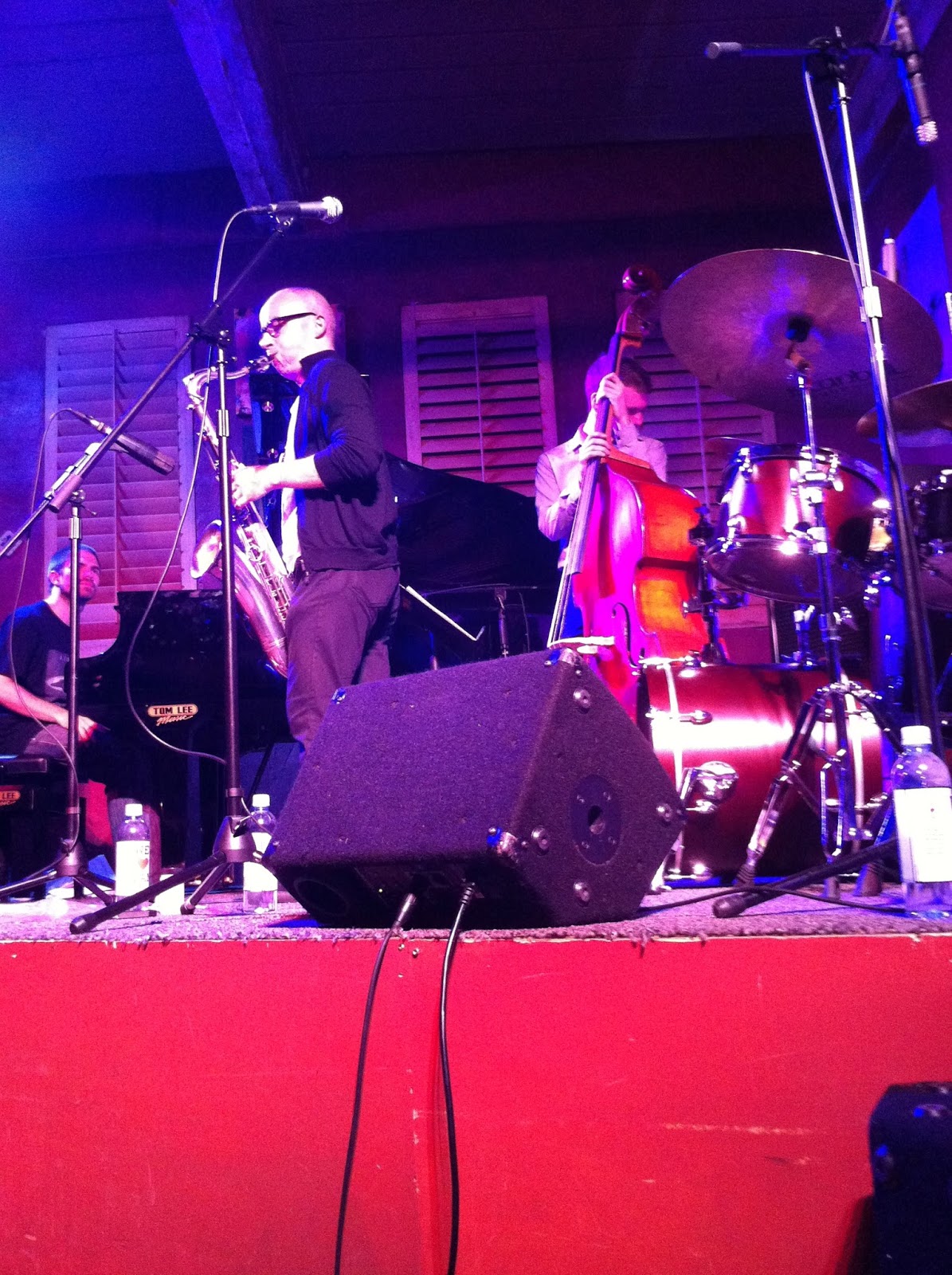
Indigo Trio –Nicole Mitchell, flutes, Harrison Bankhead, bass, and Hamid Drake, drums – offered two extended extemporaneous suites Thursday night, September 5, in the re-purposed hall of St. George’s Anglican Church in Guelph. I have been avidly listening to them since their first album appeared, on Dave Douglas’s Greenleaf label, in 2007, a recording I think of their first performance as a trio in Montreal in 2005. As then, their music remains rich, warm, flexible, free, accessible and dynamic: a paradigm for collaborative co-creation. I don’t know which composition is which, but each suite gave the impression of morphing or evolving forms, particularly around the loping, deep grooves Harrison Bankhead set up on his big upright. I thought, as did a few others there that night, that we could hear traces of the firm, warm sound of Wilbur Ware or of Malachi Favors Maghostut in his playing, echoes of departed mentors and colleagues, but also of a Chicago sound-palette that imbued his playing with a powerful historical dimension. Harrison Bankhead’s predilection for danceable lines, for groove, coupled with Hamid Drake’s strong sense of rhythmic pockets – what I’d describe as his sanguine, organic feel – drew the audience into the trio’s playing, and kept them rapt: toe-tapping, hip-swaying and happy. Nicole Mitchell played a shattering solo on piccolo, but rather than disrupt the flow, it only intensified the room’s commitment to what was happening. Each improvised “suite” concluded with Nicole Mitchell singing, in a bell-like soprano, what seemed like Afro-futuristic lyrics – two song forms, the first of which I think was a hymn of praise to Gaia, while the second, concluding piece affirmed the entwining of strength of purpose and of the embrace of difference that shape Indigo Trio’s music:
When you find the truth you will realize
You’re a stranger in a strange land
But you’re not alone
You’ve got to stand strong
What I hear, here, is a call to community in difference, community of difference: strength among strangers, audience.
KAZE: Satoko Fujii, Natsuki Tamura, Christian Pruvost, Peter Orins
KAZE is a collaborative quartet that has been in existence since at least 2011, pairing the longstanding duo of Satoko Fujii on piano and Natsuki Tamura on trumpet with two members of the French MUZZIX (sounds like “musiques”) collective, trumpeter Christian Pruvost and percussionist Peter Orins. Nominally (on the programme) Satoko Fujii’s band, the group operates more as a collective, showcasing compositions and concepts from each of its four members. I had never heard them play, either live or on CD, before Saturday morning at the River Run Centre in Guelph, although they have already recorded two albums as an ensemble: Rafale (2011) and Tornado (2013), both released by Circum-Disc in collaboration with Fujii-Tamura’s label, Libra Records. I have to say that I was blown away by their collective virtuosity and by their kinetic interaction, from the first notes they played. The two-trumpet line, in some ways, hearkens back to Louis Armstrong and Joe Oliver, and there are echoes of the playfulness and smart-aleckry of early music, although there is little in their work, in my view, of the subversive. They play with sounds, the trumpeters ebulliently incorporating “little instruments” and percussive sound-makers into their arsenals of sound-sources, but the idea is never to undermine or interrupt: disruptions are creative, centrifugal, happily unruly, both provocative and strangely supportive. All four appear to celebrate and to uphold each other’s contributions to the collective: no cutting, no ego. At the same time, both trumpeters self-evidently have technique – extended technique – to spare. Tamura and Pruvost are masters of their instruments, and then some. And, well, if you like your trumpet by turns limpid and wicked, seductive and fierce, this is the music for you.  Satoko Fujii’s virtuoso piano formed an integral part of the ensemble, negotiating between polydirectional rhythms and entwined melodic lines, sometimes subtending the performance harmonically, sometimes offering percussive counterpoint. Her playing is dynamic, ever-present, but also open and responsive; she is never at a loss for something to add in, but also never crowds at her cohorts: a paragon of give and take, of response listening. Peter Orins’s drumming was, for me, a revelation: he has a way of propelling a performance forward, while striking each tympanum with an attack that somehow individuates and momentarily savours, pulse by pulse, the elastic beat-patterns he conjured. His style of improvising at the drumkit reminded me at times, if this makes listening sense, of Ronald Shannon Jackson’s definitive touch.
         The group played two or three extended suites – akin in structure, though not in idiom, to the Indigo Trio’s set – combining, I discovered afterward, most of the compositions featured on their recent disc. (I think they recombined “Wao,” “Tornado,” “Imokidesu” and “Triangle,” although I’m relying on memory here.) Each of their forays began with quiet hiss and suck from the horns, breath feeling its way into tone, gradually ramping toward more organized thematic statements or unisons, then negotiating a series of polyglot interchanges and exchanges toward the next composition way-point. The group operated as a living assemblage, an organism pursuing not so much coherence or closure as open-edged symbiosis, a generative, sustaining autopoeisis. Each piece did, of course, reach a tenuous end, but it felt that, even after the concert was done, KAZE’s generative soundscapes still kept roiling and resonating in our minds’ ears.
         For me, hearing both of these groups had an epochal aspect, an impact not unlike, say, hearing the Parker-Guy-Lytton trio, or Wayne Shorter’s recent quartet, or Charles Lloyd’s “New Quartet,” or one of David S. Ware’s quartets; they seemed to represent something of the power and possibility of distinctive new directions in creative improvised music. A greatness.

Breakfast, Nearly, with Pharoah Sanders
I think I’m more than a fan, much more than a fan, of what people in my various small circles of friends and fellow listeners would call The Music. Not just music, but The, with a capital T. What my colleagues and I usually mean to indicate with this definitive and emphatic article is a certain lineage or a set of lineages in recent jazz, lineages that can trace their origins to consciousness-raising performances and recordings in the mid 1960s around the civil rights movement and the emergence of Black cultural nationalism in the United States. I am neither Black nor American, but I know that I have had a powerful personal investment in this music since my mid-teenage years, when, and I have no idea how to explain this objectively, my friends and I started buying jazz records. The Music has – again, powerfully – helped to shape who I feel I have become, who I think I am and how I think. For some reason, across a number of tangible cultural and social boundaries, this music came to speak to me: it’s an experience that’s not unique to me, but it does seem a bit strange that this feeling of connection occurred in small-town Nova Scotia in the late 1970s, in a place that still feels remote from the contexts out of which this music came. The Music was not in the air very much, at least not where I come from. But that’s not exactly true, either: there were people around us who knew things, there were kids like me who wanted to know, and there was the odd record that arrived in the bins of Kelly’s Stereo Mart that we could buy. The first jazz-like record I ever bought – copying what my friend had done – was The Vibration Continues, an Atlantic two-fer that appeared in 1979 two years after the death of Rahsaan Roland Kirk. It was an album that would change everything for me, or at least cause as much change as any one record can. The sense of tradition as well as of extemporaneous experimentation that vitally energize the tracks on that compilation epitomize what Mr. Kirk called “Black Classical Music,” and help me to consider the collisions and intersections of the creative and the critical, of music and poetry, of history and innovation, that seem to me to make cultural performances of all types come to matter.
         Listening to Rahsaan and to Miles Davis and others soon led me outward – tracing the networks of connections and sidemen they deployed – to John Coltrane, of course, and especially to his later, more tumultuous post-1964 music: recordings that had become established, by the time I could have encountered them, as touchstones of The Music, fierce beautiful classics. In the summer when I was seventeen, I bought a copy of Meditations. The opening track on that album, “The Father and the Son and the Holy Ghost,” with the stuttering, surging and entwined tenor saxophone lines of Mr. Coltrane and Pharoah Sanders, was transformative for me, at once devastating and profoundly moving. I don’t know how many times I have played that first side over; I can hear it in my mind’s ear even now. There is nothing like it. I think I read an interview some years ago with Carlos Santana, where he said that he tries to listen to Coltrane every day – for “spiritual nourishment” – and he mentions “The Father and the Son and the Holy Ghost” in particular. I know what he meant, what he means.
         I have been in Guelph, Ontario, for the past week, attending at the university there an academic colloquium about, among other things, The Music. The colloquium is tied to an ongoing research initiative called “Improvisation, Community and Social Practice,” and to a yearly Jazz Festival, programmed for twenty years now by Ajay Heble, who is both its Artistic Director and the Principal Investigator for the grant-funded academic initiative. Because of the relatively small size of Guelph, many out-of-town attendees end up staying at the Delta hotel there, which is where most of the musicians playing the festival stay, too. So you tend sometimes to cross paths. This year, the festival headliners included Wadada Leo Smith’s Golden Quartet, performing a scaled-down version of his Pulitzer-nominated suite Ten Freedom Summers, and Pharoah Sanders, collaborating with an amalgam of Rob Mazurek’s Chicago and Sao Paulo Undergrounds. (I’ll say something about these performances in another piece.) I was returning alone to the hotel by taxi after a wonderful concert by the Indigo Trio on Thursday night. As I came through the sliding glass doors into the lobby, there in front of me, leaning over the front desk trying to check in, was Pharoah Sanders. I knew him immediately, from photos on LP jackets I had poured over and scrutinized while I listened, headphones on, in front of the stereo downstairs in my parents’ house years ago. It was Pharoah Sanders. And for a moment, I had no idea what to do.
         Of course, I didn’t have to do anything. I felt as if I ought to approach him, ought to say something. I have been immersed in his music for decades, and feel a kinship, because of the effect that it has had on me over those years, that of course he couldn’t have shared. He has no idea who I am, or how his music has changed my life, the way Rilke once said all great art ought to do. My impulse was to try to walk up and tell him something then and there about my own story, the story of my love for his music. But, it would have been pretty rude to bother Mr. Sanders while he was trying to sort out his arrival. So I got into the elevator, went up to my room, and put up an excited jazz-nerd blurb on Facebook and Twitter about having just passed The Pharoah Sanders in the lobby.
Along with Mr. Smith, he was doing a public interview the next morning, which I was going to attend, so I would get to see and hear him anyway. And I had my ticket to the concert the following night. Great.

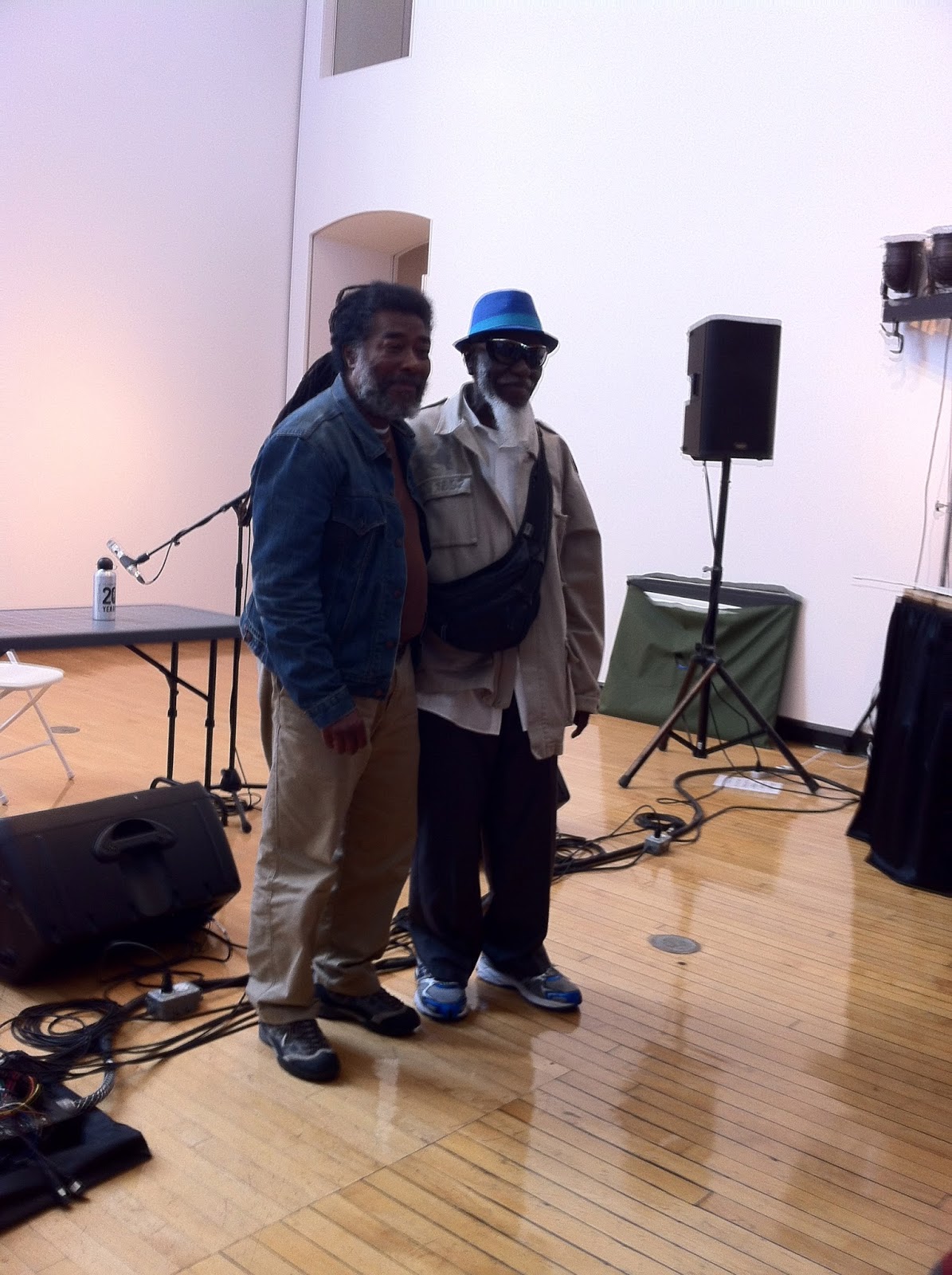
Wadada Leo Smith and Pharoah Sanders, after  the interview Friday morning, 6 September 2013
         At the interview Mr. Sanders wasn’t especially voluble. (A video recording of the interview ought to appear on the ICaSP website sometime in the near future.) What might appear as reticence in that interview could also be an after-effect of all of this public adulation and esteem, this spiritual fandom. Not that he shouldn’t be rightly and justly praised for what he has done, for the lives his music has affected, but he may have been a bit wary of the kinds of closeness that listeners like me seem to need to claim and to feel. It’s easy to forget to accord the person, the human being, the dignity and the respect, the personal space, that they deserve – and that every human being deserves. Listening, even as closely as many of us do, needs still to be kept at a remove from entitlement. And this distance, around historically significant and culturally transformative artists such as Mr. Sanders, can sometimes present a very difficult line to walk. (“He became his admirers,” says W. H. Auden of the passing of W. B. Yeats: such appropriations have a moribund aspect, I think. They objectify the living, and reify their creative energies, often without intending to, as real people get turned and admiringly calcified into their own self-representations, their myths.)
         There was another great concert Saturday morning, by KAZE. I was up a little later that morning, but still had some time, so I decided to treat myself to a warm breakfast in the hotel restaurant. As I stood by the please wait to be seated sign, waiting, Pharoah Sanders was suddenly there, coming out of the restaurant towards me; he had obviously been eating breakfast. Okay, I thought, now was my chance to say something, anything. “Mr. Sanders,” I said, “I’m a great admirer of your music.” And I held out my hand to shake his. “Thank you,” he said, and then put his own hands together in a gesture of prayer.
“My hands,” he said. “Of course,” I said, though I didn’t know exactly what he meant. (I have spoken with musicians and others who have to shake hands with strangers often when they’re on the road: they tell me that folding your hands this way is a good practice to keep from having viruses spread to you.) And then a waitress showed me to my single table, at an extended curved bench along the restaurant’s far wall.
Someone had been eating at the small single table next to me. I looked down at the menu, to figure out what I wanted to order, and then looked up again. Pharoah Sanders was coming back into the restaurant towards me. I had been seated beside his table. It turned out he hadn’t been leaving at all, but had been making a second visit to the breakfast buffet, which was located just the other side of the please wait to be seated sign. He sat back down next to me. I was becoming a little concerned he might think that somehow I was following him, so I didn’t want even to try to pester him with small talk. We ate side by side quietly at our separate tables, together. I took no photographs. I don’t know why it would even have occurred to me as something I could so, and it’s embarrassing to admit that I even considered it, so intrusive, so disrespectful of someone else’s space. When I left, I did manage to wish him a good day, and to say I was looking forward to his concert that evening. “Thank you,” he said. “Thank you.”
The concert was tremendous. As I said, I’ll post something more detailed about it soon. It ended around midnight, and I managed to flag a cab back to the hotel, amid what turned out to be masses of partying students newly arrived in town for the University’s boozy Frosh week. (None of them had anything to do with the music, with The Music. It’s a coincidence that the Jazz Festival and the academic colloquium happen simultaneously with the first week of classes.) I got back late, and went to bed.
Pharoah Sanders (and Chad Taylor) performing at Guelph on September 7, 2013
I had to be up early the next morning to catch a shuttle van to the Toronto airport. I came down to check out at 6 am, and the desk clerk asked if I had got the message that the shuttle was postponed until 6:30. (I hadn’t, but it didn’t matter.) The idea, it turned out, was to fill all seven seats on one shuttle, rather than have to send two vehicles. So, fine, I took my bags over to the hotel foyer, where coordinated brown and beige couches had been arranged to look something like a furniture showroom at The Bay.
As I sat down to wait, someone else appeared at the desk to check out. It was Pharoah Sanders. He did what he needed to do at the desk, and then came over to join me on the couches. I thought at this point that if he realized I was this same guy who kept appearing wherever he was, he might have started genuinely to worry. But he smiled and nodded at me, and started to chat. Like me, he was headed to the airport to catch a flight west. He asked where I was headed. He said he found it a bit cold in Guelph. He told me he’d had trouble with the air conditioner in his room, which kept coming on at night, and I told him I’d had exactly the same trouble, which was true.
Others arrived who were taking the same airport shuttle, all of them musicians who had performed the night before, including Wadada Leo Smith and Anthony Davis, both of whom are indisputably major composers and performers in contemporary music. The shuttle arrived; I told Mr. Sanders it was here, and he went to stand over in front of the sliding glass doors at the hotel entrance.
The doors opened, and the shuttle driver, clipboard in hand, came through, and walked right up to Mr. Sanders. “Who are you?” he asked bluntly. Mr. Sanders gave his name. “Right,” said the driver, “one of the jazz musicians.” I thought, oh, maybe I’m not on this shuttle, so I went up and asked. It looked like there wasn’t going to be enough room. “Nope,” said the driver, “this is your shuttle too. You’re the one non-musician.”
He managed to load all the bags, and told us to climb in. I ended up in the front pair of passenger seats, sitting next to Pharoah Sanders, again. I hope he didn’t mind. There was some confusion about airlines and paperwork. Pearson airport has three terminals, each of them linked to different domestic and international carriers. The driver got in, turned around in his seat to face Mr. Sanders and the rest of us, and said: “Don’t worry. I have a master plan.” I thought I heard a few chuckles, though maybe not. I don’t think the driver was deliberately making a kind of joke – he genuinely had no idea that one of Pharoah Sanders’s most praised and beloved recordings is called “The Creator Has a Master Plan.” But in that moment, what started to emerge was a troubling irony, one that creative musicians such as these must have to confront on a fairly regular basis.
“Say,” the driver said, as he started the engine and pulled away, “I’ve got the radio tuned to the jazz station.”
“No, please,” said Mr. Smith. “No music.” It was still really early, and no one had had more than a few hours of sleep.
“I thought you might want to hear some jazz,” the driver kept on. “You know, I like Billie Holiday.”
“We all like Billie Holiday,” said someone from the back of the shuttle. The driver tried to play the radio a little lower.
“No, please,” said Mr. Smith. The driver finally obliged.
The 40-minute drive east along the 401, with a fine reddish sun emerging from the clouded horizon in front of us, was silent. Most people just dozed in their seats, the way people do.
When we arrived at the airport, the first three let out included Mr. Sanders. He said goodbye, and wished everyone and was wished a safe journey.  He smiled and waved, and that was it. When the driver climbed back into his seat, he turned around and asked those who remained – except for me, the one non-musician – what kind of music they played and what clubs in Guelph they’d been playing in. (I don’t even think Guelph has a jazz club: the downtown as I’ve experienced it seems to be full of bars catering to students.) “Clubs?” said Mr. Davis. “It’s been a while since I have played in a club.” “No clubs,” said Mr. Smith.
The driver seemed mildly surprised that their performance had taken place at the city’s opera-house style concert hall, the River Run Centre. I asked if they liked the venue, and both of them said yes, and talked a little about acoustic space, about spatial acoustics. Then it was my turn to go. I wished them a safe journey, too.
After we pulled up at the terminal, the driver came around to help me unload my bag. Out of earshot of the musicians, and feeling some kind of mistaken kinship with me, he told me: “I expected this trip to be more hilarious, more fun, with, you know, those kind of . . . jazz musicians.”
Why was it, I wondered, that he waited until we were both outside of the van to tell this to me, like some kind of secret. Like I might understand him.
And then realized I knew why.
And then I knew: when he said “non-musician,” I don’t think he was talking about music. He may not have known himself what he intended. But I think I hear it now.
Pharoah Sanders, Wadada Leo Smith, Anthony Davis, and the others who happened to be on that shuttle, are among the most forward-thinking and brilliant musical geniuses of their, of my, generation; they perform and compose, for those who want to hear, a life-altering, profoundly moving music, coalescing jazz, art music, folk, and other styles and practices into their own idioms and sound-worlds, but all drawing on the creative impetus of the wide African diaspora. “If you have to ask,” Louis Armstrong is purported to have said, “you don’t need to know.”
Maybe so. But at the end of their interview on the Friday morning, Wadada Leo Smith made a point of encouraging listeners, simply, to try to speak to our neighbours, to connect with other human beings. “Consider the fact,” he said, “that someone else is important, and make that work in your life.” And it’s hard work, for sure, to overcome even a few of the complex barriers presented by ignorance and, strangely, by adulation, and instead to try to find the human gesture, both besides and beside ourselves.

Hard Frailties: MD and PiL

Always be merchandizing.

I bought a re-issue on LP of the first Public Image Ltd record a couple of weeks ago, and I have been playing it over and going back to my other PiL records, particularly the key four of the first albums (including Second Issue, Flowers of Romance and Album). I don’t know why, but I hadn’t had these out in a while. Maybe they still have a certain repulsion about them, wanting to push listeners back and keeping them estranged. It’s not exactly likable music. In their specific ways, they also have a raw immediacy and a loose fierceness – not just in the dissonant snarl and visceral whine of John Lydon’s vocals, but in the way the music assembles itself – that shake me every time I put the needle down. Even as each track locks palpably into its particular, febrile groove – and from Jah Wobble to Bill Laswell, these remain definitely groove-based records – you often get the sense that things could also shatter at any moment; songs, particularly on the first album, hang vestigially in scissions and fractures. Sometimes, they sound like the reassembled shards of songs, songs that can’t quite piece themselves together again, if they were ever whole to begin with. Setting the new-age steady on-the-beat pulse of “Public Image” against the unkempt noise of its b-side, “The Cowboy Song,” suggests the antithetical aural tug-of-war in which Lydon and companions consistently engage: centripetal and centrifugal sound. The attenuated slow drag of Wobble’s bass on “Theme” teeters on the verge of collapse, then lurches forward a bar at a time, still locked into its deep rhythmic pocket. These are compelling and unsettling collaborative performances that take aim at the sonic foundations of popular music.
The uncertainties and incommensurables inherent in the collaborative process – that there are differences among performers that can’t be overcome, and instead need to be embraced – seem to me to play a significant part in PiL’s music, in how it unfolds. Still, the track I most want to repeat on the player is “FFF” from Album (1985), and what draws me to it isn’t this uncertainty, but rather a sense of its absolute, unshakeable beat: the confident, driven heaviness of Tony Williams’s drumming, and Bill Laswell’s bass-line. In contrast to the dehiscence that I have been suggesting lies at the heart of PiL’s output, “FFF” and most of the tracks on Album (or Cassette or Compact Disc) feel intentionally stable and powerfully coherent (Lydon’s singing aside, perhaps). Album is famously a Bill Laswell project, assembling studio musicians and colleagues from Laswell’s Material bands, mixing funk players with avant-gardists, to produce a set of tracks onto which Lydon’s vocals could be overdubbed. Lydon’s liner notes to the 1999 compilation Plastic Box admit as much:
In some ways, Album was almost like a solo album, [guitarist] Keith [Levene] and [drummer] Martin [Atkins] weren’t around, and I worked alone, with a new bunch of people. Obviously the most important person was Bill Laswell.
Importantly, Laswell employs a number of forward-thinking – some might even say inappropriate – improvisers to lay down tracks on the record, most peculiarly perhaps acoustic bassist Malachi Favors Maghostutfrom the Art Ensemble of Chicago, although any potentially startling or obvious improvisational work seems to me to be largely lost in the mix here. It’s the idea of employing Favors, perhaps, rather than the quality of his actual contributions, that seems to matter – an instance of artist cred derived from public-image-making, no doubt, although Laswell also withheld the musicians’ names at the time of the record’s release, toying with the weight of notoriety in music marketing. My point is that Laswell’s pool of players offer substantial potential for creative, rule-breaking performances, although he also very audibly, musically, reins every one of them in.
         Lydon’s note continues with another significant moment of name-dropping:
But it was during the recording of this album in New York that Miles Davis came into the studio while I was singing, stood behind me ands started playing.
         Later he said that I sang like he played the trumpet which is still the best thing anyone’s ever said to me. To be complemented by the likes of him was special. Funnily enough, we didn’t use him.
There isn’t any corroborating evidence that this encounter took place, and it’s not clear what Miles Davis would have been doing in that specific studio at that time. I’m not sure how well Laswell (who had elevated his credentials working on Herbie Hancock’s Future Shock LP, which may have put him in Davis’s viewfinder) knew Davis. (Tony Williams, who would collaborate on Laswell’s Arcana, was one of Davis’s greatest drummers, but the instrumental tracks were done, and only Lydon would have been in the studio that day. Davis may also have been working on Steve van Zandt’s anti-apartheid Sun City project around that time, so their paths may have crossed around those recordings in New York.) Panthalassa, Laswell’s “Reconstruction & Mix Translation” of Miles Davis’s 1969-74 music, only happened years after Davis’s death. (Wikipedia offers another account of a fabled unreleased Laswell-Davis session from the period: “Laswell has stated in numerous interviews that he met with Davis a number of times and discussed working together, but busy schedules kept them from arranging such a recording before Davis’ death, though Laswell’s chief engineer reports an unreleased Davis recording session from 1986.”)
But there are some very real connections that might be worth pursuing about this missed encounter between Lydon and Davis, illuminating something about their respective senses of “voice” and phrasing. Paul Tingen quotes PiL bassist Jah Wobble praising Laswell’s “mix translation” of On the Corner: “The weird thing is that when I thought of On the Corner, I have always heard it in my head the way Bill mixed it. That’s how it really is. Bill’s in the one. That’s the real deal” (Tingen 140). Wobble goes on to associate the music of Davis’s pre-retirement period, the mid-1970s, with the early performance style of PiL:
Dark Magus is my favorite Miles album of that period because it is so raw, with such a hidden power, such a mixture of dark and light. When I first heard it, in 1978, it was one of those magical moments. It had an overall sound that was similar to what Public Image Ltd was about. I couldn’t believe it had been recorded several years before us. I imagine Miles deliberately threw in these new musicians at the last moment because musicians get complacent. I can imagine how he wanted to affect their psychology, and so the music. I also know that musicians can think something is not representative of their best work, and yet it’s actually great and a lot of people love it.
This doubled sense of an improvisationally rough, groove-driven music pushing itself forward even as it seems to come apart at its seams links early Public Image Ltd directly to Davis’s aesthetic, though as (what he called) “social music,” Davis lays claim to a racial provenance that both eludes Lydon and company, and also becomes an ironically appropriated foundation for their work. (“I could be black I could be white / I could be white I could be black” Lydon yawps in “Rise,” rejigging lines from a South African torture victim as a provocation against prejudice; the shock-tactics title of his memoir, Rotten: No Irish, No Blacks, No Dogs, venomously throws racist signage into its reader’s faces.) But when Lydon recounts Davis saying he sings like he plays, he creates a collision of similitude and difference that results in a species of violent fragility, or fragile violence: an antithesis, a negative identity, that emerges not through or against but as voice: “Like me, / you are unlike me,” Lydon snarls in “Fishing,” recalling Shakespearean manipulations of self-image from Twelfth Night and Othello, in which both Viola and Iago assert that “I am not what I am” – or, perhaps for the latter, “I am what I am not.” Selfhood – as (public) image, as seeming, as performance – consists in its own negation.
         And how does that negation sound? (Or maybe better, what does it sound like?) How is it voiced? Lydon may not be much help here, but Davis suggests in his autobiography that he derives his own sense of line, of musical phrase, principally from the human voice:
See, music is about style. Like if I were to play with Frank Sinatra, I would play the way he sings., or do something complementary to the way he sings. But I wouldn’t go and play with Frank Sinatra at breakneck speed. I learned a lot about phrasing back then listening to the way Frank, Nat “King” Cole, and even Orson Welles phrased. I mean all those people are motherfuckers in the way they shape a musical line or sentence or phrase with their voice. (70)
And later on, near his book’s close, comes another version of the same claim:
I had a chance to work with Frank Sinatra a long time ago. [. . .] But I couldn’t make it because I wasn’t into what he was into. Now, it ain’t that I don’t love Frank Sinatra, but I’d rather listen to him than maybe get in his way by playing something that I want to play. I learned how to phrase from listening to Frank, his concept of phrasing, and also to Orson Welles. (395)
There are some structural ironies here as well, given that the text is principally poet Quincy Troupe’s imitation of Davis’s speaking voice, culled from hours of taped conversations: it isn’t really Davis speaking directly here at all, that is. But, more importantly for my purposes here, is the recognition that Davis appears significantly to mishear his own voice. In practice, his fractured, bent phrases – no matter how lyrical they may be – have very little in common with Sinatra’s mellifluous, soporific baritone or Welles’s theatrical declamations. His connection with Lydon comes through, if at all, in the steely and fragile awkwardness of his lines, their bent uncertainty. The Barbadian-Canadian novelist Austin Clarke once told me he heard anger and fierceness in Davis’s Harmon-muted horn; this was no soothing balladry. “Anger,” sneers Lydon, “is an energy.” What’s valuable for me in the early Pil sessions isn’t so much the audible anger as this vicious, cutting lyricism, the probing, needy and breaking articulation that, for me, also makes Miles Davis’s bittersweet electric music of the 1970s so vital.

Books
Davis, Miles, with Quincy Troupe. Miles: The Autobiography.
New York: Simon and Schuster, 1989.
Lydon, John, with Keith and Kent Zimmerman. Rotten: No
Irish – No Blacks – No Dogs. New York: St. Martin’s P,
1994.
Tingen, Paul. Miles Beyond: The Electric Explorations of Miles
Davis, 1967-1991. New York: Billboard Books, 2001.

Short Live Take on Tim Berne Snakeoil

[A headnote: I’m coming back to this post a day later to do a little revising and correcting. My intention with these “short takes” was to do as little revising or reworking as possible, but in this case there were some small issues that really needed to be fixed. I had the titles of the compositions wrong in my first pass, so these needed to be amended. (Thanks to Matt Mitchell for kindly letting me know the real titles.) I’m also sure that I misperceived some of the music, hearing Berne’s new pieces as versions of older work on the issued recording. Such misprisions are a hazard of being less than intimate with the scores, and of hearing this music for the first time. But the fact remains, as well, that – given what I hope is a genuine effort to map out my own auditory affect, to explain and to frame as cleanly as possible what I thought I heard and about how I was hearing it (and given, also, the challenges of the adjective, of being as descriptively accurate as I can) – that a mistaken listening seems to me as potentially interesting to think through as an attention that’s either distracted or that falsely claims acuity or expertise. I’m no music reviewer, and don’t want to pretend to be. But writing through and about the situated reception of music, particularly the immediacy of an improvised performance, which is inherently non-repeatable or, as Vladimir Jankélévitch suggests, irreversible, strikes me as a possible practice, if it works, of an active “cultural memory in the present” (a phrase I’m lifting from Mieke Bal, who repurposed it from others). So, okay, here is the revised piece.]
Tim Berne‘s quartet Snakeoil (with Oscar Noriegaon clarinet and bass clarinet, Matt Mitchell on piano and electric piano, and Ches Smithon drums, vibes and hand percussion) played a four-tune, 75 minute set at Ironworks on the final evening of the Vancouver International Jazz Festival. Berne announced the first three compositions as something like “Lamé #2,” ” Lamé #3″ and ” Lamé #1″ (in that order), but he was also slightly, well, mumbly and off-mike, so I could easily have misheard. “Don’t judge me by my titles,” he told us. It’s not that the titles had any obvious meaning for me (Berne’s music is hardly proximate to flashy pop or disco, and I’ve never seen him dress in gold lamé), but that Berne was indicating how each of the pieces formed part of a larger conception, and there was definitely a sense in which all four fit together rhythmically, harmonically and texturally. As with his earlier Bloodcountbook, his compositions tend to use long, sinewy lines — angular, deliberate meanders often taken in unison or at least in parallel paired horns and (in this band) piano. They are also constructed — again, as far as I can make out, as a listener  in sections that, like shifting puzzle pieces, seem to lock together in various kinds of timbral juxtapositions and sequences. He counted in each piece in four, but as the quartet joined in the music instantly became more metrically dense and polyrhythmic. Overlapped sonorities created fluctuating densities, an alternately thickening and winnowing counterpoint. With his move to ECM for his latest recording (by this quartet), his open-form compositional style — mixing structural exactitude with free improvisation —  seems to me to draw at times on the work of Jimmy Giuffre, although the performances leave aside any latter-day chamber music feel in favour of harder edges and more aggressively articulated extemporizing. The fourth and last composition was announced as “OCDC” (maybe?), but listening back to the Snakeoil CD it felt to me – wrongly, as it turns out – that it was an expanded, roomier version of “Spare Parts”; I thought in retrospect (again, mistakenly) the third piece they played was also a re-arrangement of “Scanners” from the same disc. (The bass-line in Matt Mitchell’s left hand sounded remarkably close to what I can hear on the recording.) I’m sure that this sort of musical re-purposing was not really what was going on (and I’m not at all asserting that this music is somehow recycled), but what my perception of these echoes does suggest to me is not only the continuity, the organics, of Berne’s concept but also that the audience was hearing not so much product as process, compositions built from predetermined cells and segments that also relied on formal elasticity and focused improvisation to expand, to animate and flesh out a given set of sounds into new and immediate music. I was very impressed by the unthrottled drive of Matt Mitchell’s playing, by the rough ecstatic energy of Oscar Noriega’s solos, by Ches Smith’s expansive and propulsive sense of time, and by Tim Berne’s own brilliantly knotty phrasing. Berne’s group offered us an object lesson in colliding composition and spontaneity, the made and the making, to intensify a performance, and to bring it creatively, with measured noisy poise, to life. 

Mary Halvorson, "Songs that Get Stuck in My Head"

Just come back from an hour-long afternoon public workshop with guitarist Mary Halvorson at the Roundhouse Community Centre in Yaletown, part of the last weekend of the Vancouver International Jazz Festival. It was a real privilege to hear her talk and play. She was personable and articulate, taking questions and playing a handful of brief solo improvisations. 
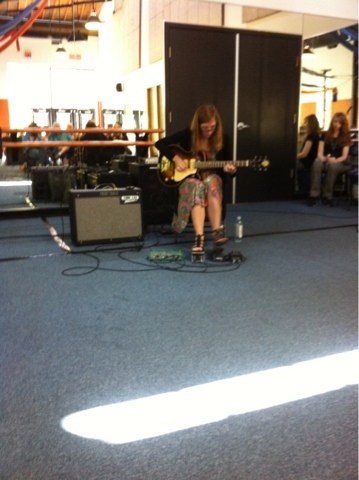
She confessed that she was in the midst of “working on solo guitar music,” and that she hasn’t really performed solo up until this point in her career as an improviser. She said that she had decided to base her nascent solo work on “songs that get stuck in my head,” which at this point were principally jazz standards, although she was also looking to various “compositions by other people” as source material. She admitted that she tends to focus on melodies and has a harder time “remembering the chords.” But there was nothing diffident or self-effacing in her aesthetic or in her performing; her spotty memory seems to offer creative opportunity rather than impediment. Or, as she put it, “I’m going to make up my own chord changes to these existing melodies.” She offered a foreshortened but compelling version of “Beautiful Love,” laced with pitch-bent burbles, halting twangs and lyrical turn-on-a-dime redirections. She likes, as she said, “weird left turns and falling off cliffs” in music–her version of the “sound of surprise”– but her playing also drew out a gently fraught lyricism in each of her lines. If this really was a hint of what’s to come, her solo work is going to be beautifully unsettling and eclectically brilliant. She talked at some length about some of the challenges she feels she is facing combining her own idiosyncratic approach to the instrument with a more idiomatically “jazz” approach to playing and to musical form. (In fact, before she began talking, she played us a track from her iPod, Johnny Smith doing “Moonlight in Vermont,” and admitted her love of Smith’s sound. Smith had passed away a little over a week ago.) She also played a track from her yet-to-be-released septet album, roiling layers of horn and guitar.
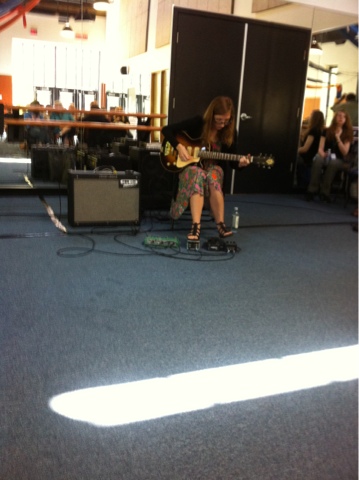
When asked about connections between her styles of band leading and composition, she said she tries to enable and to support the members of her group, and is keen “not to be too controlling.” She pointed to her experiences with Taylor Ho Bynum‘s sextet–the example was suggested by someone in the audience–as a possible model for relinquishing control and instead creating democratic interactions among the players. At the same time, referring to her studies with Anthony Braxton (whose music she said helped her decide to drop her courses in biology and pursue music) and with Joe Morris, she said she felt that “the teachers you have really shape who you become,” noting that both of these mentors encouraged her to follow their example in seeking out her own idiom, her own ways of making music. A brief improvisation built from cascading pulses closed out the workshop.

Julian Arguelles Quartet at Ironworks: a Live Short Take
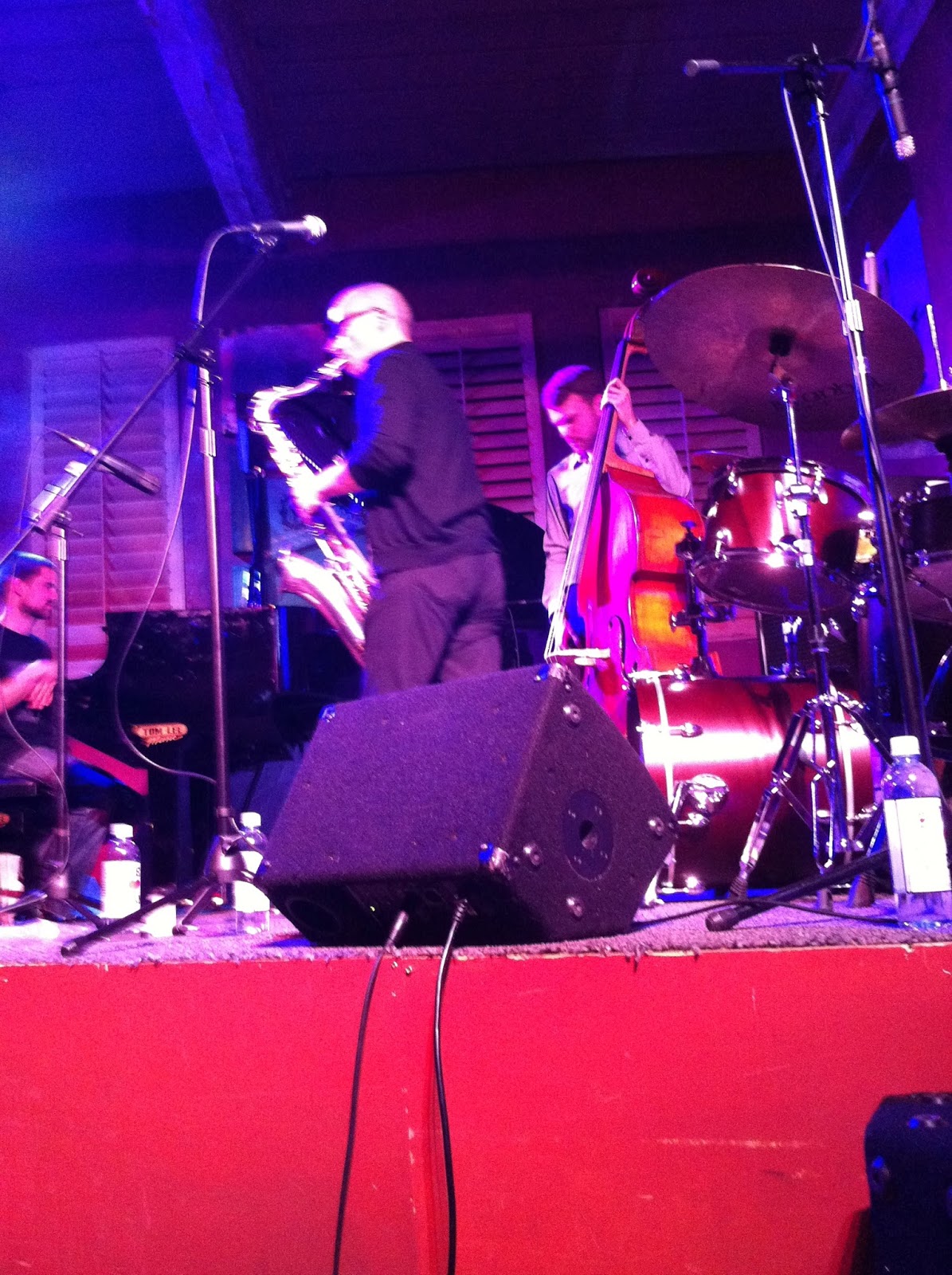
The Julian Argüelles Quartet played a warm, uplifting set at Ironworks last night, the second of three North American jazz festival dates. This new group, which has yet to record, features a rhythm section of emergent next-generation British improvisers: pianist Kit Downes, bassist Sam Lasserson and drummer James Maddren. (Maddren is also a member of Kit Downes’s current trio, and plays on Downes’s recent quintet record, Light from Old Stars, just out on Babel.) The quartet instantly demonstrated their responsiveness to each other from the get-go; the first tune, “Mr Mc,” had a calypso-like feel loosely reminiscent of Sonny Rollins, and, although Argüelles’s approach to tenor seems to me a little more angular and restrained than the colossus, his improvisations clearly drew on the thematic tactics that (according to Gunther Schuller’s reading) Rollins pioneered in the 1950s. Argüelles dedicated the piece to South African expat Chris McGregor, which might also explain what sounded like its (again, loosely) Afro-Caribbean leanings, but it also showcased Argüelles inclination toward odd meters (11/8?) and off-kilter phrasings. The quartet negotiated complex, prime-number pulses with alacrity, and teased out vamps and grooves that drew their audience in and held them, heads nodding, feet tapping. The music was thoughtful and sophisticated, but also contagiously dynamic, and I don’t think the drummer stopped smiling through the entire eighty-minute set. The second number, which Argüelles said was a “twelve-tone piece” called “A Simple Question,” started with Downes playing solo reminiscent of Paul Bley (whom he name-checks on his own CD’s second cut, “Bleydays”); Argüelles also offered lyrical and measured solo playing, but as the quartet entered the music took on a Phrygian feel and things morphed into what he described after as something “half Spanish” – his composition “Unopened Letter.”

But it was the fourth tune – called “Redman,” he said, and dedicated to “what could only be one of two saxophone players,” who turned out to be Dewey not Don – which clarified the influences on Argüelles’s conception of this group. I was hearing what I thought were echoes of Kenny Wheeler’s melodicism and – especially in the piano – of John Taylor’s latter-day harmonies, but “Redman,” both in the composition and in the improvisations that followed, hearkened directly and unabashedly to Keith Jarrett’s American Quartet, with Dewey Redman, Charlie Haden and Paul Motian. The resonances were almost uncanny. I’m not charging Argüelles with derivativeness, but rather suggesting that Jarrett’s quartet music presents a lineage, and a potential, in quartet music that rarely if ever gets taken up by recent players. The groundwork laid by Jarrett’s group in the early 1970s brilliantly drew together groove and edginess, form and freedom; Argüelles seems to me, at least in part, to be taking up the provocations offered by the American Quartet in ways that are musically compelling and still, even this many years later, forward reaching. (Both “Mr Mc” and “Redman” were recorded in 2009 with an NYC trio – Michael Formanek and Tom Rainey – but those earlier versions seem to echo less the Jarrett group than Redman’s work with Ornette Coleman. The addition of Downes’s piano makes a huge difference in the overall texture of the music: Downes is among a youngish set of British pianists, including Liam Noble, Gwilym Simcock and Nikki Iles, who seem to me variously to have appropriated and repurposed some of Jarrett’s more open – and more polydirectional – musical trajectories, an inside-outside conception parallel to and even filtered though the work of longer-established players such as Paul Bley, John Taylor and perhaps even Stan Tracey.)
Of the remaining numbers in the set, “Phaedrus” seemed to draw on the idiom of Steve Kuhn’s ECM quartets with Steve Slagle, while the waltz-like ballad “A Life Long Moment” was affectingly lyrical. The alternately falling and lifting cadences of the oddly-monikered “Lardy-Dardy” produced a sinewy, organic swell and flux. “Triality” was built around a Dave Holland-like freebop line, while the quartet’s encore – called “Pick It Up,” I think – offered a floaty, looping shuffle. The concert felt like witnessing the emergence of a historically savvy, formally propulsive and musically progressive ensemble. It was a warm, involving and affirmative performance.

What John Coltrane Left Here for Us to Learn

Listening to jazz, to improvised music, changed my life, and for the better. The music started to matter to me early on, when I was still a teenager. It wasn’t that I had a particularly difficult life, but in the struggle through late adolescence to articulate myself as someone I hoped might become a coherent human being, the music was there, impelling. And I don’t exactly mean making music, since I was never a player. But for some reason, it presented me with a calling that has remained more or less insistent throughout my adulthood. Listening — actively, deliberately — to this music continues to offer me what feels like meaning. This kind of listening wants to be proactive and deliberate, a willful focusing of the ears and the mind. A concentration you have to work at. A version of this imperative, the call to pay attention, famously takes poetic form in the disjunctive closing line of Rainer Maria Rilke’s “Archaic Torso of Apollo” (hardly a jazz poem, I’ll admit — it doesn’t even mention music, but dwells instead on the visual and the spatial), where a broken classical sculpture conjures the capacity to look (or to perceive, to attend) back through its viewers — its shoulders curve down, Rilke says, “durchsichtig,” which means translucent but also, literally, through-sighted — and to invite if not to demand, as the poem finishes abruptly addressing both onlookers and its own readers in the second person, that “Du mußt dien Leben ändern”: “You must change your life,” you must other your life, live otherwise. Illusions and delusions aside, I always knew I was never going to be much of a musician myself. But I still hear it, and write about it. It’s the experience of listening itself that continues to impel me, as what I hope to become as some sort of a creative maker, a poietes.

One of the metaphors that attaches itself to this music is curative; it’s good for you because, as Albert Ayler puts it, “Music is the Healing Force of the Universe.” This kind of music makes the world — or at least my small corner of it — a better place to be. In “The Sick Man,” one of the poems gathered in Sascha Feinstein and Yusef Komunyakaa’s first Jazz Poetry Anthology, Wallace Stevens explicitly associates Southern Black American music — a mishmash of folk blues (“mouth-organs in the night or, now, guitars”), gospel choirs and jamming bands — with a capacity to heal an epigone (“late, late”), dispirited and ailing North, a cure that takes on a specific form of attention, a form of listening:

And in a bed in one room, alone, a listener
Waits for the unison of the music of the drifting bands
And the dissolving chorals, waits for it and imagines

The words of winter in which these two will come together,
In the ceiling of the distant room, in which he lies,
The listener, listening to the shadows, seeing them,

Choosing out of himself, out of everything within him,
Speech for the quiet, good hail of himself, good hail, good hail,
The peaceful, blissful words, well-tuned, well-sung, well-spoken. (206)

There’s an uncomfortable raciology here that needs to be acknowledged. Still, the seclusion Stevens describes as the generic solitude of the sick-bed is also uncannily analogous to the situation of the music fanatic, headphones on, volume turned up, listening to recordings. The poem attends, in the dual senses of waiting and listening, but it also promises to overcome in an imagined ideality the bifurcations of race, geography and history that both inform this music and mark its distance. What Stevens describes as healthy listening — betterment signaled repeatedly as “good hail” — is not musical imitation, trying to appropriate this music as his own, but verbal response, a mode of speech that wants to find its answerable style. The sort of listening that I find myself aspiring to practice, a listening invited and even provoked by jazz, impinges on the writing, critical or otherwise, here and elsewhere, that I’m trying to do. I aim to write out and to write through acts of listening, and to suggest how, in a number of crucial ways, we can come to recognize the temporal drive and the vitality of literary language — of the intensified, musical verbiage of poetry — by digging into the heft and flux of the improvised as it intersects with words, lines, periods: and by trying to feel, in some measure, the pull of its moment, the “choosing” for which Stevens’s poem calls.
On the back cover of Echoes of a Friend, a 1972 recording of piano solos of compositions by and dedicated to John Coltrane, in whose great quartet he played in the 1960s, McCoy Tyner cites an old Calvinist adage: “Many are called, but few are chosen.” His intention is clearly to honour Coltrane’s genius, to affirm the saxophonist’s singularity and to acknowledge with careful humility his own part in Coltrane’s legacy. But what emerges in this brief statement is a figuration of the instrumentalist not so much as co-author of the work, which Tyner clearly was, but as listener, as student, as apprentice: the passive voice — “are chosen” — suggests both a sidelining of artistic ego in the service of greater things and an erasure of artistic agency in favour of a more romantic notion of the artist as passive receptor, as Aeolian harp. Stevens, in a subtle but deft move, refigures the listener as an active presence, as hearing becomes a forging in the consciousness of the listener not just of sound but of aural form, and of meaning. Heartsick and passive though he — or she — may initially appear, the listener for Stevens intervenes in the music, which transforms from “singing without words” into a plenitude of speech. The change, the healing that jazz — that Black Classical Music, as Rahsaan Roland Kirk called it — affects in this outsider, is not a case of being called or chosen, but of choosing, of taking up that call and making it speak back, a form of existential call and response.

So then, here is a story about how I once missed my own calling. In junior high when they announced over the PA that anyone who wanted to be in the school jazz band was to come down to the auditorium, I must have been talking, because I missed the announcement. And it never occurred to me, naive and acquiescent as I was by nature, that I might have still been allowed to join up after that. When I found out after school about the call for the band, I figured that was it, I’d missed my big chance, although looking back now I can’t really blame anyone else, since I was probably just more interested in other things — other than music, I mean. (I was in the drama club that year, and worked on the yearbook.) I’ve always liked brass, and used to imagine myself with a trombone, an instrument my younger brother picked up two years later. (He was clearly the kind of guy who paid attention during home room.) Years later, at graduate school I used some of my scholarship money to buy a student-style Yamaha trumpet at a pawn shop; I still take it out of the closet about once a month, squeeze out a few awkward clams, then wipe it down and put it back in its case. If you don’t practice every day, you lose your lip. Like I said, I am no player. And, all things considered, I must never really have wanted to be one, or I’d have joined the band, somehow, long ago.

Taking part in improvised music, for me, hasn’t meant playing music so much as playing along, enacting a certain kind of participatory audience, of actively listening and responding, of aural interaction. Writing about jazz and improvisation, writing alongside, through and even against it, marks off some of the traces of that interaction, and also gestures at a language of enactment, of improvising critically and verbally, a form of what Ken Nordine and Rahsaan Roland Kirk, in different contexts, once called “word jazz.” (Reflecting on his 1957 LP Word Jazz, Nordine defined what he does as “a thought, followed by a thought, followed by a thought, ad infinitum, a kind of wonder-wandering”; essentially, as a precursor to the surreal monologues of Spaulding Gray or the transcribed monologues of David Antin, Nordine improvised serial text over a hard bop background, his first two records featuring a jazz quintet led by cellist Fred Katz.) What this meant, for me, was that there could be a viable intersection of language and music, of the written and the performative, of script and improvisation.

Things started, and kept on, with record collecting, a habit I acquired at fifteen from my friend who lived down the road from me and who had a good stereo. We used to hang around in his basement after school or on Saturdays, listening to his records and, later, some of mine. He got me into jazz. I don’t know where he heard about it. We lived in a small town in Nova Scotia, where the local AM station played a mix of country, the hit parade, and MOR rock. We were both pretty well-behaved middle-class fellows, but we were secretly hooked on punk, which was still around (this was about 1979 or 1980), though nobody knew Much about our two-person subculture, since we never actually dressed the part. But even if we never really walked the walk, we still tried to talk the talk. And we weren’t all that exclusive in our tastes, and would listen to anything with a bit of a rough edge: the Rolling Stones (Some Girls and earlier, none of that disco), the Who (anything with Keith Moon — and Pete Townshend loved the Sex Pistols, which was cool), Bruce Springsteen (The River was new), Elvis Costello (everything, which at that point amount to four records), and especially The Clash. And then, maybe out of boredom, maybe out of curiosity, we both bought some jazz. Well, I bought what he bought, which started out with two records. My Dad had some old albums by Dave Brubeck (Jazz Impressions of New York) and Al Hirt (On Broadway), but we disdained them as too mainstream and too tame — too middling white like us. We wanted something sophisticated, something unique. Something that didn’t fit. And I think in our own restrained way we wanted to rebel, we wanted out. So, we each got a copy of Miles Davis’s Kind of Blue — ironically, one of the best selling and ubiquitous jazz albums of all time. And a copy of The Vibration Continues, an Atlantic two-fer compilation of Rahsaan Roland Kirk — an album that hardly anybody had, or ever would, although Rahsaan’s music, it turned out even more ironically, was even more closely in touch with mainstream pop, from Marvin Gaye to Burt Bacharach, than Miles Davis’s dressed-up “social music” of the 70s and after.

More often than not, that Rahsaan record was, to my ears, just plain weird, some of it to the point of being unlistenable. (There was a three or four minute meander on the nose-flute — Rahsaan Roland Kirk had a notoriously huge and abnormal instrumentarium, most of which he wore dangling from halters around his neck when he performed — called “Rahsaanica” that I could never get into, no matter how hard I tried to force it: Joel Dorn’s liner notes said it was genius, but I just heard noodling. It took me a long time to connect with what he called his “natural black inventions – root strata.”) Not too many people outside of aficionados and devotees, even now, have likely heard much of Rahsaan. (Most of the liner notes to recent issues and reissues of Rahsaan’s recordings used to be by Dorn, on whose independent labels these recordings often later appeared; in almost every one, he cites listeners who have experienced epiphanies — what Rahsaan himself might have called “bright moments” — at one of Kirk’s concerts: “I was blind until I experienced Rahsaan,” one listener rethinks the saxophonist’s disability into his own version of an amazing grace: “blind to the infinite potential of the human spirit.” Interestingly such insight, such personal revision, comes from Kirk’s auditory presence, his sound. Rahsaan, Dorn notes, “wasn’t given his due during his lifetime. He died frustrated, but he knew that someday people would get it.” Enlightenment, getting it, has been closely tied to jazz listening since its beginnings, even when it was essentially a popular dance music; the apocryphal story of Louis Armstrong’s response to a reporter asking him to define jazz — “If you have to ask, you don’t need to know” — implies a closed, cultish elitism that both informs the trope of “getting it” we hear circling around Rahsaan’s unjustly neglected music and runs counter to its fiercely loose populism, its imagined capacity to reach out to anyone and everyone.

Rahsaan’s music did reach me, however. I know this, because when I listened to one track in particular from that double album — a medley recorded live at the 1968 Newport Jazz Festival, which originally appeared on the second side of his Volunteered Slavery record — something was to break in on me: and not just for the first time, but every time I’ve played it on the stereo since then. The recording itself is pretty low-end. Rahsaan is backed by a great trio of pianist Ron (later Rahn) Burton, bassist Vernon Martin, and drummer Jimmy Hopps, but the piano is tinny and remote, the bass nearly inaudible, and the drums a slurry wash. But the technical quality, it turns out, didn’t really matter, and may even have pushed up the intensity of my bright moment, since Rahsaan’s flutes and saxophones are (in contrast to his band) miked so closely that the sound sometimes overloads with wow and flutter. He gets right in your face. While some might hear aggression in this performance, I hear energy, intensity, and explosive vitality. It’s next to impossible to describe what happens in the mere twelve minutes that this track takes, and it seems to me you need to hear it to believe it. Not because it’s transcendental in some naive sense, transporting us to realms of consciousness beyond words, no. But because it marks an intense collision of form and content, of tenor and vehicle, of signifier and signified that simultaneously informs and defeats what Roland Barthes once called being “condemned to the adjective” (180) in music criticism. It’s meaning, for me, consists in an iterable and nearly infinitely reproducible overwhelming of the break between act and description, a break that — if you think about it — actually forms the necessary gap across which meaning in language always occurs; this performance produces meaning both for and in the listener by closing the hiatus that requires language to mean in the first place. But I also need to be clear that I’m not talking about music itself, whatever that might be, but about a kind of affect, a response in and by a listener. About the ways in which the music enables and even contains a practice of audition, of audience.

On the recording, Rahsaan announces to his audience that he wants to play “a memorial and a short medley of tunes that John Coltrane left here for us to learn”; this particular Newport Festival happened almost two years to the day after Coltrane’s death, and the anniversary may have been on Kirk’s mind, although he also makes it clear that he “was playing this before [Coltrane] split, so I dig him very much.” It’s noteworthy that Kirk positions himself as a somewhat epigone synthesizer, a latter-day traditionalist who gathers and configures even the immediate musical past, demonstrating important continuities and influences; he gives his audience a lesson in jazz’s living history. Only one of the compositions Kirk chooses is actually composed by Coltrane, so the idea that the saxophonist “left” these tunes behind might at first appear odd. (The songs are Billy Strayhorn’s “Lush Life,” Mongo Sanatamaria’s “Afro-Blue” — which has at times been miscredited to Coltrane — and Coltrane’s own “Bessie’s Blues.”) These tunes become Coltrane’s, however, not only in as much as he recorded them and put an almost indelible interpretive signature on them, so that they would be associated with him from that point on, but also because the first song in particular points to a continuity between Duke Ellington, from whose band book “Lush Life” comes, and Coltrane. Ellington and Coltrane recorded an impulse! album together in 1962, a session for which the pianist composed the infectious blues “Take the Coltrane,” its title signifying on another famous Strayhorn composition. The blues, as the basic idiom of an African-American folk tradition — Rahsaan called jazz “Black Classical Music” — also informs each of the compositions Kirk chooses from the Coltrane canon, but the blues is also variously skewed and rearticulated. Joel Dorn writes in his liner notes to The Vibration Continues that “Rahsaan was interested in preserving the music and reinterpreting it,” but his performance creates and sustains a more radical form of musical history than such banal statements indicate. Kirk invokes a complex network of associations and resonances that extend from New Orleans through swing and bebop to Coltrane’s avant garde output of the last years of his life; furthermore, he doesn’t simply replicate, as repertory, Coltrane’s style or sound, but reinvents this music as his own, accounting for Coltrane’s presence while freely — and even sloppily — adding in his take. Rahsaan’s classicism is neither staid nor fixed, but a renovation, an amicable and lovingly rough scouring of what has come before.

If his aim in revisiting Coltrane is pedagogical, if we are meant to learn something from this music and from Kirk’s revisionary re-performance of it, what we are taught, both by example and by participation, is how to listen. Kirk’s reworking of Coltrane is an act of directed listening, of “digging” what Coltrane played, but a listening that is also a musical performance to which we — the “us” Kirk invokes is both the audience at the live performance, who scream more wildly as his performance continues, and, because this is a recording, a more general evocation of his rather fallen and decrepit America (“Can you hear that yet?” Kirk asks Dorn, and, according to Dorn, also asks all of us) — are listening. His record becomes an occasion to relearn how to hear.

This insertion of the listener into the potential sound-space of the performance, the way in which the music makes room for response, for a kind of audience participation — or really, for audience as co-participation — emerges on the recording as the Coltrane medley gives way to a Kirk composition, “Three for the Festival,” which Kirk had originally recorded in 1961 for the album We Free Kings. Writing or playing himself into this medley might seem an act of egotism, working himself into the canon by attaching his own career retrospective to that of Coltrane, but “Three for the Festival,” as various bootleg recordings of Kirk’s performances demonstrate, was a staple of his live set. Nevertheless, Kirk clearly and unabashedly does write himself into that history, not only as an exponent but also as a living presence, its embodiment. This intervention is not, however, a form of hubris so much as a delineation in performance of that history, a lived iteration of the past not disguised as immediacy but reworked in a dynamic, present-tense, active mediation. “Three for the festival” is a show-stopper, which begins and ends with Kirk blowing a simple melodic line through three saxophones simultaneously. (Kirk continued to be charged by critics with mere gimmickry for showing off his multi-horn technique, but he was also clearly more interested in the musical potential of this kind of makeshift polyphony than in empty grandstanding.) This riff frames an extended solo on the flute, while the band double-stops behind him. The effect certainly centres the performance on Kirk and foregrounds his instrumental voice (as does the extremely uneven live mix of the recording, as I’ve already pointed out), but what happens during this solo has little to do with self-aggrandizement. Kirk customarily sang or hummed into the venturi opening of his flute, creating slightly detuned unisons or harmonies; the roughness of the collision between instrumental and vocal sounds isn’t so much a failing as a roughening designed to highlight what Barthes named “the grain of the voice.” Barthes’s essay focuses on operatic baritones, and on the demystification of a perfected tonality that essentially dehumanizes the voice itself. What we hear in Kirk’s tone is just the opposite, almost all grain. Breath, vocal cords, even musculature seem to sound across the mouthpiece of his flute, and because of the close-miking what we hear is the impact of air and lip on the surface of the microphone itself. As his solo continues, Kirk refrains from letting the flute sound, retracting his breath rather than blowing into the opening. Instead, a audible set of grunts, as he sings with his mouth nearly closed, along with the clicking of his fingertips on the flute’s pads, creates a species of musical mime, a refusal that sounds as music. The notes, held back in this way, become nearly pure percussion, rhythm without melodic content: we hear, in other words, the liminal background noise of the performance — the clicks and thuds of body and breath against metal that are usually covered over by the proper sounding of the instrument — now brought to the aural foreground. We hear the grain of his voice, as the voice holds itself contingently in abeyance; the grain, Barthes writes, is “the materiality of the body speaking its mother tongue” (182). “The grain,” he asserts, “is the body in the voice as it sings, the hand as it writes, the limb as it performs” (188). But there is more to this idea than a temporary reification of sound mechanics in Kirk’s solo; within seconds, the tension caused by holding back his breath leads to an explosion of sound, a slurry of spittle, ululation, laughter and unmusical noise into the flute. Kirk clearly loses control at this point in the solo, and as he works to find a tonality again, he starts speaking — well, cursing — into the flute. Here, not just sound but extramusical commentary enters into the performance; when we hear him stutter “god damn da da you [unclear swearing]” into his instrument, we also hear his struggle to reformulate his playing on the fly, and to acknowledge his failure to keep his music on track, in line with his intention. But that failure, importantly, also is his music at that moment: it’s still integrated into the solo, which never loses momentum, despite itself. Importantly, along with this collision of performance and commentary is a simultaneity of language and music, a simultaneity that Barthes (again, in a rather different musical context) suggests is the outcome of attending to “the grain of the voice, when the latter is in a dual posture, a dual production — of language and of music” (181). That grain, however, is better understood as friction than cohesion, “the very friction between the music and something else, which something else is the particular language (and nowise the message)” (185). Barthes posits a new kind of criticism that becomes immanent to the object or performance that draws its attention, that catches its ear: the engaged listener doesn’t decode a message from the musical performance so much as experience, in this duality of word and sound, a rethinking of the structures of message-making themselves.

This doubling is what (via Rahsaan) “word jazz” is all about. This kind of critical practice, in as much as its calls for a newness, still depends on the delivery of a message, however, but it is not a content in the common sense of meaning or message. What listening to this music delivers, its message, is essentially a pedagogy, a mode of apprehension that wants to be learned, and relearned, rather than unquestioningly or casually regarded. You have to hear it, rather than just listening to it; you have to listen instead of merely hearing it. Such imperatives cling to this music, and form the core of what it not only invites but even requires from its audience. On his 1963 album Mingus Plays Piano, the bassist and composer Charles Mingus has a brief tune entitled “Roland Kirk’s Message.” (Kirk had played with the Mingus’s group that recorded Oh Yeah the previous year, with Mingus also on piano instead of bass.) One of my own responses to Kirk’s music was published in Descant in 1995, and takes up this idea of content, of message in the music, pace Barthes. It’s called “Rahsaan Roland Kirk’s Message,” and it goes something like this:

Forget the word-jazz; tell it like it is.
Most people sleepwalk through their custard lives,
then waste what little snatch of breath remains
trying to talk their way out of waking up:

volunteered slavery. The world wears its chains
like a badge of honour. Nobody gives
a damn about nobody else. Who says
the blind’ll see? Darkness fills my cup.

Somebody tell me why. Charles Mingus said,
“Maybe someday they’ll hear,” but I doubt it.
The black and crazy blues pass on. We have
to bear the cross before the cross bears us.

The poem (I need to admit) is a tissue of quotations and intertexts from Kirk — including the titles of several of his compositions, as well as a modified line from his “word jazz” version of “The Old Rugged Cross,” which forms the last sentence of the poem. The lightly inflected African American idiom isn’t and can’t ever be mine, but remains an off-kilter ventriloquy of Kirk’s voice. This is my attempt, in a far more muted and formally constrained manner, to do something like what he did to Coltrane: not imitation, but tribute. The effort, as I know it, involves finding an answerable style; not trying to sound black, for example, but to collide my sense of my own subject position with Kirk’s to produce a tension between idioms, positions, languages. That tension, for me, also manifests itself as a refusal — again, ventriloquized through my imaginary, reconstructed Rahsaan — to accept the idiom in which the poem, as quotation, tries to cast itself; the call to forget the word-jazz, that is, is actually an instance, perhaps as best as I can contingently muster, of word jazz. The imperatives, miming Dorn or Kirk, also belie the demand for honesty, a demand that characterizes the canon of Kirk’s music and its interpretation quite thoroughly. An honest speech would, in at least one sense, be an embodied language that inheres in the grain of the voice, into which meaning collapses and from which it emerges as an undifferentiated manifestation of aural plenitude, as fullness. However, such a poem, as a demand, can never lay claim to any such completion. It opens a space, perhaps, but can never fill it, depending instead — whether as invitation or imperative — on the co-presence of another listener, to inhabit that gap.

One last note: the original publication of this poem carried an unattributed epigraph that I want to explain. When my friend first got The Vibration Continues, he played the Coltrane medley for a guy he knew, a trombone player from the school band. (Again, unlike me, he had paid attention during home room announcements.) After the trackfinished, my friend asked his buddy what he thought. “Well,” came the response, “I guess he made a few mistakes.” “Mistakes?” my friend said. “Man, that’s perfection.” The imperative, and even a certain elitism, in this statement sticks with me. Some people — well, all of us, really — have to learn how to listen, and listening — if anything can be said to be absolute about it, as an act — requires a renovation of expectations, and a willingness to open oneself to the possibilities of sound or text that isn’t necessarily cleaned up, even, rectified or fixed. “Perfection,” in this sense, names a phenomenology that is neither passively acquiescent nor egocentrically overbearing, but that seeks out a openings in structures of attention where self and other are held, contingently, in tension, as the technologies of making meaning, of meaning itself, are both produced and interrogated.

Ex Tempore
KevinM

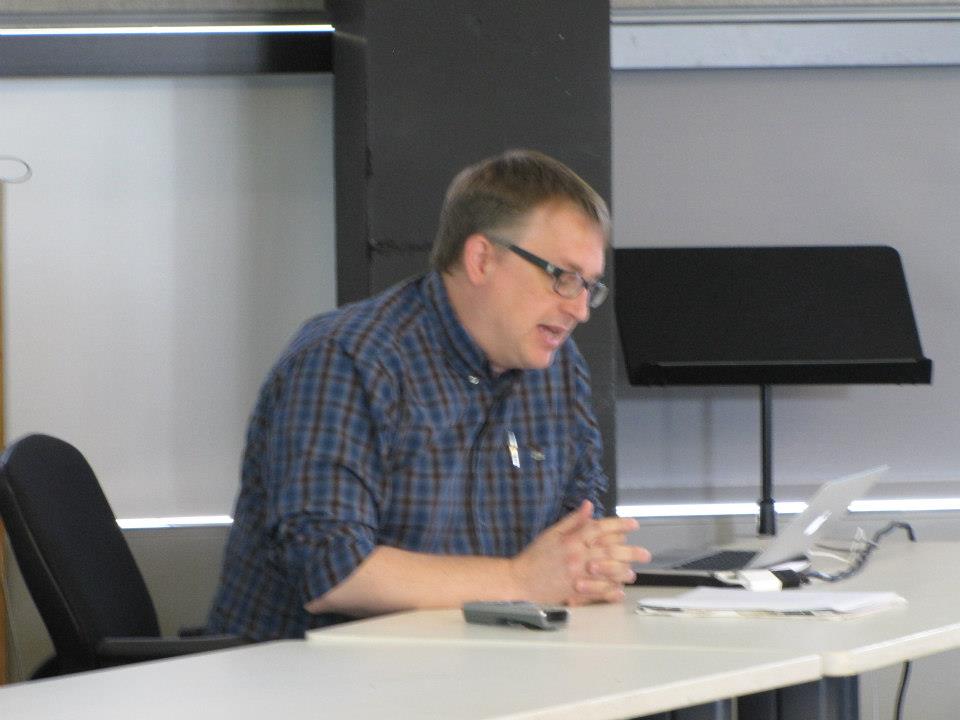
A quick post ad hoc from my mobile to initiate things. One of the research streams from the Improvisation, Community and Social Practice research initiative is called “improvisation and pedagogy.” A symposium on music education was held at the University of Guelph a couple of weeks ago that affirms a general tendency in this research stream to focus on improvised music, particularly jazz, as a model for education, particularly around practice-based research. Other significant threads want to develop community, collective and even networked paradigms for learning and for knowledge-sharing around the kinds of work done by the AACM in Chicago beginning in the mid-1960s. (See George Lewis’s A Power Stronger Than Itself.) My own interests, particularly as a pedagogically-untrained academic, involve assessing and exploring the implications of using both musical and theatrical improvisational techniques in the classroom. What are the cultural politics and the ethics around importing such aesthetic practices into an educational setting? How can improvisation be theorized as a pedagogical practice? More to come.

Short Take on Rachel Musson’s Tatterdemalion
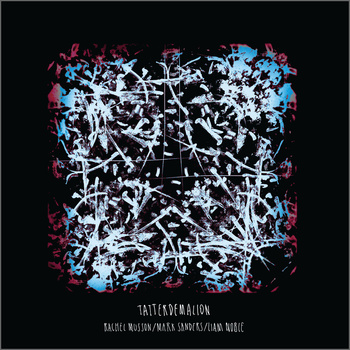
I hadn’t encountered Rachel Musson‘s music until a few months ago when I found two tracks she posted on Sound Cloud, as a foretaste of her new album Tatterdemalion (on Babel, available through bandcamp.com); these tracks are a pair of live recordings of extended electric free improvisations from a set at the Vortex in London by her trio with keyboardist Liam Noble and percussionist Mark Sanders. The performances are electric in more than one sense: they’re charged up and plugged in, but they’re also electrifying to hear. Musson’s edgy confident tenor saxophone lines cut across thick noisy substrata, layered swathes of electroacoustic rumble and skirl produced in tandem by Noble and Sanders. Their music instantly caught and kept catching my attention, with its whelming surges of volume and space, of scrabble and hum. The studio recording on CD retains plenty of the tattering energy of the live date. As I listen through the album, I find myself more and more convinced that I am hearing an important and powerful collaboration emerging into the open. 
From the outset, Musson’s overtone-rich tenor hews closely to the kinds of searching tonalities that Evan Parkeror John Butcher have been pursuing, but she evinces a more deliberate sense of melodic line than either of them might. Noble and Sanders create gradually thickening surges of sound underneath Musson, who has a tendency to worry at discrete phrases and figures, repeating them with incremental shifts in pitch and pace, as if she were trying to secure successive fragments of melody within an unruly welter of electronic buzz and percussive thrum. At times, the trio recalls Ellery Eskelin‘s longstanding group with Andrea Parkins and Jim Black. Sanders is less polyrhythmically driven than Black, less figurally definitive, his sense of pulse more distributed, organic and unresolved. A number of the intenser passages throughout the record invoke the more voluble moments of Paul Motian’s trio with Joe Lovano – Musson’s saxophone timbres are sometimes remarkably close to Lovano’s depth of horn – and Bill Frisell’s feedback-soaked, obliquely dissonant guitar: I hear echoes of “One Time Out,” for example. I know Liam Noble’s playing from his collaborations with Ingrid Laubrock or from his 2009 trio outing Brubeck, an excellent tribute to the American jazz icon. But he deploys electronics here in ways that shift his personal idiom considerably, I think.  The admixture of bent sine waves, feedback and what sounds like an electric piano recall some of Chick Corea’s more radical forays on the Wurlitzer in Miles Davis’s 1969 quintet. Musson plays tenor on most of the seven tracks, taking out her soprano for the third piece, “The Blue Man.” While the album’s title suggests raggedy dissipation, the procedure for each section of what feels like an extended improvisational suite is similar: “The Blue Man,” for instance, begins fairly muted, the musicians coaxing their instruments forward and feeling their way into a shared soundscape. As the work expands, noise and texture start morphing into discernably shaped – shaping – sound, finding bits of intersecting, if contingent, musical form. At times meditative and withholding, as on “The Blanket Feels Woollen,” but more often building to an assertive density, this is vigorous, confident, restless, searching, extemporaneous music of a very high order.