Flow, Fissure, Mesh

Home » Posts tagged 'improvisation' (Page 6)

Tag Archives: improvisation

Evan Parker Live at the Western Front

It was a privilege to hear Evan Parker play last night, Friday March 22nd, at The Western Front. The concert was a return to a venue that has become a Vancouver landmark for the avant garde, presenting cutting-edge music, dance, film and visual art for 40 years. It also marked the release of Vaincu.Va!, an LP version of a recording from The Western Front’s archives of Evan Parker’s first solo concert there on November 8, 1978, which was the last performance in his North American tour that year,  a tour that Alexander Varty credits as “the first of its kind to be undertaken by a European improviser, paving the way for an invasion of exciting new music.”  In the unfolding of this music, its trans-Atlantic dissemination, last night’s concert was a significant moment, reinvigorating an important improvisational archive, making a history happen. Again.
Evan Parker played two sets, each under three-quarters of an hour: one, an extended solo improvisation on soprano saxophone (echoing the 1978 concert), and the other in an improvising trio with Gordon Grdinaon electric guitar and oud and Kenton Loewen on the drumkit. The Front’s recently refurbished Grand Luxe hall, upstairs, was packed to capacity; there must have been close to 150 people in the palpably supportive and expectant audience, a mixture of neophyte listeners for whom this would be a first experience with Parker’s music live and others who had been following Parker’s music for decades, some of whom I even overheard saying that they had attended the first concert there 35 years ago. I felt a very real sense of a listening community, not only because I was able to reconnect with friends I’d first encountered years ago at events like this, a fairly dedicated long-standing following for improvised music in Vancouver, but also because, before the concert and at the set-break, people seemed genuinely keen to talk with each other, not just about the music they were hearing, but about themselves; it seemed to me that, whatever the aesthetic gifts and challenges that this particular music offered us, it also occasioned a sense of bonding, a coming together, however briefly, of good shared human energy.
The solo soprano set was a single continuous piece that was sui generis for Parker. “Well,” I think I heard him say quietly before he began, “here we go.” Hearing his solo soprano music feels to me like stepping into a thick stream of layered arpeggios, intersecting torrents of 32ndnotes and harmonics that Parker sustains without pause through circular breathing for half an hour or so, at which point he stops; when he plays he doesn’t produce a finished work so much as enter into an ongoing process, a rivulet of shared aural time. The rapid shifting among at least three registers on his horn produce a kind of counterpoint not unlike the compositional practices of Steve Reich (who, like Parker, acknowledges John Coltrane as an early influence), but where Reich’s music seems marked (and this is not a criticism, but an observation) by sculptural calculation, Parker’s polylinear music seems to me not so much an effect of abandon or looseness, but more accommodating than Reich’s to the unpredictabilities and small excesses, the momentary remainders and overflows, of body and breath. I could hear, I could fell the fleeting intensities of those cascading lines resonate and pulse in my ear canals. Resonance: that’s exactly the right term, I think, for what Parker’s solo music seeks, and moment by moment what it finds. He stopped playing as unceremoniously as he had begun, just taking the horn out of his mouth (as Miles Davis had told Coltrane to do back in the heyday), and was met with huge applause for that small room. I have never attended an Evan Parker performance that was less than great, but this short improvisation felt tremendous. He returned to the centre of the stand for what seemed like an encore, but instead of more, he played a 20-second head of a Thelonious Monk tune – I’m not sure what it was, maybe “Ugly Beauty,” though I’m sure that’s wrong – during which his tone shifted markedly, more rounded and plainspoken; he was hearkening back, if only for only a passing instant, to Steve Lacy. At the set break, James Coverdale (I was sitting beside him and Lynn Buhler) said he thought of Lacy too, and that it was something like an invocation to Lacy’s spirit, Lacy who has played the same room so many times, solo and in duo with Irene Aebi and others, in the past. Again, he had sounded an improvisational historicity, in the present, in our presence.
At the beginning of the break D. B. Boyko, the Western Front’s artistic director, presented Parker and artist Eric Metcalfe with copies of the LP, which they autographed for each other. (Metcalfe’s artwork adorns the album cover. He mentioned that he was one of those present who had attended the original concert.)
The second set consisted of two improvised pieces by the trio. For the first, Grdina on hollow-bodied electric guitar sometimes traded flexible lines with Parker, now on tenor saxophone, and sometimes provided resonant string texture; his tone, I thought, was sometimes reminiscent of Joe Morris, although his melodic and harmonic conception was certainly all his own. Kenton Lowen’s percussion – speaking of echoes and allusions – recalled for me the multi-directional playing of Sunny Murray (as on his sixties recordings with Cecil Taylor or Albert Ayler). Loewen started the second piece with sparse bowed metals (although I was back in the audience and couldn’t actually see what he was doing with his hands). Grdina switched to oud, and the idiomatic character of the instrument seemed to affect the playing; Parker offered what I think were largely Phrygian lines, a sort of Spanish-Moroccan tinge: lovely, moving, instantaneous world-music. There was no encore.

Short Take on Tim Daisy & Ken Vandermark

Found a copy last week of Light on the Wall, a double LP by Tim Daisy (percussion) and Ken Vandermark (reeds), recorded as a duo and both solo in Poland in May 2008, and issued on Laurence Family Records. The sound, both live and in the studio, is excellent. You can really hear Daisy’s distinctively open sense of space in the live duo set; Vandermark offers a set of solo “Etudes for Jimmy Giuffre,” but to me their duos not so much build on Giuffre’s chamber-ish conceptions, as recall duos by another Jimmy, Jimmy Lyons, with Andrew Cyrille–not that there is anything derivative in this music, but rather that both are thoroughly cognizant of their position in an emergent sense of a building tradition of forward-thinking sonic experimentation, the extemporaneous edge where the performing present takes up its audible pasts: a historicity of the avant-garde, coming on. That, and it’s a great record.

Brief Prose Alap, Remembering Ravi Shankar

When I was a first-year undergraduate at Western, I didn’t have many friends and I didn’t really try all that hard to make any. I spent much of my time between classes the same way I spent my evenings at home, sitting at a stereo with a pair of headphones on, listening to music. The university’s music library had maybe twenty listening carrels, surrounded by shelf loads of records, mostly classical, but there were no restrictions preventing non-music students from using the collection, so when I had a free hour I would walk down the snow-covered hill from the arts building to the music faculty, and sit through a couple sides of whatever interesting lps I could find. It was here that I first heard the great Bill Evans Trio (with Scott LaFaro and Paul Motian) at the Village Vanguard in 1961; the library owned a twofer compiling most of the tracks (except “Porgy,” I think) from the two albums, and I remember being blown away by the surging, elastic rhythms of their version of “Milestones,” needle again and again. I can’t say how many times over I played the first side of Keith Jarrett’s Köln Concert; those gospel-tinged, life-affirming cadences have been incised into my aural memory, as they have been for so many people – although, for me, those sounds are also marked indelibly by the context of their first hearing, at a turntable in one of those carrels. I also found a copy of John Coltrane’s Live at the Village Vanguard, which I didn’t own at the time, and could give “Chasin’ the Trane” the sustained close attention its deserves. I tried new music – they had a complete set of Stockhausen’s Aus den sieben Tagen – and found some rarities (a great set by Anita Ellis, elegantly accompanied by Ellis Larkins, which I’ve never seen again or since; an amazing Elvin Jones-Richard Davis duo on “Summertime,” which was long out of print at that point, though it’s since been re-issued). There was a pile of Smithsonian recordings of American folk: my ears were opened, my aural horizons maxed.


         There was one other record I found myself coming back to, a 1981 Deutsche Grammophon release called Homage to Mahatma Gandhi by Ravi Shankar, which combined two side-long sessions with the sitarist and tabla master Alla Rakha. With Ravi Shankar’s death a week or so ago, I started to remember hearing this music, and to think about its impact on me – immature, solitary, arty – a quarter of a century ago. I came to this music via my enthusiasm for Coltrane’s “India,” a sort of minor-modal adaptation to Western ears of Indian idioms. I knew and I know next to nothing about the technicalities of form and structure in Indian classical music, but I do know something about what I thought I heard and can still hear in Ravi Shankar’s recording. He apparently composed Rāga Mohan Kauns, the four-part raga that takes up the first side, extemporaneously and live, at the request of a radio producer in Bombay in 1948, a handful of days after the assassination of Mahatma Gandhi. (The note-sequence that acts as a modal basis for the raga, Ga Ni Dha, is based on Gandhi’s name, a musical code from which Shankar’s extended improvisations gradually take flight.) The first section of the raga is an alap, a slowly building encounter with the basic melodic materials for the piece in non-metered time, without percussion. What I take away from Shankar’s recorded performance – with its tensile, wobbling tones, his languorously whelming, softly metallic attack coupled to a strangely inverted and resilient decay – is a stretching and even a suspension of time. In the encounter with mortality, in a public act of musical mourning, of grief, Ravi Shankar finds for me a pathos, a held poignancy that recalls both the resistance to and the inevitability of death. Rhythm, as he feels his way fingertip by fingertip into his notes, emerges not as virtuosic dominion but as a vibrant elasticity, an opening of the self that bears tactile witness to its calmly passionate refusal of extinction.

Breathturn

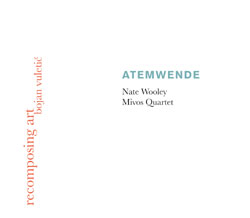
I have been listening to Atemwende, a recent CD of music composed by Bojan Vuletić for string quartet and trumpet. His work is new to me, and I bought the CD because of the presence of Nate Wooley on the recording. The composition is a suite in nine movements, and each section is derived from Vuletić’s reading of a poem by Paul Celan. These aren’t settings of text, and there is no vocalist, but Wooley’s idiosyncratic trumpet lines often cleave close to the range and timbre of the human voice, and the music sometimes seems to aspire to the condition, to the textures, of speech, particularly in the trumpet obbligatithat occur in most of the movements. I can’t really comment knowledgeably on Vuletić’s compositional method, although there are times when the textures he achieves remind me of the chamber music of Giya Kancheli, or of Krzysztof Penderecki in a rhythmic mood. But that’s just an impression: the music is accomplished and well-crafted.


It’s very tempting to hear the suite as a series of sonic allegories, as mimicking the collapse of meaning in much of Celan’s later work – a poetry that skirts the epistemic and phonemic edges of its own language. Vuletić invites exactly such an interpretation when he cites, in lieu of a liner note, a key passage from Der Meridian, Celan’s 1960 acceptance speech for the Georg Büchner Prize (the translation, uncredited on the package, is by Rosmarie Waldrop):
Poetry is perhaps this: an Atemwende, a turning of our breath. Who knows, perhaps poetry goes its way—the way of art—for the sake of just such a turn? And since the strange, the abyss and Medusa’s head, the abyss and the automaton, all seem to lie in the same direction—is it perhaps this turn, this Atemwende, which can sort out the strange from the strange? It is perhaps here, in this one brief moment, that Medusa’s head shrivels and the automaton runs down? Perhaps, along with the I, estranged and freed here, in this manner, some other thing is also set free?
Celan’s challenging poetic, I want to say, ties neither to inspiration – to the romanticizing of personal transcendence – nor to expiration – to a fraught modernist teleology of collapse. Instead, it seeks in the dissolute fraying textiles of his own language (a dire and lyrical German that offers him both enmeshment and estrangement) a semiosis, a graining of air across the larynx. Celan’s voice, the “I” that finds itself estranged poetically from itself, that appears to inhere in that very estrangement, can also temporarily – extemporaneously, for “one brief moment” – find the means to sing: es sind / noch Lieder zu singen jenseits / der Menschen (Faddensonnen, “Threadsuns”). That passing contact with a music other than or “beyond the human” can happen so fleetingly it’s hard to trust it happens at all: it’s worth listening to Celan himself read to hear if that breathturn can be made audible in his own elocution.
Eric Kligerman reads Celan’s Atemwendedifferently, as the moment in a poem when mimesis dissolves into a terrifying, stony silence; representation, as achieved semiosis, collapses into empty phonemes (as it does, literally, at the close of Celan’s Keine Sandkunst, “No More Sandart” – Tiefimschnee, / Iefimnee, / I – I – e), a loss which for Kligerman can be mapped over “the horror of an historical erasure” (118-9), an address to the unspeakable event of the Shoah. Celan’s poetry, for me, offers no simple redemption, but neither does it fall to pieces before the unspeakable; I take Kligerman’s point, but I still want to claim that Celan’s words effect a contingent but necessary return to the aural grounds, the sound-loam, into which human speech roots itself and from which it emerges. It’s risky, I think, to attempt what Vuletić attempts in recasting Celan musically, in as much as those settings might pretend as glib heurisms to give voice to the unspeakable, rather than, as Celan seems to seek to do, to find a language that takes up a fraught alterity at its core. “After Auschwitz,” as Theodor Adorno puts the problem in Negative Dialectics, “our feelings resist any claim of the positivity of existence as sanctimonious, as wronging the victims; they balk at squeezing any kind of sense, however bleached, out of the victims’ fate,” because such sense-making, for Adorno, is altogether too bleak, an “absolute negativity” (361).  Celan’s poems, I believe, respond to this terrible linguistic quandary, this crisis in sense itself, not by refusing to speak, but instead by attempting to voice that resistance as feeling, as such.


It’s tempting for me to hear Nate Wooley’s untempered trumpet lines in Vultelić’s suite as a tense, unruly sound-commentary on the through-composed string quartets. Wooley sounds very occasionally like a kind of Maurice André-Chet Baker hybrid, but more often produces a species of brittle, breathy, steel-wool (pardon the pun) sound. The seventh section, named for an early Celan poem Zähle die Mandeln, opens with a single tone (a concert G?) attenuated through circular breathing and played into what sounds like an aluminum pie-plate (I have seen Taylor Ho Bynum produce a similar timbre using a CD-R as a mute); the quick, resonant rattle not only picks up overtones, but also essentially de-tunes the sound, shivering the harmonics into a myriad of metallic threads; when the note moves a whole step, and Wooley’s starts alternating between G and A, the effect is to overlay a stannic breathy wash onto the audible effort of embouchure and string to find the sweet spot in their given pitches, to make their notes resonate and sing. At those brief moments, as  sound-grain and resonance pull at each other, I think I hear a kind of breathturn begin.
Stuff
Adorno, Theodor W. Negative Dialectics. Trans. E. B. Ashton. New
York: Continuum, 1973. Print.
Celan, Paul. Collected Prose. Trans. Rosmarie Waldrop. Manchester:
Carcanet, 1986. Print.
Kligerman, Eric. Sites of the Uncanny: Paul Celan, Specularity and the
         Visual Arts. Berlin: Walter de Gruyter, 2007. Print.
Vuletić, Bojan. Recomposing Art: atemwende.  Nate Wooley and the
         Mivos Quartet. Ignoring Gravity Music IGM 12-13. 2012.
         Compact Disc.


Lip Shake

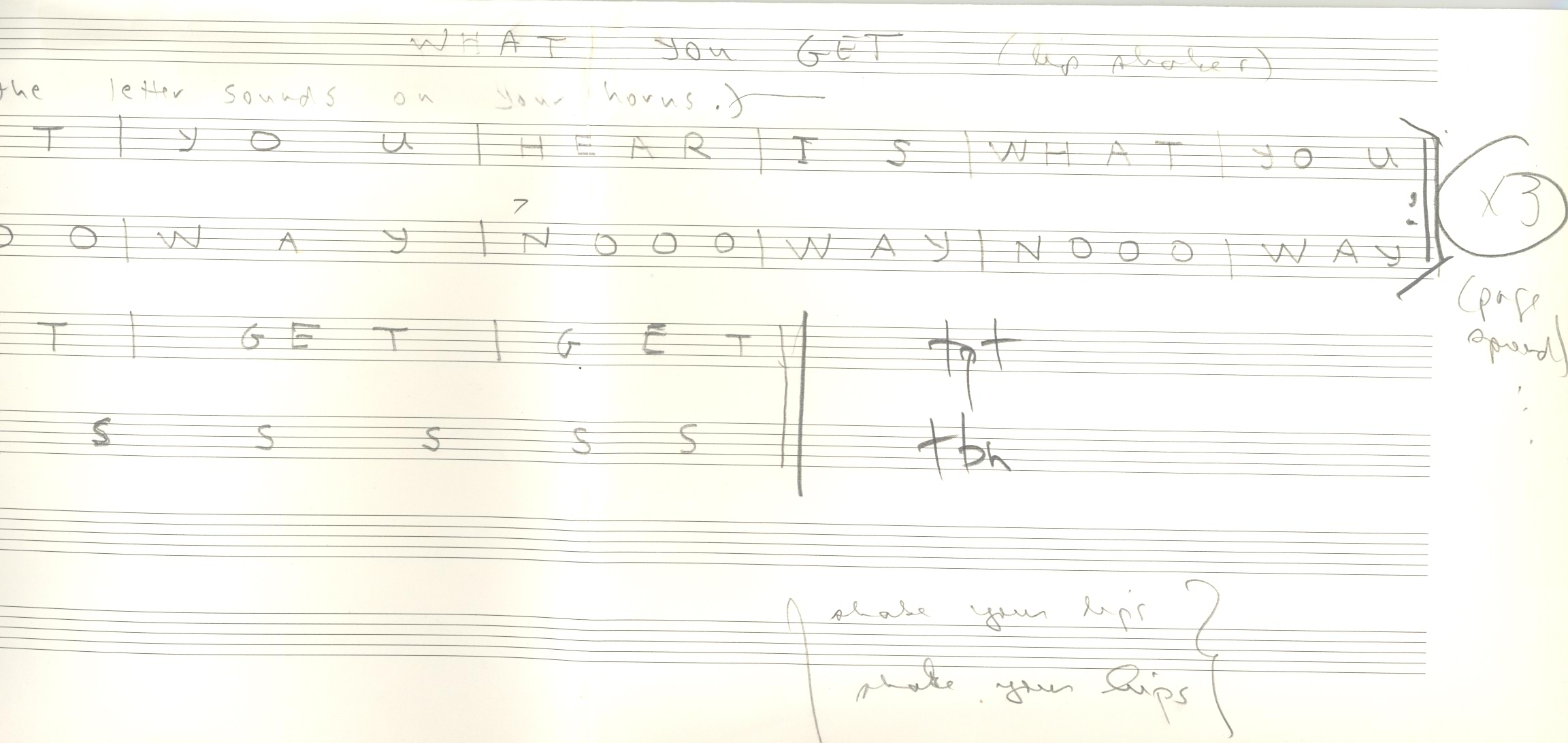
Lip Shake” is a brief piece composed for and during a master class with Dave Douglas at U. B. C., on 22 September 2011. Dave Douglas was in town working on a commission for the Turning Point Ensemble. The master class was a hands-on discussion of composition, during which Dave had everyone present — mostly music students and academics — write a composition for the available instruments, a trumpet and a trombone, with trap percussion, in about 9 minutes. I tried some notated music, but quickly realized I had no ear for sight-reading or sight-writing at all, so I wrote some words on the supplied manuscript paper instead. The poem, which I think of as a score for saying words through a solo trumpet, was revised from this draft later. (A reproduction of this draft can be seen in this post, below; the finished poem-score can be found by clicking on the title link above. You can see if you squint hard at the image how it was originally intended as a duo for two horns, but I don’t think the counterpoint worked, and I also like the idea of the solitary voice as horn and as sort of cracked a little, as inherently not quite itself.) Needless to say, I found I was a bit shy about offering it up to be played at the session. Despite the encouragement to experiment, there seemed to be a real expectation both from Dave Douglas and from the attendees for conventional notation and performance styles; by conventional, I mean generic, I think. We were certainly encouraged to think a little bit outside of our cognitive boxes. What I saying isn’t a complaint about the class. I was an interloper there, and really didn’t want to stand out in any way, or be thought of as intruding. I find I can learn a lot about word music, melopoeia, by paying attention to musicians and composers, particularly around texture and rhythm. And particularly musicians and musical thinkers of this very high calibre. I’m really grateful to have been able to attend the class, and to hear a little bit about how those present thought about sound, both theoretically but — really more pertinently — practically. The idea, for instance, of rhythmic duration, of a beat having extension rather than being some kind of singularity, I find fascinating.
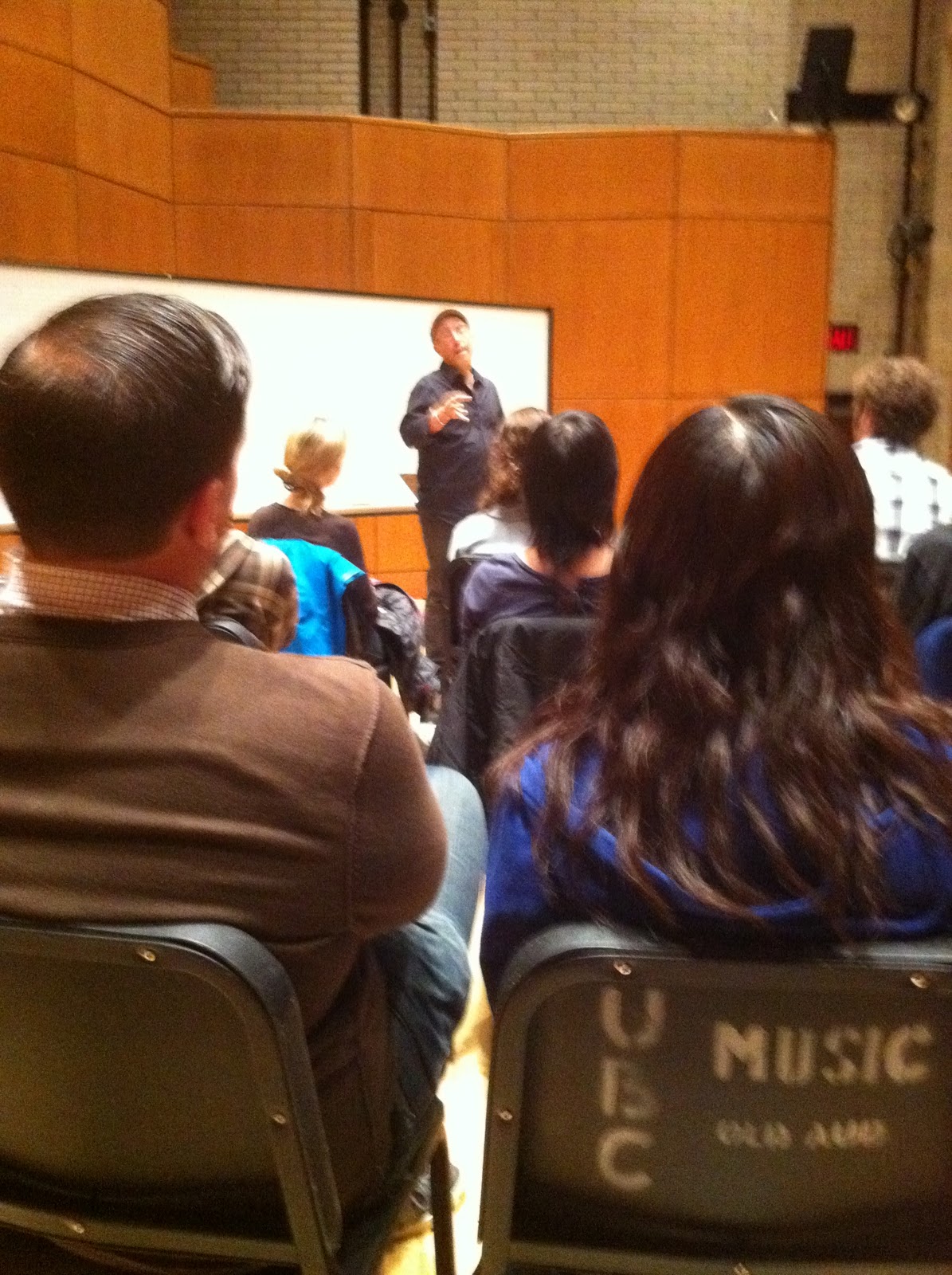
The class was great, very useful. Dave didn’t do a lot of lecturing, but encouraged feedback — not just from him but from everyone there — on the material that had been instantaneously composed and played. He even produced his own on-the-spot composition, for which he invited feedback, as if he too were a nearly-equal particpant in the various compositional processes unfolding around him. The point was, he said, to try to really write what you’re hearing in your head. In music, as he put it, “you can’t outrun who you are.” He quoted something he’s heard from Anthony Wilson: that composing is “the process of transcribing a melody that already exists in your mind.”
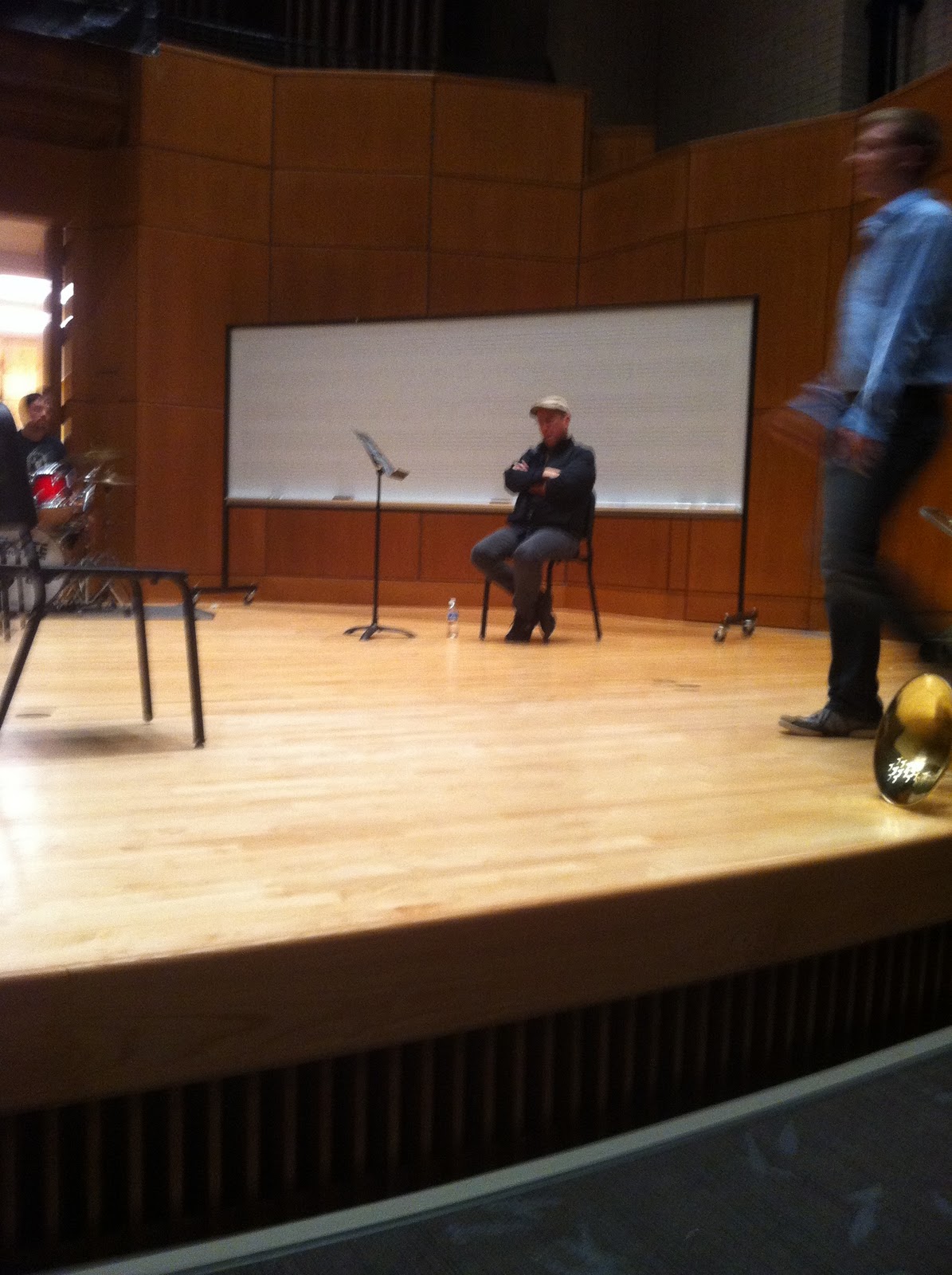
For me, in some ways, treating the poem as score means both something linked to this idea of noetic transcription — getting your mind onto the paper — and something opposed to it: opening the page up to the unruly aspects of imaginary performance, leaving space amid and even within the phonemes and dipthongs for alternatives to sound. Potentiality as typographic space, as leading.
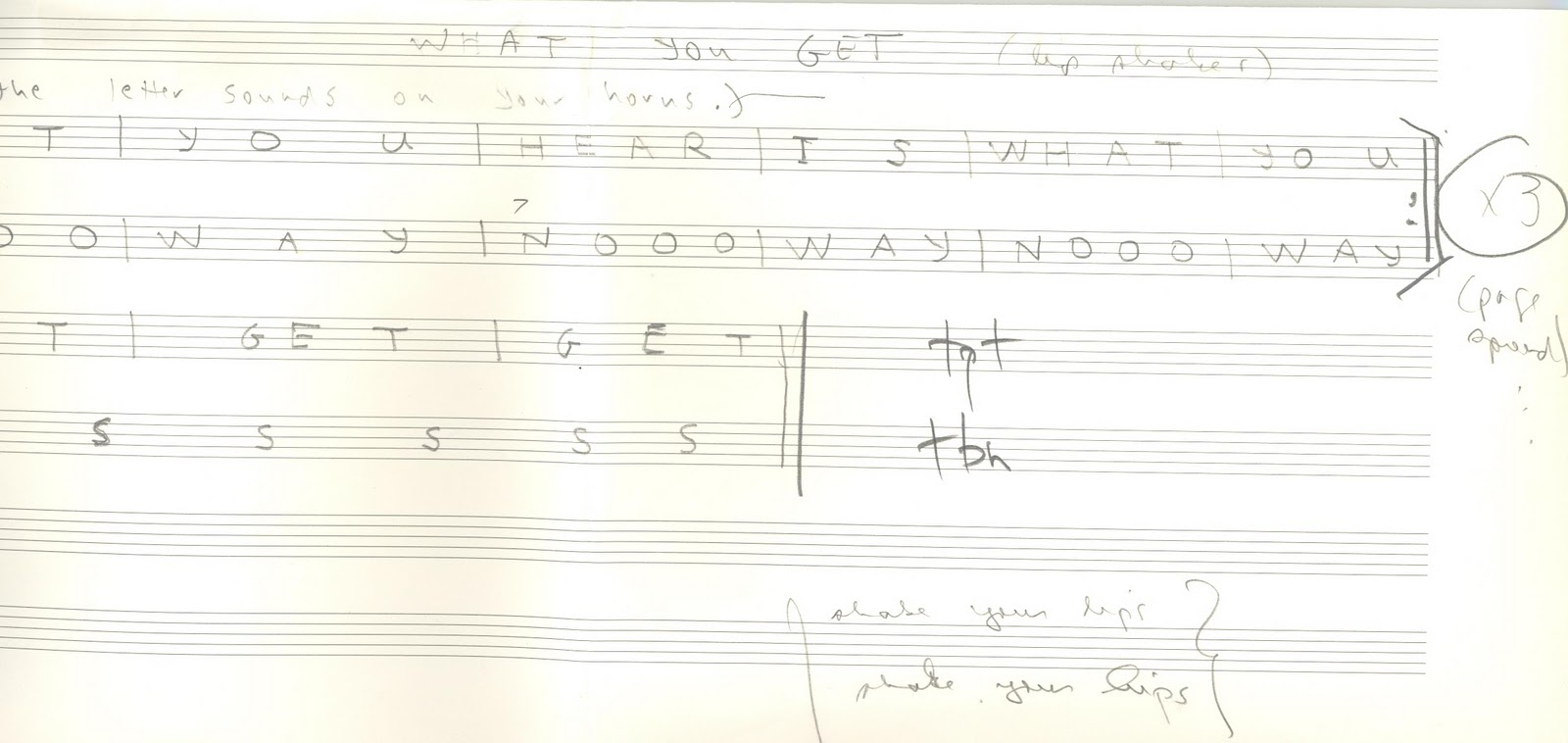
This score is called “lip shake” because Dave Douglas mentioned different kinds of trumpet sounds during the class, and that one stood out, and because making the phonemes sound down the brass tubing is going to involve particular kinds of manipulating of your lips, tongue, teeth, windpipe, embouchure, against the mouthpiece. If, that is, you decide to perform it that way.