Flow, Fissure, Mesh

Home » Posts tagged 'Mary Halvorson'

Tag Archives: Mary Halvorson

Short Take on Thumbscrew Live at Ironworks (Vancouver, 7 February 2015)
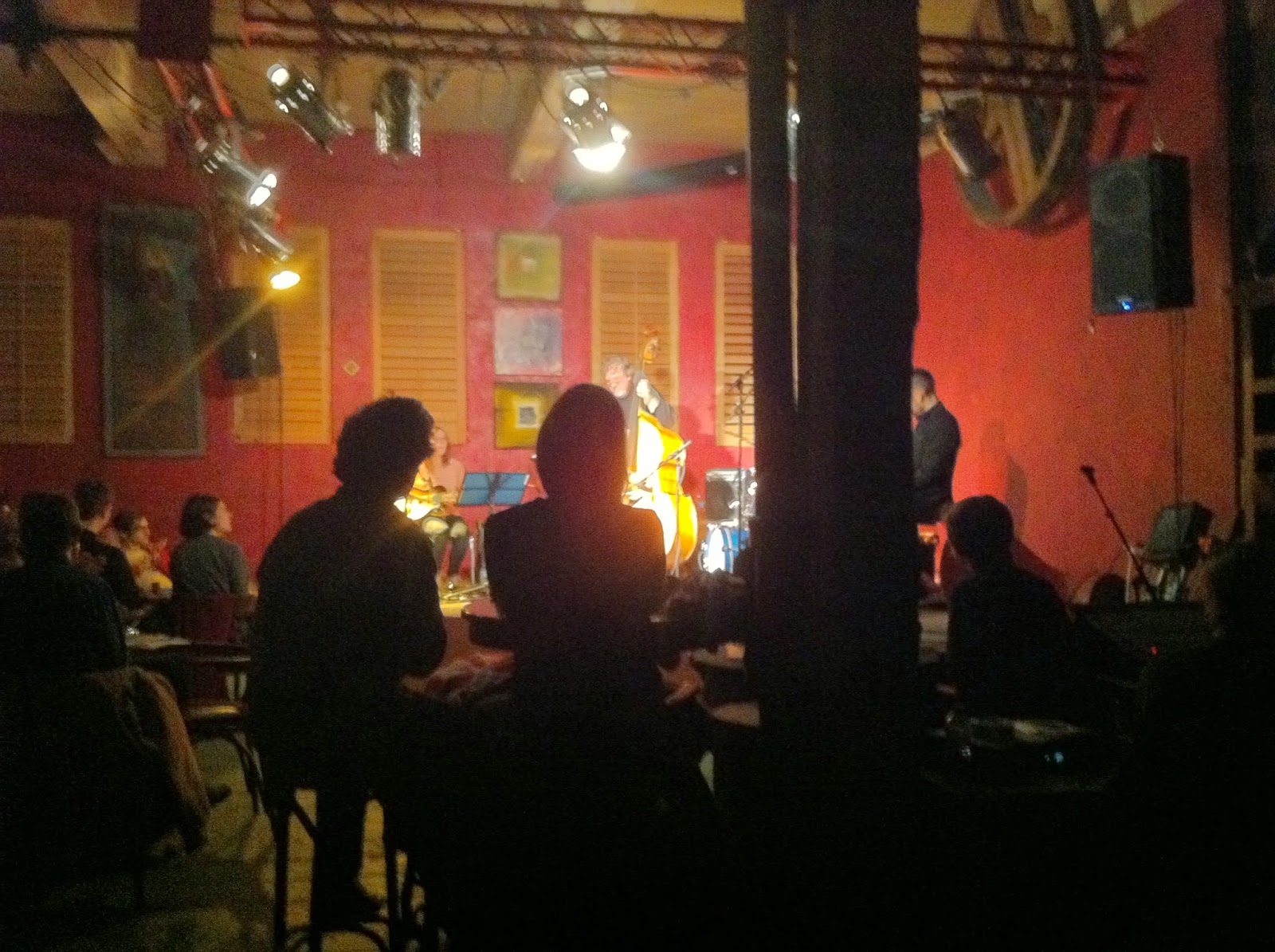
Mary Halvorson, Michael Formanek, Tomas Fujiwara (obscured behind people and a post)
Thumbscrew offered up two provocative and powerful sets at Ironworks on Saturday night. Building mostly on compositions from their eponymous album (released on Cuneiform last year), the trio’s music combines infectious come-and-go grooves with rhythmically angular, kiltering melodies and collaboratively deconstructive improvisations to create warmly engaged yet restlessly exploratory performances. Mary Halvorson’s guitar alternated between keening warbles and electrified growls, mixing bendy Johnny Smith-like chords with harder-edged Hendrixisms, cross-purposed and glassily recursive loops with tensile, open mellifluence. Her focus and calm demeanour on the bandstand seemed almost belied by the metallic, clarion fierceness of her sound. Michael Formanek’s firm, resonant bass prodded the trio forward, pushing at the leading edge of the beat. He frequently smiled, looking back and forth between his bandmates as his he drew reverberant, lithe lines from his instrument – which underlined the joyful intensity of their collaborative playing. Tomas Fujiwara’s drumming danced in and out of the pocket, by turns muscular and fleet, turbulent and tight. His body angled slightly back from his kit, he tended to face away from his bandmates, eyes closed, but only to increase what felt like his closely attentive, kinesthetic enmeshment in the group’s shared sound, their collective pulse. A few of the pieces were counted in – 1, 2, 3, 4 – but, still palpably embedded in a fixed metric, they were able to pull and surge and suspend and attenuate the beat to the extend that time itself became organically elastic, fluid, distal.  
The first set list, as far as I could make out from their announcements, started with “Line to Create Madness” (Halvorson), followed by “Buzzard’s Breath” (Formanek), “Nothing Doing” (Fujiwara), a fourth piece the name of which I missed, something called (I think) “Barn Fire Slum Brew” (Fujiwara) and “Still . . . Doesn’t Swing” (Formanek). After the break, they returned with “iThumbscrew” (Formanek), “Falling Too Far” (Halvorson), “Goddess Sparkle” (Fujiwara), a new piece by Mary Halvorson called “Convularia” – which she said had been named at her father’s suggestion after a “sweetly scented and highly poisonous plant,” the contrariety suggesting something of the tensions between the lyric and the spiky in her own and in the trio’s playing – followed by a fifth piece that might have been “Fluid Hills in Pink.” They were called back by an enthusiastic audience to play an encore – “we have exactly one more song” in their repertoire, they joked – which was an edgy ballad, to close a terrific evening of music by a brilliantly innovative trio.

Short Take on Thumbscrew (Mary Halvorson, Michael Formanek, Tomas Fujiwara)

For the last four weeks or so, since its release on the Cuneiform label on January 21st, I have kept returning to the eponymous debut CD by Thumbscrew, a collective trio of Mary Halvorson, guitar, Michael Formanek, double bass, and Tomas Fujiwara, drums. It’s a consistently great album, offering up music that collides warmly responsive interplay with infectiously kiltered grooves. The opening track, a Fujiwara head called “Cheap Knock Off,” alludes texturally– you can listen for yourself and decide if this makes aural sense – to the early John Scofield trio with Steve Swallow and Adam Nussbaum, or, given the bell-like tone at times of Mary Halvorson’s guitar, even to the Jim Hall trio of the mid 1970s with Terry Clarke and Don Thompson.

But – despite the title – this is hardly derivative or imitative; it’s more of a music keenly aware of precedents and precursors but pushing forward along the leading edge of its own present tense.  What emerges sonically in these nine tracks is the trio’s shared practice of bending and unfolding time; they co-create in each piece a motile amalgam of historicity and futurity, gesturing (at least to my ears) at a rich set of musical antecedents from the jangling two-steps of Son House to the poly-intervallic melodies of Henry Threadgill, while simultaneously opening their improvised lines outward, palpably reaching, as Robert Browning once put it, to exceed their grasp. Michael Formanek’s big tone and rhythmic conception remind me of Johnny Dyani or Henri Texier: what’s remarkable is how he – and how the whole trio – manage to synch up with such metrical acuity (listen to those unisons) while driving so fiercely forward, right on top of the beat, meeting it head on, ahead. This trio, tightly together, gives the impression of an elastic looseness, a surge and release that’s a hallmark of the best kind of collaborative improvising. For instance, the toe-tapping shuffle of Fujiwara’s stick-and-brushwork on Formanek’s “Still . . . Doesn’t Swing” gives way to a raucously dehiscent free improvisation, as if the trio had momentarily lost its footing, only to reassert its cogency as melody at a slightly slowed tempo, transformed and tugged apart and then refolded onto itself again through Halvorson’s taffy-pull lines. Countable time comes unglued, seems to stretch and then reasserts its urgencies. Thumbscrew offers a music that moves, and that moves us along with them, listening: theirs is a remarkable and important record.

Mary Halvorson, "Songs that Get Stuck in My Head"

Just come back from an hour-long afternoon public workshop with guitarist Mary Halvorson at the Roundhouse Community Centre in Yaletown, part of the last weekend of the Vancouver International Jazz Festival. It was a real privilege to hear her talk and play. She was personable and articulate, taking questions and playing a handful of brief solo improvisations. 
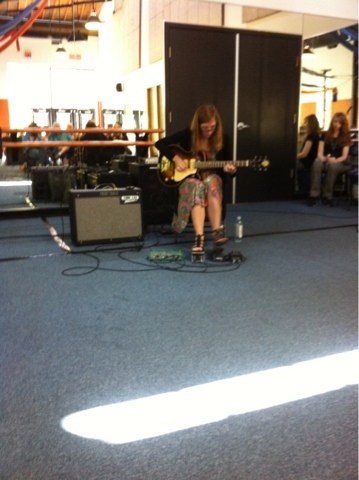
She confessed that she was in the midst of “working on solo guitar music,” and that she hasn’t really performed solo up until this point in her career as an improviser. She said that she had decided to base her nascent solo work on “songs that get stuck in my head,” which at this point were principally jazz standards, although she was also looking to various “compositions by other people” as source material. She admitted that she tends to focus on melodies and has a harder time “remembering the chords.” But there was nothing diffident or self-effacing in her aesthetic or in her performing; her spotty memory seems to offer creative opportunity rather than impediment. Or, as she put it, “I’m going to make up my own chord changes to these existing melodies.” She offered a foreshortened but compelling version of “Beautiful Love,” laced with pitch-bent burbles, halting twangs and lyrical turn-on-a-dime redirections. She likes, as she said, “weird left turns and falling off cliffs” in music–her version of the “sound of surprise”– but her playing also drew out a gently fraught lyricism in each of her lines. If this really was a hint of what’s to come, her solo work is going to be beautifully unsettling and eclectically brilliant. She talked at some length about some of the challenges she feels she is facing combining her own idiosyncratic approach to the instrument with a more idiomatically “jazz” approach to playing and to musical form. (In fact, before she began talking, she played us a track from her iPod, Johnny Smith doing “Moonlight in Vermont,” and admitted her love of Smith’s sound. Smith had passed away a little over a week ago.) She also played a track from her yet-to-be-released septet album, roiling layers of horn and guitar.
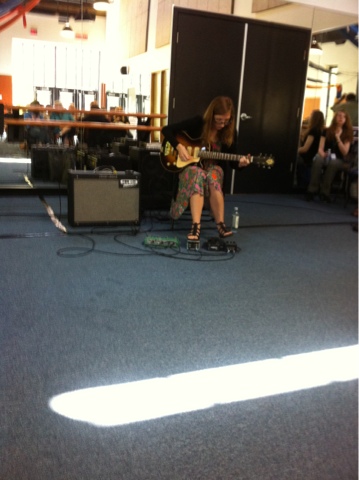
When asked about connections between her styles of band leading and composition, she said she tries to enable and to support the members of her group, and is keen “not to be too controlling.” She pointed to her experiences with Taylor Ho Bynum‘s sextet–the example was suggested by someone in the audience–as a possible model for relinquishing control and instead creating democratic interactions among the players. At the same time, referring to her studies with Anthony Braxton (whose music she said helped her decide to drop her courses in biology and pursue music) and with Joe Morris, she said she felt that “the teachers you have really shape who you become,” noting that both of these mentors encouraged her to follow their example in seeking out her own idiom, her own ways of making music. A brief improvisation built from cascading pulses closed out the workshop.