Flow, Fissure, Mesh

Home » Uncategorized (Page 5)

Category Archives: Uncategorized

Partial Elegy for Charlie Haden

The great Charlie Haden passed away Friday, July 11, and tributes of all kinds have been appearing over the past two days. I hadn’t really realized how many records in my collection Charlie Haden had appeared on; his bass playing, his sound, has been a pivotal and essential part of much of my listening. I saw him a few times in concert. Once, with his Quartet West on a double bill with John Scofield’s quartet at the Orpheum in Vancouver; and once, very memorably, with Geri Allen and Paul Motian in Montreal, as part of the 1989 invitational series. I wanted to write something in his memory; for some reason, I found myself thinking of the Kurt Weill/Ogden Nash standard “Speak Low,” an evocative version of which Charlie Haden performed with Sharon Freeman for Lost in the Stars, a Hal Willner tribute to Kurt Weill. The song leads back to Shakespeare’s Much Ado About Nothing, but I have also recently been pretty heavily under the sway of Nathaniel Mackey’s word music, so some echoes of that must have found their way into this piece. It was composed very quickly, so I’m sure there are a few rough edges and infelicities, but I’ll leave them in to honour the improvisational drift of Charlie Haden’s music.
Partial Elegy for Charlie Haden
Already gone too soon, other than him
who in this fraught hereafter could have named
the ruminant lumber his instrument
had been assembled from? Dark-toned boxwood,
hickory, lacquered spruce. Coaxing a deep
murmur from heavy-gauge strings, propounding
their full-bodied, hefty resonances,
he re-curved chthonic rumble into line
and cadence, his trademark over-fingered
pizz and tectonic double-stops marking
the thick eddies where sound and purled silence
abutted, then let go: a politics
of left-leaning, strung-out torch-songs that tell
you, “Speak low if you mean to speak at all.”

Double Short Take on Francois Houle, Alexander Hawkins and Harris Eisenstadt Trio Live at Ironworks

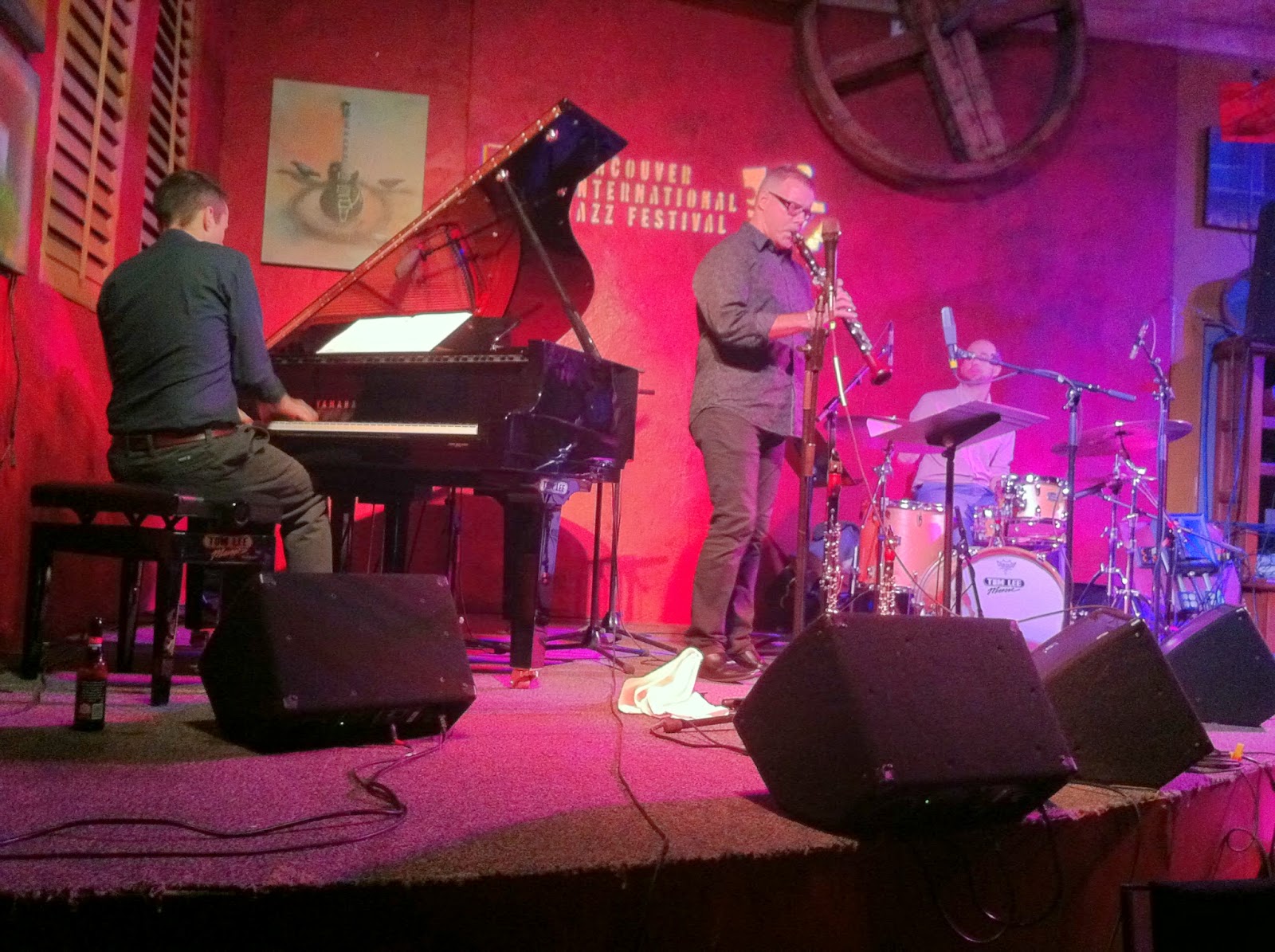
Late Sunday night, June 29th, for the last concert of this year’s TD Vancouver International Jazz Festival’s Innovations Series at Ironworks, I caught the first performance by an extraordinary new trio – Francois Houle, clarinets, Alexander Hawkins, piano, and Harris Eisenstadt, drums.  “On fire!” one member of the audience called out at the conclusion of their vociferous and strident opening number, an annunciation of gathering energies. I heard the trio again at a fantastic afternoon gig at Performance Works on Granville Island for Canada Day, and it felt as if, in the intervening hours, the group had transformed from a brilliant summit meeting of next-generation improvisers into a coherent and organically responsive ensemble.

The set list for both performances was the same, as far as I could tell: an array of original compositions from each of its three members, along with two art songs by Steve Lacy: “Esteem” and “Art.” Aside from paying tribute to their avant-jazz lineage, the inclusion of the Lacy material offered their audience some sense of the dynamic historicity of the trio’s present-tense music-making. A previous project by Houle, for instance, engaged with the compositions of John Carter, himself an improviser deeply cognizant of the complex and conflicted history of jazz; Houle’s music seems to me often to negotiate creatively between the expressive and the given, to find its contingent voice at the interface between a virtuosic performer and a motile tissue of echoes, sounding and refiguring its liminally audible past. In fact, a version of this presencing informa the playing of all three. This trio co-creatively takes up each member’s disparate instrumental and aesthetic lineages, and finds points of tension and intersection, prodding their collective sound forward along the shared leading edge of their on-stage, real-time encounter, something Herman Melville – from whose poem “Art” Lacy’s composition took shape – names “pulsed life” that emerges from the creative and attentive collision of unlikenesses:
In placid hours well-pleased we dream
Of many a brave unbodied scheme.
But form to lend, pulsed life create,
What unlike things must meet and mate:
A flame to melt—a wind to freeze;
Sad patience—joyous energies;
Humility—yet pride and scorn;
Instinct and study; love and hate;
Audacity—reverence. These must mate,
And fuse with Jacob’s mystic heart,
To wrestle with the angel—Art.
Eisenstadt, Houle and Hawkins fuse audacity and reverence in their music, which enacted during those two performances a generative wrestling with its angelic forebears and also with the immediate living context of its realization. (Lacy says in his own notes to the song that the poem seems to him to frame “the exact recipe for this activity,” for improvisational music-making.) This trio’s instrumentation (reeds/ piano/ drums) recalls the grouping that recorded Steve Lacy’s The Flame (from 1982, with Bobby Few on piano and Denis Charles on drums), but I have to say that I didn’t recognize either of the Lacy compositions at first hearing, and that Hawkins’s style is very different from Few’s, and that he draws out a more orchestrally thick and layered sound from the piano. His occasional use of wide, ringing intervals in his left hand recalled another of Lacy’s piano cohorts, Mal Waldron, but despite the inclusion of Lacy’s compositions, the Hawkins/ Houle/ Eisenstadt trio’s approach and textures were markedly different from this particular precursor.

Instead, especially during the second performance, when Hawkins launched into an extended solo passage of fractal stride, it felt to me, at least for a few minutes, as if the spectre of Teddy Wilson were somehow in the house, and that the drive and sustained ebullience of Eisenstadt’s drumming called up the impeccable abandon of Gene Krupa – whose fierce swing feel sometimes surged and ebbed from his brushes – who played alongside Teddy Wilson in Benny Goodman’s famous trio, whose instrumentation this current trio duplicates exactly. Or to go even further back I thought I could hear some of Johnny Dodds’s playing with Jelly Roll Morton, maybe with a hint here and there of Baby Dodds’s rolling tom-toms or Sid Catlett’s demiurgic rumble (to poach a phrase from Nathaniel Mackey). Still, this music isn’t in any sense neo-trad, and remains decidedly experimental in its orientation, extemporaneously free. But its approach also isn’t non-idiomatic – after Derek Bailey concept of “free” improvisation – so much as poly-idiomatic, a version perhaps of what Steve Lacy called, in the early 1970s when he composed “Esteem,” “poly-free”: a music that’s multivalent, iterative, recombinant. At one point during the first gig, for example, Houle’s circular breathing and quick-fingered looping lines recalled Evan Parker’s solo soprano technique, a sonic gesture that, more than mere homage, lent a contingently historical sense of form even to a doggedly contemporary musical avant-grade. It was as if, for each member of the trio, clusters of aural vocabulary and figments of style were simultaneously activated, cross-purposed, undone, imaginatively remade and even transubstantiated in the crucible of any given moment into a kinetic and differential accord: an alchemy of sound that I hope they managed to record, or might record soon, because, well, I’d like to hear it happen again.

Pursuing Ecstasy: Darius Jones and Tarbaby at Ironworks

Listening to improvised music can feel like chasing ecstasy: catching at those rare, first and fleeting moments of transport, of heightened attention and unadulterated joy that the performers are also after, often on our behalf – what John Coltrane might have called, following the title of one of the movements of A Love Supreme, pursuance. Last night in Vancouver in an 80-minute set, the alto saxophonist Darius Jones, buoyed up by the surging mellifluence of the piano trio Tarbaby, unleashed those spirit-heavy resonances, that deep cry, in song after song. I’m grateful to been there in the audience at the Ironworks, grateful to have heard. The compositions they played came mostly from Darius Jones’s recent album on AUM Fidelity, Book of Mae’bul, but despite being assembled as a quartet only for a current brief tour, these musicians are much, much more than featured-soloist-and-rhythm-section; they attain an audible integration, a co-creative and responsive agency that feels as if they have been together for years. The opening number reminded me a little of a David S. Ware quartet, with its roiling, keening groove, while I also heard passing echoes, I thought, of Coltrane’s late quartet, with Nasheet Waits’s multiloquent drumming calling up at times the robust, insistent textures Rashied Ali’s layered conception. Orrin Evans’s piano alternates between attenuated lyricism – his left-hand chords often feel suspended, as if holding their breath – and driving provocation. At one point in an improvisation, he appeared to find the famous melody from “I Got Rhythm,” not as an ironically knowing quote but as a means of casting our ears back over a century of foundational jazz practice, palpably reinvigorating a fragment of thoroughly worn-down standard by pulling and caressing the familiar phrase into an alternate time-frame, cross-purposing, if only for a few seconds, the known and the unknown, unsettling the given. Eric Revis’s bass playing felt charged and profound, pushing the music forward with cascading fierceness. Darius Jones’s lines negotiated between dulcet and ululating, shifting from seductive balladry to jagged yawp, before arriving at what felt to me like heartfelt psalmody. The quartet offered us a tremendous, powerful and moving set, a music that, for almost an hour and a half, bore witness to and delivered genuine, shared beauty.

George E. Lewis: Afro/Eurological Collisions

Here is the text of my colloquium paper presented this morning (Saturday, 21 June 2014) at “Improvising Across Boundaries: An Unconventional Colloquium” co-curated by the International Institute for Critical Studies in Improvisation (IICSI) and Coastal Jazz, as part of the TD Vancouver International Jazz Festival. (Given the time constraints, some of the transitions are rather abrupt, but I wanted to counterpose Paolo Freire’s “critical” pedagogy with Lewis’s approach to improvisation, for example, so I just went ahead with it as a kind of provocation.)

In the nascent, polymorphous field of what we can now call Critical Studies in Improvisation, the creative work and the scholarship of George E. Lewiscontinues to play a crucial role. A justly celebrated composer and performer, he has also become a key voice, both as public intellectual and as pedagogue, in recent academic and aesthetic debates around the cultural and social roles of improvisation. His accretive, open-minded forays into the improvised emerge from what I am going to characterize as collisionsamong subject positions, methodologies and conceptual arrays associated with a diverse aggregation of thinkers and artists, of improvisers, whose practice-based research – interventions, performances, and reflections – both shapes and interrogates this field. To put it as succinctly and as abstractly as I can, improvisation tends to emerge from and to inhere in its own creative undoing, and George Lewis’s music and writing want to address and to inhabit that liminal space, that contact zone, that edge. For a few minutes today, I want to test out the trope of the collision to try to explain a little of what his work on improvisation and his improvised work undertake. How and what does his practice-based research teach us? What forms of knowledge and of knowing do his improvisations produce and collide?
         I only have space to sketch one such collision today, around what Lewis calls “ethnic and racial identifiers” in contemporary music. Rahsaan Roland Kirk and Nina Simone, among others, preferred to characterize the continuum in which they situated their playing as “Black Classical Music,” yoking their work to popular, soul, church, blues and folk lineages and streams, as well as to what gets marketed, now as it did then, under the label “jazz.” This name-change is more than merely personal preference, and more than loosely salutary. It opens up a deep wound, a problematic around reception and legitimation of racially-marked artistry, but also seeks not to heal, however provisionally, or to suture or even Band-Aid that wound, necessarily, so much as to take issue with and even to subvert such glibly remedial tactics.
In his 2004 essay“Gittin’ To Know Y’all: Improvised Music, Interculturalism, and the Racial Imagination,” Lewis refigures this collision of “Black” and “Classical” music-making by offering a provisional history of the performance of Lester Bowie’s 1969 composition “Gittin’ to know y’all” at the “Free Jazz Treffen” in Baden-Baden that December, a performance that orchestrated a form of summit meeting between “two avant-gardes”: members of Chicago’s AACM and a set of European “free jazz” musicians. Lewis demonstrates how a presumptive binary that emerges from critical stereotyping around African-American and European cultural heritage grossly mischaracterizes the conversations and negotiations that actually occur within the music, not to reconcile differences but to sound them, and to approach them creatively. What I’m provisionally calling “collision” may sound like another name for dialectic, for a conflict of artistic interest, but I’m trying to name a set of relations among practicing improvisers that is agonistic, plural and networked rather than merely antithetical.
Lewis refers at the outset of his account of Lester Bowie’s composition to an earlier essay in which he distinguishes between what he calls Eurological and Afrological “musical belief systems and behavior”; rather than reinstitute a sweeping critical binary – which, at first glance, the pair of terms might obviously seem to do – Lewis wants to theorize exemplary and particular aspects of musical logic linked not to genetic or cultural phenotypes but to situated, historically-emergent social narratives. This conceptual move, he argues, can enable both scholars and practitioners to reflect on the “possibilities for artists to move across, transgress and possibly erase borders.” In his 1996 essay, Lewis is more specific about his deliberately contingent, complementary terms:
my construction of “Afrological” and “Eurological” systems of improvisative musicality refers to social and cultural location and is theorized here as historically emergent rather than ethnically essential, thereby accounting for the reality of transcultural and transracial communication among improvisers. For example, African-American music, like any music, can be performed by a person of any “race” without losing its character as historically Afrological [. . .]. My constructions make no attempt to delineate ethnicity or race, although they are designed to ensure that the reality of the ethnic or racial component of a historically emergent sociomusical group must be faced squarely and honestly.
Lewis’s materialist distrust of abstracted binaries informs his assessment of Lester Bowie’s music and of his own. “I wanted to explore,” he says in the liner notes to the recording of “Sequel . . . (For Lester Bowie),” a composition closely linked to his essay,
this hybrid conception that allows the free flow between the two spheres with musicians that are equally at home in the so-called acoustic and so-called electronic world. This faked binary, which has sprung up over the years, has become completely useless today.
Other “faked” binaries – between composition and improvisation, between score and text, between the individual and the collective – are also refused and refigured in what Lewis here repeatedly names “hybridity.” I’m challenging that term a little here – pace Lewis himself – by insisting on “collisions” rather than hybrids because I want to reconsider how the fusion of interests implied by the trope of the hybrid might invite us to gloss over the persistent creative divergences that also emerge from this refusal; it feels a little too synthetic, in other words, a little too compliant.
Within Lewis’s conceptual frame, the Afrological is deliberately privileged, if only because Afrological improvisative practices and traditions have been consistently devalued and underrepresented, and their recovery represents a significantly politicized gesture within the cultural politics of music. Afro-diasporic musical practices connect improvisation and community building (Lewis evokes the genre of the “ring shout,” for instance, to describe collective interchange) neither accede to nor supplant the Eurological aesthetic and social genres, but to supplement, challenge, appropriate, subvert, and remake.
The individual, expressive voice of the cogent, virtuosic performer, for example, is neither accepted nor discarded in this conception, but refigured as a subject position within a dynamic network of voices. In his notes to “Sequel: A Composition for Cybernetic Improvisors (For Lester Bowie),” Lewis gestures at what he values as an :inherent instability” within improvised performances:
My experience of the people here as well as many other people is that if they do have a personal style, it’s going to take you a long time to figure it out, probably as long as it took them to create it. I see people as creating more from a sort of multiple-voiced way. And to me that’s different from personal style. I think, because of that multiple-voiced nature and the inherent instability which goes along with it that’s where interchange and these new ideas really become possible.
We need to ask ourselves if, in the recording or especially in the live performance of a Lewis composition such as “Sequel,” we can hear the situated, historically specific character of this interchange, and what this reconceptualized practice of an active and engaged audition means. (Consider the complex circumstances informing Miya Masaoka’s innovative koto playing, for example.) But I do want to insist that in the audible collisions, transitions and even transgressions among the various, unsettled instrumentalists in this recording don’t manifest conflict but what sounds to me like productive conversation – and by productive, I don’t mean politely deferential, but closely responsive, reciprocal, attentive.
There is what I’d call an improvisational pedagogy in Lewis’s work, but not a pedagogy of lectures and informatics. Instead, the kind of knowledge-production in which Lewis interests himself is the recovery of a dynamic situatedness, of an interchange, of multiplicity.  It seems to me that the radical pedagogy of Paolo Freire might provide a helpful supplement to Lewis’s music and scholarship around his agonistic sublation of cultural binaries through situated, reflexive education. “Responsibility,” Freire asserts in “Education as the Practice of Freedom,” an intervention that coincidentally appeared in 1969 around the time of Lester Bowie’s “Gittin’ to know y’all,” “Responsibility cannot be acquired intellectually, but only through experience” (16). Freire isn’t dismissing intellection – he’s engaged in it as he writes, after all – but arguing that thought needs to be coupled to practice, rather than opposed to it, if it is to have any transformative effect, any meaning:
Critical [that is, actively self-aware] transitivity is characteristic of authentically democratic regimes and corresponds to highly permeable, interrogative, restless, and dialogical forms of life . . . . (18-19)
In Lewis’s “Sequel,” and in his other compositions, performances and even lectures and essays, I hear this active permeability as a restless and audible collision of voices.
Reading
Paolo Freire, Education for Critical Consciousness. 1969. New York: Continuum, 1973. Print.

George E. Lewis, A Power Stronger Than Itself: The AACM and American Experimental Music. Chicago: U of Chicago P, 2008. Print.

—, “Gittin’ To Know Y’all: Improvised Music, Interculturalism, and the Racial Imagination.” Critical Studies in Improvisation 1.1 (2004). http://www.criticalimprov.com/article/view/6/14

—, “Improvised Music after 1950: Afrological and Eurological Perspectives.” Black Music Research Journal 16.1 (Spring, 1996): 91-122.

Improvising Across Boundaries: An Unconventional Colloquium

Coastal Jazz, the Improvisation, Community and Social Practice (ICaSP) research initiative and the International Institute for Critical Studies in Improvisation (IICSI) are hosting a two-day colloquium in Vancouver on June 21 and 22, 2014, focused on the theme of “improvising across boundaries.” Presenters include Neelamjit Dhillon, Michael Blake, Tomeka Reid, Lisa Cay Miller and Rupert Common.

The complete colloquium schedule can be found here: IAB2014.

Here is a link to the Education webpage for the 2014 TD Vancouver International Jazz Festival, during which the colloquium is taking place.

“So many small things I still want to see”: Elise Partridge and Robert Lowell

The expanded edition of Elise Partridge’s remarkable collection Chameleon Hours (2008) reprints poems from her first volume, Fielder’s Choice (2002), including a brilliant set of four brief dramatic monologues based on lectures given in the last year of his life by Robert Lowell, lectures Elise Partridge attended and for which, she notes, she “took detailed notes on his remarks about nineteenth and twentieth-century writers.” Her poems are much more than reiterated transcriptions of Lowell’s classes, or ventriloquisms of his voice. They trace their way through a mesh of intertexts, expanding Lowell’s own iterative method in Notebook 1967-1968 (1969), History (1973) and other of his late volumes, colliding elocutionary rigour with colloquial immediacy to create a vital admixture – characteristic of Elise Partridge’s finest work – of the confessional and the objective, of the personal and the formal, of the serendipitous and the exacting.
Most of the poems in Chameleon Hours are elegies: meditations on loss, on the art of losing. They draw their passing, brief intensities from a heightened awareness of lived material detail, of “small things,” that comes in the wake of absence. Robert Pinsky praises this practice as her “art of noticing”: “Absence and failure are described [in Elise Partridge’s poetry] in a way that takes pleasure in accuracy: a considerable and original accomplishment.” Her poems, for me, evoke much more than mere pleasure, much more than an enjoyment of pretty craft, and her accomplishment is more than considerable: the crisp particularity of her characteristic line engenders a keen pathos in restraint, and unflinchingly confronts the hard expressive limits of her own mortality—“pretty or not,” as she puts it. In “Chemo Side Effects: Vision,” one of her pieces that Pinsky singles out for praise, she notes how there are “So many small things I still want to see”; the modulating vowels distilled from the long-I—the withdrawing, observant subject at the heart of this particular line attenuated into phonemic shivers, ī becoming ah-ee, then lightly drawled into aw and ĭ and braided through commonplace consonants, s’s and m’s and t’s—produce a palpable set of articulated, glassy shards on the teeth and tongue, small bursts of sense. Vatic wonder, under Elise Partridge’s pen, doesn’t so much diminish as gain a tensile acuity, a closeness.
Her Robert Lowell poems recall not only Lowell’s voice and approach, his recurrent plea for “the grace of accuracy” as he writes in one of his last poems, but also the voices and recalibrated transcripts, the “notebooks,” that fill in his absence, his retreat; she also gestures at Elizabeth Bishop’smemorial for Lowell, “North Haven,” which describes Lowell’s meticulousness as a compulsion to revise, to “derange, or re-arrange” his poems obsessively, a reflexive craft arbitrarily halted only by his sudden death in 1977. Partridge took classes with Lowell that same year, and her poems are in one sense gatherings of some of his last words. Day by Day, Lowell’s last collection, also appeared in 1977; its final poem, “Epilogue,” acts as a contingent self-elegy, in which Lowell laments what he hears “in the noise of my own voice” as a “misalliance” between imagination and memory; the last lines gesture forward, with a caveat, at this unsatisfied poetic desire, his “want to see,” to keep noticing:
                    But sometimes everything I write
                    with the threadbare art of my eye
seems a snapshot,
lurid, rapid, garish, grouped,
heightened from life,
yet paralyzed by fact.
. . .
We are poor passing facts,
warned by that to give
each figure in the photograph
his living name. (Day by Day 127)
The recalcitrant egotism and decrepit masculinity that persist in Lowell as “poor passing facts” of his existence are gently shifted in Elise Partridge’s reimagining of his lectures; like History, each poem takes up the biography and the voices of other poets, here Hart Crane, William Carlos Williams and Walt Whitman (twice), but has Lowell tease out moments in all three of fraught grandeur, when they could each be “operatic” or “awfully eloquent,” and when their robust poetic authority, their masculine assurance, is undone by “something . . . personal.” When Partridge has Lowell recall that Williams thought Crane “was all rhetoric,” the chain of spectral, layered voices at once resists poetic heightening and aspires, despite itself, to a feeling of living presence, of spontaneous immediacy that exceeds the limits of its own cleverness and craft: “And often rhythmical musical things / aren’t good, they’re padding for not feeling” (Fielder’s Choice 74).
The verbal music that Partridge characteristically seeks is perhaps closer to Elizabeth Bishop’s version of Lowell than to Lowell himself; in a 1964 note, Bishop asks for an art—I want to say a poetry, but she doesn’t—that consists in “some intimate, low-voiced, and delicate things in our mostly huge and roaring, glaring world.” Against heightening, Bishop wants the “delight” of exacting “living” diction; in “North Haven,” she catalogues local flowers, capitalized as if each were given a proper rather than a generic name, “Buttercups, Red Clover, Purple Vetch, / Hawkweed still burning, Daisies pied, Eyebright” (Poems 210). In the poems of Chameleon Hours, Elise Partridge deploys a related tactic around “souvenirs of the world,” building tenuous recollected cascades of words—as in the last lines of “Thirteen,” looking back on backyard gatherings of teenage girls:
                  And before we bounded off Kate’s trampoline
                  our teams were redivided:
                  pretty or not.
                  Earthward, staggering, reaching, reeled, thirteen.
(Chameleon Hours 6)
Part of her poetic gift, derived from Bishop but hardly derivative, is her capacity to frame a lightly dissonant clash of sound and texture as aspirant lyric, as an approach to the condition of song that delights in its almosting, its edgy shortfall, reaching. (Like Bishop, too, she has a thing for birds.)
         “Four Lectures by Robert Lowell, 1977” voices this shortfall, in its opening description of Hart Crane, as a gibe at idealism: “He’s taunting you with paradise.” Discussing Crane’s “Repose of Rivers,” Partridge’s recollected Lowell locates a poetry in the dissolution of memory:
                    The river speaks the poem;
the river’s washing out to sea
like your own life—the river’s doomed,
all childhood memories, washing out to sea
to find repose.
This last broken cadence approaches an iambic scansion, but that rhythmic surety dissolves both in the looseness of Lowell’s everyday speech (as if his talk were nearly but not quite subtended by metrical tics from his poetry) and in the refrain-like repetitions that suggest a mind feeling its way forward into words. The poem itself, like the other three “lectures” here, is also thoroughly reflexive, and we feel Lowell’s words diffused through the filter of Elise Partridge’s ear and hand, as she reconstructs his voice against the washing-out of whatever it was or is that speaks this poem, that refuses to let it repose in tacit oblivion. Against the plain speech he seems to value in Williams’s “The Yachts,” her Lowell laments how “anything beautiful” goes “trampling over all / it doesn’t notice.” Close attention and artifice are at odds in this conception—“[b]eauty’s terrible,” he tells us—and yet he values (as opposed to Crane’s seductive “thunder and obscurity”) the beauty of “careful description.” Care, in Partridge’s lectures, amounts to an unobtrusive reiteration of what she thinks she heard, what she write down.
And yet, each of Lowell’s talks is re-lineated by her, as if to discover the poems lurking behind the everyday in his recollected words. Re-appropriated, and then sculpted rhythmically and spatially into contingent poems, his texts become what he calls, in the third lecture (a reading of Whitman’s “Out of the Cradle Endlessly Rocking”) a “loose writing,” enacting and negotiating a tension between form and formlessness, mastery and relinquishment:
                           The beginning’s all one sentence, highly
                   organized musically, but loose writing,
                   as Whitman practiced. Tempting to scan; you can’t.
What Partridge gives us is the work of formation, of revision, an organization that wants but also refuses closure, that tempts us with a poetic monumentality, a Whitmanesque vastness, that its improvisational looseness inevitably belies. Just as Lowell’s epilogue functions as self-elegy, so too do each of these four poems confront the spectre of the poet’s own death:
                   “’Goodbye My Fancy’ he intended as
his last poem . . . you’re too sick to write your last
poem, when the time comes. Clear and elegant —
except for some of the language, and the meter,
it could be seventeenth-century.
Your eyes water, reading it.”
The layered quotation marks suggest the complex embedding of voices, but also point to an understanding of the poem as a lecture, as a reading of other texts. Clarity and directness, as virtues of descriptive facticity, of an attention to small things and poor passing facts, are both enabled and impeded by poetic line. But for this particular Lowell, what matters isn’t so much the airless perfection of form as the loosened vacillation between craft and sense, what Elise Partridge confronts in her poems as an essential human want, as wanting still to see.
I can’t help but hear her own difficult confrontations with cancer and with mortality, through which she writes the poems of Chameleon Hours, each one becoming something like her last, as it addresses its own passing, but still—as she has Lowell say of Hart Crane—“unusually full of life.” In a valediction, “Farewell Desires,” she asks the “Goddess of discards,” her muse of loss, to
                    let me be a waterfall
pouring a heedless mile,
stride barefoot over the drawbridge
to the plain road.
The gift of Elise Partridge’s poetry, one of its many gifts to her readers, is its careful affordance, its clear- and open- and watery-eyed encounter with a world replete in visionary plainness and casual miracles (“Seems supernatural, doesn’t it?”), awash in the small flashes that like her we still want to see.

                        Books to Read
Elizabeth Bishop, Poems. New York: Farrar, Straus and Giroux, 
         2011.
Robert Lowell, Day by Day. New York: Farrar, Straus and Giroux, 
         1977.
Elise Partridge, Fielder’s Choice. Montreal: Signal Editions, 2002.
– – – , Chameleon Hours. Toronto: House of Anansi, 2008. 

Equality as Listening: Maya Angelou and Dave Holland

When I heard about Maya Angelou’s passing last week, I also realized it had been a while since I had listened to Dave Holland’s setting of her 1990 poem “Equality,” two versions of which he recorded with his quartet (one with vocals by Cassandra Wilson) on his 1996 album Dream of the Elders. This group – with Steve Nelson on vibes and marimba, Eric Person on alto and soprano saxophone and Gene Jackson on drums – was a transitional band for Dave Holland, articulating between his two great quintets – the second of which would retain Nelson at its core. I’m not sure if “Equality” remained in the later quintet’s book, but I do remember hearing an instrumental version of the song when this quartet played Vancouver (at the Van East Cultural Centre) in June 1997. I remember how Dave Holland stressed that the tune was composed around a Maya Angelou poem, that her text made a difference as to how he felt his music could be heard and understood. The booklet for the ECM disc offers a “special thanks to Dr. Maya Angelou for permission to use her poem Equality, and for the inspiration and clarity of thought that her work gives to this world.”  

Maya Angelou’s work has a specific relationship to American cultural memory. It strives for clarity, for declarative resonance and public audibility. “You declare you see me dimly,” her poem “Equality” begins, ironically presenting intersubjectivity (in this instance, what will soon emerge in the poem as a gendered imbalance of power) as a longing for claritas. Her poem wants bright mutuality and distinctive, distinguished exchange.  Poetry, as self-attentive speech, meant for Angelou overcoming dimness or obscurity with demonstrative surety. Her writing enacts and invites, maybe even demands, a certain practice of shared listening that is at once responsive and responsible. Its verbal music can be simultaneously plain and arch, colloquial and poetical, convolute and direct; listen to the counterposed diction in a line from “Equality” like “You do own to hear me faintly . . .” As a form of public speech, her poetry satisfies conventional, base-line expectations (around rhyme and rhythm, for example, or around occasionally abstract diction) about what a poem ought to look and to sound like. Her poems seem to be woven from her own personal moral fibre, from her principled example: the poet, in this conception, preaches what she practices, and writes what she lives. “I go forth / alone,” she declares in the composite voice of “Our Grandmothers,” “and stand as ten thousand.”
Still, for all its emphasis on aspirational greatness and empowerment, her poetry also repeatedly recognizes its own shortfall. The uncompromising capital-P full-stop artistic power to which she lays claim in her poems – she isolates the term as a single-word sentence in the last line of “Love Letter”: “Power.” – relies on a potentially problematic assertion of self-mastery that risks replicating the oppressive social and cultural discursive machineries it seeks to overturn. That’s not to say that we shouldn’t recognize and respect the historical and societal circumstances out of which Angelou’s fierce voice emerges, her proud and defiant assertion of African-American women’s heritage and language against racial and sexual oppression. Speaking truth to power, particularly on behalf of the disenfranchised, ought not to be constantly compelled to interrogate its own essentialism, and such self-directed skepticism genuinely risks undermining and diffusing the political efficacy of its challenge, and of falling into unwelcome compromise: “You have tried to destroy me / and though I perish daily, / I shall not be moved.” But the firmness of Maya Angelou’s poetics, of her declarative mode, also entails acknowledging and confronting the ethical risk around a speaking subject who might declaim without listening, who offers up a language of refusal without reciprocity – even given the obvious imbalance of power and the self-evidently just demands for expressive space, to make herself heard. What she risks in writing is very real in two senses, then, as she balances the demands of self-actualizing pride and of ethical deference. And Maya Angelou says so, too. “When you learn,” her composite grandmother intones to her cultural children, “teach. / When you get, give.” Against the sculptural stridency of her lines, Angelou also repeated counsels herself and her readers to engage in an open-armed and reciprocal humility. “Enter here,” she intones, inviting her ancestors, but also her readers, to converse with her, to listen but also to be listened to.
She frames her elegy for “Ailey, Baldwin, Floyd, Killens, and Mayfield” with a gesture at the contradictions that inhere in representative greatness, in the work of exemplary self-expression and racial or community solidarity:
          When great souls die,
          the air around us becomes
          light, rare, sterile.
We breathe, briefly.
Our eyes, briefly,
see with
a hurtful clarity.
In this set of foreshortened lines, she traces the emergence of a stricken hiatus, manifest “briefly” at a moment of subjective crisis within that collective “we” when those artists and figures (in this instance, of creative black masculinity) in whose names and images we have invested, as a community, are suddenly absent. In coming days, with the unfolding of shared grief, Angelou promises that those absences will soon “fill / with a kind of / soothing electric vibration,” but this instability is enacted, in the present tense of her poem, as a claritas – a declaration – that simultaneously wounds and salves, a “hurtful clarity.” The nascent refrain in these lines, “briefly,” affirms through repetition its own sure-footedness while bespeaking a fleeting contingency, a briefness.
Elsewhere, she describes this attentive and unsettling reciprocity as a collision in the voice of the private and public, of lyric and polemic, of self and other, as a form of mutual listening:
                  Listening winds
                  overhear my privacies
        spoken aloud (in your
        absence, but for your sake).
I think that this dynamic and shifting balance of humility and power, of surety and openness, in her lines (notice the gently fractured line-breaks in what I’ve just cited, for example) is one way of understanding what she calls “Equality.” The poem employs an 8787 syllabic stanza pattern derived from hymnals:
                  Yóu annóunce my wáys are wánton,
                  thát I flý from mán to mán,
                  but íf I’m júst a shádow tó you,
                  cóuld you éver únderstánd?
(The “but” in the third line is an anacrusis.) This fixed rhythmic form – “the rhythms never change” she states twice in the poem – has been associated with the public traditionalism of Angelou’s poetry. Christopher Benfey, in a succinct entry on Maya Angelou in the Oxford Companion to Modern Poetry, notes how “[t]he strength of her lyrics, with their unashamed and passionate use of iambic rhythm and full rhyme, lies in the combination of blues and gospel traditions with strong emotional and political insight.” The performative rhythm of her verse, however, both here and elsewhere, tends to be trochaic rather than iambic, a rhythm that’s at once instantly assertive and recurrently elegiac, as each two-syllable unit begins on a strong stress and then briefly falls away. “Equality” takes as its subject the oppression of women by unresponsive and callous men, and the indices of race – unless we take her stanza form as inherently African American, which it isn’t – are much less in evidence than Benfey’s reading (which seems to rely on cultural stereotypes) suggests they might be in a Maya Angelou poem. The poem’s refrain – “Equality, and I shall be free.” – certainly echoes the public discourse of the civil rights movement, but the “equality” she seeks is presented as a balance of erotic power. It’s worth noting, too, that despite the nominal, declarative pressure that the chorus asserts, pronouncing the word ”equality” on its own as a gesture at enacting it verbally, that balance is also pulled slightly askew by the tacked-on modifier, a phrase that looks to the future rather than affirming an achieved present. Within a shifting braid of pronouns – you, I , we – the voice calls for equality, rather than attaining it.
But it’s also worth remarking that equality, repeated within a choric sentence fragment, becomes dynamic rather than discrete; it’s contingently, “briefly” attained in the process of speaking or singing the poem. Dave Holland’s recording has the syllables of “equality” attenuated and stretched in the lower registers of the singing voice, either Cassandra Wilson’s warm alto or Eric Person’s alto saxophone. The setting is built on a looped, largely unchanging slow-tempo phrase in Holland’s bass – a “line” that picks up on the trochaic lament of Angelou’s own line. Holland’s firm touch, his technically assured and rhythmically forward style on the double bass, also seems to me to correspond to what I have been calling the declarative surety of Maya Angelou’s verbal style. (Choosing to set this particular poem, Holland also arguably enacts an interracial dialogue and a masculine response to Angelou’s female cry.) Steve Nelson’s vibes provide an Afrological sound texture to the performance, echoed by Gene Jackson’s mallets on his tomtoms, which for me also recall some of Max Roach’s playing (behind Abbey Lincoln’s vocals) on “Prayer/Protest/Peace,” from his Freedom Now Suite. The collective performance of the quartet, with or without vocalist, enacts in the give-and-take between extemporaneous freedom and ensemble cohesion a formal, polymorphic analogue to what Angelou calls “equality”: a motile balancing act among disparate voices.
That the music inhabits a kind of resonant hiatus is not to suggest that it is diffident or tentative, but rather that it opens itself up to contrapuntal subject positions, a version of what Jean-Luc Nancy has described as the “listening” of (not to, but of) music itself: “alteration and variation, the modulation of the present that changes it in expectation of its own eternity, always imminent and always deferred . . .” (Listening67). I hear a version of the futurity of Angelou’s claim that “I shall be free” in Nancy’s withdrawing eternity here. Nancy insists on the selflessness of this kinesis, but between Holland and Angelou we have more like a partiality, and inclination of open-eared selves, a conversation. Although Angelou declares she will not be moved, in fact to move – in both its affective and kinetic senses – is precisely the interchange toward which “Equality” strives, toward which its imperatives incline us:
         Take the blinders from your vision,
         take the padding from your ears,
         and confess you’ve heard me crying,
         and admit you’ve seen my tears.
         Hear the tempo so compelling,
         hear the blood throb in my veins.
         Yes, my drums are beating nightly,
                   and the rhythms never change.
The eternal return of those figural drums marks a demand to be heard: that the private interiority of the voice’s pulse, a somatic beat audible we’d imagine only to herself in her own ears, might become liminally audible in the grain, in the wide long held notes, of the singing voice, in her open vowels. When Cassandra Wilson sings these words, they turn into an invitation to reflect on how we engage in attending or listening to music, on how we actively and deliberately open our eyes and ears to attend to a shared humanity. And they also, tonally, allow us briefly and approximately to access, across the tympanums of our own open ears, the palpable textures of her breath and pulse. Equality is Maya Angelou’s name for that temporary intimacy, that contact, that touch.

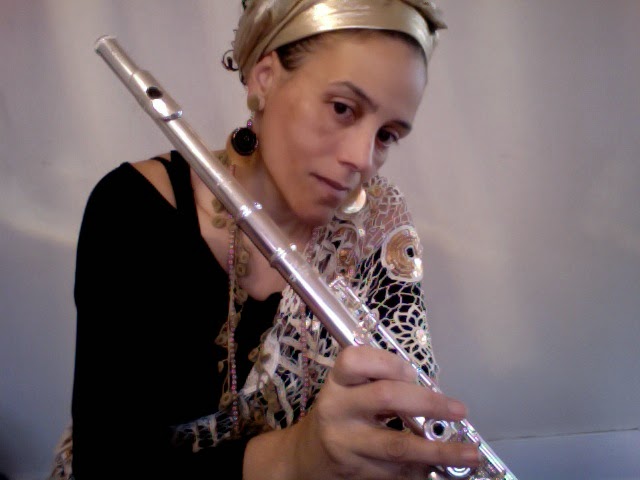
Nicole Mitchell: Afrofuturism Now (Audio)

Nicole Mitchell gave a keynote address at “Jazz, Race and Politics: A Colloquium” co-presented at the 2012 TD Vancouver International Jazz Festival by Coastal Jazz and the Improvisation, Community and Social Practice research initiative. Her talk was given the title “Afrofuturism Now,” but she ranged widely in her discussion of the cultural politics of African-American improvised musics, engaging with the work of Sun Ra and of Max Roach and Abbey Lincoln. She also explored in detail many of her own compositions and performances, and discussed her relationship to community and to heritage. She talks about her recent Xenogenesis Suite, which she composed as an homage to Octavia Butler. She also performed a brief flute solo (at about the 36 minute mark in the recording). The audience for her talk included Ajay Heble, Tomeka Reid, Billy Hart and Billy Harper – Billy Harper can be heard asking questions and engaging in discussion with the audience at the end of the talk, as well. (He and Billy Hart were scheduled to engage in a panel discussion next.) I have edited out the audio examples from Max Roach and Abbey Lincoln, and from Sun Ra, but I have retained Nicole Mitchell’s own musical examples. I am the one who can be heard introducing the colloquium (with some references to the work of Stuart Hall and Wayde Compton) and also giving Nicole Mitchell a brief introduction. Copyright for the intellectual and creative material on this recording remains with Nicole Mitchell.


Possibility Abstracts: Taylor Ho Bynum, Nathaniel Mackey and Discrepancy (Abstract)

This is the abstract/proposal for a paper I am set to give at the Vs. Interpretation colloquium and festival on the improvisational arts, which is taking place in Prague in the Czech Republic on July 17-20, 2014. The colloquium is supported by the Agosto Foundation, and keynote speakers include George Lewis and Pauline Oliveros. The original theme for the colloquium had to do with “improvising across borders.” I am aiming to extend my own thinking about the intersections of improvisational practices and the poetics of listening by addressing the work of Taylor Ho Bynum and Nathaniel Mackey. So here it is:

Released in November 2013, the multi-format set of recordings of Taylor Ho Bynum’s innovative composition for improvising sextet, Navigation, both culminates and continues his fascination with the interfaces between the extemporaneous and the written, the scripted and the performative. Separate LP and compact disc versions of the work are paired with different fragments of text from poet Nathaniel Mackey’s experimental epistolary novel Bass Cathedral, a book that Ho Bynum has recently said, for him, is probably the best writing about music he has encountered. Earlier compositions by Bynum, such as his suite Madeleine Dreams, have not only used prose fiction as libretto, but more tellingly have striven to address sonically and structurally the complex and often fraught relationships between the musical and the diegetic, between sound and sense. Navigationtakes up Mackey’s own address to this interface, sounding what Mackey understands as creative discrepancy, an expressive troubling of formal and cultural boundaries. Name-checking both Sun Ra and Louis Armstrong, Mackey has noted what he calls a “play of parallel estrangements” in improvised music and in poetry, arguing that music “is prod and precedent for a recognition that the linguistic realm is also the realm of the orphan,” that is, of the limits of sense, a liminal zone of both orchestration and letting go. Ho Bynum’s recordings pick up not only on Mackey’s thorough enmeshment in jazz history, but also on his intention to pursue the expressive potential of language and of music at their textural boundaries, at moments of troubling contact between divergent worldviews, or between dissimilar social and cultural genetics. Composing using what Mackey calls m’apping – a portmanteau splice of mapping and mishap, pursuing what Mackey calls the “demiurgic rumble” of discrepancy, improvising across the gaps between careful craft and unruly noise – Ho Bynum conjures a hybrid and collaborative music that blends the complex Afrological heritages of jazz performance style (audible in Navigation’s network of gestures to Charles Mingus and Duke Ellington, to name only two key forebears) with graphic scoring techniques derived from Sylvano Bussotti or Wadada Leo Smith, among others. If improvised music, for Mackey, represents – and represents precisely – what defies descriptive capture in language, what eludes ekphrasis, then the music of Taylor Ho Bynum’s sextet aspires to invert that representational effort, to take up the discrepant aesthetic tactics of Mackey’s writing and to assess how the written (as graphē, as graphic score) can approach and test the expressive limits of making music happen. Taylor Ho Bynum’s compositions for improvisers offer exemplary instances of how to negotiate creatively the boundaries between text and sounding, and suggest a means of addressing, too, the graphic work of other composer-improvisers, including the work of Nicole Mitchell, Anthony Braxton and Barry Guy

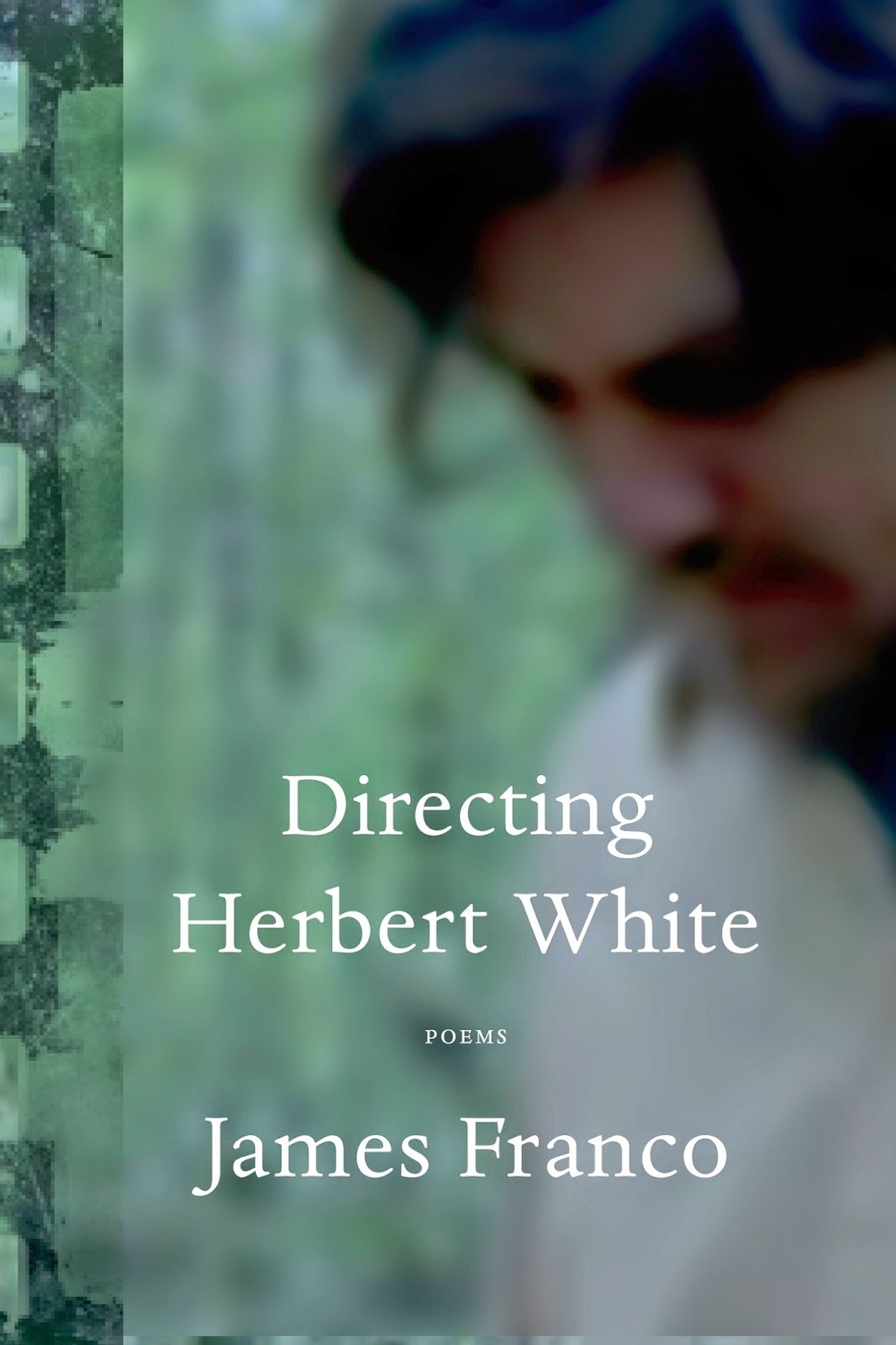
Wanting Poetry: James Franco’s Frank Bidart

As if to excuse their obvious clumsiness in awkward reflexives – by claiming in poem after poem that it’s intentional, that it’s the smart aleck work of a trained persona; by casting himself as the pretender-poet and self-proclaimed emperor of ice cream, clothed in his own thinly-veiled, simulated nudity – James Franco keeps trying to profess that his poems aspire to the condition of poetry: not only that they’re the work of a deliberate and crafty wannabe, but also that this neediness, this craving for legitimation, is in and of itself enough evidence of something approaching technique to have us take him seriously, to get him. “There is a fake version of me,” he writes, “And he’s the one that writes / These poems”:

                  He’s become the real me
                  Because everyone treats me
                  Like I’m the fake me.
I mean, it’s not just that, throughout Directing Herbert White, the emperor has no clothes, or that he coopts the role of the mythically honest boy who’s willing to say so, even about himself, but more that he makes out of his obvious and self-evident fakery, out of the contrived self-fashioning that concocts and informs the persona of a semi-notorious Hollywood lothario named “James Franco,” a set of patently fake poems, and that this fakery might just be sufficient, if it’s repeated enough times, to be aesthetically interesting, to be artistic. “He wrote the poem,” he says of Allen Ginsberg’s Howl in “Acting Tips,” “And then the poem wrote him.” Maybe it’s not the real Allen Ginsberg or even the poet Allen Ginsberg whom Franco’s describing here, but his own theatrical version of him, the alienated poetic genius he pretended to voice in a film: “In Howl I played Ginsberg, / And I was all alone. / My scenes were speeches / Given to an unseen interviewer . . . .” That line is a great one – “He wrote the poem / And then the poem wrote him” – and, ignoring the fumbled break, you can hear how the iambic cadence and the neatly turned chiasmus – both very un-Ginsberg – combine to firm up a certain sense of craft, of verbal mastery. That sense is fairly temporary, however; it’s really the only remarkable line in an otherwise flaccid and meandering text. But it does point up a potential that constitutes a genuine thematic centre for Franco’s largely ingenuous work: his want. He wants both to write and to be written by poetry, by these poems.
         Robert Polito sycophantically (there’s no other word for it, sorry) quotes this same line as evidence of James Franco’s genius when he introduces him at a reading and launch for the book in Chicago on February 19, 2014, alongside Frank Bidart, who’s obviously chuffed to share the stage with a celebrity who clearly idolizes him. (The title piece from Franco’s collection describes Franco’s efforts to make a film from “Herbert White,” the famous opening poem in Frank Bidart’s first book, and is also dedicated in part to the senior poet.) Franco, Robert Polito says, has become the “gifted filmmaker who aspired to be a poet,” and whose films aspire to the condition of poetry. In the staged interview that precedes brief readings from both Franco and Bidart, as well as a screening of Herbert White, Franco describes his trajectory toward legitimating himself artistically by pursuing a set of MFAs in film and creative writing more as a crisis of self-confidence: “I want people to treat me like a writer and not look at me as an actor writing,” he says. Now, these are just offhand remarks, and it won’t do to put too much critical pressure on them, but it is worth noting how concerned with likeness and with appearance he is in just about everything he says in this interview.
His poems, it’s not hard to see, obsess about overcoming the mediations of masking, of persona, by offering us a feint of candour, glimpses of the actor behind the actor, partial transcriptions of an imaginary episode of Inside the Actors Studio:
                  And I talk about my feelings
In the most intimate way.
It’s like I’m talking to the people
In the theater, as if they’re all my friends,
And I’m telling them
Everything there is to know
About me.
Any glimmer even of an artificial intimacy, disappointingly, is belied by the prosaic flatness of the style here, lines so “like” plain speech as to lose almost any sense of line at all. A voice that wants to produce a poetic version of Stanislavski’s magic if seems only capable, at this point, of an “as if” more Wayne’s World than anything else. “Dear James,” he writes to himself from an imaginary fan in “Film Festival,”
I don’t understand your festival. You were so great in Freaks and Geeks, why don’t you stick with that kind of stuff?
Viewers and readers, he’s suggesting, are impeded from understanding him (and his collection, for which I take this imaginary “festival” to be a trope) and from intimacy with his personal genius by the inflated expectations of fandom and by their attachments to what he has done rather than what he is trying to do, artistically. “And I’m my biggest fan,” he also says, suggesting his own ironic codependency on the very celebrity he’s trying to undo. But the humility—the negative capability— necessary to sustain this dialogue requires an actor’s practice of listening (something akin to the ways in which he describes himself listening to recordings of Ginsberg reading Howl, to  “get down Allen’s / Cadence” – and the feint of intimacy, being on an imaginary first-name basis with the poet, is also a tactic of Franco’s worth noting here), a practice of listening that the poems themselves show very little evidence of attaining.
Ultimately, as an interested reader and as a fan who genuinely loved and loves James Franco’s Daniel Desario, I feel a little cheated by a smugness pervasively offered to me in the guise of TV friendship, and by the lack of any perceptible, viable latches for my fandom. Flashes of an unregenerate and puerile misogyny, in a monody appropriating Lindsay Lohan’s voice or when he describes his encounters with underage girls or when he refers to the actress Michelle Williams as Heath Ledger’s “woman,” are symptomatic of what, all his self-excused fakery aside, must be a basic lack of self-awareness, an understanding that seems to me to be crucial both to the making of poetry and to concocting workable, if artificial links between him and his readers, his purported fans. Calling Hart Crane a “guy that [sic] could fuck sailors” and then noting how when he wrote “ ‘A bedlamite speeds to thy parapets, / Tilting there momentarily, shrill shirt ballooning,’ / He meant himself” is to counterpoint a sublime, even overdone lyric complexity (Crane’s, I mean) with a banality made ridiculous by comparison, sure, but it’s also to acknowledge a kind of intertextual straining, however short it might inevitably fall, to intersect with the contingently momentous, with the passing greatness of The Bridge, and to hear what Hart Crane is trying to articulate in these lines, to hear their poetic effort. I want to glean a sense, from his own poems, that James Franco does in fact strain to listen, if only a little.
         That said, I also think it’s very important not to, well, throw out the Franco with the critical bathwater. There are some worthwhile moments in these poems that, sometimes despite themselves, still merit thinking through. On April 19, Lemon Houndpublished “As James Franco Knows,” an ironic paean by Vanessa Place to the poetic naïveté Franco seems to epitomize:
As James Franco knows,  / 
Poetry makes me feel
 / like I can create whatever I want, because / 
all you really have to do is express
 / what you feel / 
emotionally and physically / 
and how this affects
 / the world around you
The knowing humour of this piece – and poems like this do get a laugh, I’m sure, at readings – troubles me, not least because it simply recasts the unrequited prosaic smugness of Franco’s many poems as Place’s snide pretentiousness, and doesn’t really offer up anything, well, poetic in place of her replicant dismantling of poems that don’t really stand up all that well as poems to begin with.  What seems self-evident, too, is that Vanessa Place’s Anne Carson-looking ribbon of lines isn’t any better poetry than Franco’s—which is maybe the point, and maybe why no better-crafted language emerges by her poem’s close. (Anne Carson is for me a writer who manages to transfigure banality by colliding textual and cinematic form, something Franco would clearly like to be capable of. However, Place’s piece doesn’t do any such transforming, either; it just rides blithely roughshod over Franco, doing nothing more than exploit his celebrity, his name-recognition.) It’s not that I’m trying to defend James Franco’s work against Place’s snark; it’s that I think defending him would be pointless. Franco’s poems don’t need to be satirized; in many ways, they do that well enough on their own. Rather than attack or parody James Franco, I think it’s much better to ask and to pursue what kinds of cultural and poetic work his poems actually do, or maybe want to do.
         I want to finish up by focusing on two moments in James Franco’s poems, both of which gain resonances from the February 19 reading in Chicago. The first moment involves the opening line – lines – of “Ledger,” his elegy for the actor he says he never knew, a metonymy of our own unknowing relationship to him, as readers: “I’ve tried to write about you. / I didn’t know you.” Evacuated of adjective or image, these flatly discursive hemistiches assemble into a slightly off-balance Alexandrine, which lends them a lightly magisterial finitude. Almost accidently, the poem launches with a firmness of purpose that belies the hesitancy it appears to worry over. At the end of the February reading in Chicago, Frank Bidart chooses to read this poem aloud, offering Franco’s text a performative imprimatur. More than that, Bidart’s measured reading lends the poem, at least at its outset, a density and, well, a grace after which the remainder of the text can only blunder: “I wrote a poem about you before, / Back when you died, / But it was coded and unclear . . . .” In fact, it’s not clarity that’s absent, but a sense of craft – not code, not abstruse virtuosity, but mere deliberateness – that Franco keeps hinting at and then missing. But, glancingly, as Bidart’s obliging elocution makes clear, craft occasionally still happens. And it happens, moreover, around his declarations of having tried, of what I am suggesting are his moments of straining. The most interesting poem by far in the book, is the title poem, a set of journal entries (more like prose fragments) around the making of the film version of Bidart’s dramatic monologue. There are, of course, many more moments of awkward literary naïveté: Franco seems to discover Robert Lowell’s “Skunk Hour” for the first time, and notes its famous allusion to Paradise Lost (“Myself am Hell . . .”), an out-of-character “reference” that “Herbert White” appears to make at the end of Bidart’s piece—all of which has the poem totter a bit close to becoming a first-year undergraduate essay. Still, Franco’s “Directing Herbert White” becomes an extended meditation on audience and persona, on interpretation and misprision, that’s worth at least a second look. “Sometimes,” Franco concludes, “I would like to live in a tight space and be a spy on the world,” distilling the slippages of mask and voice into a syntactically tauter and sonically more coherent sentence (notice the assonance here, for instance, the looped long i’s) than he has managed up to that point to pull off. It’s as if, for a moment or two, line and poet begin to coincide, to listen to each other. And they coincide, too, in a line that thematizes both spectatorship and desire, to look and to like.
         Frank Bidart’s sense of line, and the prosaic character of his own poetry, is much more resonantly complex, involuted. His Herbert White, distanced from himself in the act of murdering a girl, perceives “Everything flat, without sharpness, richness or line.” The genius of Bidart’s work, the genius of this first poem in his first book, is his capacity to catch a vestigial pathos, a trace humanity, in a voice that remains self-consciously repugnant, and to do so – Richard Howardargues, in his introduction to Golden State, an essay James Franco also “references” in his on-stage interview with Bidart and Polito – in a poetry that remains essentially prosaic:
Prose . . . is the basis of Frank Bidart’s prosody, his organization of language to suit and serve his need, which is his quest: a poetry in search of itself. (viii)
You can feel Bidart’s need in the displacement of commas in the line from “Herbert White” I’ve just cited, in its distanced, displaced articulation of a self approaching a line, a poetry of resonant flatness. Franco, too, wants such a poetry, and writes about that pervasive want. At times, he catches in his own awkward slippages something like Bidart’s affective prosody, his aspirant line. Honestly, I hope he keeps trying.