
Home » Posts tagged 'poetry' (Page 6)
Tag Archives: poetry
Ammons: A Sheaf of Words for Piano
I have put up on Sound Cloud a copy of a collaborative audio piece called Ammons: A Sheaf of Words for Piano, which as my notes below will tell you was recorded a couple of years ago with Montreal-area pianist Geoff Mitchell. I intend to publish the suite of poems as a chapbook, but for now the audio is out there; individual tracks will also soon be available for download via my website, http://www.kevinmcneilly.ca. Track listings and credits are temporarily available as a pdf here.

The poems in Ammons: A Sheaf of Words for Piano are linked idiomatically, for me, to the work I did for Embouchure. That is, they take for their subject matter stories of the life and music of an African-American jazz icon, in this instance the great boogie-woogie pianist, Albert Ammons. My friend Geoff Mitchell, as well as being an excellent sound recordist and artist (he did the cover drawing for Embouchure), is a brilliant pianist and improviser. He had told me when I was visiting with him in 2010 that he had been working on boogie woogie piano techniques and thinking about the historicisms of present-day jazz, and he mentioned Albert Ammons and his colleagues as influences; I wanted to collaborate with Geoff on a piece, so I started writing poems based on Albert Ammons’s music, taking cues from track titles, from events in his life, and from viewing the short film Boogie Woogie Dream, a peculiar mix of documentary and fiction shot on location in Café Society and featuring him, Pete Johnson, Lena Horne and Teddy Wilson, acting and playing.

I brought a suite of ten poems with me when I was next in Montreal, and we recorded together. (The eleventh poem, the Mondrian piece, is a typographical-visual text and is next to impossible to read. In any case, it was composed a bit later.) Geoff’s music was all freely improvised, but references the historical idiom in all kinds of interesting ways. The piano wasn’t meant to act as accompaniment, but more as commentary, and even critique of the words – at least, that’s what I think it was meant to do. The multi-tracked pieces are intended as homages to the two- and three-piano music of Ammons, Johnson and Meade Lux Lewis. All of the pieces, for me, are intended to be respectful homage. (The coda on Lena Horne was coincidentally composed around the time of her death, which I didn’t know about until after I had finished a full draft of the poem.) Race, gender and nationality are put at issue here, but because they form a crucial part of this music’s history. I necessarily come at this material as an epigone outsider, but I’m also drawn to the music viscerally, as a listener. That sometimes recalcitrant, sometimes negotiable tension between inside and outside, between deference and expression, between self and public domain, is what this suite intends to take on, at the level of voice and instrument: a conversation, a debate, a dialogue.

I’d like to thank Geoff Mitchell for his incredible music here.
Short Take on Interviewing Anne Carson
For my academic work, I have been trying to clean up and organize my curriculum vitae, which can be a depressing enough task, sorting through the welter of what I have done and what I have failed to do, what’s still available and what’s slipped from view. I interviewed Anne Carson for Canadian Literature in 2003 (ten years ago!), as part of a special issue on her work I was editing for the journal (number 176). I had been googling myself (embarrassing enough to admit) to see if I could find some electronic, on-line and/or accessible versions of any of my publications I could link to, and I came across UNSAID, which bills itself as “The Journal of New and Lasting Writing.” There you go.
And, in its issue for September 11, 2012, they have reproduced my interview with Carson, “Gifts and Questions.” You can check out the original issue of the journal here, too. It’s gratifying to come across things like this again. I remember Carson as gracious and wry, a real pleasure to speak with. And smart.
These Poems, She Said: Jan Zwicky and Robert Bringhurst
Jan Zwicky and Robert Bringhurst read together at Green College, at the University of British Columbia, on Wednesday, March 20, in the late afternoon: the last event in this year’s Play Chthonics series. I was set to introduce them to the 40-odd people who had come to hear them in the Graham House fireside lounge – a capacity crowd for a poetry reading, for that intimate space – and Jan reminded me about one of the first times we had met, which was in a two-term graduate seminar led by Don McKay at Western in the fall-winter of 1986-87. She was teaching philosophy at Waterloo, I think, but would come weekly down to London to audit the Monday evening class; her Wittgenstein Elegies had been published by Brick Books earlier that year. I was a master’s student, and was just getting underway writing what would turn out to be a thesis on the poetry and poetics of Robert Bringhurst, which McKay was supervising. The seminar was called “Poetry After 1945,” if I am remembering right, and each week was focused on a different book, a different poet – chosen, I’m pretty sure, not for any particular thematic or ideological reason, but because Don was interested in them, and he thought that theirs were poems that we ought at the very least to know about, to know: Robert Lowell’s Life Studies and For the Union Dead, Galway Kinnell’s Book of Nightmares, John Ashbery’s Self Portrait in a Convex Mirror, Ted Hughes’s Crow, Dennis Lee’s Civil Elegies, and selected poems from Denise Levertov, Daphne Marlatt, Seamus Heaney, Charles Olson, others. One guy in the seminar was keen to do something with Sylvia Plath. (I remember also discovering, through Don, Charles Wright’s The Other Side of the River that year.) And, near the end of term, Don had put on Robert Bringhurst’s The Beauty of the Weapons.
I don’t know what had drawn or what was drawing me into Bringhurst’s work at the time, whether I had picked it out from McKay’s syllabus, or found it on my own and then taken the seminar to hear more about it and to encounter those poems more fully. There was something that spoke to me quite forcefully and seriously in those days, from Bringhurst’s writing, something important. And he was also one of the few poets I had discovered who had a rigorous interest in philosophy, in thinking. What caught my ear was that Bringhurst didn’t ever merely namecheck Heidegger or Levinasor the Pre-Socratics, never merely rehearsed Zen traditions (via Gary Snyder) or First Nations mythtelling; he took these inheritances up with a keenness, a self-awareness and a deliberateness that I had never met before, and he did it not simply in but through poems, as poetry. Bringhurst aimed to have his work converse, materially and essentially, with what Kinnell called(in his brief “Prayer”) “whatever what is is.” Later poems would make this conversation more formally explicit – his “Blue Roofs of Japan” had just appeared in Pieces of Map, Pieces of Music, Bringhurst’s just-issued collection from McClelland and Stewart. The way I remember, it was this kind of poetically-informed conversation to which I hoped that seminar aspired.
By the start of second term, after I had been working at Bringhurst’s books for some time and with the in-class discussion of his poetry fast approaching, I was certainly aware that both McKay and Zwicky had been somehow more directly and closely implicated in his writing than I might have realized at first (although I knew McKay knew Bringhurst personally, and had sent him a few questions on my behalf about sources for poems). “Sunday Morning,” from Pieces of Map, is dedicated to them both, and suggests a kinship of thought and approach – around listening, around wilderness, around alterity and ontology – that Bringhurst characterizes as an interest, an inter-esse, in “the musical density of being.” Their poetry, in many and various registers, aspires to sing, to attain the condition of song. They were concerned, in the late 1980s, to reactivate a particular trajectory of the lyric, its noetic intensities.
So, what happened in the seminar was: one of the assignments involved presenting a close reading of a poem. I had chosen to examine Bringhurst’s “These Poems, She Said,” partly in response to an emergent line of questioning in the class around gender politics. Bringhurst placed the poem first in his selected, to enact a distancing irony, and to suggest a self-awareness about the contingency of the seemingly sculptural monumentality, the mythic reach, of the texts that followed:
These poems, these poems,
these poems, she said, are poems
with no love in them. These are the poems of a man
who would leave his wife and child because
they made noise in his study.
[. . .] These are the poems of a man
like Plato, she said, meaning something I did not
comprehend but which nevertheless
offended me. (Selected Poems 75)
The gesture at Plato isn’t just a philosophy joke about an authoritarian metaphysian’s aversion to the erotic. (It’s worth comparing Zwicky’s recent Plato as Artist, which recuperates an alternative Plato.) Bringhurst creates a miniature Socratic elenchus, replete with self-deprecating irony. Uncharacteristically for Plato, however, the interlocutor in this poem is female; the text’s antithetical manoeuvres, shifting from iterated critique to discomfited reaction, both sustains the authority of the male poet’s voice – everything remains filtered through him, and he is the one who affirms, at the poem’s close, that the woman’s voice has spoken “rightly” – and also dismantles any grounds he might have, other than a kind of empty verbal aestheticism (“You are, he said,/ beautiful”), to claim argumentative high ground. He sounds like he wins, but he can win only by losing, since the love he craves entails receptive openness rather than the abstract and detached rhetorical management of a well-turned phrase or line. In the seminar, I think it was difficult for me to hear the conflictedness at the core of the poem, and instead I focused only its apparent claim to rightness, its mistaken feel of surety. This reading, as you can imagine, didn’t sit well with Jan, and she told me so. What she valued in the poem wasn’t any feint of attention or pretense of listening, but a deliberate, intentional disavowal of ego; the poem, for her, in the white space that slashes through its penultimate line on the page, opens itself to what remains otherwise, to its ungovernable outside. (As I write this, I don’t think those would have been Zwicky’s terms; this is me, I’m sure, re-casting her critique. But however she put it, her point was a good one.) She argued.
What came out wasn’t just a corrective for me. More importantly, it was the sense that there were real stakes here, that something in this poetry mattered. And what mattered was the honing and the intensification and the acuity of thinking, of thought as an exacting, lyrical unknitting of selfishness, of self. That debate about poetics wasn’t just a remedial exercise, but an enactment of this rigorous openness, one that takes itself seriously. “Knowing, not owning” as Bringhurst puts in what he then called “Thirty Words,” which he would incorporate into his “credo” in later editions of his selected poems: “Praise of what is, / not of what flatters us / into mere pleasure” (Selected Poems 159). Neither Zwicky nor Bringhurst takes this demand lightly; poetry is careful, serious business, and since that evening seminar in 1987, I have tried to learn from and through their work – and I continue to do so – to correspond with, to be responsive to and responsible for, that care.
 |
| Robert Bringhurst Reading at Green College |
The Play Chthonics reading, for me, reactivated this commitment to a poetry that matters. Both Bringhurst and Zwicky presented principally new work, but their tactics and idioms were still closely and thoroughly enmeshed in the kinds of lyric thinking they have been practicing, in their distinctive ways, for decades, and for which I have, for decades, admired them. Bringhurst read from a set of what he called “language” poems, works that have little to do with idiomatic American experimentalism, but addressed themselves to the foundational becoming, the ontological pluralism, that he has pursued throughout his career. Zwicky’s poems, by contrast, focused elegiacally on the essential unknowability of things, on lost connections and on gaps and silences. But her poems also distill their music from that loss, a music that wants to draw out some of the human resonances with a world in which we are all implicated, to converse openly with the unvoiced plentitude of what we are not, which is also what we are. At different points, both she and Bringhurst coincidentally described encounters with a heron as an image of this attentive address.
After the reading, I picked up a copy of a CD that Zwicky had recorded (in June 2011) called, simply, Jan Zwicky Reads. I have been listening to it off and on for the past month. As at the live reading, I find that as I listen certain of her lines seem to hang in the air, to resonate: “that bare light not yet sweet with birds.” Zwicky’s melopoeic technique, her mastery of the phonemic music of language, evident here in the audible meshwork of consonants and gently modulating vowels, is more than “sweet” craft; what inheres in these voicings – I’m sure that’s the right term for this lyric practice – is more than the mere pleasures of listening. Zwicky offers in small, in lines such as these, a musical elenchus, a negation (“not yet”) that highlights the hiatuses and epistemological uncertainties that poetry seeks to bridge, as metaphor, but also construes as its substance, as its inevitable shortfall, again as metaphor, as approximation, as asymptote: a version, I’d say, of what Bringhurst has called, translating Paul Celan, “the caught light’s closeness / to audibility” (Selected Poems 143). The sweetness Zwicky’s poetry seeks out is never the sugary or the saccharine, but is consistently a resonance, a harmonic sweet spot, where the disparate textures of an unclosed world can briefly, barely, touch and argue, catch and hum, collide and sing.
stones that need not: Short Take on Colin Stetson & Mats Gustafsson
I’m starting out this post on my mobile phone app while waiting in line for Red Cat Records to open on this April Saturday morning for Record Store Day. So it seems like an appropriate occasion – standing iPhone in hand to pick up some new vinyl – to write about the copy I received by mail-order, yesterday, of the Rune Grammofon LP stones, a live recording of an improvised duo performance at the 2011 Vancouver International Jazz Festival by saxophonists Mats Gustafsson and Colin Stetson. It was their first meeting in this configuration, although both have played for years in similar alt-music circles, and seem to share a sensibility for mixing post-punk and avant-jazz in their playing. They also both have a well-established thing for low horns: on this occasion, Stetson plays alto and bass saxophones, Gustafsson the tenor and baritone. The concert itself was fairly brief, a 45-minute set at a packed Performance Works (there was no admission charge) on Granville Island, on a Sunday afternoon in late June. And I was there, too.

The four pieces on the record – which clock in between five and twelve minutes each – have been titled retroactively, and presumably by the Swedish Gustafsson, with fragments “inspired by” (adapted from?) the poetry of his compatriot, the modernist Gunnar Ekelöf: “stones that rest heavily”; “stones that can only be”; “stones that need not”; stones that only have.” I don’t recognize the references, but I don’t know Ekelöf’s poetry well enough, not at all. But even as a set of post hoc cues, the titles not only lend the slightly-edited set on record the feel of conceptual coherence, which it actually has, but also suggest something of the improvisational aesthetic at work here. I haven’t been able, with a cursory search, to locate any of the source-texts for the titles, but stones are a recurrent image in Ekelöf and are associated with enthropy and death, a trace perhaps held over from his early-career “suicidal” poetics, as in these lines from “The Sea is the Greatest Sculptor” (translated by W. H. Auden and Leif Sjöberg):
The sea and death
There is no stone so jagged
the sea won’t rub it smooth
or grind it to sand
or finer
But I don’t hear in the duo’s music either lapidary patience or worried foundations. The emphasis on low fundamentals, the long drones and overtones with which the first and longest track on the record begins for instance, gives way to tongue flutters and plunked finger-pads, vocalized growls and arpeggiated counterpoint: interruption and cross talk, as much as the meditative convergence of lines. The music is essentially dialogic, but that conversation is driven by antithesis as much as it is by accord, the verso of Ekelöf’s poetic, his “Non Serviam,” a biblical phrase which can translate a duplicity, a contradiction, meaning both I will not serve and I will not transgress, an amalgam of refusal and deference. Or, as Ekelöf frames this disavowal poetically, as a fraught relationship to identity and belonging,
I am a stranger in this land
but this land is no stranger in me!
I am not at home in this land
but this land behaves as if it where at home in me!
[. . .]
I cannot live in this land
but this very land lives like venom in me!
A version of this admixture of contrariety and ecstasy informs Stetson and Gustafsson’s interplay. The second track moves through echoes of Harry Carney-like Ellingtonia to sonic gesticulations at Roscoe Mitchell‘s angularities. The stuttering upper partials at the opening of the third cut recall Pharoah Sandersin Coltrane’s “The Father and the Son and the Holy Ghost,” while fragments of a Mancini-like caper theme cycle through the fourth. The music is live, in situ and a little noisy; people murmur, a child speaks, other music from a distant outdoor stage thumps softly underneath one piece. But the duo only seems to draw more energy from the hubbub. They take possession of their bandstand, committed and aggressively vital, making the place speak, making it happen. Not as homecoming, no, but as an evocation of creative estrangements, the coincidence of resonant differences: the audible collisions of what need not and can only be.
An Unlikely Sameness, Alias Myself
She is importunate, indeed distract (Hamlet IV.v.2)
Michael Robbins has fast become the laureate of American culture trash. Fast, in the contrary senses that his work confronts both the disjunctive velocities of the non sequitur and the tenuous monumentality, the making fast, of whatever might still remain of the well-turned poem in these late, noisy days. Positioning himself, with the recent publication of a spate of reviews and of his own provocative poetry, as an ornery aggregator – an alien-predator hybrid, maybe – of media flows, commoditized tag-lines and discursive meshes, he repurposes packets of worn, oversold language into brutal, keen lyric, making out of the deliberate anachrony, the untimely music, of rhyme and of vestigial stanzaic form both a temporary stay against confusion and a plastic word-bin to hoard our swelling cultural clutter.
I say “our” with some trepidation, because I’m not even American. As a reader, I still want to stay a little outside of those ineluctable surges of images, music, and text stemming from the plugged-in United States, still want to maintain a bootless resistance to the manifest destiny of its whelming literacy. Robbins’s poems might be read as articulating just such a resistance, but from somewhere inside its pervious borders:
The coyote drives her in a false-bottomed van.
He drops her in the desert. The bluffs are tan.
She’ll get a job at Chili’s picking up butts.
I feel ya, Ophelia, I say to my nuts.
And there is pansies. And that’s for thoughts.
Erotic lyricism has degenerated to bathos, and here – in the final lines of the recently published “The Second Sex” – discomfiting literary pleasures (in the reiterated highbrow melopoeia of Shakespearean misogyny) collide with the craven vocabularies of yellow journalism around “illegal” immigration and the clichéd lyrics of YouTube pop bands. The disjunctive quotations echo Eliot’s technique in The Waste Land, and enact an ironic distancing of self – the fraught “I” that enounces this poem, and for that matter most of Robbins’s poems – from its own broken voices. From this angle, Robbins might be understood as a late modernist, in as much as his ostensive love poem consists of ventriloquized stock phrases and hollowed-out figures of speech, a brief constellation of fragments shored against itself, redeployed in the service of ideology critique, parodying the commodity fetishism of literacy itself, of our sense that we’ve been sold this wordy bill of goods before. “These love poets,” he jabs in “The Learn’d Astronomer,”
couldn’t write their way
out of a bag of kitty litter. The genitals, the heart,
the burning fantastical heavens themselves–
just junk in a Safeway cart I’m pushing
down to the recycling center. (Alien vs. Predator 31)
Any Romeo-and-Juliet-style romantic transgression of boundaries, any hint of the hyperbole of “love” and tragedy, degenerates in “The Second Sex” into exploited “illegal” janitorial labour, at best some recycled junk.
This contrariety informs the “vs.” of the title of his viral New Yorker poemand of his 2012 collection, Alien vs. Predator. Picking up cigarette butts at a Chili’s (even the restaurant name suggests mestizo-mestiza cultural commodification, capitalist appropriation) literalizes the work of gathering culture trash that I am associating with Robbins’s poetry; I’m suggesting that the resistance to commodification – again, from this particular reading’s angle of incidence – takes part in the remainders of a late modernism that emerges from, say, Theodor Adorno’s assessment of Samuel Beckett in “Trying to Understand Endgame” (from which I’ve poached the whole idea of “culture trash”):
The objective decay of language, that bilge of self-alienation, at once stereotyped and defective, which human beings’; word and sentences have swollen up into within their own mouths, penetrates the aesthetic arcanum. (281)
Or, as Adorno puts it otherwise, “because there has been no life other than the false life” (275), Beckett can do little but try to confront his own, and our, ontological impoverishment, and to shock us into recognizing, if only temporarily, that falsity. (“All of old,” he would write in Worstward Ho, some two decades after Adorno’s passing:“Nothing else ever. Ever tried. Ever failed. No matter. Try again. Fail again. Fail better” [Nohow On 101].) Those small, particulate shocks, I’d say, are exactly what Robbins’s poems aspire to generate – like how, for instance, his Robert Frost gets bent backwards over an In Touch magazine: “I kiss your trash. My boobs are fake. / I have promises to break” (“Plastic Robbins Band,” Alien vs. Predator 15).
But this reading of Robbins as fusty modernist is belied in those same lines, because he doesn’t merely trash his literary forebears, but also kisses that trash, embraces it with what I read as genuine vigour. In a review of John Ashbery’s Quick Question for the Chicago Tribunein December 2012, Robbins implicitly acknowledges his indebtedness to Ashbery’s mixed technique, colliding cartoonish daftness with lissome lyric, concatenating “lucid sentences” from “marooned pronouns” and “mismatched adjectives.”Ashbery, he asserts has been replicating himself in successive publications, suggesting a certain self-parody in his work. But that auto-iterative tack, making poetry (new?) out of its own garbling memes, is what Robbins says he admires in Ashbery: “Lots of poets write the same book over and over, of course, especially as they age. Why complain about Ashbery’s sameness when it’s so unlikely?” Ashbery might be read as a latter-day modernist, a holdover, but it’s his recovery of creative disjunction from the relentless sameness of Anglo-American literary culture, from its overflowing virtual trash bin, that gives his poems their vitality. And it’s in this ardour for the unlikely that Robbins finds his own poetic purchase.
I had planned to say plenty about some of Robbins’s new poems, and as with all of his work there is probably too much to say. Instead, I’ll just return to “The Second Sex” for a moment, to its aphoristic opening line: “After the first sex, there is no other.” He’s toying with the cult-value of chastity, as a marker of moral or existential purity, and as a figure of authenticity (shades of Adorno, again?); he’s also gaming the gender-politics of the heteronormative love poem, front-loaded with patriarchal idealizations of a passive and commodified femininity, which Simone de Beauvoir criticizes in The Second Sex – the source of Robbins’s backhanded title – as a projection of masculine horror of the flesh. The poem precipitates into a set of gender-b(l)ending quips, but I want to hang on to the first line a little longer. The balanced cadence – it’s an end-stopped iambic pentameter – gives the line a monumentality, a closure that might seem at odds with making it the poem’s opening gambit. It also sounds like you may have heard it before; it sounds like poetry with a capital P – because it is, or rather, it’s an un-likeness, a turned echo, of the last line of a modernist masterwork, Dylan Thomas’s “A Refusal to Mourn the Death, by Fire, of a Child in London” (1946): “After the first death, there is no other.” Some might read Robbins’s substitution of sex for death – Freudian Eros for Thanatos, a very Thomas-like pairing – as crass, but what Robbins accomplishes with this detournement blurs lyric into trash, not to choose between them but to make them vacillate and phase. If I had to name this kind of intertextual figure, I’d suggest that it might be best understood not as epigone allusion but as distraction, as an unlikeness, a tangential negation that hangs unresolved in a hiatus of semantic duplicity, or even multiplicity. In a review-essay published in the January 2013 issue of Poetry, Robbins seems to trash Dylan Thomas by comparing his overcooked verbiage to the names of heavy metal bands:
The best metal undercuts its portentousness with self-awareness —
if your major tropes include corpse paint and Satanism, you’d better not take yourself too seriously. In Thomas’s work, self-seriousness is the major trope.
But you have to remember that Robbins professes to love heavy metal. Apparently disavowing the influence of Dylan Thomas – alongside his early enthusiasms for James Wright, Rilke (“the jerk”) and Neruda – Robbins comes to recognize the impact of Thomas’s poetic clutter:
That’s what I hate most about Thomas: if you care about poems, you can’t entirely hate him. Phrases, images, metaphors rise from the precious muck and lodge themselves in you like shrapnel.
The love-hate, the un-likeness, which Robbins registers here as influence has a visceral, palpable and (I would say) shocking aspect, because it marks what remains, amid the distractions of too much to say and hear and register, of lyric impact, of language making something happen. I think there is a connection to be made with Walter Benjamin’s prescient juxtaposition of modern, mass-culture distraction and late romantic aesthetic concentration, in his investigation of media viewership in “The Work of Art in the Age of its Technological Reproducibility” (1935-36). In the collision of art and commodification – in photography, in dada poetry, in newspapers and especially in film – Benjamin perceives a shift into distraction that ultimately politicizes the aesthetic (another modernist fantasy of redemption and recovery), but which nonetheless still entails a revitalization of perception rather than the anaesthetizing of viewership (and, I would suggest, of reading):
For the tasks which face the human apparatus of perception at historical turning points cannot be solved by optical means – that is, by way of contemplation. They are mastered gradually – taking their cue from tactile reception – through habit.
Even the distracted person can form habits. What is more, the ability to master certain tasks in a state of distraction first proves that their performance has become habitual. The sort of distraction that is provided by art represents a covert control of the extent to which it has become possible to perform new tasks of apperception. Since, moreover, individuals are tempted to evade such tasks, art will tackle the most difficult and most important tasks whenever it is able to mobilize the masses. (40)
Overcoming habituation is not simply a matter of the shock-work of ideology critique, but the discovery of a mode of apperception – a more fully and technologically mediated embodiment – that can master the uptake of aesthetic and cultural shrapnel. You can look, all the signs used to say, but you’d better not touch. On the contrary, yes, you’d better, says Benjamin. Touch this, says Michael Robbins. “A cheap knockoff, the night / proved to be,” he writes in “Be Myself” (a retooling the grandiloquent “multitudes” of Whitman’s “Song of Myself” into recirculated “platitudes,” an epigone diminishment, perhaps, but definitely a knockoff): “Nokla / not Nokia on the touchscreen.” The poem becomes touchscreen, rife with distracted tactility, rendered apparent – and apperceptive, if you read carefully enough – in the fracture that opens in an uncertain, ersatz, out-of-country brand name. Unenglished.
More Stuff
Adorno, Theodor. Can One Live after Auschwitz? A
Philosophical Reader. Ed. Rolf Tiedemann. Stanford:
Stanford UP, 2003. Print.
Beckett, Samuel. Nohow On. London: John Calder, 1989.
Print.
Benjamin, Walter. The Work of Art in the Age of its
Technological Reproducibility and Other Writings on
Media. Ed. Michael Jennings, Brigid Doherty and
Thomas Y Levin. Cambridge,Mass.: Harvard UP,
2008. Print.
Robbins, Michael. Alien vs. Predator. New York: Penguin,
2012. Print.
Short Take on Brad Cran, Elizabeth Bachinsky and Jay MillAr
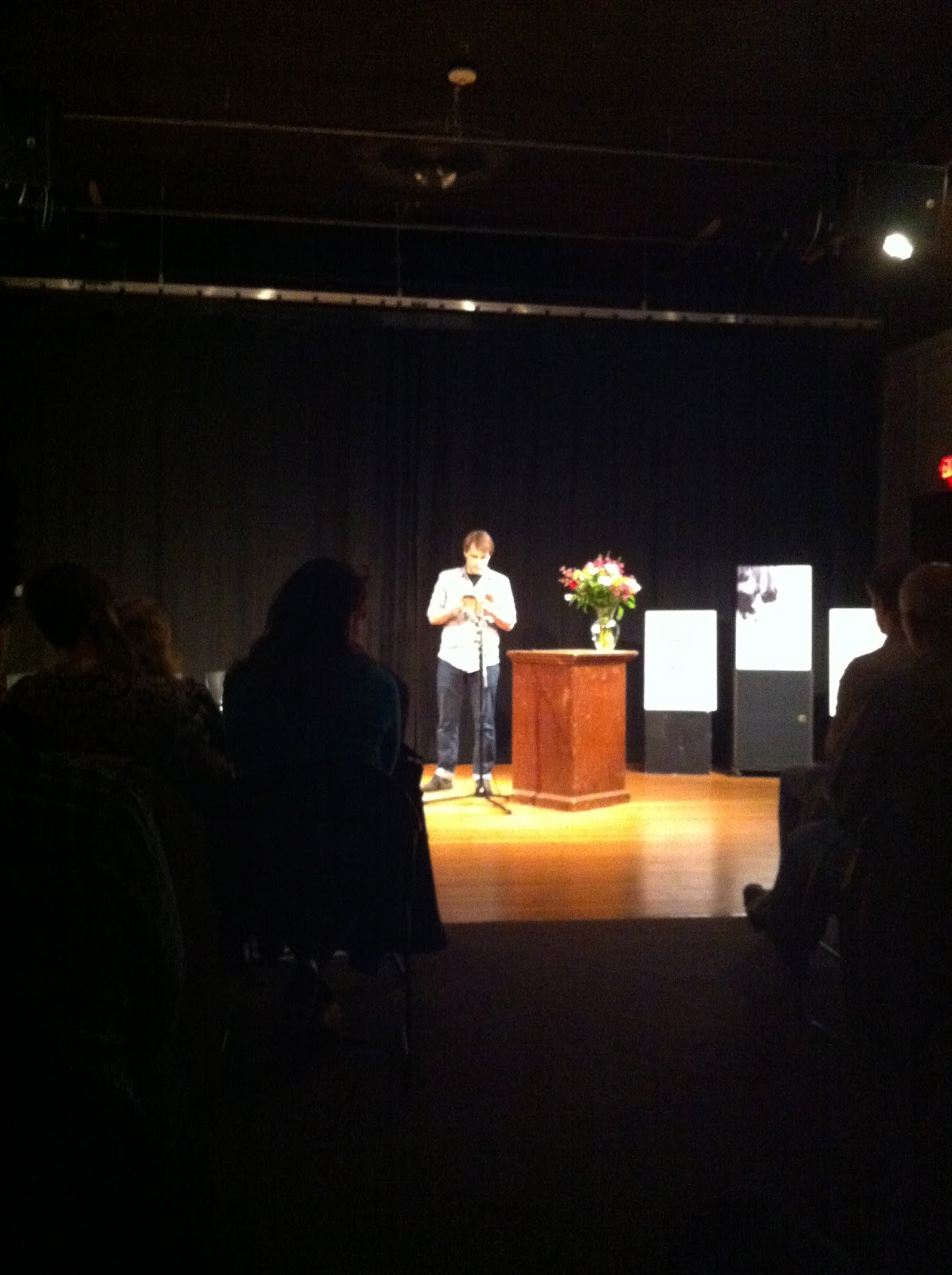
Nightwood Editions launched a trio of new poetry books in Vancouver tonight, with readings to a packed house at the Western Front. Publisher Silas White introduced Jay MillAr – himself a poetry publisher, helming Book Thug in Toronto – as one of the country’s underappreciated talents. MillAr set up half a dozen poems from Timely Irreverence by noting jokingly he’d seen a Green Day concert a few days ago and had now found a proper punk-inspired stance for reading poetry.
 |
| You can still see a little of the Green Day-inspired stance here. |
MillAr’s writing foregrounds a wry self-awareness: most of the poems thematize themselves as poems, as avowedly contingent verbal artifacts (as in the title poem: “I’m tinkering with these lines . . .”). Another preoccupation in his work seems to be with collisions of representation and violence, as in “More Trouble with the Obvious,” where in a kind of dark comedy of innocence he describes how “kids” turn found objects into imaginary guns, which still – as mundane alchemies, blurring creativity into threat – have the potential to “blow you away.”
Elizabeth Bachinsky’s poems from The Hottest Summer in Recorded Historyhave a lighter touch, but draw on a similarly intensive, if playful self-consciousness, setting formal detachment and poetic “craft” (“Eliot was right, it’s useless to describe a feeling”) against confessions of personal investment, of getting her feelings hurt:
To dislike this poem, to dislike me.
[. . .]
Astonishing. Poets like this word.
I like this word. I’ll use it again. Astonishing!
How could you not like me? Not like this thing?
She reminds me at times of Colleen Thibaudeau, with her fearless attachment to expressive particulars and to the pleasures of major-keyed melodic diction. As with her other books, Bachinsky’s range of forms (from villanelle to sonnet) is impressive; her reading of the mono-rhymed “Nails” was a highlight (check it out, get the book).
Brad Cran read a set of four poems dedicated to Gillian Jerome. These, too, are personal pieces, but very different in tone from Bachinsky’s. Some of the pieces in Ink on Paper have developed into what Cran has characterized as essay-poems: long-lined, longer texts that combine a narrative plainness (“It was days before Halloween . . .”) with almost journalistic descriptions of personal history and contemporary politics, like open letters, cut through with occasional moments of melopoeic density: “Fear beat in our chests like second hearts.” These are poems designed to communicate, without pretense or highfalutin obscurity: civic poems. Moving and provocative, they work so well when read aloud.


Never Be Touched Enough
This morning, writer, DJ and Poetry Is Dead editor Daniel Zomparelli posted to Facebook a snapshot of himself lecturing – at Pecha Kucha Vancouver, on April 11 – in front of an unnaturally large PowerPoint slide featuring the front cover of a trade edition of Suzanne Somers’s only poetry collection, Touch Me. The photo garnered a slew of likes, mostly from people who seemed to regard the image as a kind of playful meme. But Zomparelli takes Suzanne Somers’s writing seriously, as poetry. And I want to think about why he might be right, because I do, too.
I own a hardcover copy of the first edition of Touch Me. Along with my Bruce Springsteen mirror and my Sex Pistols coffee mug, it’s been one of my prized possessions, for years. I’m not sure where or when I found it or bought it – probably in a remainder bin at Zellers, although it’s not struck or marked as a cut-out. I can’t imagine I paid full price, but it looks like I might have. At first, I must have thought of the book as a joke buy, but in the last decade, as it sat unblinkingly on my office bookshelf, I have come to think of her collection of poems as significant, and as worth reading properly, fully and well.

To take these poems seriously, to take Suzanne Somers at her word, you need to learn to read in a mode that the poems can support. While they present themselves as intimate, confessional lyrics, it soon becomes apparent that they will buckle and wilt under even the slightest pressure of a close reading, of trained formal scrutiny. But they’re not meant to operate as what Cleanth Brooks would have called, in the decades of his influence, the decades leading up to their publication, “well-wrought” literary artifacts. Touch Me is a key instance of what early 1970s, post-Jonathan Livingston Seagull American popular culture would have understood as aspirational self-expression: “You have the freedom to be yourself, your true self, here and now, and nothing can stand in your way” (Richard Bach wrote this, somewhere in the second part of his groovy fantasia). Furthermore, it’s impossible to separate poetic text from its intentional frame, from Suzanne Somers’s nascent public persona, her unabashed desire for celebrity, to make herself known, as human commodity.
Pages of the book are interspersed throughout with black-and-white images (re-textured to resemble canvas) of Somers in various wistful and contemplative poses; this isn’t, or isn’t only, a faux-naiffeint of authorial presence, but it also openly describes how that sense of intimacy can be simultaneously authentic and constructed, at once a fully-fabricated persona and the real “me” of the title, almost touchable. “I could be all those things for you,” she tells an absent lover in “Some Other Time,” or tells us as his reader/stand-ins; the line mixes the artifice of role-play with erotic candour and intentional deference—and she sustains herself, in these poems, for “him” (often, but not always, Alan Hamel, who appears in two of the photos), and, as his surrogates, for us.
The poems always, always direct themselves at concocting privacy: “I like the gentle quiet loneliness of being alone.” The redundancy here is all-too-obviously awkward – again, it bears repeating that these poems will easily crumble under too close, and to my mind too unfair, an analysis – but as a refrain it overstates the outcome that all of her poetry craves: a fiction of proximity. The untutored, off-the-cuff bathos of many of her lines – “House plants have a way of invading my privacy” – only further reinforces the sense that we keep drawing closer, poem by poem, to her unguarded self.
Wikipedia dates the publication of Touch Me at 1980, on the crest of Somers’s success on Three’s Company, but the book actually first appeared in 1973, when she had had only a handful of small roles and cameos in film and had been a regular on the TV show Mantrap. More to the point, in 1970, just prior to the composition of Touch Me, she had done a nude “test” photo-shoot for Playboy, but had refused to be photographed for the magazine the following year; those photos were eventually published in 1980 by Playboy, in response apparently to Somers’s repeated public denials that they even existed. Significantly, her disavowal of such intimate images points up the fakery, the constructedness of an all-too-close, masculine scopophilia, exactly the same sort of desire – to be looked at, and to be touched – that her book of poems unerringly affirms. Touch Me, it’s worth noting, contains a satiric poem “The Model,” which offers an extended critique of her exploitation (“The smiling girl obediently transforms . . .”) by the erotic image-mill.
But her acknowledgement that such representation, in word and in image, inherently offers falsehood and deception, is counterposed in a poem fittingly titled “Lies” to the ability of the body (“my hands, my mouth, my caress”) to deceive; corporeal “lies” are worst of all because they mark not simply an artifice but a failure of connection, a hiatus: “And now I know something is over.” The denuded body can still obfuscate and play false, but in candidly confessing her failure, Somers restores a vestigial connection with her readers, as if we were sharing a secret, her small shame. By admitting that her body lies, she strangely reaffirms its truth.
This is a kind of celebrity apophasis, a disavowal that nonetheless delivers, or at least implicitly claims to deliver, what it withholds. And it’s a confessional marketing tactic that Suzanne Somers has used throughout her working life, a tactic that a severely negative review of her failed 2005 one-woman Broadway career retrospective The Blonde in the Thunderbird (a reference to her cameo in American Graffiti), made abundantly clear:
Ms. Somers is undoubtedly sincere in her desire to bare her battles with insecurity and shame in order to serve as a model, and perhaps a healer, for those whose therapy cannot be subsidized by the sale of Torso Tracks. [. . .] Liberally laced with the bland jargon of self-help books, her story proves the peculiar truth that a victory over low self-esteem often comes at the price of a swan-dive into narcissism.
Maybe so. But it’s this inversion of “The Emperor has no clothes” – a baring all that leaves her fully veiled, publically private – that has informed her self-presentation since Touch Me first appeared. “This is a book,” it says in the one-page introduction, “about touching—about human hands and arms, eyes and mouths, lives and memories, all the instruments of touch.” Well, only in so far as Suzanne Somers can present herself as common, as typically human. “Touch me,” the title poem concludes, “For I was made to be touched. / I can never be touched enough.” This kind of self-making, this auto-poiesis, both depends upon and mitigates against that commonality; we know, after all, that what we’re actually touching, holding, is a book of poems and pictures, a surrogate. She can never be touched enough because she can never be touched at all.
The echo, hardly deliberate but real enough, is of the Biblical Noli me tangere, “Touch me not,” which the unascended Jesus says to Mary Magdelene (John 20:17), caught in a post-Easter hiatus between flesh and light, humanity and transcendence. In The Space of Literature (1959), Maurice Blanchotconverts and rephrases this distancing imperative, a metaphysical disavowal, into a figure of what constitutes literature per se, Noli me legere, “Read me not”:
La même situation peut encore se décrire ainsi l’écrivain ne lit jamais son oeuvre. Elle est, pour lui, l’illisible, un secret, en face de quoi il ne demeure pas. Un secret, parce qu’il en est séparé. Cette impossibilité de lire n’est pas cependant un mouvement purement négatif, elle est plutôt la seule approche réelle que l’auteur puisse avoir de ce que nous appelons oeuvre. L’abrupt Noli me legere fait surgir, là où il n’y a encore qu’un livre, déjà l’horizon d’une puissance autre. Expérience fuyante, quoique immédiate. Ce n’est pas la force d’un interdit, c’est, à travers le jeu et le sens des mots, l’affirmation insistante, rude et poignante que ce qui est là, dans la présence globale d’un texte définitif, se refuse cependant, est le vide rude et mordant du refus, ou bien exclut, avec l’autorité de l’indifférence, celui qui, l’ayant écrit, veut encore le ressaisir à neuf par la lecture. L’impossibilité de lire est cette découverte que maintenant, dans l’espace ouvert par la création, il n’y a plus de place pour la création — et, pour l’écrivain, pas d’autre possibilité que d’écrire toujours cette oeuvre.
Pardon the long quotation, but what Blanchot is getting at is pretty close, I think, to what Suzanne Somers manages to articulate, in a more popularly pitched and less obviously “literary” text, as the stuff of poetry, of her poetry: the paradox of touch, which Blanchot characterizes as an impossibility of and within reading itself, a kind of persistent secret, the remains of a refusal to be remaindered, to demeure: a fleeting horizon of experience, however immediate and however publically private it might appear.
Fred Wah Speaking, and a Little “Ayler Music”

Thanks to Fred Wah, who gave a very fine and intellectually poised talk yesterday afternoon—“Permissions: TISH poetics 1963 Thereafter – ”—as the 2013 Garnett Sedgwick Memorial Lecture here at the University of British Columbia. He described the emergence of his own poetics alongside the founding of the mimeographed poetry journal TISH by a small group of student poets, studying with Warren Tallman and Ron Baker, among others, in the English Department here in the late 1950s and early 1960s. (The history of TISH is by now fairly well documented: see work by C. H. Gervais, Eva-Marie Kröller, Frank Davey and Keith Richardson. Those young poets—George Bowering, Frank Davey, David Dawson, Jamie Reid and Fred Wah—would go on, along with others associated with the group including Daphne Marlatt, to have substantive impacts on English-Canadian poetry and poetics.) Wah’s title, “Permissions,” alludes to the first poem of Robert Duncan’s The Opening of the Field (1960):
Often I am permitted to return to a meadow
as if it were a given property of the mind
that certain bounds hold against chaos,
that is a place of first permission,
everlasting omen of what is. (Duncan 7)
Wah suggested that Duncan’s visit to UBC in the summer of 1961, following on the publication of The Opening of the Field, offered an opening for him into a set of poetic possibilities, and presented “a place of first permission” in as much as it directed his thinking toward place, and seemed to offer him permission “to engage the local,” to turn to his own locale, Vancouver in 1961, as viable source matter for poetry. He remembered the impact of Duncan reading this specific poem at the university that summer. (Extensive audio of three lectures at UBC by Robert Duncan, delivered from July 23 to 25, 1961, and attended by Wah, can be found hosted on the Slought Foundation website, in a cluster curated by Louis Cabri; Cabri has edited Wah’s selected poems for Wilfred Laurier UP. The Fred Wah Digital Archive provides open access to essential materials, ranging from manuscript to video recordings, from throughout Wah’s body of work.)

His lecture traced a trajectory of concern in his own poetics, over the course of at least 50 years now, from place to face to race, as he put it, coming to his more recent interest in cultural hybridity. But at all points, he suggested, he remained attentive to particular figurations of opening, with Duncan’s text serving as locus (non) classicus, coalescing in the “space of [creative] equivocation” marked by the hyphen, an equivocation between permission and restriction that gives rise to certain uneasy formal traits in his writing. He referred to the impact of Gary Snyder’s innovative diction (in “Riprap”), of Robert Duncan’s “tone-leading of vowels,” and of Charles Olson’s projective verse, a “poetics yet to be found out” in which prosody served as a musical, generative tool. I don’t want to give the wrong impression; most of Wah’s talk was historical and anecdotal, and he occasionally drew out members of the audience (such as W. H. New) who had also been studying at UBC at the time. But I think I was drawn, as I listened, to the more technical and formal claims Wah made, his disclosures – sometimes in passing – about how his own ear for language works. Jazz improvisation, he suggested, “flipped him into poetry,” and as in jazz, he liked to play around with the music of words. I asked him afterward during the question period if he could elaborate a little, and he said that he understood improvisation “as a way of questioning assumed structures,” drawing analogies in particular with the capacity for chafing at the strictures of composition (and overly careful composure, perhaps) in the awkward excess of “the long phrase, the long ad lib.” (“I never did do well at composition,” he admitted.) A trumpet player himself, he referred to Miles Davis and Chet Baker; I understand the subtle instabilities Wah suggests he hears in both of those players’ phrasings, although I’m not sure about the length of their lines. In any case, the sense of the poetic line as interrogative breath seems to me to be crucial here, and something at the core of how Wah’s writing happens.
I first came to Wah’s poetry in the early 1980s when I was an undergraduate at the University of Western Ontario. I found a copy of his Breathin’ My Name with a Sigh (fresh and unopened from Coach House Press) on the shelves in the Weldon library, and I remember what struck me most were the indentations and spacings of the poems on each page, their typographical shapes. What caught my eye, too, was what I recall as a reference to Albert Ayler, to “Ayler music,” in one of the texts. I was getting deeper and deeper into Spiritual Unity and Vibrations and Witches and Devils at that point, and here unexpectedly, surprisingly, was someone writing poems that emerged, somehow, out of that open listening. It had been years, but before Wah’s talk I tried to search out the phrase, to find where it came from. It wasn’t, it turns out, from Wah’s book. It’s funny how lines can blur. I re-located it in George Bowering’s introduction to an earlier selected poems from Talonbooks, Loki is Buried at Smoky Creek (1980):
What the referential-descriptive mind sees as disorder (Chinese or Ayler music, for examples) is really part of another order. & not a competitive one, either.
So Wah is essentially a musician. He does not write fiction because his aesthetic is not geared to construction. (Once, trying to build a cabin, he put the hammer thru his front teeth.) Rather his muse urges continuity, making a line of music that disappears as it goes, like mist thru the branches. He blows solos that derive their meaning from their con-text (see how many of his poems are “letters” to other poets), in the whole forest of the composition. With others he conspires to sound our world.
He is the most musical of us all. (Loki 17)
The disorder-order dyad, which Wah reframed yesterday in his talk as permission-restriction, still obtains in his thinking, and Bowering’s intro is replete with resonances and flares (although he doesn’t quite anticipate the “bio-fiction” of Diamond Grill, and he makes Wah’s partial “Chinese” background seem a little too unproblematic). But when he says that “with others”—and Wah is, preeminently, I’d say, a poet of shared and open alterities—Wah sounds our world, sounds us out and sounds out to us, I think Bowering has it exactly right. And it’s this improvisational word-music, which some of us years ago thought we might have heard in a kind of generative relation to Albert Ayler, that Wah continues to pursue, and to make happen.
Some Books I Cited
Duncan, Robert. The Opening of the Field. New York: Grove, 1960.
Wah, Fred. Loki is Buried at Smoky Creek: Selected Poems. Vancouver:
Talonbooks, 1980.
– – -. Breathin’ My Name With A Sigh.Vancouver: Talonbooks, 1982.
My Poem of Ruins
(In February, I lectured on T. S. Eliot’s The Waste Land for Arts One, a first-year undergraduate humanities program at the University of British Columbia. Video versions of that lecture, which is an overview of the poem with an eye to the course theme of the “monster in the mirror,” can be accessed here. With my colleague Jon Beasley-Murray, I also discussed the poem, along with J. M. Coetzee’s novel Foe, in an audio podcast, that can be found here. This brief essay is an attempt to come to some personal terms with a poem I’ve been reading for over thirty years.)
Amid the iterative crescendo, the torrent of abstruse and fractured references with which The Waste Landbuilds toward formal closure (citing Arthurian legend, the Book of Isaiah, nursery rhyme, Dante Alighieri with Arnaut Daniel, the Pervigilium Veneris, Gerard de Nerval, Thomas Kyd, and the Brihadaranyaka Upanishad, almost all at once), one line stands out, anomalously clinging to a reflexive, lyric plainness and to a rhythmic heft that would soon come to characterize much of Eliot’s nascent liturgical poetry:
I sat upon the shore
Fishing, with the arid plain behind me
Shall I at least set my lands in order?
London Bridge is falling down
falling down falling down
Poi s’ascose nel foco che gli affina
Quando fiam ceu chelidon—O swallow swallow
Le Prince d’Aquitaine à la tour abolie
These fragments I have shored against my ruins
Why the Ile fit you. Hieronymo’s mad againe.
Datta. Dayadhvam. Damyata.
Shantih shantih shantih
“These fragments I have shored against my ruins”: for me, and I’m sure for many late readers of Eliot’s poem, this line offers without too much irony a small key to the interpretative challenges of The Waste Land’s broken whole; it encapsulates, with as much directness as the poem can manage, its difficult and seductive music. Not that this line stands alienated from any cultural intertext, as some nonce moment of romantic originality; I hear echoes of the autumnal decrepitude of Shakespeare’s Sonnet 73, where the leafless and bird-abandoned branches of a deciduous tree – themselves part of a sustained conceit, an ingrown metaphor comparing the poet’s aging aspect – are compared to “[b]are ruin’d choirs, where late the sweet birds sang.” Eliot’s line offers an instance of what the poem elsewhere names “that Shakespeherian rag,” when the allusive backbone of poetic canon begins to shred itself; the pentameter-based sureness of the sonnet is not lost, but starts to give way – with its missing end-stop and outriding unstressed final syllable – to its own audible ruin, shored up but crumbling. In a way, the line stands as a next-to-last gasp, a feint of vestigial originality, the expiration of the uninspired: Eliot briefly, nostalgically culling one more time, out of time, what Ezra Pound had called a “penty” lyricism from the shards of his trans-Atlantic English.
There is also an internal iteration, a dying echo: the line picks up and semantically retools the word “shore” from the mention of the fisher-king just above it. The western shores of Albion, the Atlantic verges of both promise and twilight, figure the sea both as mortal desert – the saline whirlpool picking the bones of the Phoenician sailor; the stale sea of Coleridge’s Ancient Mariner, water everywhere but not a drop to drink – and as creative protoplasm – the transformative bath of Ariel’s song, the pearls that were his eyes. To shore fragments against one’s ruin is both to beach the shards and remainders of self and culture, but also to shore up, to secure, to gather, and even to culture the scattered pearls of what might be left of Western European wisdom. What gets shored here on the poem’s formal terminus, at its ragged edge, is also subjective, personal: whoever this speaker is – and it’s tempting, given the scattered references to Eliot’s troubled private life in the poem (like the shoreline at Margate mentioned in “The Fire Sermon”), to identify this last “I” not as a persona, not some overdetermined Tiresias, but with Eliot himself, speaking candidly – whoever this speaker is in this particular line, he or she links those ruins directly with subjective agency, a reflexive capacity in language identified with a moment of intervention, of productive action: the lyric first-person staking its claim (“I at least”) as a speech act, in the iterative stuff of the poem: “my ruins.”
In a poem that appears to declare the exhaustion of its own means, and of poetic means generally, this one line offers a tenuous but palpable moment of verbal surety, of measure. Readers come to The Waste Land in these late days, ninety years or more after its first publication in The Criterion, with a sense of trepidation, of being culturally intimidated. But I think this trepidation has been carried alongside the poem since the inclusion of the footnotes two months after that first appearance: what was ever left to say about a poem that tries to say too much, and knows it does, making its bed in its own overwhelmed and overwhelming wreckage? Not much. But what does remain, for me, what lets me make these ruins also mine, somehow habitable for me as a reader, is the poem’s pulse, its measure, that music. In a 1988 speechintroducing a celebratory reading of The Waste Land, Ted Hughes remarks on “the curious fact” that “this immensely learned, profound, comprehensive, allusive masterpiece is also a popular poem. And popular with the most unexpected audiences.” (I tend to trust Hughes on Eliot, pretty much on the strength of his recorded readings of Eliot’s poetry; his Yorkshire intonations, much more than Eliot’s mid-Atlantic accent, resonates for me in these lines.) Its accessibility as poetry, Hughes declares, rests on a reader’s capacity to listen to and to hear its cadences, as well as its deeper music(s): “this notoriously difficult work is wide open, in some way, to those who can hear it as a musical composition.” Early on in the poem’s critical reception, F. R. Leavis noted that the poem’s order is essentially musical rather than logical or thematic, so in this regard Hughes isn’t saying anything that hasn’t been said before, but what he does reaffirm, for me, is the sustained immediacy – despite all the critical wear and tear – of Eliot’s “whisper music,” or what Hughes identifies as the poem’s “assemblage of human cries”:
A woman drew her long black hair out tight
And fiddled whisper music on those strings
And bats with baby faces in the violet light
Whistled, and beat their wings
And crawled head downward down
a blackened wall
And upside down in air were towers
Tolling reminiscent bells, that kept the hours
And voices singing out of empty cisterns
and exhausted wells.
Reminiscence and nostos, the pool of cultural memory, may be exhausted, fraught, depleted, but those voices still sing. And they don’t merely seem to sing; they do it. The poem doesn’t just thematize song, but aspires to it, to a condition of music. The iterative echolalia out of which the poem fabricates itself – drawn out in the eighteen-syllable last line of the passage above, which gesticulates toward its own extension, its excess – isn’t so much a set of traces or afterimages as it is a persistence, a choral sustain. Something like what Gilles Deleuze, thinking of late modernist composition, might have called an assemblage (though I’m sure this isn’t exactly what Hughes might have had in mind when he used the term). No matter how many times I come back to The Waste Land, I keep thinking that I can hear it. Still.
Reminiscence and nostos, the pool of cultural memory, may be exhausted, fraught, depleted, but those voices still sing. And they don’t merely seem to sing; they do it. The poem doesn’t just thematize song, but aspires to it, to a condition of music. The iterative echolalia out of which the poem fabricates itself – drawn out in the eighteen-syllable last line of the passage above, which gesticulates toward its own extension, its excess – isn’t so much a set of traces or afterimages as it is a persistence, a choral sustain. Something like what Gilles Deleuze, thinking of late modernist composition, might have called an assemblage (though I’m sure this isn’t exactly what Hughes might have had in mind when he used the term). No matter how many times I come back to The Waste Land, I keep thinking that I can hear it. Still.
A last note about Hughes, Eliot and – incidentally – me: in his speech, Hughes compares Eliot to what he transliterates from Gaelic as fili, a composer-bard. “Ideally,” Hughes says, the fili “carried the whole culture of the people. He was the curator and the re-animator of the inner life which held the people together and made them what they were.” Big boots for a late modern poet to step into, but boots that Hughes, a little extravagantly but appropriately, suggests that Eliot, with his Mallarméan ambitions to purify the dialect of the tribe (and which Hughes had echoed in his own acceptance of the laureateship), might fill. One possible Celtic etymology for my own last name is mac an filidh, “son of the fili.” Which means something like I might come after them, trying to find a few of their footprints.
A Windy Boy and a Bit
[This is another review essay that never made it into Canadian Literature. I delivered a version of part of this text as a paper to the Dylan Thomas Society of Vancouver in October 2003, I think.]
A Windy Boy and a Bit: Dylan Thomas at Full Volume
1.
When I was fifteen — in tenth grade in Truro, Nova Scotia — poetry started to matter to me. What held me was the built-in abstraction of any poem, what I took to be its inherent difficulty — something that appealed to my pretenses of alienated sophistication, one of the worst of teenage vanities. Small town adolescence creates a dire need to believe in your own young genius. You end up driven by palpable faith in your unheralded yet overwhelming significance, and you’re pushed by cosmic injustice to be, for a flash, “famous among the barns,” singing tragically in your local chains.
Late in that school year I horned in on a song by Pete Townshend, longstanding bard of teenage wastelands, a song I thought nailed my predicament dead-on (from Rough Mix, a record he made with Ronnie Lanein 1977): “I want to be misunderstood, / Want to be feared in my neighbourhood. / I want to be a moody man, / Say things that nobody can understand.” Well, maybe I didn’t want to be feared, but at least found out, remarked for my cryptic and appallingly contrived bitterness. The poetry I liked — and I was very particular about it from the get-go, although I’d barely read enough of anything — resonated with what I thought I absolutely knew, the crux of my goofy, half-baked intellectual machismo. I craved poems with a kind of latter-day masculine bravura, perhaps to offset what I wrongly assumed were the frailties of artistic work, and I wanted hard and strident voices to make their way into my breaking, pubescent croak.
So, there were three writers to whom I gravitated immediately. Robert Frost’s formal elegies, his temporary stays against confusion, bespoke an untenable paternity setting its teeth against its own inevitable collapse: it was heavily Oedipal, and I heard in Frost’s arch lines a way to wrestle with the laws laid down by all the fathers, my own or anyone’s. (For Christmas that year, my mom and dad gave me A Tribute to the Source, a Frost selected with misty New England photographs by Dewitt Jones; I couldn’t ever get past “Buried Child,” and still can’t.) The second of my triumvirate was John Newlove. I had found his selected poems, The Fat Man, in the high school library, and their chiseled ironic edges cut at the world the way I thought I wished I could, grimacing through the hellish existential manhood of his Samuel Hearne. (I had also asked for a copy of Newlove for Christmas, but the cashier at the bookstore sold my mother Irving Layton as a substitute, telling her it was “the same sort of thing.” Not exactly. Although Layton’s “Cain” — a poem of restrained father-son violence — is still one of my favourites, for some reason.) And then there was Dylan Thomas.
I bought a used copy of Thomas’s Dent Collected Poems from the “Nu to Yu” shop. I’d also saved some money from my summer job as a boxboy at the IGA, and bought Quite Early One Morning — a scrapbook of reminiscence, poetry and radio scripts — and, probably the first book I can say I really valued as a book, as an object: a sandy-colouredNew Directions hardback of the 1930s Notebooks, edited by Ralph Maud. This rough and unready Dylan had a sprawling immediacy that seemed especially ripe in my own meager time and place. He had remained suspended on the page young enough to be relocated to small town Nova Scotia, I think, because of the way those obscure and elitist performances, an adolescent brashness finding and wagging its tongue, tended and still tend to lift themselves out of history, out of context — even, or especially, as the material aspect of those unfinished holographs in scribblers, tends to reassert those very limits. These books unknotted and then retied their lacings, and became Truro poems, teenage poems: mine.
For me, as for many readers, Thomas’s recorded voice offered a form of verbal religiosity, of spirit possession; the man himself long dead, his speech could nonetheless carry forward from the spiral scratch of a phonograph track to animate and stir our tenuous present. I found a Caedmon double-album of Thomas readings in the Truro public library, and kept renewing it. (I had recently progressed from the Junior to the Adult card, a major shift in borrowing possibilities.) From this compilation, however, I found I leaned toward the later poems of ecstatic resignation, flush with fractured verbiage and hobbled by overripe nostalgia; the spittle-cloyed choruses of “Lament,” the hawk- and curlew-heavy upheaval of “Over Sir John’s Hill,” and the chiming, verdant bluster of “Fern Hill.” Harper Audio has issued Dylan Thomas: The Caedmon Collection, an 11-CD set gathering all of Thomas’s spoken-word recordings released by Caedmon. Thomas’s records, as many will know, were both the foundation and the mainstay of Barbara Cohen and Marianne Roney’s Caedmon label, which went on to release some of the most significant recordings of poetry and prose in the mid-twentieth century. Thomas also recorded a number of poems included in this set both live and in the studio for the CBC at Vancouver in “late May 1952,” as the notes to the collection point out, when he was on the second and last of his two reading tours of the West Coast. (This date, however, remains problematic; according to some sources, Thomas read and recorded — in conversation with Earle Birney — on 6 April 1950; his second appearance in Vancouver was on 8 April 1952, and he was not likely here in May of that year. Surviving letters and postcards place him and Caitlin on a ship at sea that month.) The transplanting that I managed to effect as a teenager, carrying Thomas across time and the Atlantic into my own embrace, retooling “Wales in my arms” for Canadian reception, was already ghosted into the recordings themselves; his voice had already arrived here, only to take flight again into the false eternal present of the stereo lp.
The Caedmon Collection reproduces in CD-sized miniature the covers of Thomas’s albums. As anyone who collects records knows, their particular material presence, their 12-inch square glossy cardboard, matters a lot, and the Caedmon compilation gestures at this nostalgia, in a conveniently reduced format; you can hold all the transcriptions of Thomas’s voice, his digitized remains, in your hand. This wan materiality emerges in Seamus Heaney’s poem “The Bookcase,” from Electric Light. In his lyric, Heaney eyes the coloured spines of his books, and remembers not merely voices but encounters, intersections, coursings; the thickness of paper and binding melds with the poems themselves, their verbal textures:
Bluey-white of the Chatto Selected
Elizabeth Bishop. Murex of Macmillan’s
Collected Yeats. And their Collected Hardy.
Yeats of “Memory.” Hardy of “The Voice.”
Voices too of Frost and Wallace Stevens
Off a Caedmon double album, off
different shelves.
Dylan at full volume, the Bushmills killed.
“Do Not Go Gentle.” “Don’t be going yet.”
Unlike the Heaney of this reminiscence, or Thomas, I was never much of a drinker — in fact, when I was wearing a groove into “Do Not Go Gentle into That Good Night,” I remember being more often than not strangely prudish; poetry seemed to fill the same selfish gaps as Heaney’s Irish whiskey might, that indulgent loneliness every boy wants to pickle in — but I know exactly what he’s writing about here: the poem that wants not to fade away, to keep going, even as it manages to sustain nothing but, nothing much more than, its own bald longing.
In “Dylan the Durable?” — the interrogative title is significant, and suggests much of the unresolved duplicity of “The Bookcase,” where the invitation to stay that remains largely unanswered — a 1991 lecture reprinted in part in his Finders Keepers: Selected Prose 1971-2001, Heaney reads in Thomas’s villanelle a formal reflex “turning upon itself, advancing and retiring to and from a resolution”:
The villanelle, in fact, both participates in the flux of natural existence and scans and abstracts existence in order to register its pattern. It is a living cross-section, a simultaneously open and closed form, one in which the cycles of youth and age, of rise and fall, growth and decay find their analogues in the fixed cycle of rhymes and repetitions.
While Heaney seems keen to fall into step with mid-century mythopoeic interpretations of Thomas — the Biblical archetypes, books of nature and Blakean contraries that saturated the first flush Thomas criticism — he nonetheless finds the vital instability at the core of this thoroughly formalized not-yet-an-elegy. But where Heaney abstracts and generalizes this uncertainty into a thematic of “youth and age,” the poem is actually more specifically gendered: it is about fathers and sons, a refusal to relinquish the bond to his father, even as it takes up the poetic work of fathering, of parthenogenesis: the poem itself, rather than merely producing formal analogues, rages against a deathly, stultifying parental stricture even as it affirms, in that contradiction, a fierce and fatherly imperative. And it performs that rage, most famously, in the contradicted doublet of its penultimate verbs: “Curse, bless, me now.” The child, as Wordsworth says, is now father to the man; Jacob and Isaac exchange places, and then trade again, in the urgent pleading of Thomas’s blasted prayer. This demand, as simultaneous question and plea that refuse not to be put, seems to me best grasped as adolescence. It cannot accept its dutiful forms, and chooses defiance of the paternal in order to affirm its surging and unruly life-force that drives its green age, even as it wants only to inhabit those forms for itself, and discovers itself blasted and made dumb by childishness. It wants, like all adolescents, to be both adult and child at once. If we scan Heaney’s selected essays, we discover too what is obviously a need for poetic maturity and respect — he tends to write only about the poetry of Nobel laureates, Harvard lecturers and old friends, to position himself within a kind of transnational academy — coupled with a pervasive nationalist pastoralism, all those Irish vowel-meadows where he ran and the peat-bogs where he dug in his youth. I don’t mean to deride Heaney, but instead to point to the necessary and vital adolescence of what he does. And to use such a claim to look back, and forward, at my own willfully unresolved reading practices.
2.
Heaney mentions no Canadian (and very few commonwealth) writers, and we could hardly expect him to. Or maybe we could. But he does provide a hinge into a more localized nationalism, one that inheres not in artificially stabilized cultural thematics, a Canadian-this or Canadian-that, but in its own ardent instabilities, an adolescent discomfort that is not to be overcome but embraced. This sweetly duplicitous craving permeates Albertan (now Mexican-resident) Murray Kimber’s illustrationsfor Fern Hill (from Red Deer College Press), the middle volume — from 1997 — in what now appears to be a trilogy of work commencing with his brilliant 1994 collaboration with Jim McGuigan, Josepha: a prairie boy’s story, for which Kimber won the Governor General’s Award for Illustration , and concluding with The Wolf of Gubbio, a retelling of a legend of St. Francis of Assisi by Michael Bedard, published in 2000. But where both of these texts are narrative, and lend themselves to a kind of captioning, as events from story are depicted by brush, Thomas’s “Fern Hill” has, at most, only shards of plot, and coheres musically rather than descriptively, in the relative abstraction and obliqueness of time remembered, a blurring of present recollection and past recollected in incantatory pastoral surges: “Now as I was young and easy under the apple boughs . . . .” Temporal modalities collide in this famous opening gambit, interlocking the immediacy of the poem’s writing, the jetztzeit of that conventional “now,” with its historically orchestrated and orchestrating subject, “I was.” Kimber intensifies this interlace of here and there, now and then, both in the arrangement of his sixteen illustrations and in their subject matter.
Kimber’s work focuses on two principal figures, represented in two small watercolour cameos that frame the main text: on the title-page, he offers us the head and shoulders of a prepubescent boy, rendered in reddish fleshtones against a purple wash; on the recto of the last page, facing a page-sized reprint of the complete text of “Fern Hill,” he sets his counterpart, a patriarch in tweeds and cap, whose open eyes and quiet pinkish smile suggest a knowing serenity. This final image echoes the first illustration, apposite to the first three lines of the poem, which shows the same old man, now rendered in light blues with oils on canvas, but now with his eyes closed and mouth gently crimped. Kimber’s intention is to suggest the poem’s tenor of reverie in age, despite the fact that Thomas was in his early thirties when he wrote it, and to link memory both to aestheticized wonderment — the “darling illusion” of recollection as Charles G. D. Roberts once put it — and to pastoral vitality; the green apples that decorate the old man’s red scarf (their tones in sharp contrast to his pallid complexion) displace the real apples of those sagging boughs onto textile pictorial, past life sustained as lovely wearable art. In the second illustration, we see this capped figure walking, but now the boy and a horse run forward from him, surging right toward the next page of the book. The palette, too, shifts from blue to peach, yellow and deep green, as the present is revived in “the heyday of his eyes,” that splendid driven vision.
Kimber’s fourteen oils (not including the watercolour miniatures) form a visual sonnet, structured in a nested frame. The image for the first three lines, the solitary face of the dreaming man, are recapitulated in the image for the last three, the same figure, now shown head to toe in the middle ground walking alone with his bare feet in the surf; the second image — man, boy and horse — is replayed in the second to last illustration, where these three figures are rejoined, although now to close the loop as we go “riding to sleep” under an equine constellation, the forward push of the former image moderated by dark purples, as man and boy, his old and young selves, walk homeward hand in hand, their backs to us as they depart across the pasture into a shadowed, moonlit farmhouse. Thomas’s poem, though highly formalized, bears little resemblance to a sonnet, but Kimber’s visuals nonetheless uncover a version of the form, dividing the first and last stanzas in three, and the remaining four stanzas in two (grouped mostly in clusters of three or four lines, with no illustration crossing between the existing stanzas). In effect, Kimber’s illustrations surround a core octave, made up of four pictorial pairs, with two tercets or triptychs, creating a recursive envelope (3-[2-2-2-2]-3) that, as I’ve already tried to indicate in my description of the opening and closing illustrations, affirms a fixed architecture. The strong outlines and lapidary textures of Kimber’s figures confirm this essentially sculptural, even monumental tendency to his style, an effort I think to stay the mutable, and to arrest the ragged arc of time. Recurrent motifs — farmhouse, ladders and fences, a married couple holding hands or standing kissing, burnished barns, even the vertical trunks of trees — solidify this stasis, a circularity that emerges from the almost obsessive repetitions of motifs and even whole phrases in Thomas’s poem: “green and golden,” “nothing I cared.”
Simultaneously, Kimber energizes this visual torpor, the viscosity of his oils, with diagonal flashes and unresolved tangents: river flow, shooting stars, floating drapes, running horses that refuse to be contained by borders or grids. This kinesis, too, comes from Thomas’s poem, in the ungraspable syntax of the third stanza, for example: “All the sun long it was running, it was lovely, the hay/ Fields high as the house, the tunes from the chimneys, it was air/ And playing, lovely and watery/ And fire green as grass.” The run-on, thematized in the poem itself, distends and stretches Thomas’s closed, formal architecture like so much verbal taffy. Time, though chained and bound, sings excessively, testing the tensile bonds of poetic enchainment. Kimber’s paintings embrace what Thomas appears to understand as the creative push of memory, the force that drives his green age, in their lovely dehiscence, as they catch at the fraying of time itself, at the doubled assembling and dismantling that inheres in the sustained “now” of the image.
So, this is much more than a children’s book; perhaps the music of this sometimes confused and difficult poem would attract a child’s ear, though the nostalgia of the text itself is fully that of an adult. It is best thought, perhaps, as an adolescent work, the text and visuals hovering between the child-like wonder the writer craves and the deathly adulthood he wants to refuse. It is a fine and engrossing work of male desire, of longing.
Kimber’s work is also mindful of its history; his landscape style echoes primarily the post-impressionists, especially Paul Cézanne’s rectangles and triangles, although his green forests clearly draw on Emily Carr’s vortices and his fields on the horizontal plains of Illingworth Kerr (perhaps something of a carry-over from his work on Josepha ). His portraits fuse the blue ovals of early Picasso with the ripe colours of Frederick Varley, I think. I’m not suggesting that Kimber’s work is derivative, nor do I wish to claim that he has merely Canadianized early European modernism. Rather, like my own youthful transport of and by Thomas, Kimber’s paintings position themselves in a kind of negotiated middle, resolutely of this place and yet thoroughly conscious of their own displacement. Thomas’s poem, Welsh though Fern Hill itself may appear, actually takes place nowhere, or rather in the many imagined nowheres of memory from afar. It can’t quite be grasped, but can only be, to take Pete Townshend out of context, misunderstood, misprised and, as Heaney suggests, respoken at full volume, reintroduced into your own place and time. Just as the poem would have time stretched into the present, and across it like a screen, so too can Thomas be reimagined, remade in the crucibles of eye and ear, as he and you and I go running together “out of grace” and into a world where, however much unheard, we can still somehow sing.
 Flow, Fissure, Mesh