Flow, Fissure, Mesh

Sheila Jordan and Cameron Brown: Tuesday Night at Ironworks, 3 March 2015
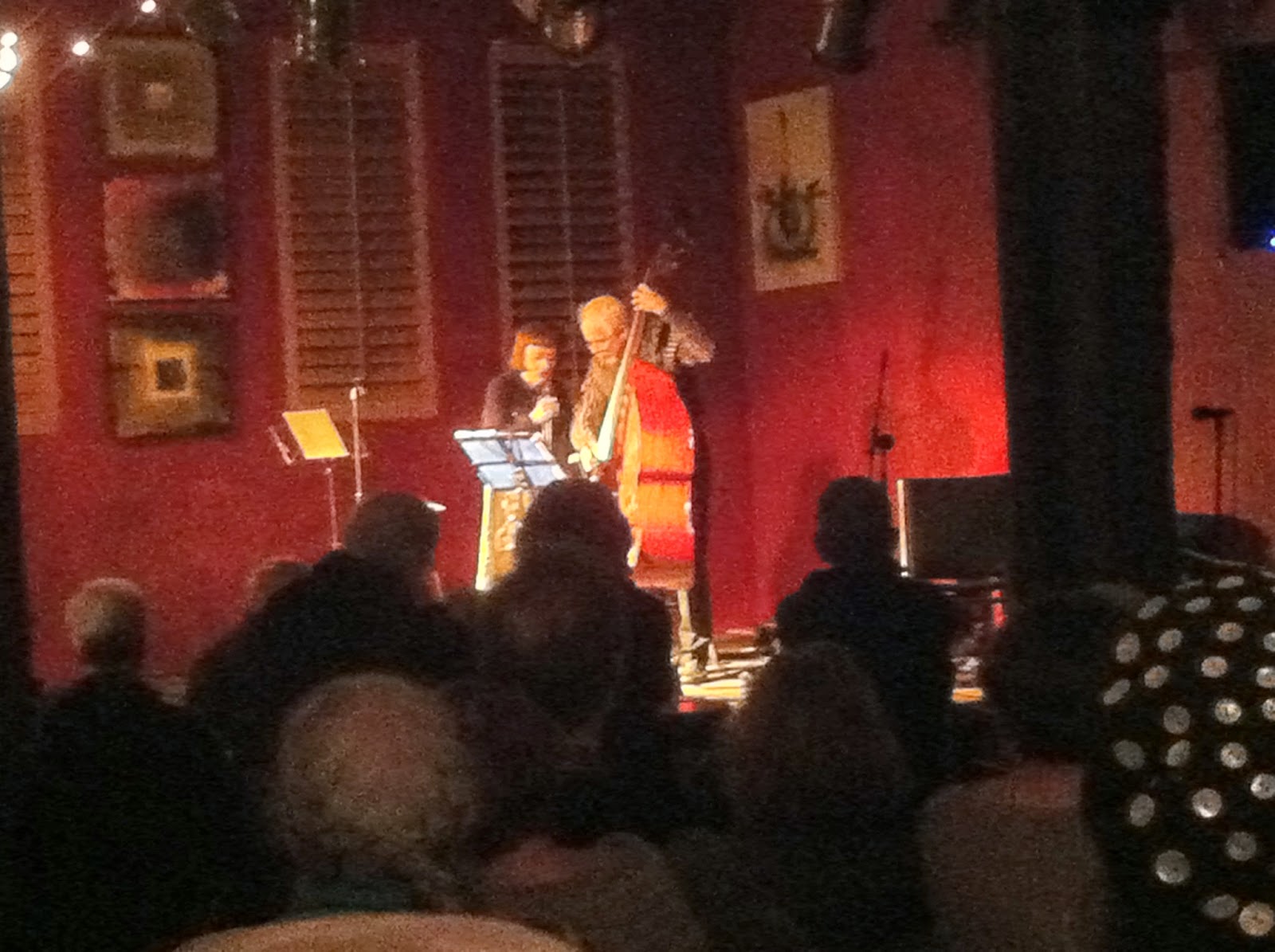

Still a jazz childat eighty-six, Sheila Jordan – who performed in her duo with bassist Cameron Brownlast night at Ironworks in Vancouver – has a vitality and playful joy that show no signs of abating. Her two sets consisted of well-developed material – medleys of standards and classic bebop, peppered with a few originals – that she’s been performing for decades, emerging primarily out of her work with Harvie Swartz. That said, every song sounds thoroughly fresh, immediate and compelling. Her lower register has taken on a little grain, but her lilting scat lines, the chirrup and purl that are hallmarks of her vocals, are undiminished: the lightly off-kilter cadences of her improvisations are as intimately compelling and as warmly engaging as they have been since her stunning 1962 debut record, Portrait of Sheila (where she defines close relationship to the bass – in this case, Steve Swallow – that comes to shape her music for the subsequent half-century). 


          We all have our favourite Sheila Jordan records; aside from Portrait of Sheila, which is an indisputably essential album for any collection, I love The Crossing (1984, on Blackhawk) and her performance on Steve Swallow’s settings of Robert Creeley poems, Home (1980, ECM): I often find myself unexpectedly humming “Sure, Herbert . . . ” out of the blue. Despite what can sometimes feel like a timbre of quiet restraint, Sheila Jordan’s voice attains a peculiar resonance; it stays with you, softly plangent and quickly sonorous. The performances last night closely matched the material on Celebration (2005, High Note), which is I think the first live recording of her work with Cameron Brown, but you could never tell that this music was over a decade old. This is late work, for Jordan, certainly, but it’s also vivacious and exuberant; aside from some street noise coming through the club walls, the audience was so quiet and intensely focused on the music you could hear Cameron Brown’s fingers brush along the strings of his instrument.

A Sheila Jordan gig offers enraptured attentiveness, a focused close listening, but she’s also just so infectiously happy, laughing and larking through each song. Commenting on the flubs she sometimes makes in her “old age,” she said there was no need “to get uptight about it. As long as your heart and soul are in it, it doesn’t matter.” She and Cameron Brown started off with an introductory blues – “And so I’ll sing of joy and pain for you / With all the happiness this melody brings” – followed by a standard, “Better Than Anything.” A version of “It’s You or No One” came next, which Brown had also recomposed by adding a new, boppish melody to the changes, and re-naming it “Sheila, It’s You.” Cameron Brown is an extraordinary bassist, his fleet and virtuosic lines emerging from a depth that recalled Charles Mingus. (Shelia Jordan opened the second set with an anecdote about singing in duo with a bassist for the first time when she was sixteen and Charles Mingus called her onto the stage to do a version of “Yesterdays”; they also offered a take, amid a tribute to Billie Holiday, on Mingus’s “Goodbye Porkpie Hat.”) There was a medley of dance-themed tunes dedicated to Ginger Rogers and Fred Astaire (“I loved this cat, I’d walk two miles to see him dance . . .”), and another medley of songs associated with Oscar Brown Jr. that included her wonderful version of Bobby Timmons’s “Dat Dere” (which also appears, in tribute to Sheila Jordan, on Rickie Lee Jones’s Pop Pop). To set up her “Blues Medley for Miles” (“Blue Skies,” “All Blues” and Jon Hendricks’s transcription of the trumpet solo from “Freddie Freeloader”), she told a story of Billie Holiday sitting in a dark corner of a club warbling out “Miiiiiiiiles, Miiiiiles” while Davis soundchecked in a basement club in New York: he apparently asked if a stray cat had got into the room, which she thought was hilarious. Sheila Jordan – her music and her persona – is all about jazz history, recounting stories of her encounters with musicians in the 1950s, especially Charlie Parker. She did versions of what might have been “Yardbird Suite” – I’m a little slow on the uptake sometimes – and what was definitely “Scrapple from the Apple”; Bird, sixty years after his death, was still a keen and powerful presence. She also gestured at her own Seneca heritage, vocalizing in an American Indian style to frame a version of the Jimmy Webb country ballad “The Moon’s a Harsh Mistress.” She acknowledged that the Seneca Queen Alliquippa was her great-great-great grandmother, – and so, she said, if it hadn’t been for Columbus she might have been royalty. The second set closed with an invitation to guitarist Bill Coon to join Jordan and Brown for a trio version of her anecdotal “Sheila’s Blues.” She offered her healing, restorative song of recovery, “The Crossing,” as an encore. As she left the stage, she laughed and called out to everyone: “Have a beautiful life, and if I don’t see you again, I’ll meet you in heaven.” Her music and her voice offered us all a gift of affirmation and of colloquial joy.


On Stephen Burt, The Use of Poetry and the Use of Place

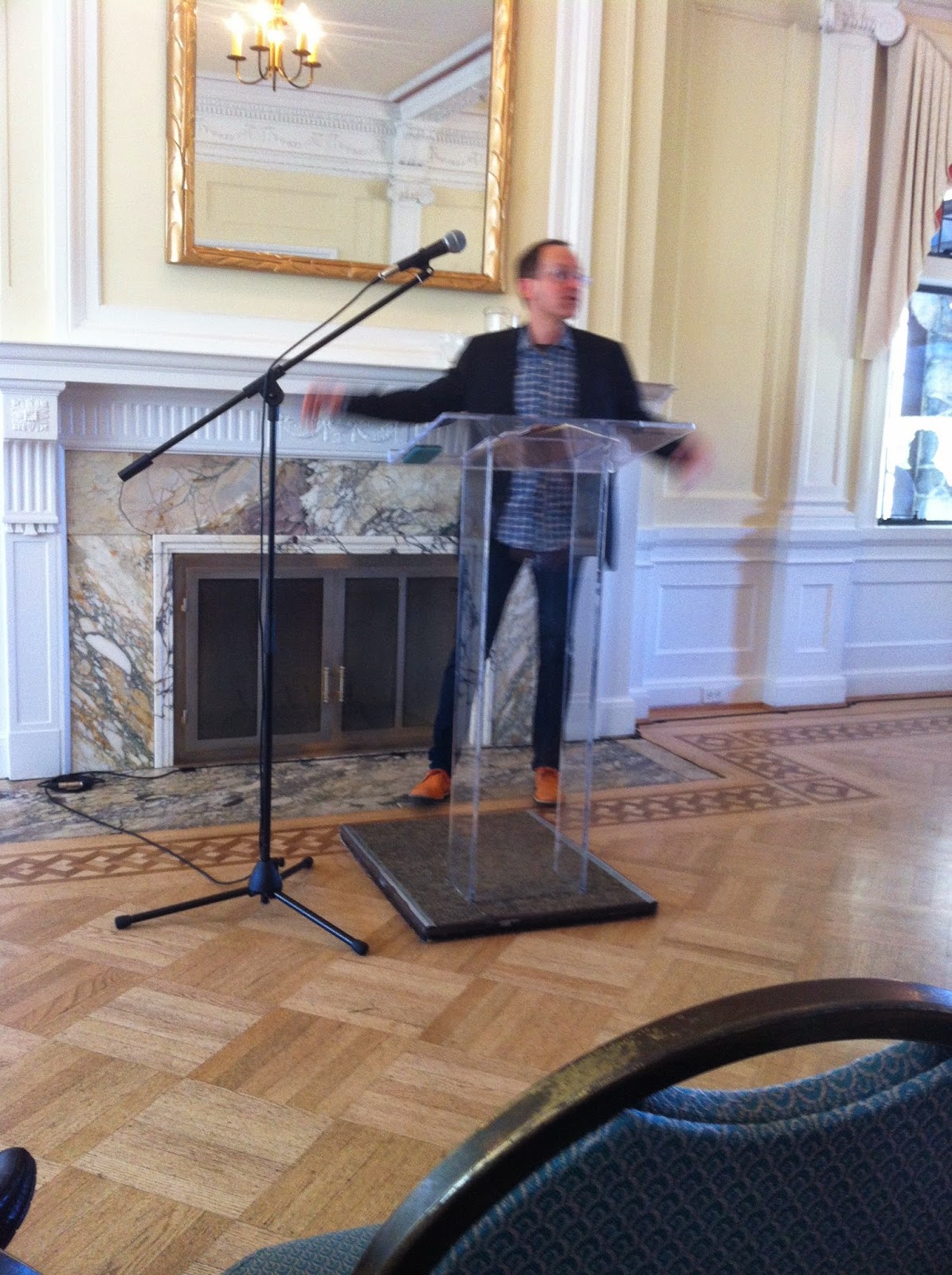
Stephen Burt delivered the 2015 Garnett Sedgwick Memorial Lecture at U. B. C. yesterday on “The Use of Poetry and the Use of Place.” For those who don’t know his work, he’s a professor in the English Department at Harvard University, currently teaching courses on “ways of reading and ways of hearing poetry” and on literature and sexuality; he’s also written extensively on poetry and poetics, particularly on the work of Randall Jarrell, and he’s published three collections of poetry. What I have discovered I like most about Burt’s critical writing, apart from its combination of clarity and intensity, is a willingness – or better, an articulate desire – to recoup lyric vitality from ideologically and aesthetically disparate poets, writers who, as he puts it, tend to disagree “in first principles, and  . . . come from all over,” yoked by an inclination to stylistic difficulty (see his Close Calls with Nonsense, page 6). Poems communicate texturally, for Burt, and those textures can sometimes be recalcitrant and forbidding, seemingly within the purview of intellectuals and literary academics; but poems also communicate, nonetheless and despite themselves, with certain affective immediacies, and it’s that public reciprocity that also draws his eye and his ear. As he puts it addressing himself in “Over Nevada,” a poem describing – circumscribing? – the prospect from an airplane window over Las Vegas, poetry distills formally from language a vital creative muddle, interstitial reciprocity, Simonidean coinage, exchange, indebtedness and gift: “How could you ever sort out or pay back what you owe / In that white coin, language, which melts as you start to speak?“ The communion of readers is fleeting and spectral, , but also, despite its frustrations, it is of this exact shortfall, it is this exact shortfall, that lyric language materially speaks.  


         His talk drew out a conceptual antithesis that marks the lyric, an ambivalence between the transcendental, “departicularized” tendency of lofty abstract language – that it happens anywhere, outside of history – and the concrete particularities of descriptive circumstance, that whatever happens inevitably has to happen somewhere, to someone. What’s interesting for me aren’t the terms of this opposition, which are so general as to be fairly banal, but Burt’s energetic investigation of the tensions between them as the stuff and the source of poetic work. Most loco-descriptive poetry, he argued, connect outward geography – I’d suggest, physiography – with “inner life” – I’d suggest not only physiology but also psychic topography. What persists, despite claims by Charles Altieri and others that the poetry of place has long since run its course, is according to Burt an intuitive sense of commonality tied to imagined place: that place, however articulated, is still  intersubjective, communal. He concentrated on the work of two key poets, for him: C. D. Wright and Mary Dalton. Quoting from Wright’s “Ozark Odes” – “Maybe you have to be from here to hear it sing” – Burt developed the homonymy of here and hear to suggest that Wright’s poems generate the textures and particularities of place apophastically, allowing the reader access through lyric attention, through the melopoeic richness of her geographically precise diction, to a phenomenologically rich encounter with that particularity. You hear the place, you sense it, palpably, in Wright’s words, despite and even because of her skeptical refusal to claim communicative success. The withdrawing “melt” of her language, in other words, is also recombinant and evocative, a plenitude. Burt gestured at Elise Partridge’s poem “Dislocations” (from Chameleon Hours, 2010 version) which also presents a “hybrid” form of lyric apophasis, refusing to lay claim to any naïve or grandiose transcendence while also, at a moment of surprising intensity, discovering how poetic intelligence still fuses to its descriptive objects, as “you feel your strengths intermingling.” One of the pleasures of Elise Partridge’s poetry, Burt said, is that its “attention to place does not preclude migration from one place to another,” and that some of her best work inheres in those transitions and intermediations. He concluded his talk with an investigation of some of the poetry of Mary Dalton. He was especially taken with how human geography and dialect words, in her poems, “imply the physical geography that the words produce.” He focused on the seductive estrangements of encountering the moments when she seemed to open her Newfoundland word-hoard. “Maybe you don’t have to be from there,” he concluded, “to hear it sing.”


Briefly, Taylor Ho Bynum and Francois Houle Duo at The Apartment, Vancouver, August 29, 2014
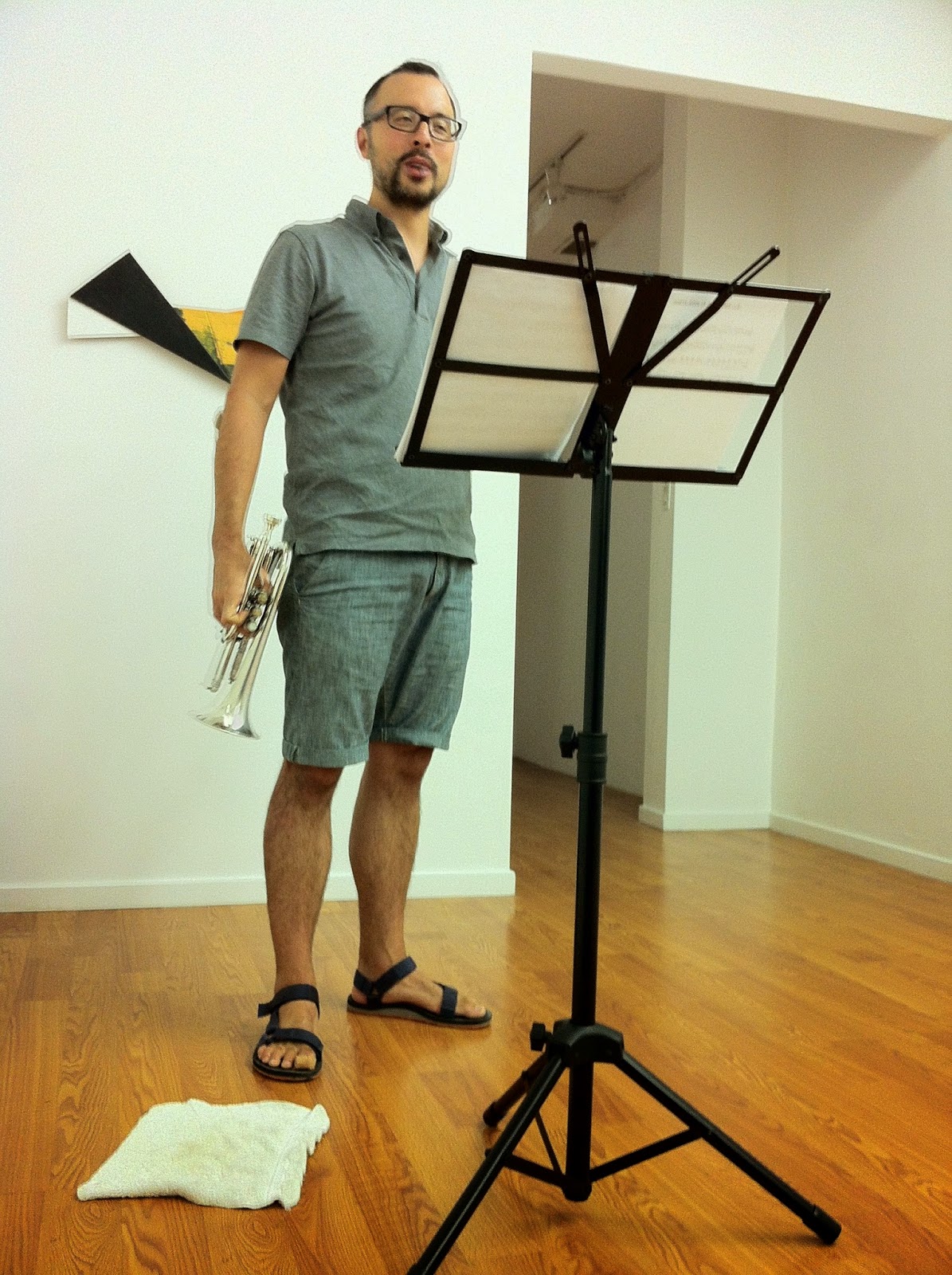
[There are a number of things – poems, travel, concerts, media stuff – from the summer and fall of 2014 I was set to write about, but life and whatever seem to have taken precedence, so I’m going to try to catch up on some of these things in the next few weeks. I have about a dozen or so fragments that need reworking, expanding, editing and polishing before they can make their way into the Frank Styles neighbourhood. Here’s the first of a bunch.]
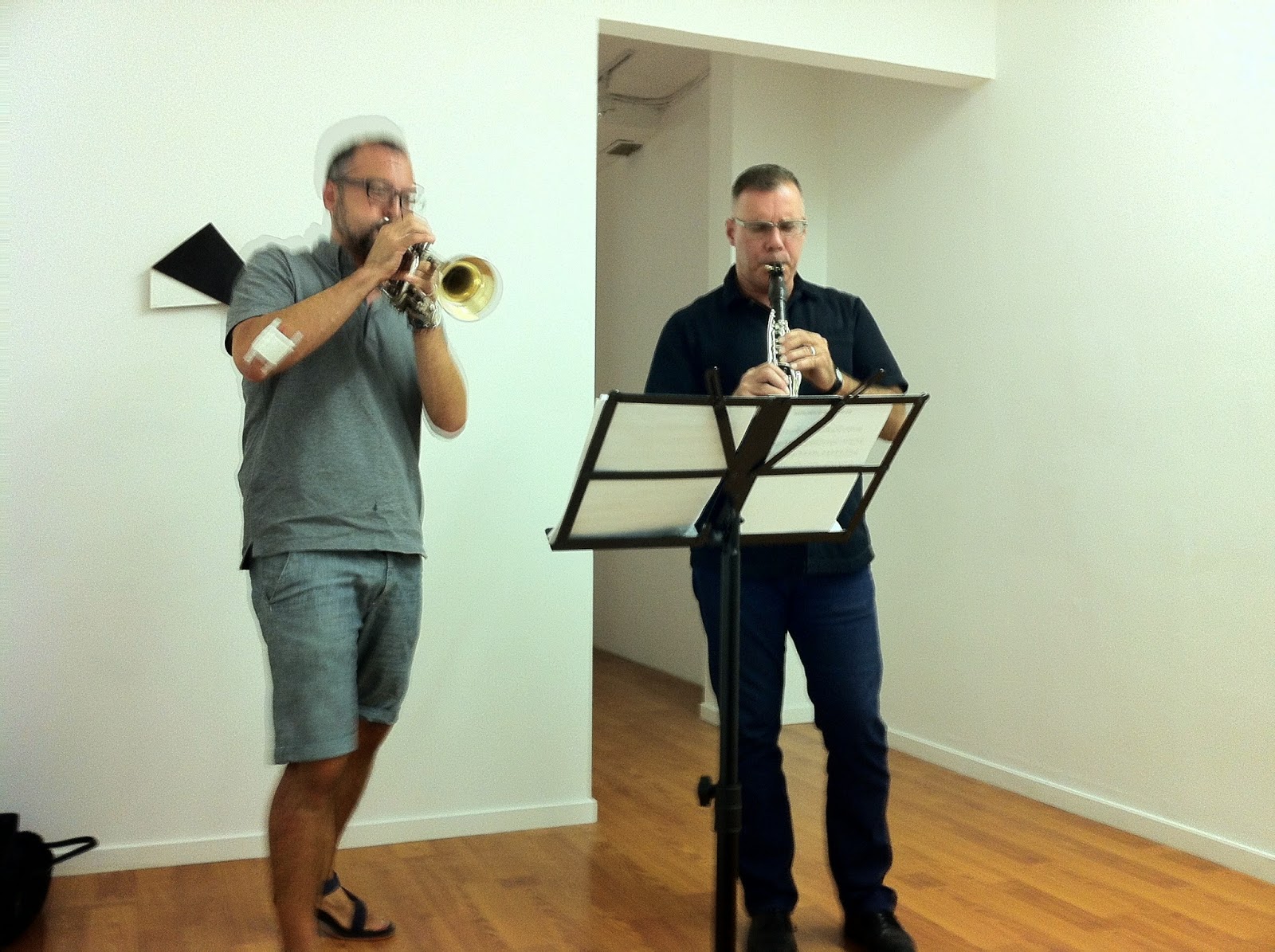
On the night of Friday, August 29, Taylor Ho Bynum played a duo concert with François Houle at The Apartment, a small gallery on East Pender, just off Main Street in Vancouver’s Chinatown.  It’s been a while, but I took down a few notes to jog my memory. Taylor started with a solo piece; the concert was the first semi-official stop on his solo West Coast Bicycle Tour, which would see him pedal a huge number of miles alone down the left coast of North America, through September to early October. He kept an on-line diaryon his website, and has put up excerpts of his musical encounters – some planned, some by happenstance – on a Sound Cloud page. The solo had shards of marches, echoing maybe a little some of Anthony Braxton’s interest in John Philip Sousa and brass marching bands, but with mixed in growls, swoops and other cornet chop suey, concocting a few momentarily avant-Cootie-Williams-like lines. 


François Houle joined him for a version of Taylor’s composition “All Roads Lead to Middletown.”  Here is a field recording of their performance:

And here is a  duo version Taylor Ho Bynum recorded with Anthony Braxton in 2002 at Wesleyan: 

A version of Houle’s composition “Seventy-Three” followed, a tune originally recorded on his album In the Vernacular (Songlines, 1998), which is dedicated to the music of John Carter. Carter, Houle said afterward, would have been seventy-three at the time of the recording. Much of the music, besides its in-the-moment spontaneity, was vitally self-aware of its own historicity, its sense of a present deeply enmeshed in lineages and antecedents, but dynamically and restlessly so. Houle also mentioned Carter’s duets with Bobby Bradford: forebears who continue to open up new and challenging possibilities for this music, as part of a living tradition of experimentation and forward motion. The duo played “Shift” from Taylor’s suite Apparent Distance, and then closed with a blistering and challenging reading of Anthony Braxton’s Composition 69c, a sinuous monody combining bluesy flatted fifths with angular sonic geometries. (At the set break that followed, a little out of breath and a bit unsatisfied with his performance, Taylor recalled speaking with Kenny Wheeler about how difficult and even lip-splitting playing Braxton’s compositions in the quartet could be.) For the second set, the duo returned with versions of two Carter pieces (played originally with Bobby Bradford): “Comin’ On” and “Sticks and Stones.” 

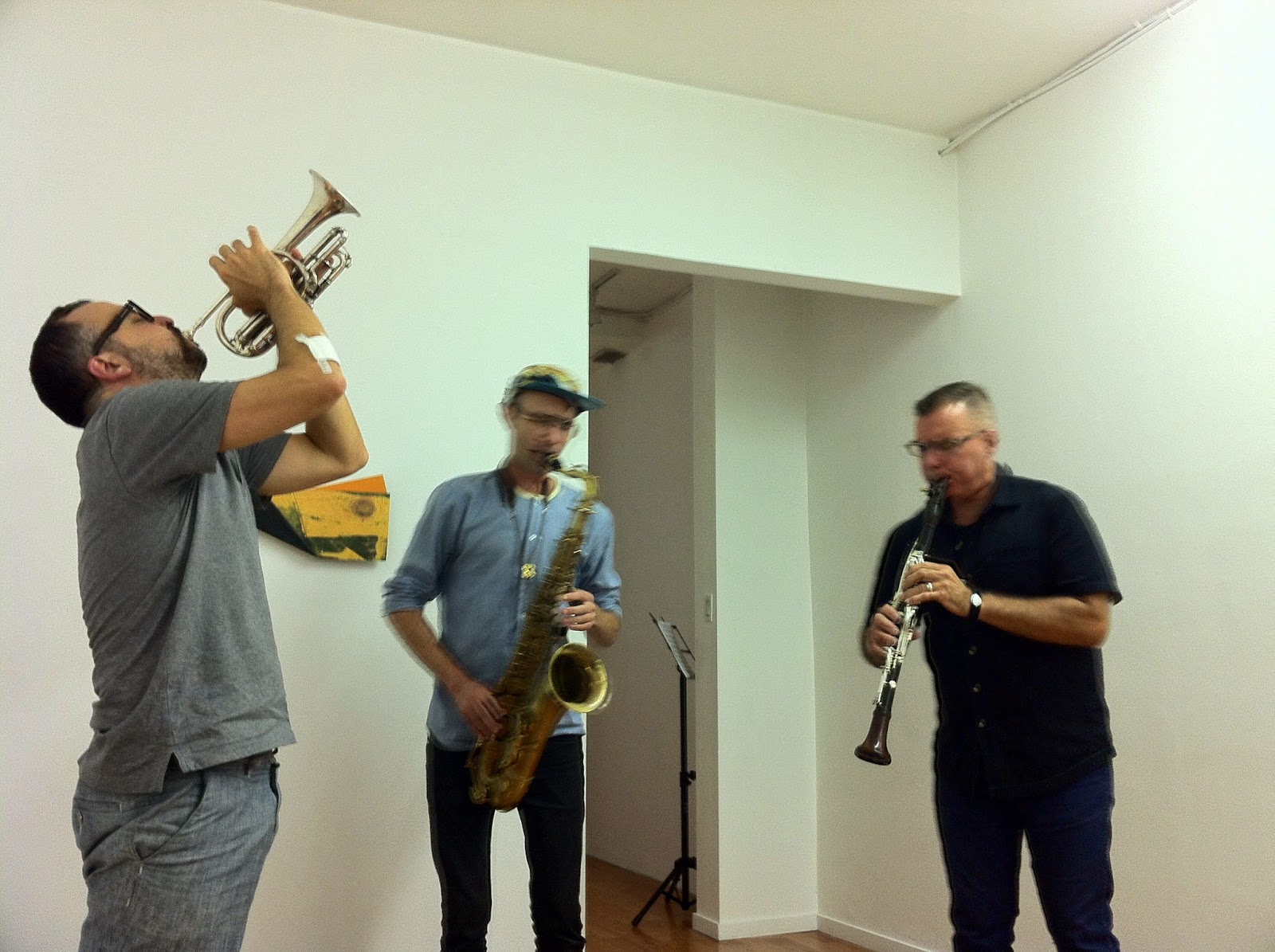
The concert closed with an extended trio; Houle invited tenor saxophonist Nils Berg to come up, and they offered a ten-or-more minute extemporaneous tone poem, with Berg’s contributions recalling the restrained lyricism of late Lester Young, or perhaps even Warne Marsh in a reflective mood. Beautiful things: bright moments, as Rahsaan might have put it. Here is Taylor’s field recording of the trio, so you can hear it for yourself.


Frankly,
KM

Short Take on Thumbscrew Live at Ironworks (Vancouver, 7 February 2015)
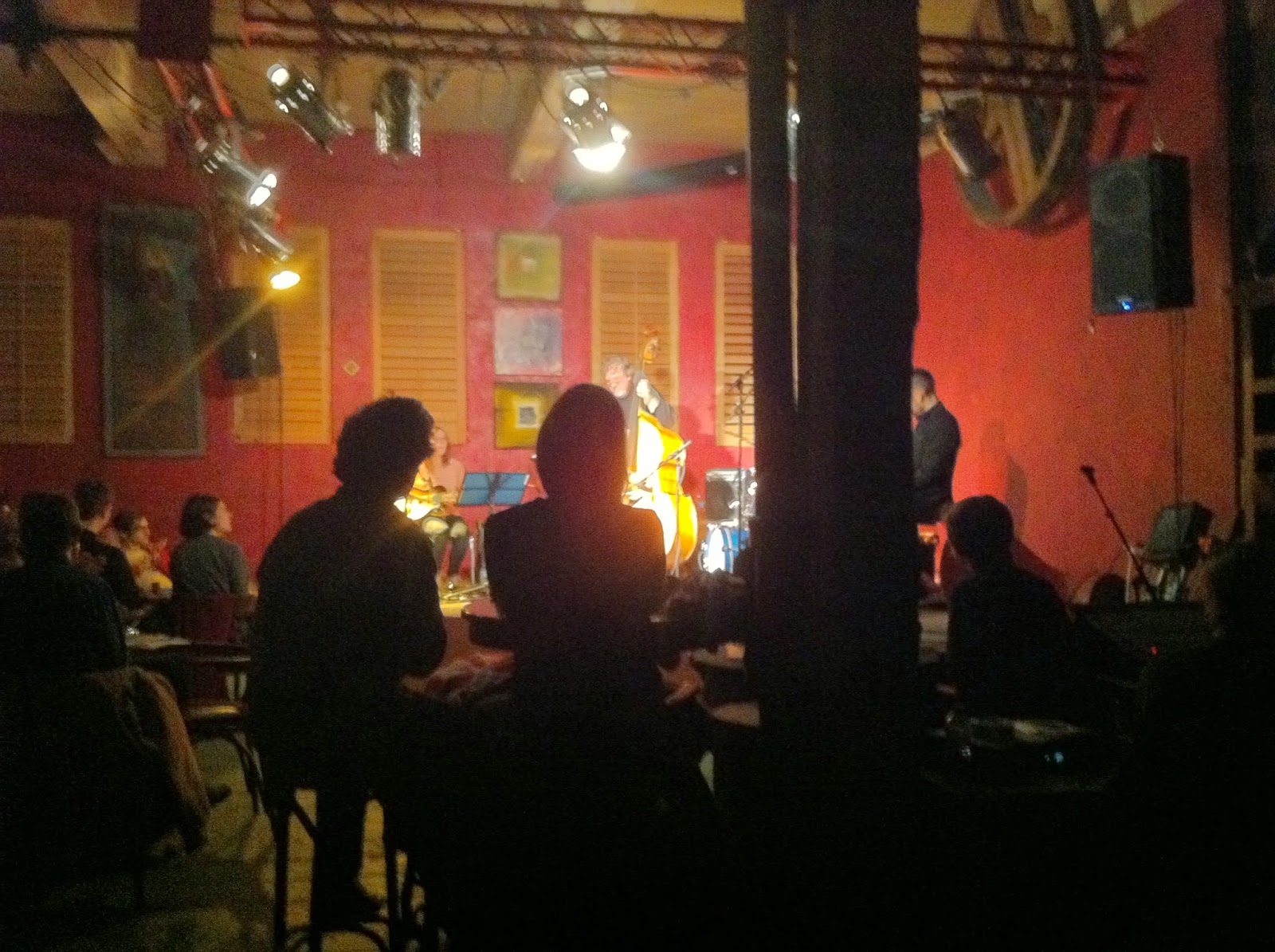
Mary Halvorson, Michael Formanek, Tomas Fujiwara (obscured behind people and a post)
Thumbscrew offered up two provocative and powerful sets at Ironworks on Saturday night. Building mostly on compositions from their eponymous album (released on Cuneiform last year), the trio’s music combines infectious come-and-go grooves with rhythmically angular, kiltering melodies and collaboratively deconstructive improvisations to create warmly engaged yet restlessly exploratory performances. Mary Halvorson’s guitar alternated between keening warbles and electrified growls, mixing bendy Johnny Smith-like chords with harder-edged Hendrixisms, cross-purposed and glassily recursive loops with tensile, open mellifluence. Her focus and calm demeanour on the bandstand seemed almost belied by the metallic, clarion fierceness of her sound. Michael Formanek’s firm, resonant bass prodded the trio forward, pushing at the leading edge of the beat. He frequently smiled, looking back and forth between his bandmates as his he drew reverberant, lithe lines from his instrument – which underlined the joyful intensity of their collaborative playing. Tomas Fujiwara’s drumming danced in and out of the pocket, by turns muscular and fleet, turbulent and tight. His body angled slightly back from his kit, he tended to face away from his bandmates, eyes closed, but only to increase what felt like his closely attentive, kinesthetic enmeshment in the group’s shared sound, their collective pulse. A few of the pieces were counted in – 1, 2, 3, 4 – but, still palpably embedded in a fixed metric, they were able to pull and surge and suspend and attenuate the beat to the extend that time itself became organically elastic, fluid, distal.  
The first set list, as far as I could make out from their announcements, started with “Line to Create Madness” (Halvorson), followed by “Buzzard’s Breath” (Formanek), “Nothing Doing” (Fujiwara), a fourth piece the name of which I missed, something called (I think) “Barn Fire Slum Brew” (Fujiwara) and “Still . . . Doesn’t Swing” (Formanek). After the break, they returned with “iThumbscrew” (Formanek), “Falling Too Far” (Halvorson), “Goddess Sparkle” (Fujiwara), a new piece by Mary Halvorson called “Convularia” – which she said had been named at her father’s suggestion after a “sweetly scented and highly poisonous plant,” the contrariety suggesting something of the tensions between the lyric and the spiky in her own and in the trio’s playing – followed by a fifth piece that might have been “Fluid Hills in Pink.” They were called back by an enthusiastic audience to play an encore – “we have exactly one more song” in their repertoire, they joked – which was an edgy ballad, to close a terrific evening of music by a brilliantly innovative trio.

"A Friend in the Art": For Elise Partridge

Galanthus, 31 January 2015
Weeks early,
snowdrop clusters poke
through moss and unraked, rotted leaves:
green, fetal fingertips,
small-scale
backyard congregations, the chewed
ends of some child’s coloured pencils,
spring stubs.
Friends in the vernal art,
they’ve already
managed to start
unclosing their glandular blooms,
split, mute bells
inclined to tremour
in this one winter’s milky breath.

This piece is for Elise Partridge, who died a week ago. Her poems and her friendship over the past twenty years have meant a great deal to me. I hope my brief elegy pays some tribute to her life and work by attending to the kinds of small, often unremarked things, like snowbells, that her poems often did, in a mode that wants to approach her own careful craft. Hers is a poetics of care — in its senses of close attention and rapt formalism, of respectful humility and warm concern. I last heard Elise Partridge read her poetry in January 2012, at the Vancouver Public Library on a triple bill with Stephanie Bolster and Barbara Nickel, two other members of the Vancouver Poetry Dogs. That night, I bought a copy of her chapbook, which was a supplement to her second book, Chameleon Hours, and she autographed it for me, as “a friend in the art.” Elise had done readings with me many years ago — I recall presenting on poetry and translation with her at Brock House (Esther Birney and Miriam Waddington were in the audience) in, maybe, 1998, and she had also invited me to several meetings of the Poetry Dogs, though I soon fell away from attending. In the past year or so, I hadn’t seen very much of her at all, and I regret my negligence. She was a deeply kind, warmly engaged person, and a truly gifted poet. 


A Short Take on Vertical Squirrels, Time of the Sign

Time of the Sign, the third album from the improvising collective Vertical Squirrels (and their second on Montreal’s Ambiances Magnétiques label), is a modest masterpiece, and ranks for me among the very best recordings of 2014. Vertical Squirrels formed as a quartet in 2008 in Guelph; its core members are faculty at the university there, three of them researchers with the Improvisation, Community and Social Practice (ICaSP) research initiative. Pianist Ajay Heble is the founder and (until this year) Artistic Director of the Guelph Jazz Festival, and his academic and curatorial work have brought him into close contact with some of the finest free improvisers in contemporary music. Guitarist Daniel Fischlinhas collaborated with Heble on key works in improvisation scholarship (including The Other Side of Nowhere [Wesleyan, 2004] and The Fierce Urgency of Now[Duke, 2013]) and is an eminent Shakespearean. Electric bassist Lewis Melville taught in the Department of Botany (now Molecular and Cell Biology), and the quartet’s original percussionist Rob Wallace was an ICaSP postdoctoral fellow. In the years leading up to the recording of Time of the Sign in June, 2012, Wallace moved on to other academic employment, and was replaced by drummer Ted Warren.

         The band is expanded to a septet for this recording, and includes Jane Bunnett(on flute and soprano saxophone), Scott Merritt  (on guitar) and Ben Grossman(on hurdy-gurdy), with contributions from Larry Cramer (on trumpet) and – not, perhaps, to be underestimated – Dave Clark (improvised conduction). Many of the musicians double on miscellaneous electronic and little instruments, an echo of some of the performance practices of the Association for the Advancement of Creative Musicians in Chicago. The Vertical Squirrels’ electronic press kit suggests that the group was “initially conceived as an informal outlet to get Heble back into playing piano after years of curating the Guelph Jazz Festival (but rarely performing himself),” but the music doesn’t centre on Heble. Lewis Melville also (on this and the other recordings) is credited as the principal producer, and seems to be something of the instigator for the group. (A recording of his composition for foghorns at the Sound Symposium in St. Johns Newfoundland is also used as a sonic underlay for the last track on the album.) But I think it’s important to emphasize the decentred character of this music: not that it’s ever incoherent, but that no single voice ever predominates or directs. There are no solos on this record, which is partly why I wanted to emphasize something like its modesty: not to say that any of the players is ever diffident or deferential; if anything, each contributor’s line or instrumental texture only adds to the gathering energies, the obvious vitality and shared dynamism that every track evinces. But there is also a proactive humility, a thoroughly engaged mutual practice of listening, that informs this music: each player seems instinctively to know when to sound and when to lay out, and what results is a set of warmly shifting, variegated accretions, folds of resonance and dehiscence, an electro-acoustic version of what Byron, of all poets, once called “voluptuous swell.”

         By saying that there are no solos, I don’t mean to indicate as absence of melodic line or improvisational drive, but rather that this music emerges from simultaneous reciprocities, layers of polymorphic call-and-response but also of departures and excursuses that loop in and out of the general, generative flow. (The music was recorded live, open to the public, over the course of two days: the session announcement is still on Facebook.) The press kit, again, compares their music to some of the improvisational jams of Frank Zappa, and I can hear that, certainly, in their communal emphasis on rock ostinato, riff and groove. But I hear a collation of influences, closer at times to, say, Ornette Coleman’s Prime Time group around Virgin Beauty (1988) – without the insistently spiky harmolodic angles of the leader’s alto – or, at other moments, echoes of the audio-Americana of Lyle Mays and Pat Metheny. (Ted Warren’s electronically treated vocals on the title track closely recall Mark Ledford’s melodic doublings with the PMG.) The compiled electric pianos of Miles Davis’s In a Silent Way sometimes feel present, and the opening track, “Falling from the Ground Up,” recalls as it unfolds McCoy Tyner’s work from the early 1970s, while Lewis Melville basslines fall at several points into a Tinariwen-like pulse. None of these audible influences ever quite settles or takes hold for more than a minute or two, however, and what emerges as each cut builds is a buoyant, unstable and living audio organism, a porosity. Each time I listen, I hear new things, other textures: the shifting mesh, for instance, of Fischlin’s and Merritt’s guitars set against the phasing, metallic stringiness of Grossman’s hurdy-gurdy and Heble’s roiling and gangly piano makes for a rich differential polyphony. This music is essentially collaborative not because it demands agreement but because it honours co-creative multiplicity, a coming together apart, not to produce community in difference, not to overcome a plural and sometimes unruly lived humanity, but a community of differences, a soundscape that embraces and welcomes the open auditory field of the many, of disenclosure, of more. Time of the Sign is one of the great recordings of committed collective improvisation. 

Isabelle Stengers, "the most amiable of philosophers"

I’m intensely grateful to the Graduate Program in Science and Technology Studies (STS) at UBC for inviting Isabelle Stengers to lead a seminar on her reading of Alfred North Whitehead’s Process and Reality, and on what she calls “cosmopolitics.” In practice, she didn’t really lead a discussion so much as aim to foster spontaneous interchange and to interrogate and even challenge some of her own thinking; her recent book is called Thinking with Whitehead (2002, trans. 2011)—rather than thinking about or explaining—and the character and practice of that with-ness, of a reading that involves co-creatively being witha work rather that staging some sort of magisterial (professorial?) exegetical mastery of it, is what I think for Stengers makes philosophy matter.
Still, the seminar involved less mutual interchange—less a practice of collaborative speculation, a discursive echo of the “open ontology” she wants to address—and became more about participants posing questions to Professor Stengers about her work. She had offered two papers for participants to read ahead of time, in the hope, perhaps, of avoiding professing, although given the opportunity of having her present in the classroom, it’s certainly understandable why a rather formal question-and-answer session might happen. Describing, in one of those papers, the emergence of her term “cosmopolitical,” she points to how “gripped by worry,” by what sounds like anxiety over philosophical reach, she “needed to slow down.” That slowing is not a diminution of attention but rather its intensification—an attention, moreover, that remains iterative and hermeneutic, but that also aspires to a reading practice that is co-creative rather than derivative or, in the mundane sense, rather than merely critical. “It’s better to read slowly,” she said in the seminar, “in order not to have understood everything.” Reading doesn’t aim at comprehension, but to actualize the creative potential in careful misprision.


She doesn’t really articulate an aesthetics in Thinking with Whitehead, if by aesthetics you mean a theory of art. But what she calls the “adventure of the senses,” of aesthesis, pervades her meditations on Whitehead’s writing and thinking. What Professor Stengers wants a seminar to become, I think, is something that Whitehead describes, in Process and Reality, as “intense experience without the shackle of reiteration from the past. This is the condition for spontaneity of conceptual reaction” (Process and Reality 105). The active mind slows into the present tense, but that spontaneity—I want to call it improvisation, but Stengers does not—is not without relation to a past, without any iterative purchase on (reading) history. Rather, the active, embodied mind, as one reads, becomes (to borrow a few metaphors from both Whitehead and Stengers) an electromagnetic resonator, an amplifier, an interstitial matrix: “It receives from the past, it lives in the present” (Process and Reality 339). The interstice—the fictive and material space “between the lines” of tissue, of both flesh and text—is a crucial trope for Stengers, marking both a material and a societal openness, a biological and a conceptual betweenness (betweenity?) that offers the condition of possibility for communities of difference, for community as difference, the unresolved and contrary, risky situation of the speculative seminar itself: “speculative presence, and the eventual efficacy associated with it, constitutes the wager of the interstice” (Thinking with Whitehead 514). “Life,” as Whitehead puts it, “lurks in the interstices of each living cell, and in the interstices of the brain. In the history of a living society, its more vivid manifestations wander to whatever quarter is receiving from the animal body an enormous variety of physical experience.” (Process and Reality105-6) Those “vivid” intensities don’t and can’t happen all the time, and I’m not even sure what a seminar conducted along those lines of sustained risk might look like, might feel like, but in the classroom yesterday, what for me was notable was how often Isabelle Stengers laughed. Her laughter was never nervous or imperious or cynical—although she did make it clear that she doesn’t abide thoughtlessness or “stupidity”—but manifest moments of vital warmth, her celebratory enthusiasm for thinking that matters, in the present. I couldn’t help but hear, as well, the nascence of an interstitial poetics, an ecology of writing that attends to some as-yet-unapprehended upwelling of life between its own unfolding lines. 

Books
Isabelle Stengers, Thinking with Whitehead: A Free and Wild
Creation of Concepts.  2002. Trans. Michael Chase.
Cambridge: Harvard UP, 2011
Alfred North Whitehead, Process and Reality, corrected
edition, ed. David Ray Griffin and Donald W. Sherburne.
New York: Free P, 1978.

All Good Possibles: Ken Babstock, On Malice

Ken Babstock read last Tuesday evening at Book Warehouse on Main St., for the Vancouver launch of his latest collection On Malice, which appeared a little earlier this fall from Coach House Books. The book gathers three extended pieces and a skewed sonnet sequence: “Perfect Blue Distant Objects,” “Deep Packet Din,” “Five Eyes,” and “SIGINT.” The emphasis falls variously in each agglomerated text on distraction and noise, on riddled and riddling semantic textures, on versions and variorums.  A little like Tom Raworth, Babstock inclines his ear closely to the saturated, thickened flows of mediatized language — “the streaming of form from the machine” as the closing line of “Deep Packet Din” puts it — catching at and contingently arresting on each page those overlapping currents, those soupy waves of vestigial sense. Each poem presents itself as a species of media drill core, a striated section of repurposed data-packets, reconstituting voice as shifty aggregates of sedimentary, lexical samples. Reading these lines, I rarely know quite who or where or how I am meant to be, or to be positioned: “The excess space junk making / prayer beads of morning’s screaming / party.” Speech cannot settle into consistency, and the speaking subject asserts itself as verbal ragpicker, as audio splicer. “May we become / noises,” somebody eventually does pray in “Perfect Blue Distant Objects.” Just so.
         Over the past year and a half I have heard Ken Babstock read three times: at Tuesday’s launch, in late October at the Vancouver International Writers Festival (as one of eight featured in the Poetry Bash), and last spring at the Play Chthonics series at the University of British Columbia, which I was coordinating. At each reading he concentrated on presenting slices from “SIGINT,” the opening sequence from On Malice. Given the complexities of this poetry and my own limited space here, I’m going to concentrate on making an initial foray into reading “SIGINT,” rather than attempting to come to terms with the book as a whole.  Even as networked arrays, each of the extended poems of On Malice is constructed and derived from a principal source, an originary pool from which its draws much of its noise; “Perfect Blue Distant Objects” refigures an essay on optics by William Hazlitt, while “Five Eyes” “mines vocabulary” (as Babstock puts it in his own notes, without which — or at least without a thorough Google search — I would have a pretty hard time figuring this out) from John Donne’s tract on suicide, “Biathanatos.” “SIGINT” is a set of thirty-nine hybridized sonnets, which seem to gather voices at an abandoned surveillance station atop the artificial Teufelsberg in Berlin, but are also built from translations of Walter Benjamin’s manuscript notes about his son Stefan’s language acquisition – records of a preschooler’s various word-games, puns and whimsical infelicities. The choice of the sonnet form may have a little to do with Benjamin’s own posthumously published Sonette, a Jugendstil-ish sequence he began composing after the war-protest suicide of his friend, the poet Fritz Heinle, in 1914 — a segment of literary history that may also link to the Donne piece. Despite any gestures at late modern formalism (Benjamin’s sequence, for example, uses Shakespearean and Rilkean sonnets as formal models), Babstock’s poems tend to be fractured both metrically and structurally, hacking their generic/genetic source-codes. Each poem consists of four tercets, substituting a hypermetrical thirteenth line for a couplet, an imaginary “incident report” of collisions between birds and aircraft, animal and machine, in Soviet airspace between Siberian and Berlin. Place names invoked in these seemingly arbitrary last lines are also ordered, approximately, alphabetically, another gesture at factors of thirteen: twenty-six letters divided by two. The sequence itself is broken symmetrically into three parts of thirteen poems. Thirteen, not quite fourteen: these are sonnets gone to pieces. But rather than collapse, the form also suggests reconstitution — not teleology or closure, but asymptote, approach. These are sonnets in the process of self-acquisition, self-fashioning, assemblage.
Teufelsberg, from http://de.wikipedia.org/wiki/Teufelsberg
         The Teufelsberg station, haunted by Cold War spectres, figures in the poems as a listening post that attends to human aftermath. The poet, in Babstock’s sequence, takes on a role derived from Benjamin’s reading of Charles Baudelaire, a cultural ragpicker: “’Everything that the big city has thrown away, everything it has lost, everything it has scorned, everything it has crushed underfoot he catalogues and collects. He collates the annals of intemperance, the capharnaum of waste.’ . . . Ragpicker and poet: both are concerned with refuse.” Babstock’s poems collate by listening to mediated human noise, attending to the “rattle again of splintered waste” that aerials, ears and dishes manage to pick up. The poems both catalogue shards and orts of discourse and aspire to regenerate meaning tentatively from semantic refuse: “It is, I’m afraid, a symbol, dear rubble.” Writing wants to devolve, fearfully, into replicant transcription, copy-editing: “I can only read out / what we get back.” What those fractured symbols might impart to us remains in abeyance, the mechanics of representation still fraught and insufficient.  “What gets learned,” our frustrated ragpicker asks,  “from all this listening?”  “One can listen all night,” we’re told, without imaginative gain. Yet traces remain, nonetheless amid what feels like aleatory jumble, of a “devotional commerce,” a vestigial lyric religiosity, a texture of sense; or, what the poems at one point name “a surplus of negative affect” onto which the voice opens, as a prayer to language itself, a call to recover from informatics welter — by what the poems call merely thinking, by cognitive and creative effort — whatever might be left to us of singing: “in the post-informational gloaming” we “can never not finish reading it as song.” Melopoeia prods readers, as listeners, into affective involvement: “I have just thrown / the feeling into your mouth. Now you tell it.” What Babstock offers as poetic throwing — and even as throwing up, an abjected language that also frames itself as “desiccated scat” and refuse —hangs in the hiatus, as the small lurch of the line break here suggests, between repression and disclosure, like the uneasy stall of a double negative (“never not finish”). “There will be no clarification,” our collator notes, so we need, even at this late moment, to”[t]hink of a good reason not to quit listening,” so that we might  somehow move past reiterative stasis. ”I am practicing dead songs,” the poet aggregator declares, but, amid “constant surveillance,” swallowed in “the knowledge industry,” the first person singular, the speaking subject, still inclines to sing: “I’m repurposing myself.” The call to listening shifts reading away from semiotic anxiety (“I’m afraid”) toward an aesthetics of mouth texture, of shared speech and permeable selves, a remaindered eros: “Because you involved me.” The hiatuses, the fractures and absences onto which these poems open, are also — as linguistic surplus, as negative tropes — spaces of desire, of human longing:
                    Because I am sleeping in love’s room
now, the moment will have
received a promise to wait.
At such moments Babstock’s sonnets become sonnets, although the trimmed tenth syllable of the pentameter in the first of these lines, “now,” thrown forward into the next line, also marks a disjunctive temporality, an abeyance: passionate stall.
         Listening to Ken Babstock read these poems out loud — briefly, quietly, even undemonstratively — gestures, despite their apparent recalcitrance as texts that might be decoded, clarified or understood, at reciprocity, at shared affect:
                  Perhaps you truly don’t own it but it’s
                  in your mouth now so take it
                  for  a walk.
(Again, a pair of skewed pentameters, sonnet shards.) At the Book Warehouse reading, like a poetry nerd, I found myself taking notes, transcribing stray lines, a little like the ragpicker of these texts. It turns out, perhaps, that I was inadvertently answering that call, getting involved, pulling a few good possibles from what I thought I heard, taking his words for another brief walk. Just so.

Extraordinary Presences: Women, Poetry, Art Song

Following the performance of The Muted Note: Songs Based on Poems by P. K. Page by Scott Thomson and Susanna Hood, the International Institute for Critical Studies in Improvisation is convening a colloquium called “Extraordinary Presences: Women, Poetry, Art Song” from 2:00 to 5:00 on Thursday, 16 October 2014 in the Dodson Room of the Irving K. Barber Learning Centre at the University of British Columbia. Two panels of poets, composers, performers and scholars will talk about their own work and their collaborations. Presenters will be investigating the cultural politics of contemporary composition and performance by women: are there particular constraints or challenges that contemporary women artists face? Are there specific musical, textual or performative strategies that women employ in their creative work when faced with such challenges? Is it still necessary or even possible to address artistic work, as performers, composers and listeners, with attention to the complex cultural politics of gender and sexuality? In addition to the two discussion panels, there will be a performance by Lisa Cay Miller of her text-based improvisations for piano, “Lessing Stories.” Admission is free, and the colloquium is open to all, students, artists, academics and the general public.

Colloquium Schedule

2:00-3:00 Panel: Extending the Poetics of Song

Scott Thomson, composer and improviser, Montréal and Toronto

Susanna Hood, vocalist, choreographer, Montréal and Toronto

Sandra Djwa, P. K. Page biographer, Vancouver

Phanuel Antwi, Department of English, UBC

3:00-3:30

Lisa Cay Miller, “Lessing Stories”

3:30-4:30 Panel: Collaborations and Challenges, Sounding Out

Rachel Rose, Vancouver Poet Laureate

Jacquie Leggatt, composer, Vancouver

Bronwyn Malloy, Department of English, UBC

A downloadable PDF version of the colloquium schedule can be found here: Extraordinary Presences schedule

Taylor Ho Bynum on Wreck Beach, 28 August 2014

Sunset on Thursday, August 28, was supposed to happen, according to my smartphone app, at about 8:00pm – although sunsets are attenuated diminishments, not sudden closures of the light, so the timing was no doubt loose enough. But I was still running a bit late, and cutting it close. It was about 7:45. Taylor Ho Bynum had announced that he was beginning his west coast bicycle tour this evening with a sunset fanfare on Wreck Beach, Vancouver’s famously clothing-optional strand, at the tip of Point Grey on the University of British Columbia campus. I wanted to be there to hear him play. Getting to the beach involves descending a fairly steep set of 400-odd wood-framed earthen stairs. I had rushed past some former students at the top, saying hello but that I was headed for what I thought was to be a solo concert of improvised cornet music on the beach that was about to start so I was sorry but I had to go. At least, that’s what I think I said. I took the stairs two-at-a-time as I started down, but that soon proved to be too dangerous a tactic, so I dialed the urgency back a little and settled into a one-by-one descent. Tanned and mellow, loosely garbed nudists and dreadlocked dudes passed by me on their way up from a day of sunbathing in the heavy, bronze August light. The staircase itself is shadowed and cool, snaking along a gully in the cliff-side amid stands of west-coast cedar, poplar and the odd birch. Clumps of oversized ferns open in the various cusps of hillocks a few metres off the south side of the path. As I made my way down, at speed, I was pelted by what looked in the dimness like scissor-winged dark moths, small meandering swarms of them newly airborne, a sign of the oncoming night. One or two clung to the folds of my t-shirt. I brushed them off, and, passing the green plastic Johnny-on-the-Spot, emerged from the trees onto the beach sand at the foot of the stairs.
         I couldn’t see anything that looked like a concert. It took a moment to orient myself. Scattered beach-goers were still perched against logs, facing the Georgia Strait, watching the sunset in the west across the water. A naked, deeply tanned old man nodded and passed me. Nothing out of the ordinary seemed to be happening. I thought I might have missed Taylor Ho Bynum.
         And then I heard what sounded like a Harmon-muted horn, a little faint, off to the right of the stairs. Perched against one of the many driftwood logs that serve as breaks and that define limited privacies amid this reach of open public space, Taylor – shirt off – was playing to some seagulls who had waddled up to him, curious. I came over and sat on the log next to his. There seemed to be a few other people around the space, at their own chosen logs, who were listening, too. Most of the folks around us were couples, however, out for some kind of romantic postcard moment. The seagulls squawked at Taylor’s playing, and he engaged in a little playful conversation with them, before they wandered off. The couple I took for lovers looked over, once, then went back to themselves. The Harmon mute on the cornet gave his sound an intimacy, a hush that was a little swallowed in the rhythmic wash of ocean on sand, and in the wide-open air. You had to be sitting close by to hear.

         Taylor finished what he was playing, set down his horn, and put on his shirt. I came over to him and said hello. He’s a very affable, open person, and chatted for a few minutes, telling me how on the very first leg of his bicycle tour – what would probably amount to 1800 miles over the course of five or six weeks, from Vancouver to Tijuana, playing concerts and ad hoc gigs along the way – he had fallen and cut his leg and arm; he had just been washing his cuts in ocean water, which he told me he hoped would work as a kind of natural antiseptic. (Taylor’s own account of his accident, and of playing on Wreck Beach, can be found in his on-line journal for his Bicycle Tour.)

         Another listener, whom I recognized from jazz festival gigs this past June and whose name, if I remember right, is Michael, sat down on the log opposite, and joined in the casual talk.
         Taylor noticed that the sun was beginning to set in earnest, and said he ought to play some music, like he’d intended. He was concerned that he might be too loud for the thinning community of beach-goers around us, so he placed a soft hat over the bell of his cornet. He improvised an angled fanfare for a little under ten minutes, eventually removing the hat and letting the horn sing out a bit more fully. Michael and I sat a few feet on either side of him as he played, facing the water. The open ocean seemed more or less to swallow up the sound – I don’t think there was a danger of him being too loud here – while the cedars lining the embankment behind us occasionally bounced a cluster of notes back toward us, gently resonant. He was recording himself on an iPad that he had placed to his right, against the log. He put both performances on Sound Cloud – they’re called “Gulls” and “Wrecked at Sunset” (the latter presumably in honour both of Wreck Beach and his crash) – and you can easily make out the ways in which he shifts from counterpointing his lines with the aural textures of the local biosphere through a form of call and response, leaving space for those ambient sounds to overcome his notes before reasserting his voice in tandem with that soundscape, shifting foreground and background, and finally, to my ear, melding his voice into that variegated chorus. You can hear at the close of “Wrecked at Sunset,” if you listen closely, the trees returning his melodies like ghosts.
         For those few minutes, it felt like Taylor had begun to initiate a musical ecology: situated and embodied, even a little wounded, this wasn’t a “concert” but a shared auditory space, or better: a temporary entry into the layered networks of place, a kind of sonic reciprocity. The inescapably linear monody produced by the cornet gains depth and polymorphous heft by combining expressive assertion with attentive deference, by concocting instances of responsive, correspondent exchange. A conversing. Not playing for so much as playing along, playing with.

Actual sunset with which Taylor Ho Bynum was playing on Wreck Beach– including a couple in the right foreground.

         After Taylor finished, and we chatted a little more, one of the RCMP officers who patrol the shore strolled past, and politely suggested that the beach would be closing at dark, and it was time to go. Taylor picked up his horn, and played the Miles Davis outro tag-line from “The Theme,” a light-hearted nod to the historical spectres of improvisers who inevitably haunt our musical memories and an acknowledgement, by quirkily twisting jazz convention, of the ways in which this was no concert, no outdoor club date.  He packed up his horn, and picked up his bike, which he had carried down to the beach and which he would have to carry back up the stairs with him. And that was that.
Follow Flow, Fissure, Mesh on WordPress.com

Stats

  • 9,942 prerusals